




































Software teams reach a point where internal QA capacity cannot keep up with faster releases, growing product complexity, and rising customer expectations. Hiring more testers seems like the obvious next step, but building an in-house QA team takes time, budget, tools, and ongoing management before the first additional release benefits from the new headcount.
Managed testing services offer another path. A managed model lets the business outsource QA through a structured engagement where a testing partner runs planning, execution, automation, reporting, and continuous improvement under defined SLAs, while the internal team focuses on product knowledge and roadmap.
The trade-off is real on both sides, and the decision usually comes down to which model fits the next twelve to eighteen months of release pressure. The 2025 McKinsey Report on AI in Software Engineering found that more than 90% of software teams used AI for refactoring, modernisation, and testing, saving roughly six hours per week.
The productivity baseline against which an in-house QA team is measured by release engineering has already shifted, which makes the sourcing decision more strategic than transactional.
This guide explains what managed testing services include, how they compare to in-house QA across cost, control, speed, and quality ownership, when to move from internal QA to a managed model, how the engagement typically works, and what to ask a managed QA partner before signing.
Managed Testing Services Explained
Managed testing services are outsourced QA services where a third-party provider manages part or all of a company’s software testing function. The scope can include test strategy, functional testing, regression testing, automation testing, performance testing, security testing, API testing, defect reporting, and QA governance.
The difference between managed testing and basic outsourced testing is ownership. In a managed model, the provider helps define the testing approach, set up processes, manage testing activities, track quality metrics, and improve QA maturity over time. Managed QA services, outsourced testing services, and testing as a service (TaaS) are related but distinct terms in the same category.
A managed testing engagement may include:
- Functional testing for application features and business workflows
- Regression testing to validate existing functionality after new changes
- Automation testing for repeatable and high-value test cases
- Performance testing to assess speed, load, and scalability
- Security and compliance testing to reduce application and data risks
- API and integration testing for connected systems
- Defect tracking, reporting, dashboards, and release-readiness updates
- QA governance to improve visibility, accountability, and delivery confidence
The category overlaps with outsourced testing and TaaS, but the lines matter. Outsourced testing typically focuses on specific tasks or projects, with the buyer retaining QA ownership. TaaS is more flexible and on-demand, often used for performance peaks or specialised tests.
Managed testing services are broader because the provider takes ownership of QA delivery, governance, and ongoing improvement under SLA-based commitments rather than tactical execution alone. A managed engagement is also one of the practical ways to extend or replace a testing Centre of Excellence (COE) when the in-house centre cannot keep up with release demand.
Managed Testing Services Vs In-House QA: How To Compare The Two Models?
Choosing between managed testing services and in-house testing depends on QA maturity, release frequency, internal capacity, budget, and quality goals. In-house QA gives direct control over people, processes, and product knowledge.
Managed testing services give faster access to QA expertise, scalable capacity, automation capabilities, governance, and structured delivery support. The line between outsourced testing and managed testing matters in this comparison, because outsourced models usually keep QA ownership with the buyer while managed models shift it to the provider under SLAs.
Comparison Area | In-House Testing | Managed Testing Services |
| Cost and investment | Requires hiring, salaries, training, tools, infrastructure, and ongoing management | Offers access to QA expertise, tools, and capacity without building every capability internally |
| Control and visibility | Direct control over the team and daily QA activities | Visibility through dashboards, governance meetings, SLAs, reports, and defined ownership |
| Speed of setup | Months to hire, onboard, and train the right QA talent | Faster setup with ready testers, automation engineers, frameworks, and processes |
| Scalability | Harder to scale quickly during major releases, sprint spikes, or modernisation programmes | Easier to scale capacity up or down based on project and release needs |
| Specialised skills | Requires separate hiring or training for automation, performance, security, API, and compliance | Access to specialised QA skills through the managed partner |
| Quality ownership | Quality ownership stays fully internal | Provider can own execution, reporting, defect tracking, automation maturity, and improvement |
| Best fit | Stable products with predictable QA needs and deep internal domain knowledge | Businesses needing flexible capacity, faster execution, governance, and specialised QA support |
For many businesses, the right model is hybrid, with internal teams owning product knowledge and business validation while a managed QA partner handles regression, automation, performance, security, and release testing.
The hybrid model is also easier to reverse than a full outsource if priorities shift, which is why most enterprise QA leaders converge on it as the practical sourcing answer for the next twelve to eighteen months.
Cost and Resource Investment
Building an in-house QA team requires ongoing investment in recruitment, salaries, training, tools, devices, infrastructure, and management. These costs remain in place even when testing demand is low or release velocity dips below the org chart’s assumed capacity, which makes the in-house model sticky once the headcount is approved.
Managed testing services can reduce the need for permanent QA overhead. The business gets access to testing specialists, tools, frameworks, and scalable execution support without building every capability internally, and the cost shape follows the actual release calendar rather than the fixed org chart. The trade-off matters at the financial-planning level.
Internal QA salaries are predictable but inflexible, while managed engagements are variable but require careful scope control to avoid creep. Buyers who scope managed engagements by deliverable rather than headcount tend to keep cost predictability higher than buyers who scope by hours, because deliverable-based scoping forces both sides to agree on outcomes upfront.
Control, Visibility, and Accountability
One common concern with outsourcing QA is losing control. A well-structured managed testing model addresses this through dashboards, governance meetings, SLAs, escalation paths, quality metrics, and release-readiness reporting that gives the buyer operational visibility without daily management overhead.
In-house QA gives direct managerial control over people, processes, and daily activities. Managed testing services give operational visibility when ownership, communication, and accountability are defined clearly from the start.
The trade-off is real, and a poorly governed managed engagement can underperform a well-run in-house team on every metric that matters. The signal that closes the question is whether the managed provider publishes its governance cadence in the SOW rather than as a verbal commitment.
Weekly reviews, monthly stakeholder calls, and quarterly business reviews documented upfront tend to be maintained under release pressure, while verbally committed governance often slips by month three.
Speed of Setup and Execution
Hiring and onboarding internal QA talent can take months. Managed testing services can often be set up faster because the provider already has testers, automation engineers, processes, and tools in place, with engagement playbooks adapted from prior deployments at comparable scale.
The setup speed advantage matters most for businesses preparing for product launches, major releases, modernisation projects, or fast-moving development cycles where waiting for an internal hiring cycle delays the release plan. The advantage compounds when the provider has done similar engagements in your industry, because the playbook is already adapted rather than freshly written for your stack.
A managed engagement that requires extensive onboarding on application-specific business logic can lose its speed advantage, which is why early access to product owners and SMEs is usually built into the engagement timeline rather than treated as a separate workstream after kickoff.
Scalability During Changing Release Cycles
Testing demand does not stay consistent across the year. Sprint spikes, major releases, new modules, seasonal demand, and product updates can create temporary QA capacity gaps that internal teams struggle to fill on short notice, particularly when the spike falls in a hiring freeze quarter.
Managed testing services allow the business to scale testing effort up or down based on release needs, which avoids delayed releases without maintaining a large permanent QA team during slower periods. The scalability is most useful when the provider can deploy pre-trained testers familiar with your stack rather than spinning up fresh resources for each spike.
For enterprises with multi-region delivery teams or 24/7 release windows, the managed model also allows for follow-the-sun testing coverage that an in-house team rarely matches without significant geographic investment. The economic difference becomes most visible at peak periods when in-house teams would otherwise burn out under release pressure.
Quality Ownership and Delivery Risk
With in-house QA, quality ownership stays fully internal. This works well when the team has enough capacity, strong automation, mature processes, and deep product knowledge across every part of the application stack.
With managed testing services, the provider can take ownership of test execution, defect reporting, coverage improvement, automation maturity, and continuous QA improvement. The independence of an external QA team also serves as a useful check on the development team’s internal biases about what is “good enough” to release, which is a discipline most in-house teams struggle to maintain on their own.
The risk shape changes rather than disappearing. Managed engagements that lack clear ownership boundaries tend to drift, with both buyer and provider assuming the other is handling a test category. The boundary document is what separates a well-functioning managed engagement from a finger-pointing one, and it should define who owns each test type, each environment, and each release-readiness sign-off explicitly in the SOW.
When To Move From In-House QA Testing To Managed Testing Support?
Moving to managed testing support makes sense when QA starts affecting release timelines, product stability, or internal team productivity. The decision should not be based only on cost. It should also consider capacity, testing coverage, release confidence, and risk across the next twelve to eighteen months of releases.
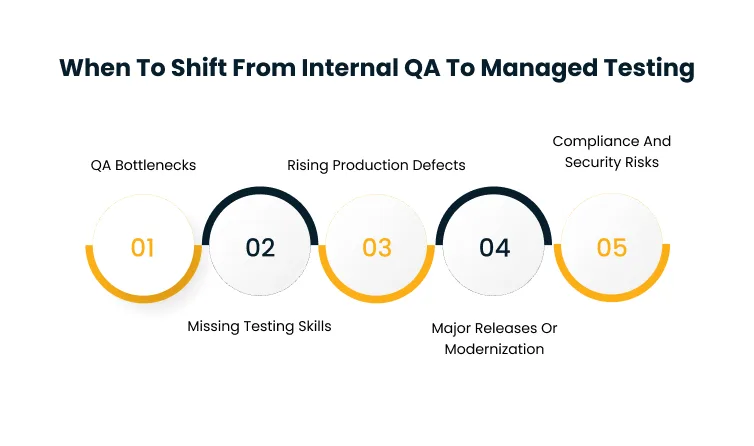
QA Bottlenecks Are Delaying Releases
If testing repeatedly delays releases, internal QA may not have enough capacity to keep up with development speed. Managed testing services can add structured execution support, regression coverage, automation, and reporting to reduce release delays without permanent headcount growth.
In one engagement, Cygnet.One supported a leading outdoor and lifestyle technology provider’s QA strategy modernisation, where smoke tests took 12 to 14 hours, and regression testing was fully manual.
Restructuring smoke testing for batch execution and parallelisation reduced test duration from 14 hours to 5 hours, a 64% reduction in smoke-test cycle time, with faster feedback loops and improved coverage without adding headcount.
The signal that this section applies to your team is when release retrospectives keep flagging QA capacity as the bottleneck across multiple consecutive sprints, despite the team working extended hours. Capacity gaps that are sustained, rather than occasional, are the architectural signal that a sourcing change is overdue.
Specialised Testing Skills Are Missing Internally
Internal QA teams may be strong in functional testing but lack expertise in automation, performance testing, security testing, API testing, or compliance validation. A managed QA partner can provide these specialised skills without long hiring cycles or heavy training investment.
Cygnet.One’s Business Assurance Testing practice, for example, provides coverage across UI, UAT, regression, performance, load, stress, and security testing under one engagement model, which is the operational shape most enterprises need when the test-type gaps are spread across more than one specialism rather than concentrated in one area.
The trade-off is paying a higher rate for specialist hours, which is usually defensible when the specialist work is concentrated in specific release windows rather than spread evenly across the year. A specialist on permanent retainer is expensive; a specialist available on demand through a managed engagement is usually the cleaner economic choice.
Production Defects Are Becoming Harder to Control
Frequent production defects often point to weak regression coverage, incomplete test design, limited automation, or poor release-readiness checks. Managed testing services can help identify quality gaps, improve test coverage, strengthen defect tracking, and reduce defect leakage before releases reach users.
The underlying signal is usually that the in-house team has been running at capacity for several quarters, and trade-offs are accumulating. Each decision to skip a regression cycle or defer an automation refactor seems reasonable in the moment, but the compound effect over six months is a noticeable drop in release confidence and an uptick in production hotfix volume.
Managed engagements scoped to defect reduction typically run an initial six-week diagnostic that identifies the top three or four contributors to leakage, then design a coverage plan that targets those contributors first rather than spreading effort evenly across all test types.
Major Releases or Modernisation Projects Need Extra QA Coverage
Large releases, cloud migrations, ERP upgrades, platform modernisation, and application redesigns often need more QA effort than internal teams can handle alone. Managed testing support can cover peak testing demand without permanently increasing internal headcount, with the engagement scoped to the modernisation window and ramped down once the platform stabilises.
Modernisation programmes usually require testers who understand both the legacy and target architectures, which is a profile most in-house QA teams have not had reason to develop. A managed partner who has done comparable modernisation work can compress the early ramp by reusing test scenarios, environment patterns, and defect taxonomies from prior engagements.
The risk to manage is scope creep at the project tail. Modernisation projects routinely extend past their original windows, and the managed engagement should have explicit ramp-down clauses rather than indefinite continuation, which is the contract pattern that protects both sides.
Compliance, Security, or Data Risks Need Stronger Validation
Applications that handle sensitive financial, healthcare, customer, or enterprise data need stronger testing controls. Managed testing services can support security validation, access-control testing, test data handling, audit readiness, and compliance-focused QA processes.
The 2024 IBM Cost of a Data Breach Report put the global average cost of a breach at USD 4.88 million, with cloud misconfigurations behind 15% of breaches. The number sets the order-of-magnitude price tag for weak test-environment security and incomplete pre-release validation, which is usually what tips the calculus from internal-next-quarter to external-partner-now.
For regulated industries, the managed partner should hold demonstrable experience under the relevant frameworks (SOC 2, HIPAA, PCI-DSS, GDPR) and produce the evidence trail that satisfies auditors. Generic compliance language on a website is rarely the same as an engagement-level audit experience under a real regulator.
How Managed Testing Services Work: A Step-by-Step Framework?
Managed testing services usually follow a structured delivery model. The process starts with understanding the current QA setup, then moves into strategy, team setup, execution, reporting, and continuous improvement.
A provider that cannot describe these five phases in the first conversation is either templated rather than adapted to the buyer’s estate, or staff-augmentation in disguise.
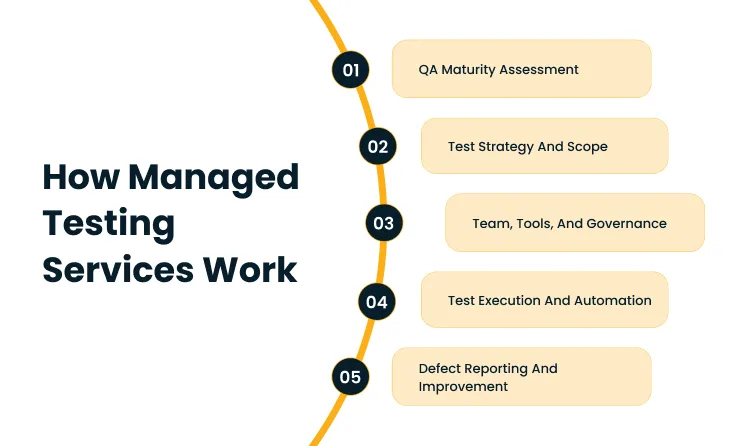
Step 1: QA Maturity and Application Assessment
The engagement begins with an assessment of current QA processes, application complexity, release cycles, defect history, automation coverage, tools, environments, and internal team capacity.
This identifies what should be managed externally, what should remain internal, and where testing improvements are needed most. The assessment is also the artefact the buyer keeps if the engagement does not extend, which is why the value of a test maturity assessment stands on its own, even before the broader managed engagement begins.
The output should be a documented baseline that the in-house team can act on, with or without the external partner continuing. A mature managed provider typically runs the assessment over four to six weeks, with structured interviews, tooling audits, and baseline metrics feeding into a written report with prioritised recommendations.
Step 2: Test Strategy and Scope Definition
The next step is to define testing scope, priorities, test types, timelines, ownership, SLAs, and success metrics. This alignment ensures the business and the managed QA partner know exactly what they are accountable for before execution begins.
The scope document also names the in-house owners on the buyer side, which is what keeps governance functional once execution starts. Without named in-house counterparts, the managed engagement runs on assumed authority and tends to slow down whenever a cross-team decision is needed.
The strategy should explicitly call out what is out of scope, not just what is in scope. Most engagement friction at month three comes from work the buyer assumed was included, and the provider assumed was excluded.
Step 3: Team Setup, Tools, and Governance
The provider sets up the QA team structure, tools, communication process, and reporting cadence. The team may include QA leads, manual testers, automation engineers, performance testers, security testers, and test architects, depending on the scope agreed in step 2.
Governance gives stakeholders visibility into progress, blockers, risks, defects, and release readiness through dashboards and a documented review calendar. The cadence usually settles into weekly tactical reviews, monthly stakeholder syncs, and quarterly business reviews aligned to the release calendar.
Tool setup is where many engagements lose early momentum. Access provisioning, environment access, and credential sharing are usually slower than expected, which is why mature providers build a two-week buffer for environment setup into every engagement plan.
Step 4: Test Execution and Automation Rollout
Once the structure is in place, the managed QA team begins test execution. This may include sprint testing, regression testing, automation scripting, API testing, performance checks, and defect reporting under the SLAs defined in Step 2.
Automation is usually introduced gradually, starting with repeatable, high-value test cases that reduce manual effort and improve release speed. Trying to automate everything in the first sprint usually produces flaky scripts and erodes confidence in the broader suite, which is why mature providers sequence automation by stability and business value rather than by ease of authoring.
The automation roadmap should include flaky-test management as a first-class workstream, not an afterthought. Flaky tests left untracked tend to multiply and quietly destroy trust in the entire automated regression suite.
Step 5: Defect Management, Reporting, and Continuous Improvement
Managed testing continues past execution. The provider tracks defects, analyses root causes, reports quality metrics, and recommends improvements at each release boundary rather than only at the end of the engagement.
The goal is to improve test coverage, reduce defect leakage, increase automation maturity, and make release decisions more predictable. Each quarter’s report should feed the next quarter’s plan, with measurable targets that show the engagement compounding value rather than running flat across renewals.
A provider that cannot show how the engagement has matured QA over twelve months in concrete metrics is signalling that the engagement has become a steady-state outsource without ongoing improvement, which is a contract worth renegotiating or exiting.
Questions To Ask Before Choosing A Managed QA Partner
The right managed QA partner brings more than testing resources. They offer technical depth, governance, reporting, security discipline, and the flexibility to support QA goals over time. The framework that applies to choosing a QA outsourcing partner translates directly to evaluating a managed testing provider, because the underlying questions are the same.
Use these questions to evaluate potential providers:
- Have you handled similar applications or industry-specific QA needs before?
- What testing services can you manage end-to-end?
- How do you decide what should be automated first?
- What QA metrics and reports will we receive, and on what cadence?
- How do you manage test data, access, and security?
- Can your dedicated testing team scale up or down based on release demand?
- How will your team work with our internal QA, development, and DevOps teams?
- What does the handover look like if we decide to bring testing back in-house?
The last question is the one most buyers skip, and it is the one that surfaces whether the partner has confidence in their ongoing value. A provider that cannot describe the handover protocol clearly is protecting their renewal leverage rather than your sourcing flexibility.
How Cygnet.One Helps You Move To A Managed QA Model?
Cygnet.One helps businesses move from reactive testing to a structured, managed QA model through its Quality Engineering practice. The approach starts with understanding current QA maturity, application complexity, release goals, testing gaps, and internal team capacity, then matches the operating model to the next twelve to eighteen months of release pressure.
The engagement model is shaped around three operating principles. Strategy precedes tooling, frameworks precede scripts, and ownership precedes go-live. Each principle has an operational anchor in the delivery method, which is what makes the model repeatable across web, mobile, API, ERP, and enterprise application contexts.
The QEXcelerate framework benchmarks QA maturity across people, process, and technology, with an AI-maturity overlay that evaluates readiness for AI-driven QA automation.
The output is a strategic blueprint with measurable scores, gap identification, and targeted improvement recommendations aligned to business priorities, which is the artefact that informs whether a managed engagement, a hybrid model, or an in-house build is the right fit.
For businesses deciding between expanding internal QA and moving to managed testing support, the engagement defines the right model, sets up scalable QA processes, and improves release confidence without adding unnecessary internal overhead. TestingWhiz and AutomationWhiz accelerators are available for codeless automation and enterprise application testing where the test pool includes non-technical users.
Conclusion
Managed testing services are a practical option for businesses that need stronger QA capacity, specialised testing expertise, and better release confidence without building a large in-house QA team. The right decision depends on cost, control, speed, scalability, quality, ownership, and delivery risk across the next twelve to eighteen months of release pressure.
For some companies, in-house QA will remain the right fit. For others, a managed testing model provides the structure, flexibility, and expertise needed to support faster and safer software delivery.
The hybrid model is increasingly the practical answer, with internal teams owning product knowledge and business validation while a managed QA partner handles regression, automation, performance, security, and release testing.
The decision that follows is which partner can describe the first ninety days of the engagement in operational specifics and back the description with case studies and references at a comparable scale. Book a demo with Cygnet.One to assess current testing maturity, identify the right managed QA model, and map a practical roadmap for the next release calendar.
FAQs
Outsourced testing usually focuses on specific testing tasks or projects, with the buyer retaining QA ownership. Managed testing services are broader because the provider takes ownership of QA delivery, governance, reporting, and ongoing improvement under structured SLAs rather than executing assigned tests inside the buyer’s process.
Managed testing services suit companies needing scalable capacity, specialised QA skills, faster setup, or stronger governance than the in-house team can build. In-house QA suits stable testing needs, requiring deep product knowledge. Most enterprises find that a hybrid model outperforms either pure option.
A company should consider managed testing services when QA bottlenecks delay releases, internal teams lack specialised skills, production defects increase, or modernisation projects need additional coverage. Compliance and security testing demands for applications handling regulated data are another common trigger, particularly when audit windows compress.
Choose a partner based on domain expertise, automation capabilities, security practices, reporting quality, governance model, and ability to scale with release needs. Ask for a redacted runbook, a sample monthly QA report, and the handover model if you bring testing back in-house.
Typical managed testing SLAs cover test execution turnaround, defect categorisation timelines, automation script delivery cadence, regression cycle duration, reporting frequency, and release-readiness sign-off windows. Mature engagements also include flaky-test resolution SLAs, environment availability targets, and quarterly business review commitments.
Most managed testing engagements move from contract signing to first execution within four to eight weeks. The QA maturity assessment runs in parallel with team setup, tooling provisioning, and governance design. Full automation rollout typically follows in months two through six, depending on scope.
Author


Abhishek Nandan
AVP, Marketing
Abhishek Nandan is the AVP of Services Marketing at Cygnet.One, where he drives global marketing strategy and execution. With nearly a decade of experience across growth hacking, digital, and performance marketing, he has built high-impact teams, delivered measurable pipeline growth, and strengthened partner ecosystems. Abhishek is known for his data-driven approach, deep expertise in marketing automation, and passion for mentoring the next generation of marketers.