


































Bain & Company reports that 40% of megadeals in 2025 were transformative, accounting for more than 50% of the acquirer’s market cap. When that much is at stake, the operational work of combining two organizations cannot be treated as secondary.
Data is where that work gets the hardest. Two organizations merge, and behind them come two completely different things that must become one:
- Data environments
- System architectures
- Governance frameworks
- Data standards
The timeline is fixed and the regulatory pressure is immediate. M&A data migration is where integration either holds together or falls apart. This blog breaks down exactly what makes it so difficult and what a structured approach actually does to prevent failures using data migration services.
Why Is M&A Data Migration Fundamentally Different from Standard Migration Projects?
Two Environments, Zero Shared Standards
Merging organizations rarely share the same CRM, ERP, data warehouse, or database architecture. Data definitions conflict at the most basic level in complex data management environments.
Three specific conflicts appear in almost every M&A integration:
- Naming conflicts: One organization calls it “client_id,” the other calls it “customer_id”
- Calculation conflicts: Revenue recognition methods differ between the two finance teams
- Format conflicts: Date fields stored as strings in one system, as datetime values in another
Timeline Pressure Has No Equivalent
Standard migrations have flexible timelines. M&A integrations do not. Board commitments, regulatory deadlines, and investor expectations create fixed integration windows.
M&A data migration that runs over schedule does not just cost money. It delays the operational benefits the acquisition was designed to produce, which carries its own financial consequences separate from the overrun cost itself.
Regulatory and Compliance Complexity Doubles
Two organizations mean:
- Two compliance histories to reconcile
- Two audit trails to merge without gaps
- Two sets of data governance policies to harmonize
All three must be resolved simultaneously. Moreover, legal and governance teams have to coordinate in parallel throughout the integration window.
These differences make M&A data migration one of the most operationally complex projects an enterprise can undertake.
What Are the Biggest Risks in Data Migration During Mergers and Acquisitions?
Gartner notes that organizational momentum to get the deal done consistently causes teams to overlook red flags during due diligence. In data migration, those overlooked red flags become the failures that surface after go-live.
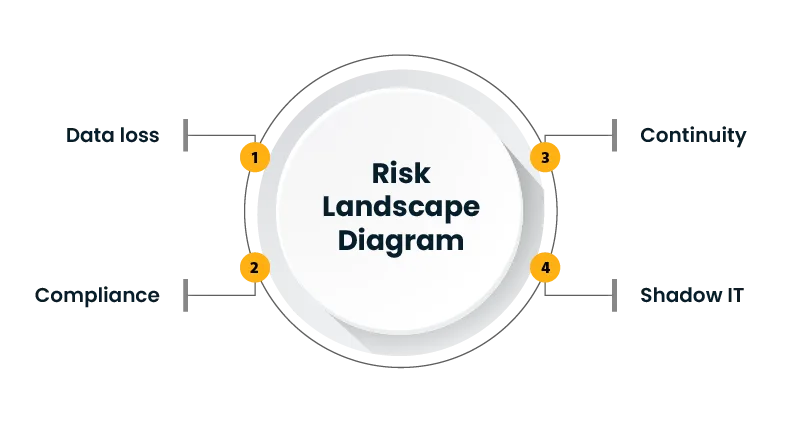
Data Loss During System Consolidation
When two ERP systems merge into one, records from both sources must arrive in the target without duplication or loss. Conflicting primary keys between source systems create duplicate records or silently overwrite valid data.
Enterprise data integration M&A failures most commonly trace back to key conflicts that were not identified and resolved before consolidation began. By the time they surface, the damage is already in the target system.
Business Continuity Disruption
Both organizations keep operating during the integration window:
- Transactions are processing in real time
- Customer records are being updated continuously
- New records are being created in both source systems simultaneously
A migration that does not account for live data changes delivers a target system that is already outdated the moment it goes live.
Loss of Historical Data Integrity
Historical records carry legal and operational value that the acquiring organization paid for as part of the deal. This includes:
- Financial transaction histories
- Customer interaction records
- Compliance audit trails
Data migration during mergers and acquisitions that prioritizes speed over accuracy consistently produces historical data gaps without strong data quality management. Those gaps surface during the first post-merger audit, when fixing them costs significantly more than preventing them would have.
Shadow IT and Undocumented Systems
Acquired organizations frequently run systems that do not appear in any official inventory. These include departmental databases, spreadsheet-based workflows, and locally stored files carrying business-critical data. Missing them during migration means losing data that nobody knew needed to be moved until someone asks for it and it is not there.
Each of these risks has a documented pattern. They also have specific prevention strategies, and applying them is what separates integrations that close cleanly from those that drag on for years.
What Are the Core M&A Data Consolidation Strategies That Actually Work?
1. Pre-Integration Data Discovery and Inventory
Before any data moves, every data source in both organizations gets documented and assessed. System integration data migration that skips discovery consistently encounters undocumented systems mid-integration, at the worst possible moment.
Discovery covers:
- All source systems identified and documented with assigned data owners
- Data quality baseline established per source system
- Shadow IT and unofficial data sources cataloged separately
- Retention and compliance requirements documented per data domain
- Business criticality ranking applied to every identified source
2. Data Harmonization Before Consolidation
Enterprise data harmonization means agreeing on a single definition for every shared data concept before a single record moves to the consolidated system. Without harmonization, the target system receives conflicting records with no way to determine which version is correct.
| Conflict Type | Example | Harmonization Action |
| Field naming | “client_id” vs “customer_id” | Unified naming convention defined |
| Calculation difference | Revenue recognized differently | Single calculation rule agreed and documented |
| Data type mismatch | Date stored as string vs datetime | Target type defined, transformation rule built |
| Classification conflict | Product categories differ | Unified taxonomy built before migration |
3. Phased Integration by Business Domain
Migrating all systems simultaneously creates unmanageable complexity and uncontrollable failure risk. Phased integration prioritizes by business impact:
- Phase 1: Customer data
- Phase 2: Financial records
- Phase 3: Operational data
- Phase 4: Supporting systems
Each domain completes full validation before the next domain begins. Enterprise data integration M&A projects that run domain by domain contain failures within each phase rather than allowing them to cascade across the entire integration.
4. Golden Record Creation for Conflicting Entities
When both organizations hold records for the same entity, a golden record process determines which version becomes the authoritative record in the target system. Golden record rules get defined in advance:
- Most recently updated record wins
- Acquiring organization’s record takes precedence by default
- Field-by-field merge produces a composite record where both sources contribute specific fields
Without golden record rules defined before migration, duplicate entities survive in the target system indefinitely, creating reporting errors, billing conflicts, and customer experience failures.
5. Continuous Data Sync During the Integration Window
Both organizations keep operating during integration. Change Data Capture tracks every insert, update, and delete in both source systems throughout the integration window and pushes those changes to the target continuously.
M&A data consolidation strategies that do not include continuous sync always produce a target system that lags behind the source at cutover. That lag creates a data gap that requires manual reconciliation after go-live.
What Should an Enterprise Expect From a Structured M&A Data Migration Engagement?
A structured M&A data migration engagement runs in defined phases with clear entry and exit criteria at every stage.
| Phase | Activity | Exit Criteria |
| Discovery | Full inventory, quality assessment, shadow IT catalogue | All sources documented, owners assigned |
| Harmonization | Conflict resolution, golden record rules, unified taxonomy | All definitions agreed and documented |
| Migration | Phased execution by domain, CDC running throughout | Each domain validated before next begins |
| Validation | Field-level reconciliation, business rule checks, audit trail | Zero critical defects, full sign-off |
| Decommission | Legacy system retirement after confirmed validation | Target system confirmed complete and accurate |
Enterprise data integration M&A engagements that follow this structure consistently close within planned timelines. Engagements that skip discovery and harmonization, the two phases most commonly cut when timelines feel tight, consistently require remediation work after go-live.
The difference between the two outcomes is not technology. It is planning, governance, and execution discipline applied by a team that has managed M&A integration before.
Why Do Enterprises Choose Cygnet.One for M&A Data Migration?
System integration data migration at the complexity of a real merger or acquisition requires a team that has managed conflicting systems, live data changes, regulatory deadlines, and governance gaps all running simultaneously.
Cygnet.One brings:
- Structured discovery and harmonization frameworks built specifically for M&A timelines
- Golden record processing and conflict resolution built into the engagement as defined deliverables
- Independent validation and full audit trail generation at every migration phase
- Continuous data sync architecture that keeps the target current throughout the integration window
- Post-migration support through the full decommission phase
Organizations currently managing an M&A integration, or planning one, can connect with Cygnet.One directly to discuss what a structured engagement looks like for their specific environment.
What Enterprises Say About Working With Cygnet.One
“Cygnet’s comprehensive approach to cloud transformation has been a game-changer for our business. They didn’t just help us migrate to the cloud; they enabled us to innovate and stay ahead of the competition.”
— CEO, Multinational Corporation
Explore Cygnet.One’s services today!
The Only Acceptable Outcome in M&A Data Migration Is a Clean One
M&A data migration is not a larger version of a standard migration. It is a different category of project entirely. Two data environments, two governance frameworks, a fixed timeline, and zero tolerance for data loss or integrity failures.
The strategies are documented and proven:
- Pre-integration discovery and inventory
- Data harmonization before consolidation begins
- Phased domain execution with validation at every stage
- Golden record processing for conflicting entities
- Continuous sync throughout the integration window
The gap is always in execution. Execution at this level of complexity requires experience that most internal teams are building for the first time during the migration itself. Data that arrives inaccurately, incompletely, or ungoverned in a post-merger environment does not just create technical problems. It undermines the financial and operational case for the acquisition itself.
FAQs
How do you ensure data integrity during migration?
Run validation at every stage, not just at the end. Pre-migration profiling establishes a quality baseline. In-flight checksum validation confirms that records are being transferred correctly. Post-migration field-level reconciliation confirms transformation logic produces accurate output. Every discrepancy gets traced to its root cause before the migration is marked complete.
What are the 4 pillars of data integrity?
Accuracy confirms that the data reflect the real-world values they represent. Consistency confirms that data is uniform across all systems that hold it. Completeness confirms that no required records or fields are missing. Validity confirms data conforms to the format and business rules the target system expects.
What steps do you take to ensure data migration or system integration goes smoothly?
Start with a full data inventory and quality assessment before planning begins. Define transformation rules, validation thresholds, and rollback triggers before any data moves. Run migration in phases by business domain. Validate each phase completely before the next begins. Keep the source system live until the target is fully confirmed.
How do you avoid data integrity issues during migration?
Profile source data before extraction to identify quality problems. Define golden record rules for duplicate entities before consolidation. Run continuous data sync during the migration window to prevent the target from falling behind live source changes. Never decommission the source system before post-migration validation is fully signed off.
Author


Yogita Jain
Content Lead
Yogita Jain leads with storytelling and Insightful content that connects with the audiences. She’s the voice behind the brand’s digital presence, translating complex tech like cloud modernization and enterprise AI into narratives that spark interest and drive action. With a diverse of experience across IT and digital transformation, Yogita blends strategic thinking with editorial craft, shaping content that’s sharp, relevant, and grounded in real business outcomes. At Cygnet, she’s not just building content pipelines; she’s building conversations that matter to clients, partners, and decision-makers alike.