



































Release cycles are getting shorter, while testing complexity continues to increase across web, mobile, cloud, and enterprise applications. Internal QA teams often struggle to keep pace with regression coverage, automation demands, performance testing, and faster deployment expectations.
Businesses now evaluate a QA outsourcing company on several dimensions at once, including cost predictability, scalability, specialized expertise, faster release confidence, and continuous testing support. The decision is no longer whether to outsource software testing. It is choosing the right QA partner without slowing delivery, compromising quality, or creating communication gaps.
In the 2024 Deloitte Global Outsourcing Survey, 80% of executives reported plans to maintain or increase investment in third-party outsourcing. That signal reflects how central external delivery capacity has become to engineering operations, and how high the stakes are when selecting a long-term QA partner.
This guide explains how to evaluate QA outsourcing services, compare engagement models, identify red flags, and choose a testing partner that aligns with your delivery goals.
What Does A QA Outsourcing Company Do?
A QA outsourcing company is an external software testing partner that manages quality assurance activities, including manual testing, automation testing, performance testing, security testing, and continuous QA support throughout the software development lifecycle.
Businesses outsource QA to improve release speed, access specialized testing expertise, reduce operational overhead, and scale testing capacity efficiently as delivery demands grow. The right QA outsourcing partner helps organizations improve product quality, reduce internal testing bottlenecks, and accelerate software delivery without compromising release confidence.
Engagement models typically include dedicated QA teams, Testing-as-a-Service (TaaS), and project-based testing support, allowing businesses to choose the structure that best matches their delivery cycles, regulatory requirements, and long-term quality goals.
What Services Should A QA Outsourcing Company Provide?
A reliable QA outsourcing company should support both manual and automated testing across the software lifecycle. Beyond executing test cases, the partner should improve testing efficiency, visibility, and release confidence. The strongest QA outsourcing services combine technical expertise, process maturity, scalable delivery models, and clear communication standards.
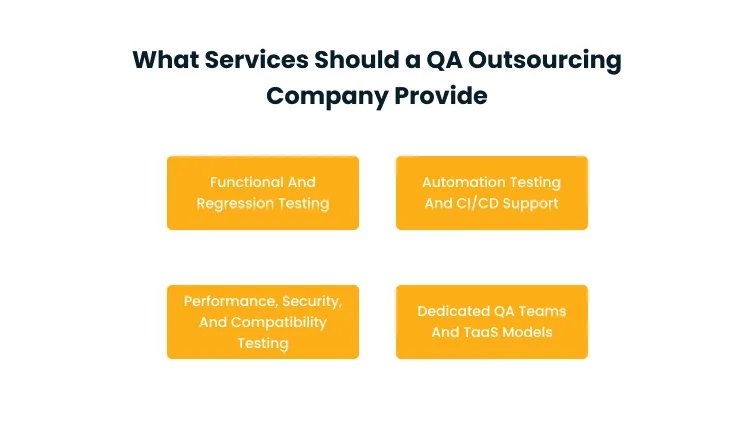
Functional And Regression Testing
Functional testing validates whether applications behave as expected across workflows, devices, browsers, and user scenarios. Regression testing ensures that new releases do not break existing functionality.
For teams building repeatable regression coverage, an enterprise software testing strategy helps define test ownership, coverage priorities, and release readiness standards before outsourcing begins.
Strong regression coverage becomes critical for Agile and continuous delivery environments where releases happen frequently. Without it, every new feature carries an unmeasured risk of breaking something already in production.
Automation Testing And CI/CD Support
Modern QA outsourcing companies should provide automation frameworks that integrate directly into CI/CD pipelines. Automation improves release speed, reduces repetitive manual testing, and supports continuous validation across deployment cycles.
A deeper understanding of automation testing helps teams evaluate whether a QA partner can build scalable test suites that support faster and more reliable releases. When evaluating an automation capability, teams should look at the following areas:
- Framework scalability across products, browsers, and platforms.
- Test maintenance practices and stability of existing automation suites.
- CI/CD integration capability with tools the team already runs.
- Reporting visibility and traceability across test execution data.
- Automation coverage maturity across regression, integration, and API layers.
Performance, Security, And Compatibility Testing
Enterprise applications require testing beyond functionality. Performance bottlenecks, security vulnerabilities, and cross-platform compatibility issues can directly impact business operations. A strong QA partner should cover the following testing areas under one engagement:
- Load and stress testing across realistic production conditions.
- Vulnerability testing aligned with OWASP and enterprise security baselines.
- Browser compatibility testing across modern and legacy environments.
- Mobile device testing across operating system versions and form factors.
- API reliability validation across integration boundaries.
Cygnet.One’s Enterprise Application and Software Testing practice brings functional, performance, security, and compatibility testing into a single delivery model, with frameworks designed for complex enterprise application landscapes.
Dedicated QA Teams And TaaS Models
Different businesses require different engagement models. Some organizations need fully dedicated QA teams that operate as an extension of internal engineering, while others prefer flexible Testing-as-a-Service (TaaS) support that scales with release pressure.
Dedicated QA teams work well for long-term product testing where context retention matters, while TaaS models help organizations scale testing resources based on release cycles and project requirements. The choice depends on release rhythm, product complexity, and how much testing context the partner needs to retain across cycles.
When Does QA Outsourcing Become The Right Move?
QA outsourcing becomes the right move when internal testing capacity can no longer keep pace with release frequency, automation needs, regression coverage, or quality expectations. At this stage, outsourcing is not only about reducing workload. It becomes a way to protect, release confidence, improve test coverage, and scale QA operations without delaying engineering delivery.
The 2024 Deloitte Global Outsourcing Survey says 83% of executives reported leveraging AI as part of their outsourced services, signalling that modern outsourcing engagements have moved beyond pure cost arbitrage into capability access.
Release Bottlenecks And QA Backlogs
Internal QA teams often struggle to keep pace with frequent deployments and growing regression workloads. The result is delayed deployments, expanding bug backlogs, slower regression testing cycles, and a steady increase in production defects that escape into the release.
These signals usually appear once the delivery frequency outgrows the testing capacity already in place. Outsourcing becomes the practical option when adding internal headcount cannot move fast enough to clear the queue without compromising release quality.
Limited Automation And Testing Scalability
Modern delivery environments require scalable automation and continuous testing support. Businesses often outsource QA when internal teams lack automation maturity or bandwidth. This usually happens when the following conditions are present.
- Automation coverage remains low across regression and integration suites.
- Manual testing effort continues to increase per release.
- CI/CD testing maturity is limited or inconsistent across teams.
- Testing demand fluctuates rapidly across product cycles.
Rising Quality, Compliance, And Customer Experience Risks
As applications scale, testing requirements expand into performance, security, compatibility, compliance, and customer experience validation. Outsourced QA helps businesses access specialized testing expertise without increasing operational overhead.
Organizations often seek external QA support in the following situations:
- Testing costs continue rising without a proportional release-quality lift.
- Compliance requirements increase across regulated workloads.
- Internal QA bandwidth becomes limited against release demand.
- Release quality starts impacting customer experience and retention.
How To Choose The Right QA Outsourcing Company?
Choosing a QA outsourcing partner requires more than comparing pricing or team size. Businesses should evaluate technical capability, communication maturity, scalability, delivery transparency, and long-term operational fit. The best QA outsourcing companies function as strategic delivery partners rather than isolated testing vendors.
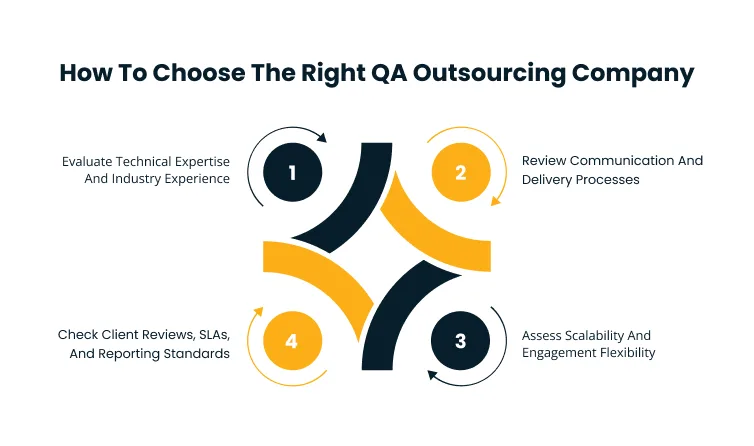
Evaluate Technical Expertise And Industry Experience
Testing requirements vary significantly across industries such as healthcare, fintech, SaaS, retail, and enterprise software. Industry familiarity improves testing accuracy, compliance understanding, and risk identification across regulated workloads.
Strong partners demonstrate depth in technology stack expertise, automation capabilities, domain experience, compliance testing, and recognized QA certifications and methodologies rather than treating any of these as bolt-on additions. Before locking in an engagement, organizations also benefit from a formal testing maturity assessment that maps current QA gaps against target delivery requirements.
Cygnet.One’s Test Consulting and Maturity Assessment practice supports this evaluation phase, helping enterprises identify the right engagement model, automation roadmap, and governance structure before commercial terms are finalized.
Review Communication And Delivery Processes
Poor communication is one of the biggest reasons QA outsourcing relationships fail. Teams should evaluate collaboration workflows, escalation processes, reporting standards, and delivery transparency early. Strong QA partners typically provide the following operational standards by default.
- Clear sprint communication aligned with the client’s Agile cadence.
- Real-time defect visibility through shared dashboards and ticketing systems.
- Defined escalation channels for production and release-critical issues.
- Consistent reporting cadence across weekly and release-level checkpoints.
- Shared QA ownership across the partner team and internal engineering.
Assess Scalability And Engagement Flexibility
Testing requirements often fluctuate based on release schedules and product growth. QA partners should scale resources without disrupting delivery timelines, and engagement structures should allow teams to expand quickly, reduce operational overhead, support multi-release cycles, and handle temporary testing spikes without renegotiating commercial terms each time.
Engagement flexibility becomes especially important during major launches, regression cycles, or compliance-driven testing pushes where standard team capacity will not absorb the surge. Partners that can demonstrate prior surge support, with named outcomes, tend to handle these moments better than those who treat every scale-up as a fresh negotiation.
Check Client Reviews, SLAs, And Reporting Standards
Third-party validation helps evaluate operational reliability. Platforms such as Clutch and G2 provide insight into delivery quality, communication standards, and customer satisfaction. Beyond review platforms, businesses should also examine the following contractual and reporting commitments.
- SLA commitments tied to defect resolution timelines.
- Defect reporting standards across severity classification.
- Escalation response times for production-impacting issues.
- QA governance practices across release boundaries.
- KPI tracking processes are shared across both teams.
Questions To Ask Before Choosing A QA Outsourcing Company
Before signing a QA outsourcing contract, businesses should validate whether the vendor can support their release cadence, automation goals, quality standards, and governance expectations. The right questions help separate execution-only testing vendors from QA partners that can support long-term software quality.
A test maturity assessment can also help teams convert these questions into a structured view of current QA gaps, automation readiness, and outsourcing fit. Ask these questions during evaluation:
- What functional, regression, automation, performance, security, and compatibility testing capabilities do you provide?
- How will your QA team integrate into our Agile workflows and sprint cadence?
- How do you measure and improve automation coverage over time?
- What CI/CD integration capabilities do you support?
- What reporting dashboards will we get for test execution, defect trends, and release readiness?
- What SLAs do you provide for defect resolution, escalation response, and reporting cadence?
- How quickly can your team scale during regression cycles, product launches, or release surges?
- What domain experience do you have with similar applications, compliance needs, or industry workflows?
- How do you manage security, data access, and compliance across the testing environment?
- What governance model will be used to track quality outcomes across releases?
These questions help validate operational alignment before the engagement begins. Vague answers should be treated as evaluation risks before the contract is signed.
Red Flags To Avoid When Evaluating QA Outsourcing Companies
Some QA vendors prioritize low-cost delivery while lacking the processes, automation maturity, and governance standards required for long-term testing success. Identifying operational gaps early helps businesses avoid delivery slowdowns, quality risks, and communication failures later.
Weak Automation And Scalability Capability
A QA partner without mature automation practices can slow release cycles and increase long-term testing costs. Limited scalability also creates delivery risks as testing demands grow. Warning signs include the following.
- Low automation coverage across regression and integration suites
- No CI/CD integration capability beyond basic test execution
- Heavy dependence on manual testing for repetitive validation cycles
- Inability to scale QA resources quickly during release surges
Poor Communication And Reporting Standards
Communication gaps often become one of the biggest causes of outsourcing failure. Limited visibility into testing progress, defects, and escalations reduces delivery confidence. Common indicators of this gap include the following.
- Inconsistent reporting cadence across sprints and releases
- Weak defect visibility through shared tracking systems
- Undefined escalation workflows for production incidents
- Delayed communication during release-critical windows
Lack Of QA Governance And Process Maturity
Strong QA outsourcing requires structured testing processes, accountability, and measurable quality standards. Vendors without mature governance frameworks often struggle to maintain consistency across releases. Businesses should watch for the following gaps.
- No clear SLA commitments tied to release-impacting outcomes
- Unclear QA workflows across sprint and release boundaries
- Inconsistent resource allocation across testing phases
- Weak documentation practices across test cases and defect history
- Limited quality governance processes at the program level
Limited Domain And Industry Expertise
Testing requirements vary across industries, especially in regulated and enterprise environments. Vendors without domain familiarity may miss critical compliance, workflow, or user experience risks that surface only under industry-specific scenarios.
The risk grows in healthcare applications, fintech platforms, enterprise SaaS products, and compliance-heavy environments where a generic test plan rarely covers what regulators or customers actually evaluate.
A low-cost QA vendor can become expensive if testing quality impacts production stability, customer experience, or release velocity. The savings on the rate card rarely offset the cost of a single high-impact production defect that domain-aware testing would have caught.
How To Measure QA Outsourcing Success?
Successful QA outsourcing should improve release confidence, reduce production defects, and support faster software delivery without compromising stability. The right measurement framework helps businesses evaluate whether the QA partner is improving engineering efficiency, testing quality, and overall release performance.
The 2024 McKinsey Report on IT Productivity documented that one organization reduced the time required for regression testing by more than 95% after automating CI/CD pipelines, which illustrates the upside available when measurement frameworks force the QA partner to track and improve cycle metrics, not just defect counts.
Operational KPIs
Operational metrics help teams measure day-to-day testing effectiveness and QA process maturity. These indicators reveal how efficiently testing activities are executed across releases. Key metrics typically include the following:
- Defect leakage rate across release boundaries
- Test execution speed across regression and integration cycles
- Mean time to resolution for critical defects
- Escaped defect reduction over consecutive releases
- Test case execution coverage against the active suite
Delivery And Release Metrics
Delivery-focused metrics evaluate how QA outsourcing impacts release timelines, deployment stability, and engineering velocity. Strong QA operations should help reduce release friction rather than create additional bottlenecks. Businesses typically track the following indicators:
- Release cycle efficiency from code freeze to deployment
- Regression testing turnaround time across release windows
- Automation coverage growth across consecutive quarters
- Deployment stability is measured by the post-release defect rate
- Release readiness improvement across release gate reviews
SLA And Performance Tracking
SLA and governance metrics help businesses evaluate accountability, responsiveness, and long-term delivery consistency. This becomes especially important for enterprise-scale testing engagements where downstream business processes depend on release quality. Important evaluation areas include the following.
- SLA adherence across defect severity classes
- Escalation response times during release-critical windows
- Reporting consistency across sprint, release, and program checkpoints
- Resource scalability during surge periods
- Defect resolution timelines tied to severity-based commitments
Cygnet.One’s Business Assurance Testing practice builds these SLA, reporting, and governance frameworks into the engagement model from day one, with measurement structures designed for enterprise-scale release programs where predictability matters as much as raw test execution speed. The goal is not only faster testing, but more predictable and reliable software delivery at scale.
Why Enterprises Choose Cygnet.One As A QA Outsourcing Partner?
Modern software testing requires more than isolated QA execution. Businesses need scalable testing operations, automation maturity, CI/CD alignment, SLA-backed governance, and continuous quality visibility across delivery cycles that no longer pause for traditional test windows.
Cygnet.One supports enterprise QA programs through a full quality engineering model that covers testing maturity assessment, enterprise application testing, business assurance testing, automation, and long-term managed QA operations. This helps businesses move from vendor-led test execution to a more structured QA operating model aligned with release cadence, automation goals, and governance requirements.
For teams still defining their outsourcing approach, Cygnet.One’s Test Consulting and Maturity Assessment practice helps identify QA gaps, automation readiness, engagement model fit, and governance requirements before the delivery model is finalized.
For enterprises with ongoing release needs, Cygnet.One’s Quality Engineering practice supports scalable test execution, Agile-aligned delivery, and measurable release-quality improvement across complex software environments.
This makes Cygnet.One strong fit for organizations that need a QA outsourcing partner capable of moving from assessment to execution to managed QA operations without separating strategy, delivery, and governance across multiple vendors.
Conclusion
Choosing the right QA outsourcing company directly impacts release quality, delivery speed, operational efficiency, and customer experience. The strongest QA partnerships go beyond test execution and contribute to long-term product stability, automation maturity, and scalable delivery operations.
Businesses evaluating QA outsourcing services should focus on technical expertise, communication maturity, automation capability, scalability, and governance standards rather than cost alone. A reliable QA partner helps teams release software faster while reducing testing risk and operational friction across the program.
If your team is evaluating QA outsourcing companies and wants a partner that can move from a structured testing maturity assessment through long-term managed QA operations, book a demo with Cygnet.One to see how our Quality Engineering practice aligns with your release cadence, automation roadmap, and governance requirements.
FAQs
Companies outsource software testing to reduce release bottlenecks, access specialized QA expertise, and scale testing capacity without expanding internal teams. Outsourcing also brings mature automation frameworks, broader test environment coverage, and predictable SLAs that internal QA teams often cannot build fast enough on their own.
Evaluate technical expertise, automation maturity, communication standards, SLA commitments, scalability, client reviews, and industry experience together. Cost alone is not a reliable signal. The best QA outsourcing companies show clear governance, named outcomes, and the ability to scale testing capacity without renegotiating commercial terms for every release surge.
Offshore QA outsourcing focuses on cost efficiency, larger talent pools, and 24-hour delivery coverage across time zones. Onshore outsourcing provides closer collaboration, local timezone alignment, and easier real-time communication. Hybrid models combine both, with onshore leads coordinating offshore execution teams for regulated or release-critical engagements.
Yes, when the engagement is structured well. QA outsourcing reduces hiring costs, infrastructure overhead, and operational expenses while improving testing efficiency and release speed. Cost-effectiveness depends on automation maturity, SLA design, and engagement flexibility. Low-cost vendors without governance maturity can erase the savings through release-impacting defects.
Testing-as-a-Service (TaaS) is a flexible QA outsourcing model where businesses consume external testing resources based on project needs, release cycles, or testing demand. TaaS works well for teams with fluctuating workloads, short-cycle releases, or specialized testing surges that do not justify a fully dedicated outsourced team.
Yes. Modern QA outsourcing companies integrate with Agile, CI/CD, and DevOps workflows to support continuous testing across shorter release cycles. Strong partners embed test automation, defect tracking, and SLA reporting directly into the existing pipeline rather than running tests as a separate downstream phase.
Author


Abhishek Nandan
AVP, Marketing
Abhishek Nandan is the AVP of Services Marketing at Cygnet.One, where he drives global marketing strategy and execution. With nearly a decade of experience across growth hacking, digital, and performance marketing, he has built high-impact teams, delivered measurable pipeline growth, and strengthened partner ecosystems. Abhishek is known for his data-driven approach, deep expertise in marketing automation, and passion for mentoring the next generation of marketers.