
































A cloud team can automate a deployment in minutes and still make developers wait three days for an account, an IAM decision, or a security exception. The pipeline is fast; the operating model around it is slow. That contradiction has moved platform engineering from an architecture discussion to an executive concern.
DORA’s 2024 research found that internal developer platforms can improve individual productivity, team performance, and organizational performance. It also warned that poor implementation can reduce change stability and throughput. A platform creates value when it removes friction without weakening engineering discipline.
AWS platform engineering addresses this problem by turning recurring cloud decisions into maintained internal products, similar to how cloud automation strategy helps standardize repeatable enterprise cloud operations. DevOps continues to guide collaboration, automation, feedback, and service ownership. Platform teams package common decisions so developers avoid rebuilding delivery machinery for each workload.
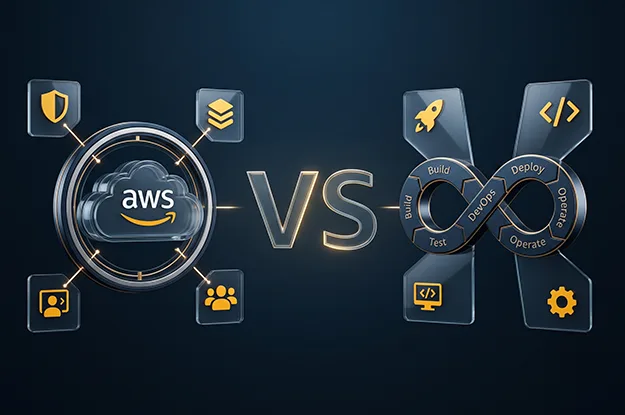
Platform Engineering vs DevOps on AWS
The relationship between DevOps and platform engineering becomes clearer when responsibility is separated from capability. DevOps defines how development and operations work together across build, release, and production. Platform engineering creates shared services that make those practices easier to apply across teams.
| Area | DevOps focus | Platform engineering focus |
| Primary concern | Delivery flow and service reliability | Developer experience and reusable cloud services |
| Ownership | Shared by application and operations teams | Managed by a dedicated platform product team |
| Automation | Pipelines, testing, deployment, and feedback | Templates, interfaces, infrastructure, and guardrails |
| Governance | Applied through delivery practices | Embedded within approved platform routes |
| Success measures | Throughput, stability, recovery, and quality | Adoption, completion time, usability, and support demand |
These DevOps vs platform engineering differences matter because application teams often own business logic, IAM design, network policy, observability, cost allocation, and compliance evidence. That workload creates uneven controls and repeated engineering.
Where Enterprise DevOps Starts to Break
DevOps loses efficiency when autonomy becomes duplication. One team writes Terraform modules for containers. Another creates similar modules with different tagging, logging, and encryption choices. Security reviews both implementations, operations supports both, and shared components receive limited maintenance.
Warning signs include:
- Long queues for accounts, environments, and access
- Different pipeline controls for similar workloads
- Security issues discovered close to release
- Observability configured differently by each team
- Cloud costs assigned after resources are created
- Senior engineers handling routine provisioning work
This is less a tooling failure than an ownership gap. A cloud operating model AWS leaders can govern needs clear boundaries between platform services, product responsibilities, and specialist review.
Why Platform Teams Are Becoming Internal Product Teams
The rise of AWS platform engineering changes the role of the central cloud function. Traditional cloud teams publish standards and resolve exceptions. Platform teams encode repeatable standards into services that developers can consume through a portal, API, command-line interface, or repository template.
AWS guidance describes an internal developer platform as a self-service product for managing environments, deployments, resources, and configurations. It recommends a product mindset with defined users, a roadmap, support, documentation, and measurable outcomes.
When leaders ask, “what is platform engineering AWS?”, the practical answer is an internal product function. It combines cloud operations, security, architecture, software engineering, and developer experience around reusable routes.
A sound platform backlog begins with observed friction. Review ticket queues, failed deployments, policy exceptions, onboarding delays, and repeated infrastructure code. The first platform service should solve a frequent problem with clear ownership and a measurable result. Starting with a broad portal often places a polished front end over fragmented processes.
Golden Paths That Developers Will Actually Use
Golden paths are opinionated routes for common workloads. A path may create a repository, pipeline, infrastructure, security checks, ownership metadata, logging, dashboards, and deployment workflow from one request. AWS guidance positions these paths as a core platform capability that combines automated delivery with organizational security and compliance requirements.
Within AWS platform engineering, a golden path should provide strong defaults while preserving a documented exception route. Developers need freedom where requirements differ, while common controls should arrive automatically.
A useful golden path includes:
- Approved defaults for a defined workload pattern
- Versioned infrastructure modules with named maintainers
- Automated security, quality, and policy checks
- Standard logging, metrics, tracing, and alert ownership
- Cost tags and business ownership metadata
- Clear exception, upgrade, and retirement procedures
A second DevOps vs platform engineering distinction appears here. Application teams remain accountable for service behavior and outcomes. Platform teams remain accountable for the quality, safety, and usability of the route.
Self-Service Infrastructure Without Governance Drift
Self-service should reduce waiting without creating unrestricted provisioning, which is why enterprises need guardrails that don’t slow down AWS innovation. Developers need fast access within technical and financial boundaries. An approved request should produce more than a resource. It should include identity controls, encryption, network settings, logs, tags, budget signals, and lifecycle rules.
For AWS platform engineering, the interface is the least important part. A portal can improve discovery, but the product underneath includes versioned code, policy checks, orchestration, ownership, documentation, and support.
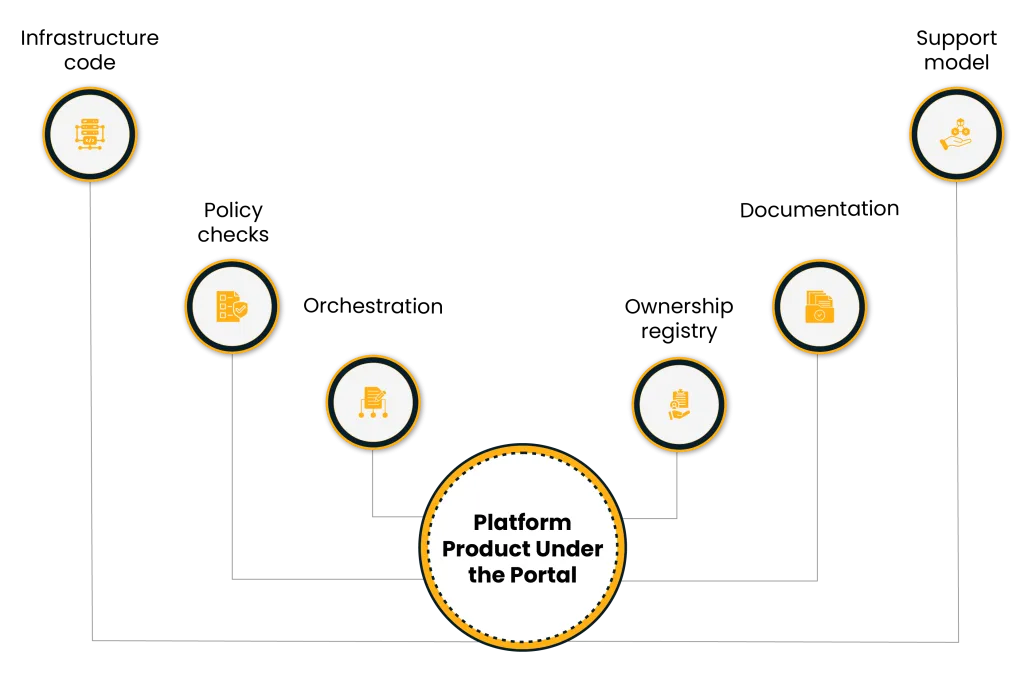
AWS developer platform best practices should cover the complete service lifecycle:
- Request a service through a simple interface.
- Provision it through versioned infrastructure code.
- Run policy and security checks before deployment.
- Register technical and business ownership.
- Track reliability, cost, usage, and security signals.
- Update or retire the service through managed versions.
AWS identifies infrastructure as code, continuous delivery, identity management, observability, artifact management, service discovery, and developer portals as central internal platform capabilities.
Self-service succeeds when the approved route is easier than workarounds. Mandates may increase portal usage, yet they rarely create trust.
Enterprise Use Cases With Clear Business Value
Platform investment should target frequent demand, repeated controls, and visible waiting time, supported by AWS landing zone best practices that standardize accounts, controls, and delivery foundations. These use cases provide a credible starting point.
Application onboarding: Create accounts, repositories, pipelines, permissions, ownership records, and baseline monitoring through one workflow.
Container delivery: Provide approved Amazon ECS or Amazon EKS patterns with image scanning, secrets handling, networking, deployment controls, and observability included.
Serverless applications: Package API management, compute, identity, logging, testing, and release patterns for common event-driven services.
Data products: Provide governed storage, processing, catalog registration, access controls, retention rules, and cost ownership.
Regulated workloads: Build evidence collection, policy checks, separation of duties, and approved configurations into delivery routes.
AWS documents golden-path examples for serverless workloads, Amazon ECS, and Amazon EKS, making these practical starting points for internal platform services.
These examples support enterprise cloud operating model evolution by moving governance closer to consumption. Specialists spend less time repeating routine reviews and more time handling new risks, exceptions, and architectural decisions.
Redefining the Enterprise Cloud Operating Model
The DevOps vs platform engineering decision is really a responsibility-design exercise. Enterprises need an explicit contract covering platform services, application ownership, exceptions, and support.
A practical cloud operating model AWS program begins with three actions. Map recurring developer delays. Select one high-volume delivery path. Measure completion time, adoption, failed changes, support demand, and developer satisfaction before adding more services.
Avoid treating portal logins, template counts, or provisioned resources as proof of success. Those numbers show activity, not whether software reaches production faster, operates safely, or needs less specialist intervention.
Platform Engineering Extends DevOps
AWS platform engineering gives DevOps practices a reusable delivery system, while AWS managed services help maintain platform reliability, observability, incident response, and operational governance after launch. Platform teams maintain shared routes, application teams own services, and security and finance teams contribute executable controls.
The boundary depends on repetition. When teams repeatedly solve the same cloud problem, the platform backlog should absorb it. When a decision belongs to one product, ownership should remain with that product team.
A credible cloud operating model AWS strategy reduces repeated engineering while preserving accountability. That is the real promise behind DevOps vs platform engineering: clearer ownership, safer defaults, shorter waiting time, and more attention available for the software customers actually use.
Author


Yogita Jain
Content Lead
Yogita Jain leads with storytelling and Insightful content that connects with the audiences. She’s the voice behind the brand’s digital presence, translating complex tech like cloud modernization and enterprise AI into narratives that spark interest and drive action. With a diverse of experience across IT and digital transformation, Yogita blends strategic thinking with editorial craft, shaping content that’s sharp, relevant, and grounded in real business outcomes. At Cygnet, she’s not just building content pipelines; she’s building conversations that matter to clients, partners, and decision-makers alike.