


































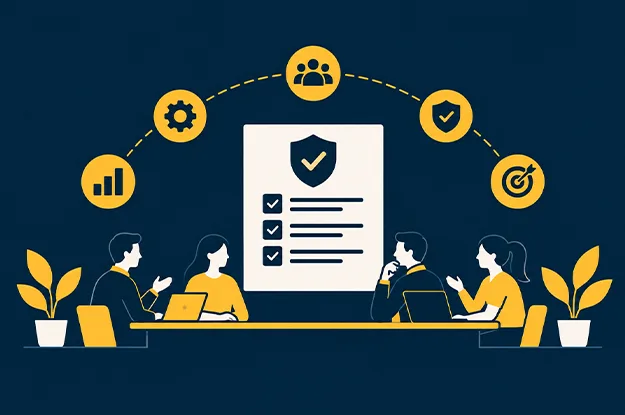
Managed services can perform well operationally and still drift away from what the business needs — a tension that enterprises relying on managed IT services must address through structured governance rather than contract compliance alone.
That tension is becoming harder to ignore. KPMG’s 2026 Managed Services Outlook, based on 1,224 senior leaders, found that 99% of surveyed organizations consider managed services a strategic investment priority. Yet only 11% identified accelerating strategic outcomes as the area where managed services have their greatest impact today. The gap is revealing. Operational capability may be present while business alignment remains unfinished.
An IT governance review exists to close that gap. It gives enterprise leaders and service partners a structured forum to examine whether day-to-day support is producing the outcomes the organization currently values. Good managed services governance therefore looks beyond ticket closure, availability, and contractual compliance. It asks whether service effort is focused on the right problems, whether risks are being addressed effectively, and whether service improvements reflect current business priorities.
The distinction matters because a managed service rarely fails through one dramatic event. Misalignment usually develops quietly. A backlog fills with low-value requests. Recurring incidents become normal. Reporting grows longer while decisions become harder to find. Business priorities change, but service measures stay fixed.
Governance is where those signals should be challenged.
Why Daily Managed Services Can Drift From Business Priorities
Operations naturally reward immediacy. Incidents need restoration. Requests need completion. Changes need coordination. Those responsibilities are essential, but they create a short planning horizon.
Business priorities move on a different clock. A finance function may be preparing for an acquisition. Operations may be entering a peak season. Security teams may be responding to a new control requirement. A product group may be retiring an application that still consumes support effort.
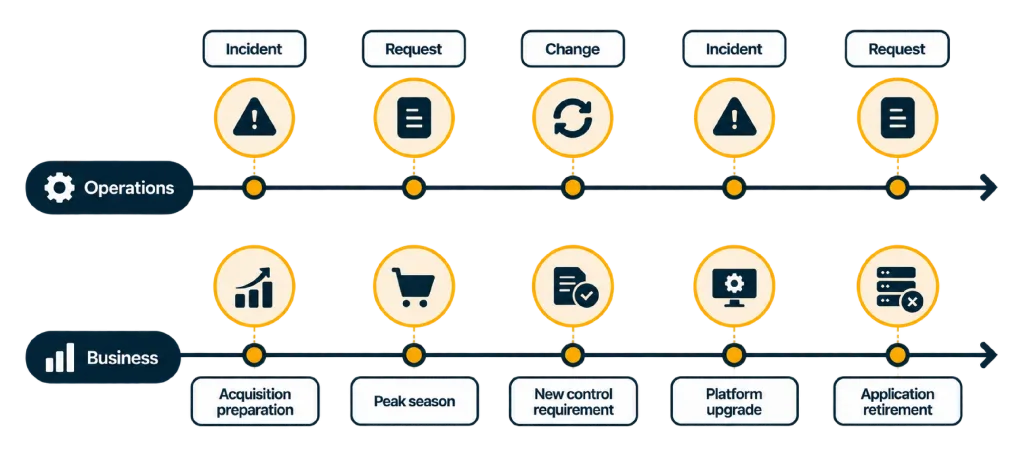
Without an IT governance review, the service provider can keep meeting yesterday’s priorities with impressive consistency — exactly the misalignment pattern examined in the comparison between managed IT vs in-house IT operating models.
This is one reason managed services governance should not be treated as contract administration. Contract measures show whether agreed services were delivered as expected. Governance examines whether the service agreement, priorities, and improvement plan remain aligned with business needs.
A useful review separates three questions:
- Is the service performing as agreed?
- Is the service reducing operational and business risk?
- Is service effort aligned with the outcomes that matter now?
The third question is often the least developed. It is also where governance becomes commercially useful.
Set an IT Governance Cadence Around Decisions, Not Calendar Habit
A monthly meeting is not automatically governance. Neither is a quarterly presentation packed with service charts.
The IT governance cadence should match the speed and consequence of the decisions being made. Operational issues may need monthly attention. Material risks, investment choices, service changes, and priority conflicts often need a wider business view at a quarterly forum.
A practical structure can look like this:
| Review layer | Typical focus | Questions that belong there |
| Operational review | Incidents, requests, changes, recurring service issues | What needs immediate correction? |
| Governance review | Risk, service outcomes, backlog priorities, cross-team dependencies | What requires a decision or owner? |
| Strategic review | Business direction, major service changes, investment priorities | Does the service model still fit business needs? |
The point is not to create more meetings. It is to stop mixing decisions that require different people, evidence, and time horizons.
A service review board becomes useful when it has authority to settle trade-offs. If a recurring infrastructure issue competes with an application enhancement for the same engineering capacity, the board should decide which outcome carries greater business consequence. Leaving that choice to be determined by the support queue removes an important prioritization decision from the governance process.
Put the Right Stakeholders in the Room
Attendance lists often reveal the quality of governance before the meeting starts.
If only service delivery managers and technical leads attend, discussion tends to stay operational. If senior executives attend every routine review, the meeting can become too high-level to resolve service detail. The participants should reflect the decisions that need to be made during the review.
A typical service review board may include the service owner, provider lead, technology representative, business stakeholder, and risk or finance representatives when relevant.
Each participant should have a reason to be present. Representation for its own sake creates spectators.
This is where managed services governance benefits from explicit decision rights. Responsibilities for service performance, business priorities, risk decisions, and improvement funding should be assigned to stakeholders with the authority to act on them.
RACI charts can document those roles, but the review needs something simpler in practice: no material issue should leave the meeting without one accountable owner.
Service Metrics Should Explain Consequence
Managed service reports often contain accurate numbers that answer weak questions.
Ticket volumes, SLA attainment, mean time to restore, change success, backlog age, availability, and customer satisfaction all have value. Problems start when those measures become the final story.
Managed IT reporting should connect service performance to business impact. A rise in incident volume matters differently if incidents affect a low-use internal tool than if they repeatedly interrupt an order-processing workflow — the kind of business-consequence thinking that separates mature enterprise managed IT services from basic SLA reporting. A backlog of 200 items says little until age, risk, business value, and dependency are understood.
A stronger reporting pattern moves through four levels:
- Measure: What happened?
- Pattern: Is it recurring, worsening, or concentrated somewhere?
- Consequence: What is the impact on business processes, risk, cost, or customer outcomes?
- Decision: What action, owner, or priority change is required?
This structure keeps an IT governance review from turning into a narration of dashboard content.
It also improves managed IT reporting because fewer metrics need executive attention. Detailed operational data can remain available without crowding the discussion.
Treat Risk as a Decision Queue
Risk registers often become storage systems. Items are logged, scored, reviewed, and carried forward for months.
That is administrative control, not effective managed services governance.
A governance review should treat material risks as a decision queue. For each risk, four things need to be clear: current exposure, business consequence, proposed response, and accountable owner. If the response is deferred, the reason and acceptance authority should be recorded.
This approach changes the tone of risk discussion. “Open risk” is too vague. “Customer onboarding depends on an unsupported integration with no tested recovery path” gives leaders something concrete to assess.
Technical debt deserves governance attention when it changes reliability, security exposure, operating cost, delivery speed, or support for a business plan — the same dimensions that a structured technical debt reduction programmer uses to triage and sequence remediation work. Age alone does not establish priority.
Build an Improvement Backlog That Competes on Business Value
Improvement backlogs often fail because they become collections of sensible ideas with no common basis for priority.
An effective IT governance review should force improvement items to compete against one another. Each item should state the problem, expected business effect, effort, dependency, owner, and evidence that will show whether the change worked.
A simple prioritization test is useful:
| Test | Governance question |
| Recurrence | Does the issue keep returning? |
| Exposure | What happens if nothing changes? |
| Reach | How many users, processes, or services are affected? |
| Timing | Is there a business event or dependency creating urgency? |
| Evidence | How will improvement be verified? |
This is where continuous service improvement becomes a managed discipline rather than a list of good intentions.
The backlog also needs a retirement rule. Items that are no longer relevant distort priority and consume governance attention.
Good managed services governance is willing to stop work that no longer earns its place.
Accountability Should Survive the Meeting
A governance meeting can feel productive while producing very little. Discussion is not completion.
Every decision should leave a trace: what was decided, who owns the next action, when it is due, and what evidence will close it. The next review should begin with those commitments before new material is introduced.
This discipline creates a useful test of business aligned IT services — one grounded in the same principles that define effective IT strategy and consulting, where service decisions are traced back to business outcomes rather than operational convenience. Alignment is visible when business priorities can be traced into service decisions, improvement work, risk treatment, and resource choices.
It also exposes a common failure mode. Some actions repeatedly move from one meeting to the next because ownership is shared across several teams. Shared contribution is normal. Shared accountability is usually ambiguous.
Several teams may contribute to an action, while one named owner remains accountable for its progress.
What Outcome-Focused Managed Services Governance Looks Like
Outcome-focused governance changes the questions asked in the room.
Instead of “Did the provider meet the SLA?” the discussion becomes “Did service performance protect the business process the SLA was meant to support?”
Instead of “How many incidents were closed?” it becomes “Which incident patterns still create avoidable business interruption?”
Instead of “What is in the improvement backlog?” it becomes “Which improvement deserves funding or capacity next, and what evidence supports that priority?”
These questions create business aligned IT services because operational performance is interpreted in business context.
They also give continuous service improvement a firmer standard. Improvement is complete when the targeted condition changes and evidence confirms the change. Closing a task or deploying a fix is only part of that test.
This is the practical value of an IT governance review. It creates a recurring point where service evidence meets business judgment.
A Better Governance Review Agenda
A useful agenda does not need many sections. It needs the right sequence.
- Previous decisions and actions: Close overdue commitments first.
- Business priority changes: Identify anything that changes service attention.
- Service exceptions and patterns: Review material performance shifts, not every metric.
- Risk decisions: Accept, mitigate, fund, defer, or escalate.
- Improvement backlog: Reprioritize against current business value.
- Commercial or capacity decisions: Address constraints that affect delivery.
- Decisions, owners, and dates: Confirm the record before the meeting closes.
This sequence gives governance continuity. Each meeting begins where the previous one ended rather than resetting the conversation.
It also makes the governance record useful outside the room. Executives can see why priorities changed. Service teams can see what received approval. Providers can distinguish contractual work from newly agreed improvement. Audit and risk functions can trace significant decisions without reconstructing months of email.
Conclusion: Governance Keeps Managed Services Relevant
Managed services alignment is not established once at contract signature. Priorities change, risks shift, systems age, and service dependencies take on different levels of business importance over time.
The governance mechanism has to detect those changes early enough to alter service behavior.
A strong IT governance review connects operating evidence with business consequence. It gives stakeholders a place to challenge priorities, make risk decisions, sequence improvements, and hold one owner accountable for each commitment.
When that discipline is consistent, managed services governance stops being a reporting ceremony. It becomes the control point that keeps service effort tied to outcomes the enterprise still cares about.
Author


Yogita Jain
Content Lead
Yogita Jain leads with storytelling and Insightful content that connects with the audiences. She’s the voice behind the brand’s digital presence, translating complex tech like cloud modernization and enterprise AI into narratives that spark interest and drive action. With a diverse of experience across IT and digital transformation, Yogita blends strategic thinking with editorial craft, shaping content that’s sharp, relevant, and grounded in real business outcomes. At Cygnet, she’s not just building content pipelines; she’s building conversations that matter to clients, partners, and decision-makers alike.