






























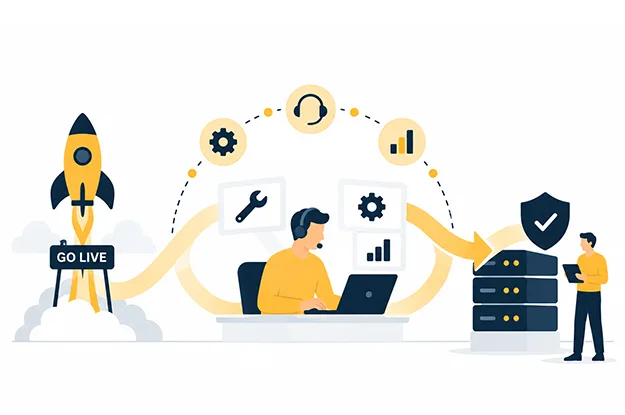
Go-live is the first day an enterprise application is exposed to the full weight of the business. Real transaction volumes arrive. Interfaces meet live data. Month-end jobs run against production records. Users take routes through the system that testing did not fully reproduce. Then the first change request lands.
That is where operational quality starts to show.
- DORA’s current software delivery model treats change failure rate and deployment rework rate as measures of software delivery instability.
- New Relic’s 2025 observability research also lists software changes among the leading causes of high-impact outages and reports that engineers spend 33% of their time addressing disruptions.
The implication for enterprise systems is practical: a successful implementation does not remove operational risk. It changes the type of work required to control it.
This is the job of application managed services. Effective enterprise application support connects monitoring, incident handling, user assistance, controlled change, performance work, and improvement into one operating discipline — the same scope that defines mature managed IT services across complex enterprise environments. The objective is straightforward: keep the application dependable while the business continues changing around it.
Why Enterprise Applications Become Harder to Manage After Go-Live
Implementation teams work toward a defined release. Production teams inherit an open-ended system.
Once live, an ERP, CRM, HCM, SCM, or other core platform becomes part of daily business execution — which is why enterprise application testing services must validate not just technical correctness, but the real-world process paths users will rely on every day. A slow approval screen can delay purchasing. A failed integration can leave orders incomplete. A background job that finishes two hours late may affect reporting before anyone sees a technical error.
This creates a different definition of stability. Uptime alone is too narrow. A system can be available while a business process is degraded.
Good post go-live application support therefore watches four conditions at once: technical health, process continuity, user experience, and change risk. Application stability management becomes the discipline of keeping those conditions within agreed limits rather than waiting for a severe incident to prove that something has drifted.
SAP’s current Cloud ALM operations guidance reflects this broader view. It separates health monitoring, real-user monitoring, integration and exception monitoring, business-process monitoring, and job monitoring because each exposes a different failure mode.
A useful operating principle follows: stability should be measured at the point where technical behavior meets business consequence.
Application Monitoring Should Follow Business Processes, Not Tool Boundaries
Many support models collect large amounts of telemetry and still miss early signs of trouble. The issue is rarely lack of data. The issue is weak connection between a signal and the business activity affected by it.
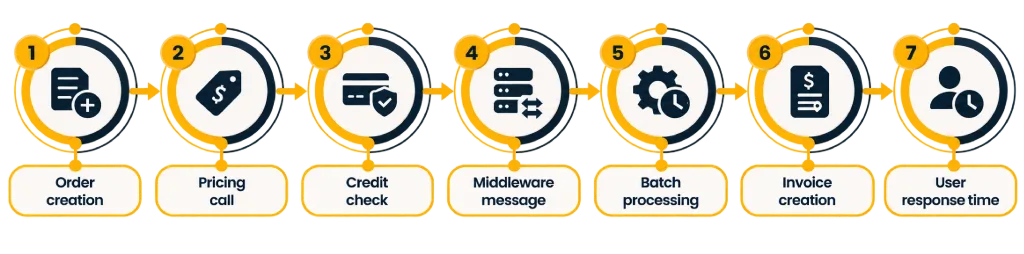
Application performance monitoring should begin with critical user journeys and process paths. For an order-to-cash flow, that could mean order creation, pricing calls, credit checks, middleware messages, batch processing, invoice creation, and the response time experienced by users. Monitoring each component separately leaves gaps between them.
For application managed services, the monitoring design should answer five questions:
- Which business process is affected?
- What changed before the condition appeared?
- Is the issue isolated, recurring, or spreading?
- Which team owns the next action?
- What evidence will confirm recovery?
This approach also reduces noisy escalation. Grafana’s 2025 observability survey found alert fatigue was the most cited obstacle to faster incident response across most organizational roles. More alerts do not automatically produce better control — a lesson that applies equally to reducing IT downtime in enterprise environments where signal volume already exceeds team capacity. Alerts need business context, ownership, and thresholds that justify action.
Strong enterprise application support therefore measures signal quality as closely as signal volume.
Incident Resolution Needs a Recovery Path and a Learning Path
An incident process usually has one obvious objective: restore service. That is necessary, but incomplete.
Reliable production support services separate immediate recovery from permanent correction. The first path contains impact, restores the affected service, communicates status, and verifies that users can continue. The second path determines why the condition occurred, whether it can recur, and what change should prevent recurrence.
That distinction matters because temporary fixes can quietly become permanent operating habits. A job is restarted manually each week. An interface queue is cleared after failure. A user workaround becomes part of an unofficial process. Ticket closure looks healthy while operational debt grows.
A mature incident record should preserve:
| Incident evidence | What it should establish |
| Business impact | Which process, users, transactions, or deadline were affected |
| Technical symptom | What failed or degraded and where it was detected |
| Recovery action | What restored service and whether the action was temporary |
| Causal evidence | Logs, traces, configuration, data, or change history supporting the diagnosis |
| Recurrence control | Problem record, defect, monitoring adjustment, documentation update, or approved change |
For application managed services, repeated incidents should influence the improvement queue. For enterprise application support, incident closure should mean more than returning a status to green.
User Support Is an Early-Warning System for Application Stability
Users often detect operational weakness before dashboards do.
A finance team may notice slower transaction processing during period-end activities. Procurement may see duplicate confirmations from an interface. Warehouse teams may report that a transaction works, but requires repeated refreshes. These reports can look minor when viewed as individual tickets. Taken together, they may reveal performance degradation, data-quality issues, workflow friction, or a recent configuration problem.
Good post go-live application support should distinguish break-fix incidents from access requests, how-to questions, process defects, data issues, and enhancement requests. This classification makes recurring issues and support trends easier to identify.
The service desk also needs a feedback loop into engineering and functional teams. If the same question appears repeatedly, documentation or training may be weak. If the same workaround appears, design may be weak. If complaints rise after a release, change validation may be weak.
This is where enterprise application support protects trust. Users judge the application by whether work can continue predictably, not by whether infrastructure dashboards remain green.
Change Control Should Protect Production Without Freezing It
Enterprise applications cannot remain static after launch. Tax rules change. Products are added. Roles change. Interfaces are updated. Vendors release fixes. Business teams request new capabilities.
Stability therefore depends on disciplined movement, not absence of change.
DORA’s current framework separates software delivery throughput from instability and uses change fail rate plus deployment rework rate to examine the stability side of delivery. That makes a useful point for application operations: the quality of change should be measured after deployment, not only by whether a change passed approval.
A practical application managed services change process should link each production change to business impact, test evidence, dependency checks, rollback criteria, release timing, and post-release observation — exactly the governance discipline that quality engineering services embed into the delivery lifecycle before changes reach production. High-risk changes may need a longer watch window because certain failures appear only when scheduled jobs, integrations, or peak user activity occur.
Application stability management also needs change correlation. When latency rises, a job fails, or an interface starts rejecting records, support teams should be able to see what changed recently without reconstructing the release history manually.
Enhancement Backlogs Need Operational Priorities, Not Just Business Priorities
An enhancement queue can become a hidden source of instability.
Business value matters, but production evidence belongs in prioritization too. Enhancement backlog management should consider recurring incidents, manual workarounds, support effort, process delays, technical dependencies, and risk reduction alongside requested features.
A useful classification looks like this:
| Backlog type | Priority question |
| Recurring defect | How much operational disruption continues while it remains open? |
| User friction | How much avoidable effort is being created? |
| Control gap | Does the current process create audit, security, or data risk? |
| Performance issue | Is response time or throughput affecting business execution? |
| Business enhancement | What measurable outcome will improve after release? |
This prevents the backlog from becoming a popularity contest. It also gives production support services a route for converting recurring support evidence into planned engineering work.
For enterprise application support, backlog quality is a stability issue. Deferred operational fixes accumulate interest through repeated tickets, manual interventions, and higher change risk — a pattern that mirrors the broader challenge of technical debt reduction in enterprise teams where short-term workarounds quietly compound into structural instability.
Performance Tuning Must Use Real Production Behavior
Pre-production testing establishes a baseline. Production exposes reality.
Real-user traffic, data growth, integration timing, custom logic, background jobs, and concurrent workloads interact in ways that test environments may only approximate. This is why application performance monitoring needs both technical telemetry and user-experience evidence.
SAP Cloud ALM, for example, distinguishes health monitoring from real-user monitoring and provides drill-down into performance and individual request execution. Its synthetic monitoring can also run scripted scenarios repeatedly to detect availability or performance issues before end users report them.
Within ongoing support, tuning should follow a controlled sequence: establish the affected transaction or process, compare current behavior with its baseline, isolate the constrained layer, change one meaningful variable where practical, then verify the business result.
CPU, memory, database time, API latency, queue depth, job duration, and response time provide diagnostic evidence. They should be assessed alongside their impact on the affected business process.
The AMS Operating Model Should Make Accountability Visible
Tooling rarely fixes unclear ownership.
A stable service needs named responsibility across detection, triage, functional analysis, technical resolution, change approval, release, and business validation. The operating model should also define when an issue stays within support and when it moves into problem management, engineering, vendor escalation, or enhancement delivery.
A simple governance view helps:
- Daily: Active incidents, failed jobs, integration exceptions, critical alerts
- Weekly: Recurring tickets, aged problems, pending fixes, upcoming changes
- Monthly: Service trends, performance drift, backlog health, recurring root causes
- Quarterly: Support demand, architecture concerns, technical debt, process risks, service improvement priorities
This cadence gives the support model a way to connect immediate support with longer-term correction. It also keeps enhancement backlog management tied to production evidence rather than separate planning conversations.
The result is stronger operational control because decisions are based on recurring patterns, business impact, and operational risk.
How to Evaluate an AMS Provider After Go-Live
A service proposal can look complete while leaving the difficult operational questions unanswered. Evaluation should focus on how the provider works when production becomes uncertain.
Look for evidence in these areas:
- Monitoring tied to business services and critical process paths
- Clear incident severity, ownership, escalation, and communication rules
- Functional and technical coverage across the live application landscape
- Change governance with test evidence and post-release checks
- Problem management for repeat incidents and temporary fixes
- Backlog prioritization that includes operational pain and risk
- Performance baselines and trend review
- Reporting that explains causes, actions, recurrence, and business impact
An application managed services partner should be able to explain the route from signal to accountable action. An enterprise application support model should also show how knowledge moves from incidents into fixes, documentation, monitoring changes, and future releases.
Stability After Go-Live Is a Managed Outcome
Go-live closes an implementation phase. It opens a much longer period in which reliability is tested through daily use, new business requirements, software updates, integrations, and production change.
The strongest support model treats stability as a managed outcome. Monitoring identifies meaningful conditions. Incident practices restore service and capture recurrence risk. User support exposes friction. Change control protects production. Backlog decisions convert repeated pain into planned work. Performance tuning keeps real usage within acceptable limits.
That is the real value of application managed services after launch. Effective enterprise application support preserves more than system availability. It preserves confidence that the application can continue carrying important business work without creating avoidable operational uncertainty.
Author


Yogita Jain
Content Lead
Yogita Jain leads with storytelling and Insightful content that connects with the audiences. She’s the voice behind the brand’s digital presence, translating complex tech like cloud modernization and enterprise AI into narratives that spark interest and drive action. With a diverse of experience across IT and digital transformation, Yogita blends strategic thinking with editorial craft, shaping content that’s sharp, relevant, and grounded in real business outcomes. At Cygnet, she’s not just building content pipelines; she’s building conversations that matter to clients, partners, and decision-makers alike.