




































When roughly 30% of your engineering capacity goes to maintaining code nobody wants to touch, the cost shows up everywhere. Feature timelines slip. Hiring doesn’t fix velocity because new engineers spend their first month deciphering undocumented modules. Is that cloud migration on the roadmap? It’s been there for three quarters, and it’s not moving because the codebase underneath can’t support it.
Most enterprise engineering teams know exactly where the debt lives. The same components get flagged in every sprint review. The same deployment risks get documented, accepted, and carried forward. Awareness was never the problem. What’s missing is a structured path from “we know this is bad” to “here’s what we’re fixing, in what order, and what it saves us.”
That’s what this guide is built around. Not a theoretical overview of technical debt, but a working remediation framework: how to assess and score what you have, choose the right reduction strategy for each debt type, and build a roadmap that actually holds up when delivery pressure hits.
What Is Technical Debt?
Technical debt is the accumulated cost of shortcuts, deferred decisions, and architectural tradeoffs that were practical at the time but now require additional engineering effort to maintain, extend, or replace. It functions like financial debt: the longer it sits unaddressed, the more expensive it becomes to service.
In enterprise systems, technical debt shows up as:
- Declining sprint velocity despite a stable or growing team size
- Rising defect rates in areas of the codebase that weren’t recently modified
- Deployments that require manual intervention or carry a known failure risk
- Onboarding timelines that stretch weeks longer than they should
- Strategic initiatives like cloud migration or AI adoption that keep stalling
At this scale, technical debt isn’t a code quality metric. It’s an operational constraint that directly affects release speed, engineering retention, and the organization’s ability to adopt new technology at the pace the business needs.
Types of Technical Debt Enterprises Accumulate
Enterprise technical debt rarely sits in one layer. Most organizations carry it across code, architecture, dependencies, testing, infrastructure, and documentation simultaneously. The problem is that teams often treat all of it as a code quality issue, which means the deeper structural debt at the architecture and infrastructure level goes unaddressed until it forces a crisis.
The table below breaks down the six main categories, where each one surfaces, and what it actually costs the business.
| Debt Type | Where It Shows Up | Business Cost |
| Code-level debt | Slow feature delivery, rising defect rates | Engineering hours spent debugging instead of building new capability |
| Architecture debt | Deployment bottlenecks, scaling failures | High cost of every change, inability to ship independently |
| Dependency debt | Outdated libraries, unpatched vulnerabilities | Security incidents, failed compliance audits, and regulatory exposure |
| Test debt | Regression spikes after routine changes | With slower release cycles, engineers are afraid to refactor |
| Infrastructure debt | Manual deployments, environment drift between staging and production | Production instability, DevOps team consumed by firefighting |
| Documentation debt | Slow onboarding, tribal knowledge | Key-person dependency that becomes a single point of failure when someone leaves |
In most enterprise codebases, these categories don’t exist in isolation. Architecture debt makes code-level debt harder to fix because refactoring a tightly coupled system carries a higher risk.
Test debt makes infrastructure changes dangerous because there’s no safety net to catch regressions. The compounding effect across categories is what turns manageable debt into a delivery constraint.
How to Identify and Prioritize Technical Debt
To identify and prioritize technical debt at enterprise scale, start by mapping the warning signals that indicate debt has become an active delivery constraint, then score each debt item by business risk and remediation effort rather than technical severity alone.
Most organizations struggle with exactly this. Gartner found that 44% of organizations call technical debt a top challenge, but fewer than 20% say they manage it effectively. The gap is not awareness. It’s having a structured method to score what you have and get remediation funded.
The two steps are broken down below.
Signals That Debt Has Reached a Critical Level
The signals below indicate that debt has moved past background noise and is actively constraining what the engineering org can deliver. Teams experiencing three or more of these simultaneously are typically in debt-constrained mode, where the codebase itself is shaping every delivery decision.
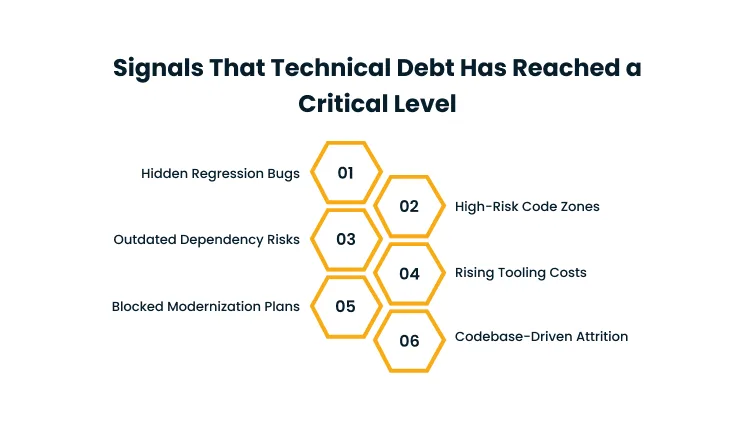
- Regression bugs are appearing in modules that were not touched in the most recent sprint, indicating hidden coupling between components
- Engineers consistently flag the same areas of the codebase as high-risk zones they avoid modifying them
- Security or compliance reviews are surfacing vulnerabilities in dependencies that have not been updated in 12 months or more
- Infrastructure or tooling costs are rising quarter-over-quarter without a corresponding increase in delivered capability
- A planned cloud migration, platform upgrade, or AI initiative is structurally blocked because the current architecture cannot support it without remediation first
- Engineering attrition is partially driven by codebase quality, with experienced engineers leaving because the environment does not support productive work
Once you’ve identified which signals apply, the next step is quantifying the damage. The tools that matter here:
- SonarQube for code complexity scoring and identifying which modules carry the highest maintenance burden
- Snyk for dependency vulnerability mapping with CVE severity ratings, which feeds directly into compliance risk conversations
- DORA metrics, specifically lead time for changes and change failure rate, for quantifying delivery-level impact at the team level
- Technical debt ratio (remediation cost as a percentage of total development cost) for giving leadership the single number they need to approve the budget
The goal of measurement is not a comprehensive audit. It’s building a case that connects specific debt concentrations to specific business constraints, whether that’s blocked modernization, compliance exposure, or engineering capacity lost to maintenance.
Scoring Debt by Business Risk, Not Just Code Quality
Once you have a debt inventory, plot each item on an impact-effort matrix with business impact on one axis and remediation effort on the other. This gives you three groupings:
- Wave 1: High impact, low effort. Fix these first. They deliver visible improvement quickly and build organizational confidence that the remediation program is working.
- Wave 2: High impact, high effort. Architecture debt and platform-level issues typically land here. These need dedicated project capacity beyond normal sprint allocation.
- Defer: Low impact regardless of effort. Batch into scheduled maintenance windows.
The matrix gets you a sequence. The harder part is getting it funded. A SonarQube score or a list of CVEs will not move a VP of Product or a CFO to approve headcount. You need to translate each high-priority item into a language the business already tracks:
- Dependency debt with known CVEs is an active compliance risk. In BFSI, healthcare, or manufacturing environments, unpatched vulnerabilities carry regulatory penalties and audit consequences that have dollar values attached.
- Architecture debt in core systems is a modernization blocker. If the current architecture cannot support a planned cloud migration or AI initiative, every quarter of delay has a measurable opportunity cost.
- Test debt is an elevated change failure rate. Low test coverage in critical paths increases both the probability and the blast radius of production incidents.
- Documentation debt is a key-person concentration risk. When the only engineer who understands a critical module leaves, the business absorbs weeks of recovery time.
For each Wave 1 and Wave 2 item, document three numbers before taking it to leadership:
- Current cost: Engineering hours absorbed per sprint on maintenance, workarounds, or incident response tied to this debt item
- Failure risk: Probability of a production incident if this debt goes unresolved, and the estimated business cost when it happens
- Remediation estimate: Effort required to resolve, broken into phases if the work spans multiple sprints
A CTO walking into a budget conversation with these three numbers per debt item is making a business case. A CTO walking in with a code quality dashboard is asking for trust.
Technical Debt Reduction Strategies for Enterprise Systems
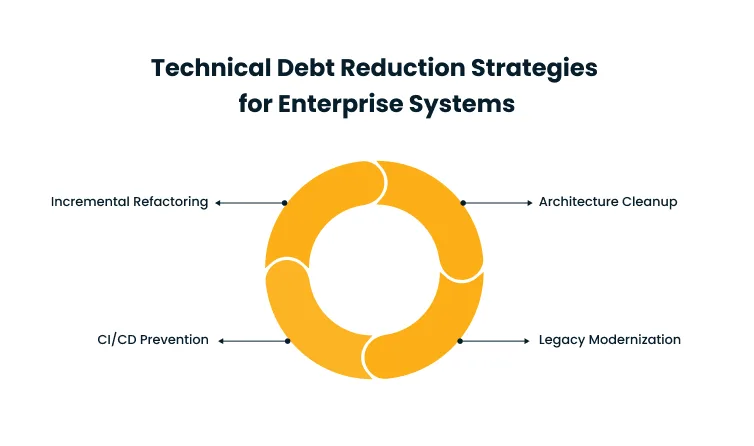
Enterprise technical debt reduction requires four strategies working in parallel: incremental refactoring for code and test debt, architecture decomposition for structural bottlenecks, legacy modernization for platform and infrastructure debt, and CI/CD enforcement to prevent new debt from accumulating while existing debt is resolved.
Most mature remediation programs run at least two of these simultaneously, matched to whichever debt type is constraining delivery the most.
Incremental Refactoring Within Active Development Cycles
Incremental refactoring is the practice of improving code structure, test coverage, and software maintainability as part of ongoing feature work rather than as dedicated cleanup sprints. The underlying principle is the Boy Scout rule: leave the code cleaner than you found it.
In practice, this means requiring test coverage improvement when engineers touch high-debt modules, introducing automated linting that flags new complexity before it merges, and using feature flags to decouple risky refactoring changes from live deployments. The advantage of this approach is that it fits within the existing delivery cadence without requiring a feature freeze or a dedicated remediation sprint.
Incremental refactoring addresses code-level debt and test debt in systems under active development. The key limitation is that it cannot resolve architecture debt. A tightly coupled monolith does not become a well-decomposed system through incremental cleanup. Code quality tools like SonarQube can enforce merge gates that prevent new code from worsening existing quality scores, which gives this approach structural teeth rather than relying on individual engineers to self-police.
Architecture Cleanup and Monolith Decomposition
Architecture debt is the hardest to address because the system typically cannot stop running while the work happens. The primary approach for managing this safely is the strangler fig pattern: progressively route traffic to new services built alongside the monolith, rather than attempting a big-bang rewrite that carries high delivery risk and extended timelines.
The decomposition itself should follow domain boundaries rather than technical layers. Breaking along business domains, such as orders, payments, and inventory, produces independently deployable services that teams can own and modify without coordinating across the entire codebase. An API gateway layer insulates consumers from the structural changes happening behind it during the transition period.
This approach delivers value incrementally. Each extracted service reduces the coupling footprint of the remaining monolith, which means deployment risk falls with each completed extraction rather than remaining constant until a future completion date. Architecture debt in core systems caps delivery velocity structurally, not just operationally. No amount of incremental refactoring resolves it.
Legacy Modernization and Platform Migration
When debt has accumulated at the platform and infrastructure level, covering outdated runtime environments, unsupported frameworks, and on-premises infrastructure that predates cloud-native architecture, the remediation work becomes a modernization program rather than a refactoring effort.
Three modernization paths are available, each with a different risk and effort profile:
- Replatforming: Move workloads to modern cloud infrastructure with targeted optimizations. Lower risk, faster execution, and partial debt reduction without rearchitecting the application.
- Refactoring to cloud-native: Containerization, microservices, and managed cloud services. Higher upfront effort with significantly better long-term scalability and operational cost structure.
- Database modernization: Migrating from legacy RDBMS to modern alternatives such as MSSQL to PostgreSQL on AWS. Eliminates licensing debt and removes a category of scaling constraint.
Platform migrations are also the right moment to audit and resolve accumulated dependency debt systematically. When the runtime environment changes, the full dependency stack needs review, which makes systematic cleanup far less expensive than treating it as a standalone effort later.
Enterprises pursuing AWS-based modernization can use structured frameworks like Cygnet.One’s ORBIT framework, which provides a repeatable migration methodology designed to reduce execution risk while maintaining operational continuity across the migration window.
CI/CD and DevOps as Structural Debt Prevention
The strategies above address existing debt. CI/CD and DevOps enforcement prevent new debt from entering the codebase while that remediation work proceeds.
- Automated static analysis on every pull request flags complexity, duplication, and maintainability regressions before merge. The feedback loop is immediate rather than deferred to a future audit.
- Dependency scanning as a merge gate blocks pull requests that introduce libraries with known CVEs above a defined severity threshold.
- Test coverage requirements on high-debt modules ensure that engineers touching risky code must improve coverage as part of the change, not as a separate future task.
- Infrastructure as Code with automated drift detection prevents environment configurations from diverging between staging and production, eliminating a root cause of infrastructure debt.
These gates work best alongside active remediation. They cannot resolve existing architectural debt. What they do is hold the line, so remediation progress isn’t erased by new debt accumulating behind it.
How to Build a Technical Debt Reduction Roadmap
Knowing the available strategies is not the same as having a program that survives contact with delivery pressure. The failure mode most organizations encounter is not a lack of intent. Debt remediation work gets displaced by product priorities sprint after sprint, and what was announced as a focused cleanup effort quietly becomes background noise.
Turning strategy into sustained execution requires two things: a planning structure that gives debt work a protected place in the delivery cycle, and governance mechanisms that prevent new debt from rebuilding faster than existing debt is resolved.
Phasing and Capacity Planning
The starting point for any roadmap is a baseline assessment. Before planning remediation, you need to quantify what you have. Static analysis, dependency scanning, and architecture mapping produce a debt inventory scored by severity and business impact. This inventory is the single source of truth for every subsequent planning decision. Without it, the roadmap is a set of intentions rather than a program.
Once the inventory exists, structure the work in three ways:
- Allocate dedicated capacity as a standing commitment. Set aside 15 to 25% of engineering sprint capacity for debt work as a fixed line item, not a discretionary allocation that gets cut when a feature slips. This capacity covers incremental refactoring, architecture remediation, and modernization work depending on which wave is active. The moment debt work becomes optional, the program fails.
- Sequence remediation in waves. Wave 1 covers high-impact, low-effort items identified in the scoring step. Wave 2 takes on high-impact, high-effort work that requires dedicated project capacity beyond the standing sprint allocation. Lower-priority items get batched into scheduled maintenance windows.
- Report in delivery metrics, not code metrics. Show stakeholders that sprint velocity is increasing, production incident rates are falling, and deployment frequency is improving. A SonarQube score improvement by itself does not hold a budget. Business-facing outcomes do.
The wave structure also forces sequencing discipline. Teams that try to address all debt types simultaneously typically make partial progress on everything and complete progress on nothing.
Governance That Prevents Debt From Rebuilding
Pipeline gates enforce standards at the code level. Governance ensures those standards survive delivery pressure at the organizational level. Without this layer, thresholds get loosened under deadline pressure, exception processes become the default path, and debt rebuilds within two to three quarters of any cleanup effort.
- Quality gate ownership: Someone needs to own the thresholds for acceptable complexity, coverage, and dependency health. Define who sets them, how they’re reviewed quarterly, and what the exception process looks like when edge cases arise.
- Definition of Done updates: A feature is complete when both the functionality works and the quality bar is met. Include refactoring, documentation, and test coverage in the team’s completion criteria.
- Architecture review cadences: Quarterly or semi-annual reviews where senior engineers assess whether recent design decisions still fit the current scale and team size. Early course corrections cost a fraction of deferred rewrites.
- Dependency health SLAs: Treat library updates as operational maintenance with defined response timelines, not as optional backlog items that accumulate until a security audit forces action.
A roadmap that only engineers understand will lose funding by the third quarter. Governance is what gives debt reduction organizational durability beyond the first wave.
When to Bring in an External Modernization Partner
Bring in an external modernization partner when engineering velocity has been declining for two or more consecutive quarters despite stable headcount, when most sprint capacity goes to maintenance rather than new capability, or when architecture-level remediation keeps stalling under delivery pressure.
The core signal is that your team can identify the debt, but cannot execute the fix alongside active product development.
Two decisions follow from that recognition: confirming the debt load has genuinely exceeded internal capacity, and knowing what to look for in a partner who will actually reduce debt rather than audit it and hand you back a report.
Signs the Debt Load Has Exceeded Internal Capacity
The earlier signals in this guide help you recognize that debt exists and has reached a critical level. These are different. They indicate that your organization has already identified the problem but lacks the capacity to resolve it alongside active product delivery.
- Remediation work has been planned and prioritized in at least two consecutive planning cycles, but was displaced by product delivery both times
- The team has attempted architecture-level fixes internally, but each attempt was either abandoned mid-execution or scoped down until it no longer addressed the root problem
- A planned modernization initiative (cloud migration, platform upgrade, AI adoption) has a hard dependency on debt resolution, and the timeline is slipping because the prerequisite work has no protected capacity
- Engineering leadership can quantify the debt and articulate the remediation path, but cannot staff it without pulling engineers off revenue-generating work
- Compliance or security findings require remediation depth and speed that exceeds what the current team can absorb within normal sprint allocation
When you might not need external support yet: If debt is primarily at the code and test level, your team can address it through incremental refactoring within existing sprints, and no major platform initiative is blocked waiting on remediation. The constraint in that case is usually execution discipline rather than capacity, and a structured internal roadmap may be enough.
What to Look For in a Technical Debt Remediation Partner
Not every modernization partner operates at the depth enterprise debt reduction requires. These are the capabilities that separate firms that resolve debt from those that document it.
- Assessment before prescription: The partner should run a structured technical assessment, covering code quality, architecture mapping, dependency health, and infrastructure state, before proposing any remediation plan. Partners who arrive with a predetermined solution are selling a methodology, not solving your problem.
- Architecture-level execution: Code-level cleanup is table stakes. The partner needs to handle monolith decomposition, platform migration, and cloud-native refactoring, which is where the highest-impact enterprise debt typically sits.
- Remediation without feature freeze: The engagement model should support debt work running alongside active product development. Any partner whose approach requires a full development stop is not viable for most enterprise environments.
- Governance is built into the handoff: The engagement should leave behind enforceable quality gates, pipeline-level controls, and dependency health policies, not just a cleaner codebase. Without this, debt rebuilds within two to three quarters of the engagement closing.
- Regulated industry depth: BFSI, healthcare, and manufacturing environments add compliance constraints that shape every remediation decision. A partner without delivery experience in regulated verticals will underestimate the complexity.
- Process maturity: CMMI Level 5 certification, defined engagement frameworks, and transparent milestone reporting are the clearest indicators of predictable execution over multi-quarter programs.
Cygnet.One’s application modernization practice covers the full scope here: technical due diligence, legacy remediation, architecture evolution, and cloud-native migration under a single engagement.
Their CMMI Level 5 maturity and delivery track record across BFSI, manufacturing, healthcare, and ISVs is worth evaluating if your debt load requires a structured multi-quarter program.
Conclusion
Technical debt reduction is not a cleanup sprint. It’s a standing engineering commitment that requires honest assessment, prioritization by business risk, the right strategy matched to each debt type, and governance that keeps new debt from outpacing what you resolve.
The starting point is always measurement. Until you can quantify what each category of debt costs in delivery time, incident risk, and blocked modernization initiatives, every remediation decision is a guess. The organizations that make sustained progress are the ones that give debt work protected capacity in every planning cycle, rather than treating it as something that happens when product priorities leave room.
If your engineering team is spending more capacity servicing debt than shipping new capability, and planned initiatives like cloud migration or AI adoption are stalling because the codebase can’t support them, that’s not a backlog problem. That’s a structural constraint.
Cygnet.One’s Application Modernization practice covers the full remediation cycle: technical due diligence, debt assessment, architecture evolution, and cloud-native migration.
Talk to a Cygnet.One’s engineer about what structured remediation looks like for your systems.
FAQs
Industry benchmarks estimate that technical debt absorbs 20 to 40% of engineering capacity across enterprise teams. That lost capacity shows up as slower releases, higher defect rates, rising infrastructure costs, and delayed strategic initiatives every quarter that the debt remains unresolved.
Engineering leadership and product management share ownership. Engineering identifies and quantifies the debt. Product leadership approves prioritization and allocates capacity. When either side opts out, remediation loses to feature delivery in every sprint planning cycle.
No. Full development freezes rarely hold at enterprise scale because product pressure resumes before the cleanup finishes. Sustained remediation works better: protect 15 to 20% of sprint capacity for debt work as a standing allocation, not a one-time pause.
Technical debt is the accumulated cost of suboptimal decisions in any codebase, including modern ones. Legacy systems are older platforms that have outlived their original design. Legacy systems almost always carry heavy technical debt, but modern systems accumulate it too.
AI-assisted code analysis can accelerate code-level debt reduction by flagging complexity, duplication, and vulnerable dependencies. It cannot resolve architecture debt, infrastructure problems, or organizational misalignment. Those require human judgment, structured planning, and cross-team execution.
Most enterprise remediation programs run 2 to 4 quarters, depending on debt severity and scope. Wave 1 items with high impact and low effort can show results within the first sprint cycle. Architecture and platform-level debt typically requires dedicated multi-quarter project capacity.
Author


Abhishek Nandan
AVP, Marketing
Abhishek Nandan is the AVP of Services Marketing at Cygnet.One, where he drives global marketing strategy and execution. With nearly a decade of experience across growth hacking, digital, and performance marketing, he has built high-impact teams, delivered measurable pipeline growth, and strengthened partner ecosystems. Abhishek is known for his data-driven approach, deep expertise in marketing automation, and passion for mentoring the next generation of marketers.