


































• Cygnet IRP
  • Glib.ai
  • IFSCA
Cygnet.One
  • About
  • Products
  • Solutions
  • Services
  • Partners
  • Resources
Generic selectors
Exact matches only
Search in title
Search in content
Post Type Selectors
Get Started
About
  • Overview

    A promise of limitless possibilities

  • We are Cygnet

    Together, we cultivate an environment of collaboration

  • Careers

    Join Our Dynamic Team: Careers at Cygnet

  • CSR

    Impacting Communities, Enriching Lives

  • In the News

    Catch up on the latest news and updates from Cygnet

  • Contact Us

    Connect with our teams across the globe

What’s new

chatgpt

Our Journey to CMMI Level 5 Appraisal for Development and Service Model

Full Story

chatgpt

ChatGPT: Raising the Standards of Conversational AI in Finance and Healthcare Space

Full Story

Products
  • Cygnet Tax
    • Cygnet Tax
    • e-Invoicing / Real time reportingIRP-integrated e-Invoicing with real-time validation
    • e-Way Bills / Road permitsGST-compliant centralized e-Way Bill platform for scalable operations
    • Direct Tax ComplianceAccurate direct tax compliance, filings, litigation, and assessments
    • Indirect Tax ComplianceEnterprise-grade platform for indirect tax compliance
      • Indirect Tax Compliance
      • GST Compliance India
      • VAT Compliance EU
      • VAT Compliance ME
    • Managed ServicesEnd-to-end indirect tax compliance support by experts
  • Global e-Invoicing
    • Global e-Invoicing
    • APAC
      • India
      • Malaysia
      • Singapore
      • Japan
    • Africa
      • Egypt
      • Kenya
      • Zambia
      • Nigeria
    • Europe
      • Spain
      • France
      • Germany
      • Poland
      • Belgium
    • Oceania
      • Australia
      • New Zealand
    • Middle East
      • UAE
      • Oman
      • Saudi Arabia
      • Bahrain
      • Qatar
      • Jordan
  • Cygnet Vendor Postbox
    • Cygnet Vendor PostboxDigitize purchase invoice validation & posting to ERPs & maximize ITC
  • Finance Transformation
    • Finance Transformation
    • Cygnet FinalyzeUnlock working capital with data-driven invoice-based credit decisions
    • Bank Statement AnalysisEvaluate company health by analyzing performance and financial risk
    • Financial Statement AnalysisAssess company performance and risk with financial statement analysis
    • GST Business Intelligence Report360-degree financial health insights using GST data analytics
    • GST Return Compliance ScoreGST-based compliance score to assess business risk and credibility
    • ITR AnalysisAssess creditworthiness and lending risk using ITR filing analysis
    • Invoice Verification for Trade FinanceVerify invoices to reduce fraud and improve credit decisions
    • Account Aggregator – Technology Service Provider (AA-TSP)Onboard to the Account Aggregator ecosystem with FIP & FIU modules
  • Cygnet BridgeFlow
    • Cygnet BridgeFlowAutomated digital onboarding with real-time validations and compliance
  • Cygnet Bills
    • Cygnet BillsGST-compliant centralized e-Way Bill platform for scalable operations
  • Cygnet IRP
    • Cygnet IRPIRP-integrated e-Invoicing with real-time validation
  • Cygnature
    • CygnatureSecure, compliant digital signing with audit-ready traceability

What’s new

e-Invoicing compliance Timeline

Know More →

UAE e-Invoicing: The Complete Guide to Compliance and Future Readiness

Read More →

Types of Vendor Verification and When to Use Them

Read More →

Safeguard Your Business with Vendor Validation before Onboarding

Read More →

Modernizing Dealer/Distributor & Customer Onboarding with BridgeFlow

Read More →

Accelerate Vendor Onboarding with BridgeFlow

Read More →

GST Filing 360°: GST, E-Invoicing, E-Way Bills & Annual Returns Made Simple

Read More →

Why Manual Tax Determination Fails for High-Volume, Multi-Country Transactions

Read More →

GST Filing 360°: GST, E-Invoicing, E-Way Bills & Annual Returns Made Simple

Read More →

Key Features of an Invoice Management System Every Business Should Know

Read More →

Automating the Shipping Bill & Bill of Entry Invoice Operations for a Leading Construction Company

Read More →

From Manual to Massive: How Enterprises Are Automating Invoice Signing at Scale

Know More →

Solutions
  • HireAI
  • Agent as a Service
  • AI-powered Voice Assistant
  • Generative AI Workshop
  • TestingWhiz
  • VIPRE

What’s new

AI powered Interviewer

AI-Powered Interviewing Helped an Education Group Reduce Hiring Time Significantly

Know More

Generative AI ebook

Navigating the Generative AI Landscape

Download eBook

Services
  • Data Analytics & AI
    • Data Analytics & AI
    • Data Engineering and ManagementData engineering and management for smart, scalable systems
    • Data Migration and ModernizationData migration and modernization for future-ready platforms
    • Insights Driven Business TransformationInsight-driven business transformation for faster decisions
    • Business Analytics and Embedded AIBusiness analytics and embedded AI for data-led growth
  • Digital Engineering
    • Digital Engineering
    • Technical Due DiligenceEnabling smarter decisions through future-ready digital ecosystems
    • Product EngineeringEngineering impactful digital products that elevate business growth
    • HyperautomationSmarter hyperautomation using low-code for agile business processes
    • Enterprise IntegrationIntegrating enterprise systems for seamless operations and growth
    • Application ModernizationModernizing IT ecosystems with scalable, AI-driven innovation
  • Quality Engineering
    • Quality Engineering
    • Test Consulting & Maturity AssessmentTest consulting and maturity assessments for reliable software QA
    • Business Assurance TestingBusiness assurance testing aligned with real business outcomes
    • Enterprise Application & Software TestingEnterprise application testing for continuity and scale
    • Data Transformation TestingData transformation testing for scalable, trusted data quality
  • Cloud Engineering
    • Cloud Engineering
    • Cloud Strategy and DesignCloud strategy and design services for secure, scalable growth
    • Cloud Migration & ModernizationORBIT: a proven framework for measurable cloud transformation
    • Cloud Native DevelopmentCloud-native development for resilient, scalable innovation
    • Cloud Operations and OptimizationCloud optimization and operations for enterprise resilience
    • Cloud for AI FirstAI-first cloud transformation for smarter, scalable enterprises
  • Managed IT Services
    • Managed IT Services
    • IT Strategy and ConsultingStrategic IT consulting to align technology with business goals
    • Application Managed Services24/7 managed application services for performance and security
    • Infrastructure Managed ServicesEnd-to-end infrastructure management for resilient IT operations
    • CybersecurityComprehensive cybersecurity solutions to protect business assets
    • Governance, Risk Management & ComplianceGRC solutions to manage risk, compliance, and governance
  • Cygnet TaxAssurance
    • Cygnet TaxAssurance
    • Tax DatalakeUnified tax data lake for intelligent, compliant decision-making
    • Tax InfraDigital tax infrastructure for efficient, compliant transformation
  • Amazon Web Services
    • Amazon Web Services
    • Migration and ModernizationMake Your Move to the Cloud With AWS Smarter & Faster
    • Generative AIRun your Gen AI workloads on AWS with full control

What’s new

AI-Powered Voice Assistant for Smarter Search Experiences

Explore More →

Cygnet.One’s GenAI Ideation Workshop

Know More →

Our Journey to CMMI Level 5 Appraisal for Development and Service Model

Read More →

Extend your team with vetted talent for cloud, data, and product work

Explore More →

Enterprise Application Testing Services: What to Expect

Read More →

Future-Proof Your Enterprise with AI-First Quality Engineering

Read More →

Cloud Modernization Enabled HDFC to Cut Storage Costs & Recovery Time

Know More →

Cloud-Native Scalability & Release Agility for a Leading AMC

Know More →

AWS workload optimization & cost management for sustainable growth

Know More →

Cloud Cost Optimization Strategies for 2026: Best Practices to Follow

Read More →

Cygnet.One’s GenAI Ideation Workshop

Explore More →

Practical Approaches to Migration with AWS: A Cygnet.One Guide

Know More →

Tax Governance Frameworks for Enterprises

Read More →

Cygnet Launches TaxAssurance: A Step Towards Certainty in Tax Management

Read More →

Partners
  • Cygnet Elevate Global Partner Program
  • Products Partner Program

Partner Program

Cygnet Elevate Global Partner Program

Cygnet Elevate Global Partner Program

Strategic Services Partner Program

A partner program built for services businesses to collaborate, expand offerings, and drive shared growth with Cygnet. Tap into shared expertise, go-to-market support, and long-term value creation.

Know more→

Products Partner Program

Products Partner Program

Co-create value through our global SaaS products.

Partner with Cygnet.One, a global leader in AI-powered compliance, tax, e-Invoicing, and automation solutions. Deliver seamless digital experiences, enable client success, and scale across markets with a future-ready platform.

Know more→

Resources
  • Blogs
  • Case Studies
  • eBooks
  • Events
  • Webinars

Blogs

A Step-by-Step Guide to E-Invoicing Implementation in the UAE

A Step-by-Step Guide to E-Invoicing Implementation in the UAE

View All

Case Studies

Cloud-Based CRM Modernization Helped a UK Based Organization Scale Faster and Reduce Deployment Complexity

Cloud-Based CRM Modernization Helped a UK Based Organization Scale Faster and Reduce Deployment Complexity

View All

eBooks

Build Smart Workflow with Intelligent Automation and Analytics

Build Smart Workflow with Intelligent Automation and Analytics

View All

Events

11th CIO Conclave & Awards

11th CIO Conclave & Awards

View All

Webinars

Beyond Chat: How Voice-Assisted AI is Redefining Digital Engagement

Beyond Chat: How Voice-Assisted AI is Redefining Digital Engagement

View All
Cygnet IRP
Glib.ai
IFSCA

Enterprise Software Transformation: Monolith to Microservices

  • By Cygnet.One
  • October 18, 2022
  • 7 minutes read
Share
Subscribe

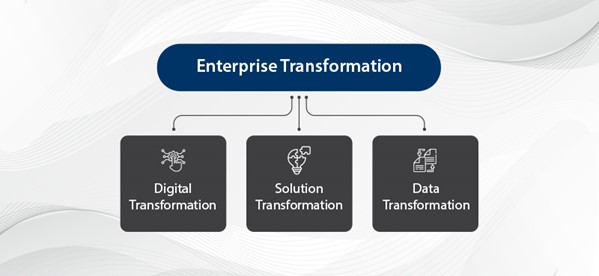
Technology has been taking swift strides this decade, and digital transformation is imperative for every business. While shedding outdated processes and legacy technology, business leaders are ready to invest heavily in new technology and digitization to witness the astounding outcomes of this digital transformation. For enterprise transformation with the help of digital transformation, solution transformation, and data transformation, innovation is becoming a top priority for businesses. Every organization is predicted to be a software organization at some level.
Most businesses have been sticking to traditional enterprise systems for a long time, hosted on-premise or migrated to the cloud with lift and shift.

Nowadays, businesses realize they can provide breakthrough digital customer experiences using cloud-first solutions and its services. Vendors of major enterprise systems – like Microsoft, SAP, and Oracle – have switched their attention to their cloud products, ceased supporting their existing systems and stimulated their clients to switch to the cloud first by providing attractive benefits like slashed prices, security enhancements, development and low maintainability with new features and services. Many businesses shifted to leverage their capabilities, while others forcefully made the shift during the pandemic.

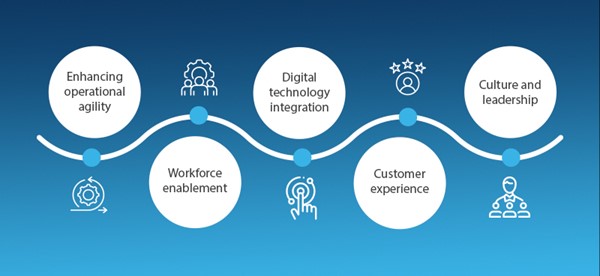
Scaling the next level of digital transformation, businesses look forward to:
Businesses are switching to the more versatile microservices approach to build applications that meet business competition’s speed and agility requirements.

Following is the chart showing how technology and its uses have evolved and how businesses are using it to achieve their technological goals.

 Earlier (Upto 2010)Now (2011-2023)Imminent (Post 2023)
Software modelTransaction-centricAs-a-serviceEcosystem-centric
Transaction type1:11: ManyMany: Many
ProductMonolithic, On-premises softwareMulti-tenant, Cloud-basedModular, Microservices-based
ArchitectureProprietaryMulti-tenantOpen
PersonalizationHeavily customizedConfigurableExtensible & intelligent
Time to deliverYearsMonths to weeksDays (or continuous)
PricePerpetual licence-basedSubscription & consumption-basedOutcomes-based value
Place of saleDirect & channel salesDigital engagementPlatform-based marketplace
ScalabilityDifficult-to-scaleScalableInteractive ecosystems
InnovationSlow pace of innovationAccelerated innovationNetwork effects
PromotionIT-centric, procurement-drivenBusiness-centric (IT & LoB), CFO driven – business case drivenC-suite driven customer journeys, Use case centric

Monoliths are large code bases which contain all the logic needed to run an application anywhere. It is self-contained, employable and includes a lot of functionality. It is composed of many modules that represent different functionality in an application. Everything within the monolithic architecture is connected or can be connected to anything else. All the relevant code in this project is kept in a single repository.

Cloud-based enterprise systems enable businesses that regularly require large amounts of computing power to provide some digital product or digital experience. They add capabilities that include advances in data analytics technologies, quick adoption of agile product development approaches and automation.

In the microservice architecture, the code is broken into pieces and converted into services. Each microservice is designed and implemented to do a more specific task. Specific services are independently built, deployed, operated, and scaled. They can take requests and potentially call each other to fulfil these requests.
Digital, Application and Product Engineering

Advantages of monoliths

  • No duplication: Consolidated code in monoliths leaves fewer chances for duplication.
  • Beneficial for small teams: Monoliths are helpful when a business scales in terms of customers, not internal teams. Small teams benefit from the consolidated code in monoliths.
  • No breaking changes: More clear communication happens in a monolith. For example, Module A to Module B needs a single function call: getProfile (int profileID). The parameters that pass into this function are explicit and clear. So, if this is a wrong function call, the compiler will not allow it and ask for the correct function call: getProfile (string profileID). On the other hand, in a microservice, if the ID was earlier ‘int’ and now it has run out of integers and made it a string, all the other services that connect to this service are going to use the profile with the ID as ‘int’ as they are not aware that the ID has turned into a string. This means that all communication to this service will break. This is called a breaking change – Earlier, there was something, and now there is something else which is not compatible. It is easier to have breaking changes in microservices, which is not good, so the libraries need to be updated continuously. In monoliths, as the code and expectations are in one place, it is much more challenging to have such problems.
  • Contracts are in one place: Service contracts are placed within the consolidated code in monoliths. This is not the case with microservices, where individual contracts exist between different services.

Advantages of microservices over monoliths

When the internal team in a business scale and all want to move about individually, different product teams are working on different products, and the business demands smooth deployments, the business needs to move to a microservices architecture. A microservices architecture brings in the following benefits:

  • Good separation of concerns: To make any feature change, you need to go to the relevant service and make the change—no need for a cumbersome dependency analysis for changing something in the code.
  • Relatively easier engineering: Coding in microservices is sometimes easier because the coder needs to make changes only to the code pertinent to a particular service. This defines the expectations and responses very well, as the engineers in the rest of the services will respect the contracts made with other services. Also, the design and interaction of these services are much simpler and smoother.
  • Easier deployments: When there is a change in a particular service, the engineer can deploy that service separately. This also removes any hassles associated with the non-functioning of non-critical services.
  • Enhanced Security: The best part about microservices architecture is enhanced security. With this architecture/ecosystem, you may not need to worry about ransomware attacks and be rest assured about the safe and secure environment.

Strategies of microservice architecture

When you decide to migrate from the monolithic to the microservices architecture, you are not only changing the way you code but also the entire business model. So, you need to plan and prepare for the operations to continue smoothly during the transition. The following strategies are a reliable guide.

  • Business logic: The services are designed based on the business blocks by defining services focussing on localizing a business process.
  • Data strategy: The complexity of the data in today’s world is very high. With different data types and storage availability, a data strategy is key for any architecture for smooth running and future growth. As the services are designed, the data can be partitioned either based on each service or data relationships. Both these methods have their advantages as well as disadvantages. It is always better to define data architecture by isolating services or segregating data and accessing it based on demand.
  • Checks and balances: Visibility is key for such distributed and decoupled architecture. The fine balance between dependency vs decoupling is maintained with the use of gateway and client/server-side discovery patterns.
  • Bundling of common components: It is critical to handle cross-cutting concerns by building libraries and packages and maintaining them as a centralized component for all services and processes.
  • Process-driven: Some business processes need critical attention; thus, opting for their independent architecture is also observed.
  • FanOut: As all the services are independently managed but collaborate continuously, the key is to strategize the circuit breaker with the proper mechanism to reduce latency.

Migrating from monolith to microservices – application modernization

Step 1: Gain a comprehensive understanding of the existing monolithic application

  • Establish a baseline of the present application architecture.
  • Try to gain a good comprehension of the problem space prior to moving into the solution space by extracting the capability’s data, logic, and user-facing components. Also, assess the cost versus benefits. This involves both the technical and business teams.
  • The existing monolith application is segmented into logical components (sets of the interlinking entity that performs one business function) as services.
  • Identify the global or common components that need to be converted to libraries/packages for easy maintenance and scalability.
  • Strategize a request router/ API gateway to manage the incoming HTTP requests and divert their route as if this is not planned correctly it can become a bottleneck in future.
  • Keep adding the necessary functionality to monolithic applications for business growth and sustainability, keeping in mind the new architecture for easy adaptation.
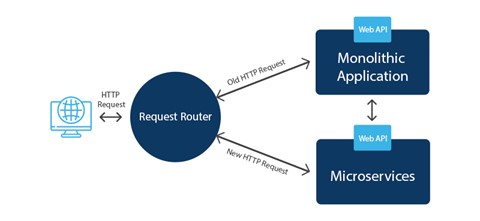
Step 2: Use the domain-driven design to expand the identified services and fragment the frontend and backend

  • Disentangle the dependencies within the existing monolith and decouple the services with a domain-driven design after assessing the size of the components identified for converting to future services and designing data models for remote UI with API access.
  • Split the presentation layer between the business logic and data access layers.
  • Define data architecture with service isolation or data segregation methodology.
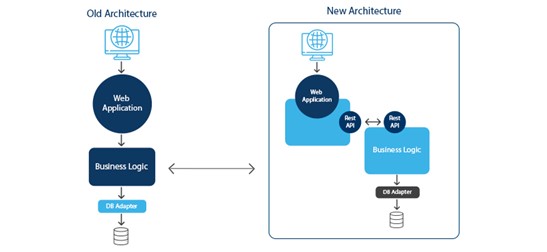
Step 3: Build services and eliminate the monolithic architecture incrementally

  • Adopt ETL tools, such as TestingWhiz Pro, or manual scripts for data migration from monolithic and microservice databases.
  • Migrate incrementally to allow the monolith code to run alongside the new application that consists of microservices. Install proxies amongst API consumers and services. Prioritize the services for migration based on the type and scale of dependency and ensure that while migrating the services incrementally, communication between services and monolith is configured through well-defined API contracts.
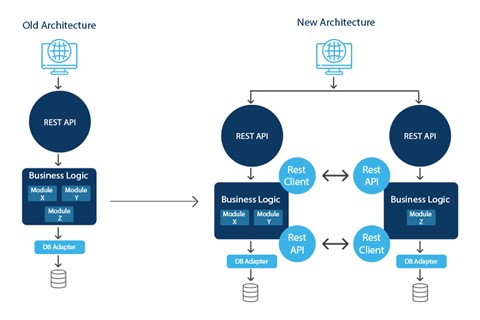
Step 4: Evolution of your enterprise application with microservices

  • Set up facades. Release new code over time and the functionality implemented by the monolithic application reduces. It either transforms into another microservice or disappears altogether.
  • For architectural growth, any design pattern can be adopted for the new services.
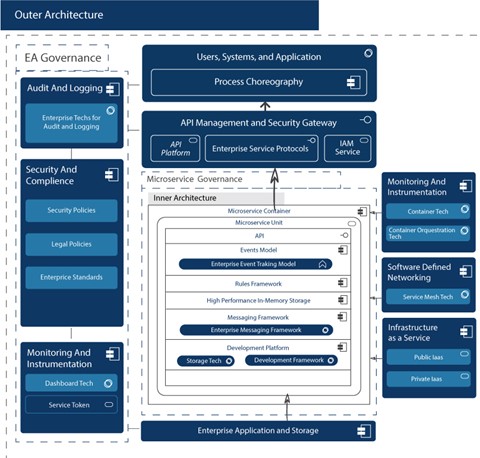
Note: Services in a microservice architecture are planned around business concerns and not technical concerns. So, there may be a need to create larger services instead of smaller services and defining service boundaries may be an iterative process.

Let Cygnet Digital be your technology partner in growth and innovation. Reach out to us today!

Author

Cygnet.One Linkedin
Cygnet.One
Living the trust

Cygnet.One is a technology consulting and development company, that co-creates business growth strategies and delivers partnership value through the Power of Digital. We specialize in leading technologies such as Cloud Computing, AI/ML, and Blockchain with a focus on innovation and agility.

A US-based exhibition company reduced operations costs by 40%

Online Ordering Download Success Story

Related Blog Posts

Cygnet’s Innovative Engineering: Making Digital Transformation Efficient

CalendarMay 08, 2024

Top 5 things to consider Tech Due Diligence in your Digital Transformation Journey

CalendarMay 14, 2024

Unveiling the Power of Process Understanding: A Catalyst for Business Success

CalendarAugust 29, 2023

Sign up to our Newsletter

    Latest Blog Posts

    Evaluating AWS Landing Zone vs Control Tower 
    Evaluating AWS Landing Zone vs Control Tower 

    CalendarApril 15, 2026

    Modernizing Legacy Integrations Using EventBridge and Step Functions 
    Modernizing Legacy Integrations Using EventBridge and Step Functions 

    CalendarApril 15, 2026

    Why Is Data Product Thinking Transforming Enterprise Analytics Teams? 
    Why Is Data Product Thinking Transforming Enterprise Analytics Teams? 

    CalendarApril 14, 2026

    Let’s level up your Business Together!

    The more you engage, the better you will realize our role in the digital transformation journey of your business


      I agree to the Terms & Conditions and Privacy Policy and allow Cygnet.One (and its group entities) to contact me via Promotional SMS / Email / WhatsApp / Phone Call.*

      I agree to receive occasional product updates and promotional messages from Cygnet.One (and its group entities) on Promotional SMS / Email / WhatsApp / Phone Call.

      I agree to receive informational SMS (e.g., service updates, account notifications) from Cygnet.One (and its group entities). Message frequency varies. Message & data rates may apply. Reply HELP for help or STOP to opt out.

      I agree to receive promotional SMS (e.g., offers, product updates, marketing messages) from Cygnet.One (and its group entities). Up to 4 messages per month. Message & data rates may apply. Reply HELP for help or STOP to opt out. Consent is not a condition of purchase.

      Cygnet.One Locations

      India India

      Cygnet Infotech Pvt. Ltd.
      2nd Floor, The Textile Association of India,
      Dinesh Hall, Ashram Rd,
      Navrangpura, Ahmedabad, Gujarat 380009

      Cygnet Infotech Pvt. Ltd.
      6th floor, A-wing Ackruti Trade Center,
      Road number 7, MIDC, Marol,
      Andheri East, Mumbai-400093, Maharashtra

      Cygnet Infotech Pvt. Ltd.
      WESTPORT, Urbanworks,
      5th floor, Pan Card Club rd.,
      Baner, Pune, Maharashtra 411045

      Cygnet Infotech Pvt. Ltd.
      10th floor, 73 East Avenue,
      Sarabhai campus, Vadodara, 391101

      Global

      CYGNET INFOTECH LLC
      125 Village Blvd, 3rd Floor,
      Suite 315, Princeton Forrestal Village,
      Princeton, New Jersey- 08540

      CYGNET DIGITAL IT SOLUTION LLC
      Office 707, Magnum Opus Tower,
      Al Thanyah First, Dubai, U.A.E,
      P.O. Box 125608

      CYGNET INFOTECH PRIVATE LIMITED
      Level 35 Tower One,
      Barangaroo, Sydney, NSW 2000

      CYGNET ONE SDN.BHD.
      Unit F31, Block F, Third Floor Cbd Perdana 3,
      Jalan Perdana, Cyber 12 63000 Cyberjaya Selangor, Malaysia

      CYGNET INFOTECH LIMITED
      C/O Sawhney Consulting, Harrow Business Centre,
      429-433 Pinner Road, Harrow, England, HA1 4HN

      CYGNET INFOTECH PTY LTD
      152, Willowbridge Centre,
      39 Cronje Drive, Tyger Valley,
      Cape Town 7530

      CYGNET INFOTECH BV
      Peutiesesteenweg 74, Machelen (Brab.), Belgium

      Cygnet One Pte. Ltd.
      160 Robinson Road,
      #26-03, SBF Centre,
      Singapore – 068914

      • Explore more about us

      • Download Corporate Deck
      • Terms of Use
      • Privacy Policy
      • Contact Us
      © Copyright – 2026 Cygnet.One
      We use cookies to ensure that we give you the best experience on our website. If you continue to use this site we will assume that you are happy with it.

      Cygnet.One AI Assistant

      ✕
      AI Assistant at your help. Cygnet AI Assistant