
































It is a Monday morning. A finance head in Makati has just told her board that the company will issue electronic invoices before 31 December 2026. Her IT lead then asks three questions. Which permit comes first? Who runs the sandbox tests? Where do the signing keys live?
Businesses across the Philippines now understand the broader Philippines e-Invoicing framework.. The technical steps behind it are still new to most teams. This guide walks through the e-Invoicing BIR requirements as RMC No. 98-2026 describes them, in the order a project team will meet them: the PTI, BIR EIS Certification, the sandbox and the PTT.
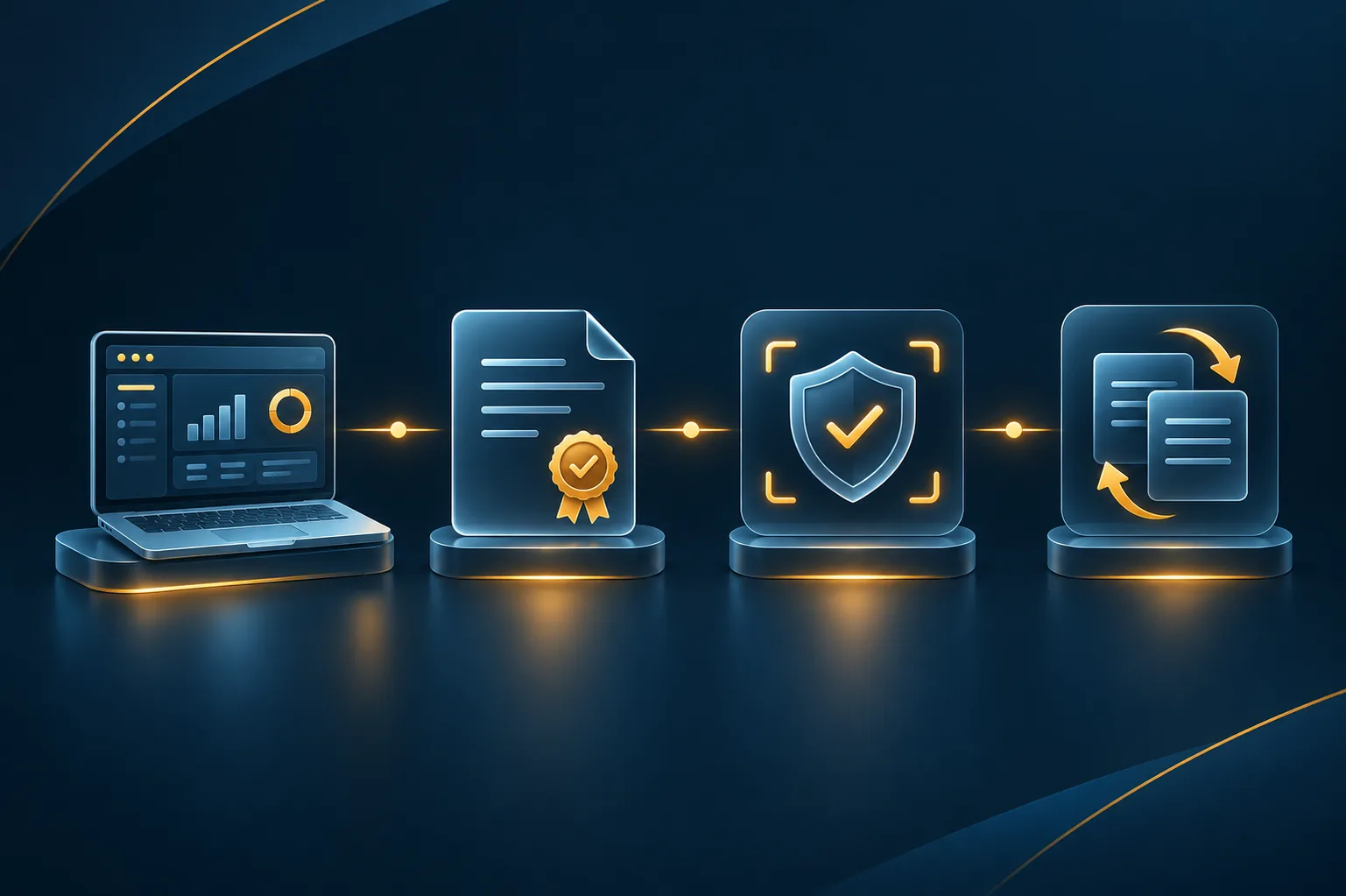
The EIS onboarding journey briefly
- PTI – Permit to issue, before the first e-invoice
- Portal and keys – Account, authentication key, signing key pair
- Sandbox – Mandatory tests on eis-cert.bir.gov.ph
- EIS Certification – Within six months of PTI
- PTT – Only when the BIR directs sales reporting
The PTI comes before the first e-Invoice. Certification follows within six months of the PTI. The PTT waits for a BIR directive.
Permit to Issue (PTI) Electronic Invoice: What it is and when you need it?
RMC No. 98-2026, dated 22 September 2026, requires a covered taxpayer to hold a Permit to Issue Electronic Invoice before issuing its first e-Invoice. The PTI authorises issuance through a specific approved Philippines e-invoicing solution. A Permit to Use or a CAS Acknowledgement Certificate does not replace it.
- Branches: The head office and each branch carry the same PTI number. A new branch on the same approved system needs a notification to the BIR, not a new number.
- Where to file: Your Revenue District Office (RDO) or Large Taxpayers Office. The BIR evaluates a complete application within 20 working days.
- Who is covered: covered taxpayers other than Micro taxpayers must issue e-Invoices on or before 31 December 2026.
EIS Certification: Timing and what is tested
The process starts as soon as the PTI is issued. Then comes EIS Certification which must follow within six months. Moreover, if you miss it, it becomes the breeding ground on which the PTI can be revoked.
The certification confirms that your system can extract, process and transmit sales data to BIR technical standards. RMC No. 98-2026 sets five mandatory tests, or seven where API callback applies.
Teams often ask for the EIS certificate Philippines taxpayers receive after passing. It is an EIS Certification Number, and it is not the same thing as the PTI. BIR EIS Certification proves your system can do the job. The PTI gives you the authority to start. Neither one switches on sales reporting by itself.
Permit to Transmit (PTT): Production access, registered IPs, renewal
The PTT is a separate approval for electronic sales reporting under Section 237-A. Under RMC No. 98-2026 it applies only when the BIR notifies or directs the taxpayer. Some older vendor guides still tie it to the 31 December 2026 deadline. It is not tied to that date.
Prepare for it early anyway. The permit to transmit BIR application asks for five documents: a Risk and Disaster Management Plan, Software Features and Specifications, a Sworn Statement, an IT Systems Configuration Diagram, and a System, Data and Process Flow.
- Registered IPs: after approval you enter fixed public server IPs in the portal. Under the BIR Electronic Invoicing System only whitelisted IPs can transmit, and the BIR emails the production endpoint. Update the list before any hosting change.
- Renewal: the sources reviewed for this guide publish no renewal cycle for the PTT. Confirm the terms with your RDO instead of assuming one.
Sandbox Testing: Test cases, common failures, sign-off
Request sandbox access on eis-cert.bir.gov.ph and wait for BIR approval. Generate your authentication key and digital signing key pair first. EIS sandbox testing then covers Authentication, Invoice Issuance (with or without callback) and Inquiry Result.
| Common failure | What usually causes it |
| Signature rejected | Invoice signed with the wrong key, or not packaged as a signed JSON payload |
| Callback test fails | Callback endpoint unreachable, slow or returning the wrong response |
| Schema errors | JSON fields that do not match BIR specifications or the taxpayer’s Form 2303 details |
| Throttled calls | Test scripts calling the sandbox faster than it allows |
Sign-off comes in two moves. Pass every mandatory test, then submit the certificate request. That request completes BIR EIS Certification once the BIR reviews your test invoices and issues the number.
Documents and information to prepare
| Item | Needed for |
| BIR Form 2303 details and authorisation document | Portal account sign-up |
| PTI application papers | RDO or Large Taxpayers Office filing |
| Authentication key and signing key pair | Sandbox and production calls |
| Sample invoices in BIR JSON | Mandatory sandbox tests |
| The five PTT documents | Permit to Transmit, when directed |
| Fixed public server IPs | Production whitelisting |
Typical timeline and who does what
Three dates are fixed: a 20-working day PTI review, BIR EIS Certification within six months of the PTI, and e-Invoices by 31 December 2026. Everything between them depends on how early EIS sandbox testing starts. With about six weeks left, the PTI review alone takes most of a month.
| Stage | Taxpayer owns | Provider supports |
| PTI | Application, signatures, filing with the RDO | System description, document drafts |
| Sandbox | Access request, sign-off on test data | Key setup, test scripts, fixes |
| Certification | Certificate request, final accountability | Evidence pack, error resolution |
| PTT | Applicant and sworn statement | Architecture documents, IP planning |
One rule never moves. The taxpayer holds the PTI and the EIS Certification, whatever the provider arrangement.
How Cygnet manages certification, sandbox and key custody
Cygnet treats BIR EIS Certification as an engineering project with a paper trail, and the taxpayer stays the applicant at every step.
- Certification: We map your invoice data to the BIR JSON structure, run the mandatory tests and keep the evidence for the certificate request.
- Sandbox: Runs are repeatable, so a failed case is fixed once and re-run, not patched later in production.
- Key custody: Signing keys sit under controlled access, with named owners and a plan for replacement before they expire.
The BIR has said it had accredited no e-Invoicing service provider as of its 14 September 2026 advisory. Ask any provider, Cygnet included, to show in writing what BIR status it holds.
Conclusion
Nobody frames an EIS Certification Number. Nobody hangs a PTI in the lobby. Yet on the day a customer, an auditor or the BIR asks, these small documents are the only proof that your invoices are real. The BIR e-Invoicing requirements reward the boring virtues: test evidence, named owners and a straight answer to the question of who holds the key.
Cygnet has spent its years in the unglamorous corners of tax technology, across India, the UAE, the GCC, Southeast Asia and Europe, where mandates arrive on the government’s calendar and never on a convenient one. We do not hand out stamps and call it trust. Credibility, in our view, is the willingness to be audited before the audit arrives. Start the PTI this week and ask us for the rest.
FAQ's
No, unless the BIR notifies you. The deadline is for issuing e-Invoices, which needs a Permit to Issue Electronic Invoice. The permit to transmit BIR process begins only when sales reporting is directed.
The PTI is the authority to issue e-Invoices through an approved system. EIS Certification tests that the system can extract, process and transmit sales data. The first comes before issuing, the second within six months after.
The BIR can revoke the PTI. Treat the six months as a ceiling and book sandbox work in the first weeks after approval.
The provider can build, test and support. You still need your own PTI and your own BIR EIS Certification, because the obligation sits with the taxpayer.
Yes. Sandbox work runs on test invoices at eis-cert.bir.gov.ph. Production sits on a separate portal, eis.bir.gov.ph, and opens to whitelisted IPs only.
Author


Kesha Shah
General Manager - Products Marketing
Kesha Kumar leads the global products marketing team at Cygnet.One, where she turns the complexity of tax and finance transformation into stories that resonate with the people who matter most. She’s the strategic force behind the brand’s presence across India, the GCC, Southeast Asia, and Europe, translating dense subjects like e-Invoicing mandates, digital engineering, and enterprise AI into narratives that inform and drive action. With expertise spanning tax and finance transformation, quality, enterprise applications, and data and AI, Kesha blends sharp strategic thinking with a marketer’s instinct for what truly connects. At Cygnet.One, she does more than build campaigns and content; she shapes the conversations that help enterprises navigate compliance with clarity and confidence, propelling the brand to the forefront of the industry along the way.