

































Introduction
In the Philippines, the Electronic Invoicing System (EIS) forms part of the Bureau of Internal Revenue’s (BIR) digital invoicing and sales-reporting framework. Taxpayers within the applicable scope of BIR e-Invoicing requirements under Revenue Regulations (RR) No. 11-2025 are required to issue electronic invoices using structured invoice data. RR No. 26-2025 extends the compliance period for specified covered taxpayers to 31 December 2026 for electronic invoice issuance. Electronic sales-reporting requirements remain a separate consideration and depend on the applicable regulatory and technical framework.
This article explains eis meaning in the BIR context, how electronic invoice issuance differs from electronic sales reporting, and what finance, tax, and IT teams should assess when preparing systems and processes.
What does EIS Meaning in the BIR Context?
EIS refers to the BIR’s Electronic Invoicing System and the related regulatory and technical environment for electronic invoicing and, where applicable, electronic sales reporting.
Understanding the BIR’s Electronic Invoicing System (EIS)
EIS stands for Electronic Invoicing System. BIR materials also use terminology referring to electronic invoicing and sales reporting, so businesses should assess the specific system, process, and obligation applicable to their taxpayer category.
Why it exists is clear: the BIR is moving from paper-heavy, manually reconciled sales evidence toward structured, system-generated invoice data that can be validated, stored, and analysed at scale.
The role of EIS within the BIR’s digital tax strategy is to support Sections 237 and 237-A of the National Internal Revenue Code, as amended, by giving the authority a clearer transaction-level view of sales activity from covered taxpayers.
RR No. 11-2025 defines electronic invoicing as the automated process of generating an electronic invoice in structured invoice data that can be easily extracted electronically. The framework is not based simply on emailing PDF invoices; it relies on structured, electronically extractable invoice data and applicable digital processes.
EIS vs Electronic Invoicing vs Electronic Sales Reporting
This is one of the largest sources of project confusion, so the distinctions should be fixed early.
| Concept | What it means in practice |
| EIS | The BIR’s electronic invoicing system environment and related framework for electronic invoice and, where applicable, sales-reporting processes |
| Electronic invoice issuance | Generating and issuing system-generated invoices with structured, extractable invoice data under RR No. 11-2025 |
| Electronic sales reporting | Transmitting required sales data to the BIR under the applicable reporting framework and technical process |
Electronic invoice issuance and electronic sales reporting should be assessed separately. RR No. 26-2025 gives specified covered taxpayers until 31 December 2026 for electronic invoice issuance, while further electronic sales-reporting requirements for certain categories remain tied to BIR system capability and separate guidance.
How the BIR Electronic Invoicing Framework Works
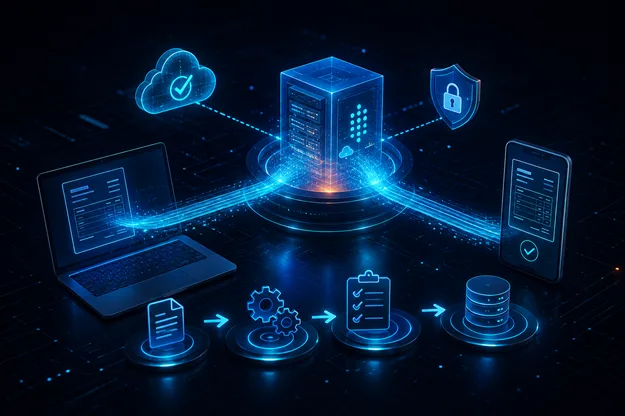
Before selecting a Philippines e-Invoicing solution or APIs, teams need a clear view of the ecosystem: where invoice data is born, how it becomes structured, how it is validated, and how issuance differs from later reporting.
EIS Process: From Invoice Creation to Reporting
The process should be understood in stages, with the applicable BIR requirements confirmed before implementation.
- Create the transaction. The ERP, billing system, or other source application records the sale and generates the invoice data.
- Prepare structured data. The system maps the transaction into the required invoice fields and preserves the invoice identifier and relevant taxpayer information.
- Validate the record. Business rules check mandatory fields, taxpayer identifiers, tax treatment, totals, and document consistency.
- Issue the electronic invoice. The covered taxpayer issues the invoice according to the applicable regulatory requirements.
- Perform additional reporting steps where required. If electronic sales reporting applies, the relevant data is processed through the reporting method and technical requirements applicable to that taxpayer.
- Manage errors and corrections. Failed processing is assigned to an owner, investigated, and resolved using the appropriate correction process.
- Retain evidence and reconcile. Finance and tax teams preserve invoice records, processing histories, relevant acknowledgments, and correction links, then reconcile the activity with accounting and tax records.
These stages describe the business control lifecycle, not a claim that every taxpayer follows an identical BIR-side API sequence. Electronic invoice issuance and electronic sales reporting must remain separate in the implementation design.
Why Structured Invoice Data Matters
Structured invoice data is central to electronic invoicing because it allows systems to extract and process invoice information without relying on manual re-entry or document recognition. The data may include seller and buyer details, taxpayer identifiers, invoice numbers, transaction lines, tax treatment, and totals.
A PDF can present an invoice clearly to a person, but a readable PDF alone should not be assumed to meet the structured-data requirement under RR No. 11-2025. Businesses need to establish whether their source systems can generate the required invoice data in an electronically extractable format.
JSON, XML, and Digital Signatures
The technical format and transmission method must be assessed against the applicable BIR specification. The guide describes JSON in the API-based electronic sales-reporting model and identifies XML as a format that may be supported in some contexts. These should not be presented as interchangeable options for every BIR process.
Where the applicable technical specification requires a JSON Web Signature (JWS), teams should verify the prescribed signing algorithm, payload structure, credential handling, and signature-validation process against current BIR documentation. They should also confirm how the system records validation outcomes and preserves the evidence needed for audit and troubleshooting.
Before choosing an integration design, obtain the current technical specifications relevant to the taxpayer’s scope and confirm the required format, validation rules, and transmission method with the implementation team.
How Businesses Connect to the EIS
Connection work should start only after regulatory scope and data readiness are understood. The technical path depends on volume, system landscape, and the BIR processes that apply to the taxpayer.
Choosing the Right Integration Approach
There is no single mandatory architecture for every business. Three patterns appear most often. Direct ERP integration suits organisations with a dominant ERP or billing platform and strong internal integration capability. Middleware suits multi-ERP, multi-branch, or multi-channel landscapes where mapping and exception handling need a central control point. Compliance platform approaches can be useful when organisations need specialised validation, monitoring, and regulatory change management across complex entity structures.
| Approach | Best fit when | Watch-outs |
| Direct ERP integration | Single core system, strong IT ownership | Branch or bolt-on billing tools may sit outside the design |
| Middleware | Multiple source systems need one control layer | Ownership of mapping and exceptions must be explicit |
| Compliance platform | Need specialised validation, monitoring, and change handling | Still depends on clean upstream ERP and master data |
Manual or file-based processing may be possible where supported by the applicable BIR process, but high volume usually makes heavy manual dependence a control risk.
Preparing Your Systems Before Integration
Preparation determines whether integration succeeds. Master data is the first gate: buyer TINs, customer tax profiles, branch party data, and item or service classifications must support a valid electronic invoice. ERP readiness means the system can generate required invoice scenarios with consistent numbering and audit trails. Invoice mapping links each required and conditional data element to a reliable source field or rule. Validation rules should catch missing TINs, inconsistent tax amounts, incomplete buyer details, and document-type errors before issuance or reporting. Confirm any certification, enrollment, credential, or Permit to Transmit (PTT) steps that apply, including the BIR EIS certification environment where relevant.
What Happens After an Invoice Enters the EIS?
Once invoice data moves into EIS-related processing, the organisation still needs a controlled operating model. The exact BIR-side flow depends on the issuance and reporting processes applicable to the taxpayer, but organisations can still design consistent internal controls around the core processing stages.
Invoice Processing Lifecycle
A practical lifecycle includes invoice creation in the source system; validation of required and conditional data against transaction and tax rules; exception handling for records that fail checks; and electronic invoice issuance according to applicable BIR requirements. Where electronic sales reporting applies, required data is processed under the relevant reporting framework. Retain processing history so tax and audit teams can reconstruct what was issued, corrected, and reported.
Managing Errors and Exceptions
Validation failures should route to a named queue with business ownership, not an unmonitored interface log. Typical causes include missing data. Correction workflows need clear rules for when a draft can be fixed and reprocessed, when a credit note or cancellation is required, and how corrected records link to the original transaction. Cover partial failures across branches or channels with agreed cut-off, reconciliation, and restart procedures.
Common EIS Readiness Challenges
Implementation programmes stall on operational and technical gaps that only appear when real transaction variety is tested.
Business Challenges
Poor master data is a common implementation blocker. Invalid or missing customer TINs, duplicate customer records, and incomplete branch data create repeated validation failures. Multiple ERP systems split invoice logic across entities and acquired businesses, so one head-office assessment is rarely enough. Branch inconsistencies matter because covered taxpayers may need consistent electronic invoice issuance across head office and branches. Other gaps include unclear ownership between Tax, Finance, AR, and IT, and treating registration or portal access as full compliance.
Technical Challenges
Integration complexity rises with custom billing engines, e-commerce platforms, POS edges, and existing middleware. Data mapping is harder than it looks when the same commercial concept is stored differently across systems. Testing is often too narrow and misses cancellations, exempt or zero-rated scenarios, multi-branch series, and volume behaviour. Downtime procedures are frequently missing: teams need documented steps for identifying affected transactions, queuing invoices, reconciling after restoration, and completing any required resubmission. Security, authentication, signing, and credential management should follow current BIR technical requirements, including JSON Web Signature (JWS) where specified.
EIS Meaning for Finance and IT Readiness Roadmaps
A usable roadmap starts with scope and data, not with a go-live banner. Understanding EIS is less about the acronym and more about whether invoice data can pass validation reliably at production volume. The December 2026 issuance window for specified covered taxpayers is an implementation checkpoint, not a project start date.
What Finance Teams Should Do
Finance and tax leaders should assess regulatory scope under RR Nos. 11-2025 and 26-2025: LTS status, large-taxpayer classification under the EOPT framework, e-commerce or internet-transaction activity, and CAS/CBA or invoicing-software use, including branch impact. They should review invoice processes end to end including issuance, credit notes, cancellations, discounts, and month-end reconciliation to VAT reports. They should evaluate ERP capabilities with IT: can the landscape produce structured invoice data consistently, or only PDFs? Define exception ownership, correction approvals, and audit evidence standards, and keep electronic invoice issuance separate from electronic sales reporting in the programme plan.
What IT Teams Should Do
IT should lead integration planning only after source systems and data owners are identified. An API strategy should match BIR requirements applicable to the taxpayer, including any certification, PTT, or portal steps. Testing should cover functional scenarios, negative tests, volume, branch variation, and failure recovery. Monitor validation failures, downtime, and backlog ageing, and document runbooks with Finance. Clean master data and stable invoice mapping remain prerequisites. For multi-system groups, the EIS integration design must span every invoice source, not only the core ERP, so electronic invoicing bir controls remain consistent across channels.
Conclusion
In the BIR context, eis meaning is tied to the Electronic Invoicing System and the Philippines’ shift toward structured electronic invoice data under RR No. 11-2025. The eis system is not a synonym for every digital invoice practice, and it is not identical to electronic sales reporting. Covered taxpayers should use the period through 31 December 2026 to strengthen Philippines e-Invoicing readiness, remediate invoice data, prepare source systems, and design exception controls before technical cutover.
A successful programme depends on more than software selection. Finance, tax, and IT need a shared view of how invoice data is generated, validated, issued, corrected, reported where required, and retained.
Cygnet.One supports enterprises assessing e-Invoicing data, ERP integration, validation, and operational workflow requirements across complex system environments. For Philippine businesses, a structured readiness assessment can help identify invoice data gaps and implementation priorities.
FAQ's
In the Philippine tax context, EIS stands for Electronic Invoicing System, the BIR framework and system environment associated with electronic invoice requirements and related digital sales processes. Unrelated acronyms that share the same letters do not apply to BIR compliance.
Not exactly. Electronic invoicing is the broader process of generating and issuing invoices electronically. In the BIR context, the EIS is the regulatory and system framework associated with those requirements. RR No. 11-2025 defines electronic invoicing around structured invoice data that can be extracted electronically. Assess issuance and sales-reporting obligations separately.
The EIS is the broader electronic invoicing system context. Electronic sales reporting is the obligation to transmit required sales data to the BIR under the applicable reporting framework. RR No. 26-2025 distinguishes the compliance period for electronic invoice issuance from future electronic sales-reporting requirements for specified categories.
No. Obligations depend on taxpayer category and applicable regulations. RR Nos. 11-2025 and 26-2025 cover specified groups such as certain Large Taxpayers, e-commerce and internet-transaction taxpayers other than micro taxpayers, and CAS/CBA or invoicing-software users with electronic invoicing capability. Size alone does not decide scope.
Author


Kesha Shah
General Manager - Products Marketing
Kesha Kumar leads the global products marketing team at Cygnet.One, where she turns the complexity of tax and finance transformation into stories that resonate with the people who matter most. She’s the strategic force behind the brand’s presence across India, the GCC, Southeast Asia, and Europe, translating dense subjects like e-Invoicing mandates, digital engineering, and enterprise AI into narratives that inform and drive action. With expertise spanning tax and finance transformation, quality, enterprise applications, and data and AI, Kesha blends sharp strategic thinking with a marketer’s instinct for what truly connects. At Cygnet.One, she does more than build campaigns and content; she shapes the conversations that help enterprises navigate compliance with clarity and confidence, propelling the brand to the forefront of the industry along the way.