


































An approved policy can become unreliable evidence for an AI assistant even when its configuration remains unchanged. A newer policy replaces it, access rights change, or an operational exception expires. Yesterday’s source may remain indexed and cited as current.
That is the operational risk behind enterprise retrieval-augmented generation (RAG). The model receives relevant passages from a connected knowledge source and uses them to compose an answer. Relevance alone cannot establish authority, employee access, or current validity.
GenAI knowledge governance addresses that gap through defined source ownership, publication rules, permission checks, revision history, and evidence-based review, making these controls essential for enterprise generative AI services. An enterprise knowledge base for GenAI needs these controls from the start, when answers influence commitments or regulated work. AI knowledge base management then becomes an ongoing operational responsibility rather than a document-loading exercise.
Why Enterprise AI Answers Drift After Deployment
Knowledge changes at different speeds. A travel policy might remain valid for months; an incident workaround could expire within hours. Legal guidance may be superseded without its old link disappearing, while product teams may publish overlapping instructions for different releases.
RAG systems introduce another layer between the source and the answer. Documents are extracted, split into passages, indexed, and retrieved. A successful source update does not prove the corresponding passage is current in the retrieval index. A citation cannot establish approval for the intended audience.
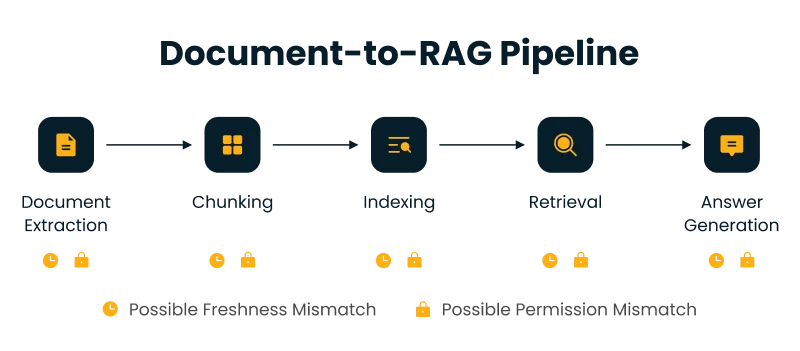
The practical objective is to keep four states aligned: what the business currently approves, what the source repository contains, what the retrieval system can access, and what an employee may legitimately see. Drift between those states is where apparently credible answers become operationally risky.
Assign Clear Ownership to Every Knowledge Source
A shared repository often has editors, administrators, and contributors, yet nobody accountable for deciding which instruction is authoritative. GenAI content governance begins by separating technical custody from business authority.
The source owner decides what the material means, when it takes effect, and when it should retire, supported by metadata management practices that clarify data ownership and definitions. A platform team manages connectors, indexing, and service availability. A security owner defines information classifications and access requirements. These decisions should meet in a source register before ingestion.
| Required field | Governance purpose |
| Business owner | Approves content, resolves conflicts, and accepts review responsibility |
| Authoritative location | Identifies the controlled original rather than a copied attachment |
| Audience and classification | Defines who may retrieve the material and for what use |
| Effective date and review due date | Distinguishes current instructions from old or unverified ones |
| Superseded-by reference | Links retired material to the replacement source |
AI knowledge base management becomes easier when these fields travel with each document or can be reliably resolved through the source system, making data engineering services important for metadata management and data integration. Without ownership metadata, a flagged answer often ends up with engineering even when the underlying problem is an outdated business procedure.
An important admission rule follows: material without a responsible owner should enter a review queue, not automatically become authoritative evidence. GenAI knowledge governance requires a defensible reason for trusting a source before the retrieval service distributes its content.
Set Freshness Rules Based on the Consequence of Being Wrong
Source freshness in RAG involves two separate clocks. The business clock measures when the underlying instruction becomes effective or expires. The technical clock measures when its latest approved version becomes available for retrieval. A connector can run successfully while the system remains behind the business clock.
A universal nightly refresh is a weak policy. Rapidly changing support procedures may require event-triggered updates. Stable reference manuals can tolerate scheduled checks. High-impact policies need a way to withdraw or block an obsolete version promptly, even before its replacement has finished indexing.
Define three controls for each source category:
- Freshness threshold: The maximum acceptable delay between an approved source change and its availability in retrieval.
- Expiry behavior: Whether an overdue document is suppressed, returned with a warning, or sent for review.
- Failure response: Who investigates failed synchronization, missing updates, or content that cannot be verified.
Effective dates matter as much as modification timestamps. A policy uploaded today might take effect next month. Treating the newest file as automatically applicable can produce an answer that is technically current and operationally premature.
AI knowledge base management should track content age and ingestion delay. Amazon Bedrock documentation, for example, distinguishes source additions, edits, and deletions during incremental synchronization. Successful synchronization is still a technical event; business validity needs separate checks.
Enforce Source Permissions Throughout Retrieval
An assistant should not disclose an HR investigation simply because a similar question appears in a user’s search. Secure knowledge retrieval depends on carrying source access rules into the retrieval process and applying them to the identity making the request.
One failure pattern is a connector with broad reading rights feeding a shared index. If queries run only under that connector’s privileges, content that was restricted in the original repository may surface to a wider audience. OWASP’s 2025 guidance on vector and embedding weaknesses identifies unauthorized access and cross-context leakage among the risks in RAG systems.
Permission-aware designs need to account for document-level restrictions, group membership, sensitive classifications, and changes after indexing, supported by cybersecurity services that protect enterprise information. If a person’s access is revoked, previously indexed passages should no longer be retrievable by that person. The retrieval layer must have current authorization information or verify permissions against an authoritative service when needed.
Application-level filtering requires trusted identities, accurate permission mapping, and consistent enforcement. Some managed search services offer native query-time access checks; feature maturity and source support differ, so implementation details require validation.
GenAI knowledge governance also covers what happens after retrieval. Logs, cached answers, conversation history, and evaluation datasets may retain sensitive excerpts. Their retention, access, and deletion rules deserve the same attention as the index.
Keep Document Versions, Deletions, and Conflicts Under Control
A source can be accurate in isolation and misleading alongside another version. Consider two troubleshooting articles describing different firmware releases. If the retrieval engine combines passages without their version context, the generated procedure may contain steps that are individually valid but incompatible together.
The remedy is to preserve the relationships between documents, releases, and effective periods. Each indexed passage should be traceable to a stable source identifier, an identifiable revision, and applicable product or policy context. Chunking must not sever qualifying statements such as region, eligibility, or effective date from the instructions they govern.
AI knowledge base management also needs an explicit removal process. Deleting a file from a repository does not necessarily clear every index, cache, backup, or stored excerpt immediately. Retirement events should initiate index removal or suppression, followed by verification that old material is excluded from new answers.
When current sources disagree, the assistant should not silently blend them. Define precedence rules, such as approved policy over informal notes, and route unresolved conflicts to an accountable reviewer. GenAI knowledge governance becomes tangible when a disputed source can be quarantined without disabling the entire assistant.
Make AI Answers Traceable to the Evidence Used
AI answer traceability begins with source citations, but a link alone is insufficient. A document may have changed since the answer was generated. The cited page might also contain several passages, only one of which supports the claim.
A useful evidence record connects the generated response to the retrieved passage IDs, source revisions, retrieval time, applied permission policy, and relevant model or prompt configuration. These investigation records need not appear in employee-facing answers.
The distinction matters when a customer challenges a response weeks later. A live citation points to what the document says now. A controlled evidence record can establish what content was retrieved when the answer was produced, subject to privacy and retention requirements.
AI knowledge base management should preserve enough lineage to distinguish retrieval failure from generation failure. Did the search find the wrong document? Was the retrieved document outdated? Or did the model misstate a correct passage? Each defect needs a different response.
Use Review Cycles That Respond to Real Changes
Calendar reviews miss urgent changes between checkpoints. GenAI knowledge governance works better when review is triggered by both time and events: policy approval, product release, access revocation, incident closure, or a repeated answer complaint.
Reviewers need more than a request to confirm that a document still looks correct. They should inspect the answer patterns the material supports. A policy can remain accurate while a retrieved excerpt drops the exception that determines whether it applies.
For AI answer traceability, maintain a small test set of representative business questions linked to expected source revisions. After a meaningful content or retrieval change, rerun those questions and inspect the evidence. A changed answer may be justified; an unchanged answer after a critical source revision deserves investigation.
Record each review as approved, corrected, retired, or escalated. AI knowledge base management then has a closed process: detect a problem, assign it, fix the underlying source or retrieval behavior, and verify the resulting answer.
Measure the Health of Knowledge, Not Just Chatbot Usage
Conversation volume says little about answer reliability. Measure whether controls work where business consequences are highest.
| Signal | What it reveals |
| Overdue critical-source reviews | Material that lacks recent business confirmation |
| Change-to-index delay | How long approved updates take to reach retrieval |
| Post-revocation access test failures | Cases where restricted documents remain retrievable |
| Answers lacking valid evidence | Where retrieval or citation checks require investigation |
| Repeat corrections by source | Documents creating persistent answer defects |
These indicators make source freshness in RAG measurable without pretending that one universal freshness target fits all content. They also expose whether secure knowledge retrieval holds up after access changes, which is more revealing than testing permissions only at launch.
The priority should be failure severity rather than a polished average. An expired safety instruction can outweigh many correct low-impact answers.
Establish an Operating Rhythm for Enterprise Knowledge Governance
An enterprise knowledge base for GenAI needs a named workflow for accepting, changing, restricting, and retiring content, aligned with governance risk compliance services and defined accountability. Start with one domain and identifiable source owners.
Begin by inventorying high-value documents, identifying duplicate authorities, and attaching the minimum ownership and validity metadata. Test ingestion delay, permission changes, deletions, and version conflicts against realistic questions. Make the results visible to both content owners and the technical team.
GenAI knowledge governance also needs clear escalation boundaries, especially when operationalizing agentic AI across enterprise workflows that depend on trusted knowledge and accountable decisions. Business owners decide what guidance is valid; security teams decide who may access it; engineers investigate retrieval and generation failures. Shared reporting keeps accountability visible.
Build a Knowledge Review Process That Keeps Answers Defensible
The most credible enterprise assistant is one that can establish why an answer was permitted, which approved material supported it, and whether that material was valid at the time. This requires discipline after implementation.
Prioritize source ownership, source-to-index change monitoring, permission-aware retrieval, revision control, and evidence retention according to business risk. GenAI content governance provides the publication discipline; AI knowledge base management keeps the working system aligned with those decisions.
The result is a knowledge service that can update an answer, withdraw an unsafe one, and explain its evidence when challenged. Enterprise AI teams should build their knowledge review processes around these standards.
Author


Yogita Jain
Content Lead
Yogita Jain leads with storytelling and Insightful content that connects with the audiences. She’s the voice behind the brand’s digital presence, translating complex tech like cloud modernization and enterprise AI into narratives that spark interest and drive action. With a diverse of experience across IT and digital transformation, Yogita blends strategic thinking with editorial craft, shaping content that’s sharp, relevant, and grounded in real business outcomes. At Cygnet, she’s not just building content pipelines; she’s building conversations that matter to clients, partners, and decision-makers alike.