


































A resource can carry the correct tags and still have no accountable owner. The cost center may have closed, the application may have changed hands, or the environment label may describe a workload that was moved into production months ago. All three cases can pass a basic check for the presence of tags while leaving decisions about spending, access, and recovery unresolved.
That gap deserves more attention than tag coverage alone. AWS tagging governance works when metadata stays connected to the decisions it is supposed to support, making AWS consulting services relevant for establishing consistent tagging standards and accountability. A label should help determine who investigates a cost increase, who approves an exception, and which controls apply to a workload. If nobody maintains that relationship, reporting becomes tidy while operational uncertainty grows.
Why AWS Tagging Matters Beyond Resource Organization
Tags are often introduced as a way to group cloud resources. Their more demanding role begins when different functions rely on the same labels for different decisions. Finance needs reliable allocation. Security needs a defensible classification. Operations needs a reachable service owner. Audit teams need evidence that the information was reviewed, not simply entered during provisioning.
The central question for a cloud tagging strategy is therefore straightforward: what action would change if this tag were wrong? If the answer is unclear, the tag may be decorative. If the answer affects a bill, an access rule, or an incident response, the tag requires an owner, an approved value, and a review trigger.
A useful starting point is to separate administrative identifiers from operational classifications. Project names may stay fixed while environments and ownership change. Overly rigid labels become stale; unrestricted edits weaken cost and security reports.
Define a Tagging Standard Around Decisions, Not Departments
An effective tag catalogue begins with a small mandatory set and a clear explanation of each field. The same key should mean the same thing across accounts, with defined exceptions where services cannot support the intended tagging method. AWS tagging governance becomes easier to operate when values are drawn from approved systems rather than improvised during deployment.
| Tag key | Example value | Decision supported | Source of truth |
| Application | payments-api | Service grouping and impact review | Application inventory |
| OwnerTeam | platform-ops | Incident and change routing | Team ownership register |
| CostCenter | CC-410 | Financial allocation | Finance directory |
| Environment | Production | Operational control selection | Deployment inventory |
| DataClass | Confidential | Security review and handling requirements | Approved data classification |
| Lifecycle | Active | Retention and retirement review | Service lifecycle record |
AWS generally permits 50 user-defined tags per resource. Keep mandatory keys tied to specific decisions. The tag dictionary should also specify capitalization, permitted values, accountable approvers, inheritance rules, and what happens when a source record changes.
One overlooked part of AWS tagging best practices is the distinction between a required value and a trustworthy value, a challenge also addressed through ongoing AWS account hygiene. OwnerTeam=platform-ops may satisfy a validation rule even after responsibility moves elsewhere. The metadata is present, but its meaning has expired. A cloud tagging strategy needs a maintenance process for that situation, not another mandatory field.
Establish Cloud Resource Ownership That Survives Team Changes
Resource ownership should identify the team accountable for an application’s operation, along with the party responsible for its cost where those duties differ. An engineer may leave a project, while a deployment pipeline can serve several teams. Neither reliably identifies the accountable owner.
Ownership also needs to cover shared services. A network component, observability service, or centrally managed database may support several applications. Assigning all such resources to the nearest application produces misleading accountability. A better model records the platform team as the operational owner and uses a separate allocation method for shared expense.
AWS tagging governance should make changes of responsibility visible, an important part of AWS workload lifecycle governance after applications go live. When an application moves to another team, the handover should include a tag update, service inventory update, access review, and confirmation of cost responsibility. Otherwise, incident tickets reach former teams despite clean compliance reports.
This is where a cloud tagging strategy intersects with IT service management. Tags help route decisions only when the referenced owner record has a working escalation path. A value such as team-a is insufficient if that team has no current contact or service responsibility.
Make Cost Allocation Tags Useful for Finance
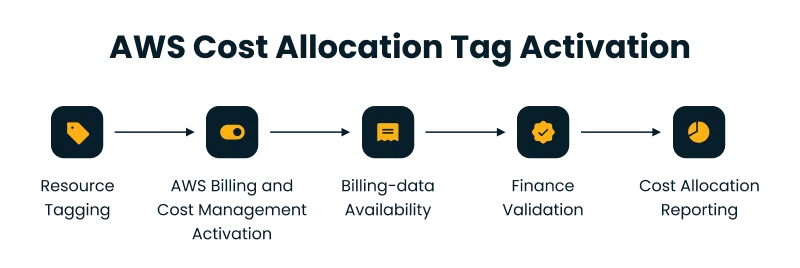
The cost allocation tags AWS uses in billing reports need to be activated in Billing and Cost Management. Applying tags to resources is only part of the process. AWS notes that new user-defined tag keys can take up to 24 hours to appear for activation, with additional time for activation itself. Cost reporting therefore requires an activation check and a deliberate verification step.
For finance, the test of a cloud tagging strategy is whether labels reflect the way costs are assigned, reinforcing the importance of cloud cost optimization strategies for improving spending visibility and financial accountability. Consider two production applications supported by one logging service. The logging bill cannot be attributed accurately by giving the service an arbitrary application tag. Shared costs need an allocation rule that finance accepts, while the service remains operationally owned by the platform team.
The cost allocation tags AWS supports also cannot explain every charge through resource labels alone. Some charges are untagged, unsupported, or shared. AWS Cost Categories can group spending using tags and other dimensions, while split charge rules provide a separate allocation view for shared expenses. The split charge results appear in Cost Categories details and do not change Cost Explorer or Cost and Usage Reports. These rules need documented assumptions and periodic reconciliation with the billing total.
A practical AWS tagging governance review should ask which costs remain unallocated, which labels refer to closed budgets, and whether a resource’s billed owner matches the current financial owner as part of ongoing cloud optimization services. That exposes errors hidden by tag coverage metrics.
Use Environment Classification Without Weakening Security Controls
A production label carries operational consequences. It may influence approval workflows, incident priority, maintenance restrictions, or access decisions. Security teams therefore need to know whether Environment=production is an approved classification or a value entered by whoever provisioned the resource.
A cloud tagging strategy should distinguish descriptive labels from security-sensitive labels. An application owner can maintain a service description. Changes to a classification used in authorization should pass tighter controls, because altering the label may change which policy applies.
AWS Identity and Access Management supports attribute-based access control through conditions such as aws:ResourceTag, aws:RequestTag, and aws:TagKeys, where supported by the relevant service. Tag editing rights then become part of the security design.
Cloud governance metadata can help identify resources that warrant deeper checks, but a DataClass=confidential tag does not verify encryption, network isolation, or retention settings. Those properties require their own configuration evidence. Confusing classification with proof of protection is a dangerous shortcut.
For compliance reporting, the stronger question is whether classifications agree with the controls actually deployed. Mismatches should trigger investigation rather than automatic relabeling to make a dashboard appear compliant.
Enforce AWS Tags During Provisioning and After Deployment
An AWS tag policy in AWS Organizations can standardize key capitalization and permitted values for supported resource types. Basic compliance enforcement can reject operations that use noncompliant values. It does not, by itself, block a resource created without any tags. That distinction matters when a policy is described internally as mandatory tagging.
AWS also supports required-tag checks for infrastructure-as-code deployments, where cloud engineering services can help integrate tagging validation into provisioning workflows. For example, the AWS-managed CloudFormation tagging compliance hook can warn about missing required keys or fail a deployment, when configured for the relevant accounts and Regions. Other IaC workflows have their own integration requirements. Service control policies can add tag-on-create guardrails for supported actions, while AWS Config’s required-tags rule detects missing tags on supported recorded resources without preventing creation.
A sensible enforcement workflow follows the path that resources actually take into the environment:
- Validate templates early
Check mandatory keys and approved values before deployment, including defaults supplied by common modules. - Apply preventive controls selectively
Test policies against automated provisioning and services that create dependent resources, then expand coverage. - Detect gaps after creation
Use AWS Config and complementary inventory checks for services and resource types that require different methods. - Route exceptions for review
Record an owner, reason, expiry date, and remediation action rather than granting permanent exemptions.
AWS tagging best practices are most useful when enforcement is tested against real provisioning paths. An overly strict rule can interrupt automated resource creation. A permissive rule may allow missing ownership data to become permanent. AWS tagging governance needs both controlled prevention and follow-up remediation.
Report on Tag Quality, Drift, and Exceptions
An AWS tag policy compliance report should be read with its coverage limitations in mind. AWS notes that resources that have never been tagged do not appear as noncompliant in basic tag-policy results. Likewise, the Resource Groups Tagging API’s GetResources operation does not return resources that have never been tagged. AWS Resource Explorer can help find untagged resources using tag:none, subject to supported resource coverage.
Cloud governance metadata needs separate findings for missing keys, invalid values, outdated owners, conflicting classifications, and approved exceptions. Each calls for a different response.
Useful measures include the share of in-scope production resources with a verified owner, costs awaiting allocation, overdue exceptions, and the time taken to correct classifications after service changes. These measures say more about operational reliability than the raw count of populated fields.
A cloud tagging strategy should establish review triggers around application handovers, budget changes, production releases, and service retirement. Routine reconciliation with application and finance records is usually more valuable than asking teams to reapprove every label without context.
Make Tagging Governance Part of Everyday Cloud Operations
Tagging quality deteriorates where provisioning, billing, security, and service management follow different records. The remedy is a clear operating agreement: platform teams maintain technical rules, finance owns allocation definitions, security owns sensitive classifications, and application teams confirm operational accountability. Exceptions need named reviewers and deadlines.
The success of AWS tagging governance is demonstrated when a cost anomaly reaches the correct budget owner, a security review finds the right workload classification, and an incident team can locate the accountable service team without searching several systems. Cloud resource ownership remains dependable because business changes update both records and resource labels.
A sustainable cloud tagging strategy starts with the decisions that require reliable metadata, tests enforcement against actual deployment methods, and checks whether existing tags remain accurate after ownership and workload changes. The priority is to make fewer labels carry clearer responsibilities, with enough evidence to trust them when a decision cannot wait.
Author


Yogita Jain
Content Lead
Yogita Jain leads with storytelling and Insightful content that connects with the audiences. She’s the voice behind the brand’s digital presence, translating complex tech like cloud modernization and enterprise AI into narratives that spark interest and drive action. With a diverse of experience across IT and digital transformation, Yogita blends strategic thinking with editorial craft, shaping content that’s sharp, relevant, and grounded in real business outcomes. At Cygnet, she’s not just building content pipelines; she’s building conversations that matter to clients, partners, and decision-makers alike.