


































Most cloud teams reach a familiar crossroads when formalizing their AWS foundation. After the initial excitement fades, they sit around a table and ask a simple-sounding question:
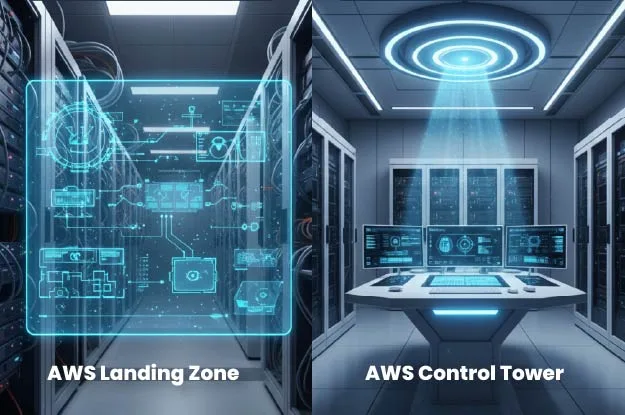
“Should we go with AWS Landing Zone or adopt AWS Control Tower?”
That question is about far more than tooling choices. It reflects how your organization wants to handle governance, automation, accountability, and long-term cloud operations. If you view it as a basic checklist comparison, you miss the real decision. This guide looks at the practical factors that shape the right answer for your environment rather than the generic summaries often shared online.
The flow for this evaluation is straightforward:
Assess organizational needs → Compare capabilities → Evaluate Landing Zone → Evaluate Control Tower → Map use cases → Choose deployment model
Step 1: Start by examining your organization’s needs
Before exploring features, get clear on how your team works — a principle also emphasized in building an effective cloud strategy roadmap. The quality of this step determines whether the final decision fits your structure or becomes a constraint you fight later.
Ask questions like:
- How many application teams will rely on the initial setup?
- Do you have a strong Cloud Center for Excellence or platform engineering capability?
- Are you under heavy regulatory oversight or periodic audits?
- Does your culture favor infrastructure as code as the default for all changes?
- How quickly do you need new accounts and environments?
- Will governance be owned centrally, or distributed across business units with shared guidelines?
The answers reveal whether you need a system that allows deep customization or one that provides managed guardrails with less internal overhead.
Step 2: Compare capabilities through a governance lens
A common mistake is comparing AWS Landing Zone and AWS Control Tower feature by feature. A better approach is to view them through a governance lens, especially for teams planning broader cloud modernization initiatives across business units. This gives a realistic picture of the ongoing work your teams will carry out.
Use this AWS governance comparison framework:
Guardrail ownership
Consider whether you prefer custom guardrails created by your platform team or managed guardrails maintained by AWS.
Change lifecycle
With custom guardrails, every change passes through code review and deployment pipelines. With AWS managed guardrails, AWS handles updates, and you validate impact.
Operational responsibility
One option places orchestration and automation fully under your team’s control. The other provides a ready control plane with less maintenance overhead.
Extensibility
Some organizations value complete freedom to alter every component. Others prefer a baseline that is stable, predictable, and easy to maintain.
When viewed through these dimensions, the differences between the AWS Landing Zone and the AWS Control Tower become clearer and more practical.
Step 3: Evaluate AWS Landing Zone
Many organizations still use AWS Landing Zone as a configurable foundation for multi account environments. It offers flexibility and granular control, which appeals to teams with strong engineering maturity.
Strengths of AWS Landing Zone
- Precise control over account structure and OU hierarchy
- Ability to define naming standards, tagging policies, and network patterns
- Integration with your CI/CD workflows and existing security tooling
- Freedom to adapt the structure based on enterprise or compliance needs
This approach works well when your cloud platform team wants to architect and maintain the environment through code. It gives you independence and room to create a tailored setup.
Understanding Landing Zone limitations
You also need to be realistic about Landing Zone limitations:
- Maintenance requires steady ownership and documentation
- Customizations can become complex if architecture changes frequently
- Introducing new AWS governance features often needs manual updates
- Teams without experienced platform engineers may struggle to keep it healthy
If you accept these Landing Zone limitations, the model offers high flexibility and deep integration with your existing processes. If not, you may feel like you are maintaining a system that demands more work than it returns.
Step 4: Evaluate AWS Control Tower
AWS Control Tower is the managed, opinionated successor that simplifies multi account governance, making it a strong choice for enterprises scaling their Amazon Web Services foundation. While it does not offer the same level of raw freedom as AWS Landing Zone, it brings consistency and reduced operational complexity.
Strengths of AWS Control Tower
- Out-of-the-box setup aligned with AWS best practices
- Prebuilt guardrails that are reviewed, updated, and maintained by AWS
- Quick account provisioning without building custom pipelines
- Centralized visibility for governance, compliance, and configuration
- Clear lifecycle management for future AWS updates
For many organizations, this reduces overhead and reduces the risk of technical drift. Control Tower’s structure also encourages cleaner boundaries and simpler onboarding of new teams.
Practical notes on adoption
Many teams want to know how to set up Control Tower. The typical flow includes:
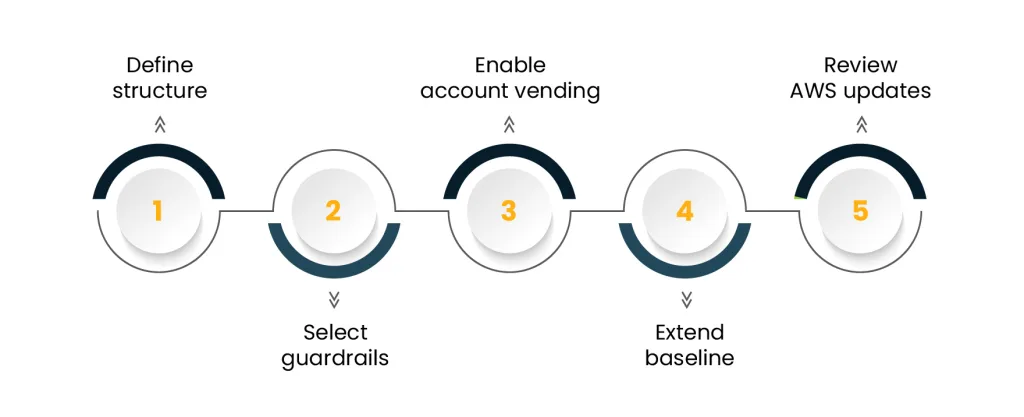
- Defining your organizational structure and naming conventions
- Selecting mandatory and optional guardrails
- Enabling account vending for new workloads
- Extending the baseline using AWS services like IAM Identity Center, Config, CloudTrail, Service Catalog, or custom pipelines
- Periodically reviewing AWS updates for new controls or enhancements
The process is structured, predictable, and easy for teams that prefer managed governance — a strong complement to specialized cloud engineering services.
Step 5: Map use cases to the right option
At this stage, it becomes easier to answer the question many teams ask early on:
“Landing Zone or Control Tower which is better?”
The honest answer is that it depends on the use case and the culture of your teams.
When does AWS Landing Zone fit better?
- You need deep customization across account patterns, connectivity, integrations, or compliance controls
- You have a platform engineering team comfortable with IaC and automation
- Your industry requires specific security implementations that differ from AWS defaults
- You want a foundation that grows with internal practices rather than predefined guardrails
When does the AWS Control Tower fit better?
- You want a quick, reliable, repeatable foundation managed directly by AWS
- Your team does not want to own the full maintenance burden
- Governance updates should arrive through AWS rather than custom engineering
- You prefer simplicity, visibility, and predictable operational effort
- You want consistent account creation without designing a framework from scratch
Both models work. The decision depends on how much structure you want to define yourself and how much you want AWS to handle.
Step 6: Choose a deployment model that aligns with your long-term plan
Your final choice should reflect how your cloud environment will grow, not just how you operate today.
Use this decision path:
- If you need customization and strict control → pick AWS Landing Zone
- If you want managed governance and steady updates → pick AWS Control Tower
- If you already use Landing Zone but want consistency → consider migrating to Control Tower
- If you expect heavy automation across multiple BUs → Landing Zone may still offer benefits
- If the priority is ease of onboarding new teams → Control Tower offers a simpler route
There is no single right answer. The right answer is the one that matches your operational maturity, team skill sets, and governance model.
Final thoughts
Both AWS Landing Zone and AWS Control Tower solve the same broad challenge: creating a secure, governed, multi account environment. What separates them is the balance between customization and managed governance, between ownership and convenience, between engineering depth and operational ease.
When you understand those tradeoffs, you can confidently choose the model that fits your organization instead of following generic advice. And in the end, that clarity matters far more than picking up the trendier option.
Author


Yogita Jain
Content Lead
Yogita Jain leads with storytelling and Insightful content that connects with the audiences. She’s the voice behind the brand’s digital presence, translating complex tech like cloud modernization and enterprise AI into narratives that spark interest and drive action. With a diverse of experience across IT and digital transformation, Yogita blends strategic thinking with editorial craft, shaping content that’s sharp, relevant, and grounded in real business outcomes. At Cygnet, she’s not just building content pipelines; she’s building conversations that matter to clients, partners, and decision-makers alike.