


































A growing cloud environment has a way of exposing every weak decision quietly made in the past. The naming standard nobody followed. The unused instances left running over a weekend. The access rule granted “just for now” and never reviewed again. The tagging policy written in a document but never enforced. None of these choices looks serious in isolation. Together, they become cost leakage, audit pressure, operational confusion, and security risk.
This is where enterprise cloud governance becomes more than a compliance exercise. It becomes the operating discipline behind cloud growth.
The difficult part is that governance has to do two things that often pull against each other. It has to protect the business, and it has to let teams move. Too much control creates queues, exceptions, and shadow IT. Too little control creates waste, drift, and risk. A good cloud governance strategy sits between those extremes. It gives teams enough freedom to build, while making sure the enterprise does not lose visibility or control as cloud usage expands.
That is why scalable cloud governance models matter so much for large enterprises. They are not just about writing rules. They are about deciding how cloud decisions are made, where accountability sits, how policies are enforced, and how governance keeps pace with new teams, new workloads, new regulations, and new business priorities.
For C-suite leaders, technology heads, cloud platform teams, and compliance owners, the question is no longer whether governance is needed. The real question is whether the current model can still hold when cloud adoption grows across business units, geographies, applications, and data environments.
Governance basics that matter before scale
Before an enterprise can scale governance, it needs to define what governance actually controls. This sounds obvious, but many organizations begin with a narrow view. They treat governance as security approval, budget review, or compliance reporting. Those are only parts of the picture.
A practical answer to what is cloud governance model enterprise is simple: it is the decision and control structure that guides how cloud resources are requested, deployed, secured, monitored, funded, and retired across an organization.
That definition matters because cloud is not a single technology layer. It touches infrastructure, applications, data, identity, security, procurement, finance, legal, and operations. If governance only sits with one function, it leaves gaps elsewhere.
A mature enterprise cloud governance framework usually covers five major control areas.
| Governance Area | What It Controls | Why It Matters at Enterprise Scale |
| Identity and access | User roles, privileged access, service accounts, permission boundaries | Prevents excessive access and reduces the risk of misuse |
| Cost and financial control | Budgets, cost allocation, chargeback, showback, tagging, idle resource tracking | Keeps cloud spend visible and tied to business ownership |
| Security and compliance | Encryption, logging, network controls, vulnerability checks, data residency | Supports audit readiness and lowers exposure |
| Operations and reliability | Monitoring, incident response, backup rules, recovery targets, environment standards | Improves stability across workloads |
| Resource lifecycle | Provisioning, naming, tagging, retirement, policy exceptions | Reduces sprawl and keeps environments manageable |
The strongest enterprise cloud governance programs do not treat these areas as separate checklists. They connect them. A tagging rule supports cost allocation. A logging rule supports security investigation. An identity rule supports audit evidence. A provisioning standard supports reliability. The same governance decision often affects five downstream outcomes.
This is the first place many enterprises get governance wrong. They write policies by department instead of designing controls around how cloud actually operates. Finance asks for tags. Security asks for encryption. Operations asks for monitoring. Application teams hear three different rulebooks and start looking for shortcuts.
Better governance starts with one shared control model.
Why governance breaks when cloud adoption grows?
Small cloud environments can survive on informal behavior. A few experienced engineers know what to do. A security architect reviews major deployments. A finance person watches the monthly bill. This works for a while because the number of decisions is still manageable.
Growth changes that.
As more teams adopt cloud, the number of daily decisions rises sharply. New accounts get created. New workloads move in. Developers test new services. Data teams spin up storage. Business units ask for faster delivery. Suddenly, the old model depends on too many manual checks and too much personal memory.
This is when cloud governance models start to show their limits.
Here are the most common breaking points.
| Growth Pressure | What Usually Happens | Business Impact |
| More teams using cloud | Teams create their own standards | Inconsistent controls and hard-to-audit environments |
| More accounts and subscriptions | Visibility becomes fragmented | Unknown cost, unknown risk, slow reporting |
| More cloud services | Teams adopt services before controls exist | Policy gaps and configuration drift |
| More compliance needs | Evidence collection stays manual | Audit cycles become painful |
| More cost ownership | Spend is not mapped to teams or products | Finance cannot explain cloud value clearly |
| More deployment velocity | Manual approvals become bottlenecks | Teams bypass process or delay releases |
I have seen one pattern repeat often: enterprises think their governance problem is a tooling problem, when it is actually an ownership problem. Tools can enforce policies, but they cannot decide who owns risk, who approves exceptions, who pays for waste, or who updates controls when the cloud estate changes.
A scaling enterprise needs governance that assigns accountability clearly. Central teams should not become the approval desk for every decision. Application teams should not be left to interpret compliance rules on their own. Platform engineering, security, finance, and delivery teams need a shared operating model.
That is where cloud governance models become a serious business decision, not a technical side project.
Choosing between centralized and federated governance
The debate around centralized vs federated cloud governance is not academic. It decides how fast teams can work, how much control the enterprise keeps, and how well governance can scale without creating friction.
A centralized model places most governance authority in one core team. This team defines policies, approves exceptions, controls provisioning standards, and often manages the shared cloud platform.
A federated model spreads governance responsibility. A central team sets enterprise guardrails, while business units, product teams, or platform squads manage certain decisions within those guardrails.
Most large enterprises need a hybrid model. Pure centralization slows delivery. Pure federation creates inconsistency. The right answer depends on cloud maturity, regulatory pressure, team capability, and business risk.
| Decision Area | Better Centralized | Better Federated |
| Identity baseline | Yes | No |
| Encryption standards | Yes | No |
| Approved regions | Yes | Sometimes |
| Application architecture | No | Yes |
| Cost optimization actions | Shared | Yes |
| Tagging standards | Yes | Shared |
| Incident response ownership | Shared | Shared |
| Tool selection for business workloads | Sometimes | Yes |
| Compliance evidence model | Yes | No |
| Environment-level tuning | No | Yes |
The decision is not about control for its own sake. It is about deciding which choices should never vary and which choices can vary safely.
A useful rule is this: centralize what protects the enterprise, federate what helps teams deliver responsibly.
For example, identity boundaries, encryption rules, network segmentation, logging requirements, and approved deployment regions should usually sit at the center. These controls affect enterprise risk. Individual teams should not redefine them for every workload.
On the other hand, application teams should have room to choose workload patterns, scaling settings, deployment schedules, and service configurations, provided they operate inside approved guardrails.
This is the practical middle ground in centralized vs federated cloud governance. It gives the enterprise a consistent risk posture without forcing every cloud decision through one team.
A working model for enterprise governance decisions
A clear decision model prevents governance from becoming personal opinion. Teams should know where authority sits before a request is raised.
Here is a simple model that works well for growing enterprises.
| Governance Decision | Central Cloud Team | Security and Risk | Application Team | Finance |
| Account structure | Owns | Reviews | Uses | Informed |
| Identity baseline | Owns | Owns with cloud team | Follows | Informed |
| Budget allocation | Supports | Informed | Owns consumption | Owns |
| Tagging policy | Owns | Reviews | Applies | Uses |
| Workload architecture | Advises | Reviews high-risk cases | Owns | Informed |
| Compliance evidence | Supports | Owns | Provides workload inputs | Informed |
| Exception handling | Coordinates | Approves risk exceptions | Requests | Reviews cost impact |
| Cost optimization | Provides tooling | Informed | Owns action | Tracks |
This kind of model does two things. It reduces ambiguity, and it lowers delay. When teams know who decides what, they stop sending every question to the same central mailbox.
It also makes governance easier to audit. Auditors do not only ask whether policies exist. They ask whether policies are enforced, whether exceptions are documented, and whether decision rights are clear.
A strong cloud governance strategy should make those answers easy to prove.
Policy automation turns governance into daily behavior
Manual governance does not scale. It depends on people remembering rules, reviewing tickets, and catching mistakes after they happen. That may work in a small environment. It fails when hundreds of changes move through cloud accounts every week.
This is where cloud policy automation tools become essential. They help enforce rules during provisioning, deployment, monitoring, and remediation.
The point is not to replace judgment. The point is to remove avoidable manual work and reduce inconsistent enforcement.
A practical automation flow looks like this:
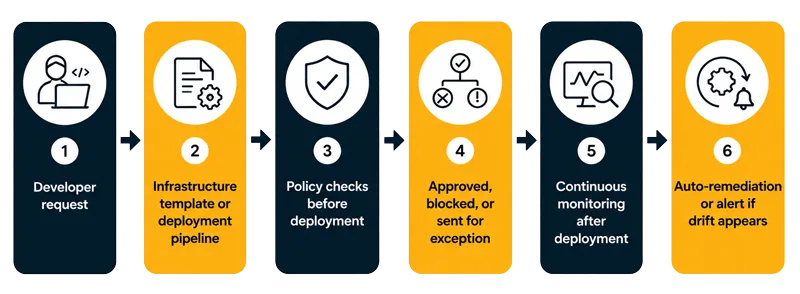
That flow matters because governance has to operate before, during, and after deployment. Pre-deployment checks prevent bad configurations from going live. Runtime checks catch drift. Remediation workflows reduce the time between detection and correction.
Automation also changes the tone of governance. Instead of a security team saying “you missed the policy,” the system gives feedback inside the workflow. Developers see what failed, why it failed, and how to fix it.
Typical automation use cases include:
| Automation Use Case | Example Policy | Outcome |
| Tag enforcement | Every production resource must include owner, cost center, environment, and application tags | Cleaner billing and better reporting |
| Region control | Workloads can only run in approved regions | Better compliance and data control |
| Encryption enforcement | Storage and databases must use encryption by default | Lower security risk |
| Public access prevention | Storage buckets cannot be public unless an approved exception exists | Reduced exposure |
| Instance type control | Teams can only use approved compute families | Cost and performance consistency |
| Idle resource detection | Unused resources are flagged or shut down | Lower waste |
| Logging enforcement | Production systems must send logs to approved monitoring destinations | Better investigation and audit readiness |
For BOFU buyers, this is where a governance program becomes measurable. You can track policy compliance rates, exception volume, drift frequency, mean time to remediation, and cloud spend tied to ownership.
That turns governance from a policy conversation into an operating metric.
How to scale governance without creating delivery drag
The biggest fear teams have about governance is delay. They worry that every rule will become another approval step. That fear is valid because many governance programs are designed around control points instead of team flow.
Scalable cloud governance models work differently. They build control into the path teams already use.
This requires three shifts.
First, governance must move into templates, pipelines, and platform services. Teams should not need to read a 40-page policy document before deploying a workload. The approved path should already include the right controls.
Second, exceptions must be managed as data, not informal approval. Every exception should have an owner, reason, expiry date, risk rating, and review cycle. Permanent exceptions are usually signs of broken policy or weak architecture.
Third, governance metrics must be visible to the people who can act on them. A central dashboard helps leadership, but application teams need their own view. They should know which resources are non-compliant, where spend is rising, and which actions are expected.
A scalable enterprise cloud governance framework usually includes the following layers.
| Governance Layer | Purpose | Scaling Requirement |
| Foundation | Account structure, identity, network, landing zones | Standardized and reusable |
| Policy | Security, compliance, cost, operations rules | Written as code where possible |
| Platform | Approved templates, deployment paths, shared services | Easy for teams to consume |
| Automation | Checks, remediation, drift detection | Embedded into workflows |
| Reporting | Dashboards, alerts, compliance views | Role-based and actionable |
| Operating model | Decision rights, exception handling, review cadence | Clear ownership |
The key is not more governance meetings. The key is better governance design.
Where many enterprises lose control
There are a few hidden governance traps that appear late. They are easy to miss because the cloud environment may still look functional from the outside.
Tagging without enforcement
A tagging policy written in a document has little value. Teams forget. Names vary. Required fields stay blank. Once this happens across hundreds or thousands of resources, cost reporting becomes unreliable.
The fix is enforcement at creation time, plus reporting for older resources.
Exceptions without expiry
Some exceptions are valid. A legacy workload may need time before it can meet a new rule. A critical business system may need a temporary architecture pattern.
The problem begins when exceptions never expire. Every exception should have a review date. If it cannot be closed, the policy may need revision or the workload may need a funded remediation plan.
Central teams doing too much
When the central cloud team becomes the owner of every cloud decision, it turns into a bottleneck. Skilled people spend their time approving routine requests instead of improving the platform.
The central team should build paved roads supported by scalable cloud engineering services.
Cost governance treated as finance work only
Finance can report cloud spend, but engineering controls cloud spend daily. Right-sizing, storage lifecycle rules, autoscaling choices, and environment shutdown schedules sit close to delivery teams.
Cost governance works when finance creates visibility and engineering owns action.
Security checks after deployment
Late-stage review creates conflict. Teams have already built the workload, timelines are committed, and policy issues become release blockers.
Security and compliance checks need to appear earlier in design patterns, templates, and CI/CD workflows.
These are not theoretical problems. They are the operational reasons governance programs lose trust.
Best practices for governance that grows with the business
For enterprises moving from cloud adoption to cloud maturity, governance should be treated like a living operating system. It needs ownership, measurement, and continuous refinement.
Here are the practices that hold up.
Build governance around business risk
Not every workload deserves the same control depth. A public customer-facing payment system and an internal test environment should not follow identical review paths.
Classify workloads by sensitivity, business criticality, data type, and regulatory exposure. Then apply control levels based on risk.
Make the approved path the easiest path
If teams must fight the process to do the right thing, they will avoid it. Provide approved templates, reusable modules, standard landing zones, and clear deployment patterns.
Good governance feels simple to teams because complexity has already been handled in the platform.
Use automation before adding process
Before creating another review board, ask whether the control can be automated. Many rules can be checked in code, enforced in policy engines, or monitored continuously.
This is where cloud policy automation tools help reduce friction while improving consistency.
Measure governance performance
Track more than compliance status. Track the signals that show whether governance is working.
| Metric | What It Shows |
| Policy compliance rate | How consistently teams follow required controls |
| Exception volume | Where policies may be too strict or teams need help |
| Drift frequency | How often environments move away from approved state |
| Time to remediate | How quickly issues are fixed |
| Untagged resource percentage | How reliable cost and ownership reporting is |
| Idle resource cost | How much waste exists |
| Access review findings | Whether identity controls are working |
| Deployment failure due to policy | Whether teams need better templates or guidance |
Keep policy language clear
Policy language often becomes too broad. Phrases like “must be secure” or “should follow best practices” do not help teams. Good policies are specific enough to enforce.
Weak rule: Production databases must be protected.
Better rule: Production databases must have encryption enabled, public access disabled, backup enabled, and logs forwarded to the approved monitoring system.
Review governance as cloud usage changes
Cloud services change. Regulations change. Business priorities change. Mergers, new markets, AI adoption, and data expansion can all shift governance needs.
The answer to what is cloud governance model enterprise will also change as the enterprise grows. The model used for 20 workloads may fail at 500. The model used in one region may not satisfy requirements across several countries.
Governance should have a formal review cycle. Quarterly is often practical for most enterprises. Highly regulated environments may need more frequent review for high-risk controls.
A simple maturity model for enterprise leaders
A maturity view helps leaders understand where they are and what should come next.
| Maturity Stage | Common Signs | Main Risk | Next Move |
| Ad hoc | Teams create resources with little central control | Spend and risk are hard to see | Define baseline standards |
| Controlled | Policies exist, but checks are manual | Slow approvals and inconsistent enforcement | Standardize account and tagging models |
| Standardized | Landing zones, templates, and shared services exist | Adoption varies across teams | Improve automation and reporting |
| Automated | Policies are enforced in pipelines and runtime | Exception handling may lag | Build stronger feedback loops |
| Adaptive | Governance adjusts by workload risk and business priority | Requires mature ownership | Refine metrics and operating cadence |
Most enterprises do not jump from ad hoc to adaptive. They move in steps. The important part is to avoid building a governance model that only solves the current stage.
A BOFU buyer should ask vendors and partners one direct question: will this model still work when cloud usage doubles?
If the answer depends on adding more manual reviewers, the model will not scale.
What Cygnet.One brings to cloud governance?
Enterprises often know they need better governance, but they struggle to connect strategy, tooling, and operating ownership. That is where the right partner can shorten the path.
Cygnet.One helps enterprises design governance that fits their cloud maturity, business structure, regulatory needs, and growth plans. The goal is not to add another layer of process. The goal is to create a governance model that teams can actually use.
A practical engagement often includes:
| Focus Area | What Gets Defined |
| Governance assessment | Current gaps across identity, cost, security, compliance, and operations |
| Operating model | Decision rights across central teams, business units, security, finance, and application owners |
| Policy design | Clear rules for access, tagging, regions, encryption, logging, backup, and lifecycle |
| Automation roadmap | Controls that can be enforced through templates, pipelines, and policy engines |
| Cost governance | Ownership mapping, tagging design, budget controls, and waste reduction actions |
| Compliance readiness | Evidence models, audit trails, reporting views, and exception handling |
| Scale roadmap | Phased improvements aligned to business growth |
This matters because governance cannot be copied from a generic reference model. A bank, a manufacturer, a SaaS provider, and a healthcare enterprise may all use cloud at scale, but their risk profiles and operating realities differ. The right enterprise cloud governance approach must reflect those differences through aligned cloud migration services.
Final take
Cloud growth does not become risky all at once. It becomes risky through hundreds of small choices that nobody owns clearly enough. A resource created without tags. A policy exception without review. A workload launched outside approved patterns. A cost spike noticed too late. A compliance control checked only after release.
A strong cloud governance strategy prevents those choices from becoming enterprise-level problems.
The right model gives central teams control over the rules that protect the business. It gives application teams freedom inside clear boundaries. It uses automation to enforce repeatable controls. It gives finance, security, and technology leaders the visibility they need. Most importantly, it grows as the enterprise grows.
That is the real test of governance. Not whether it looks complete on paper. Whether it still works when the cloud estate gets bigger, faster, and more business-critical.
Author


Yogita Jain
Content Lead
Yogita Jain leads with storytelling and Insightful content that connects with the audiences. She’s the voice behind the brand’s digital presence, translating complex tech like cloud modernization and enterprise AI into narratives that spark interest and drive action. With a diverse of experience across IT and digital transformation, Yogita blends strategic thinking with editorial craft, shaping content that’s sharp, relevant, and grounded in real business outcomes. At Cygnet, she’s not just building content pipelines; she’s building conversations that matter to clients, partners, and decision-makers alike.