


































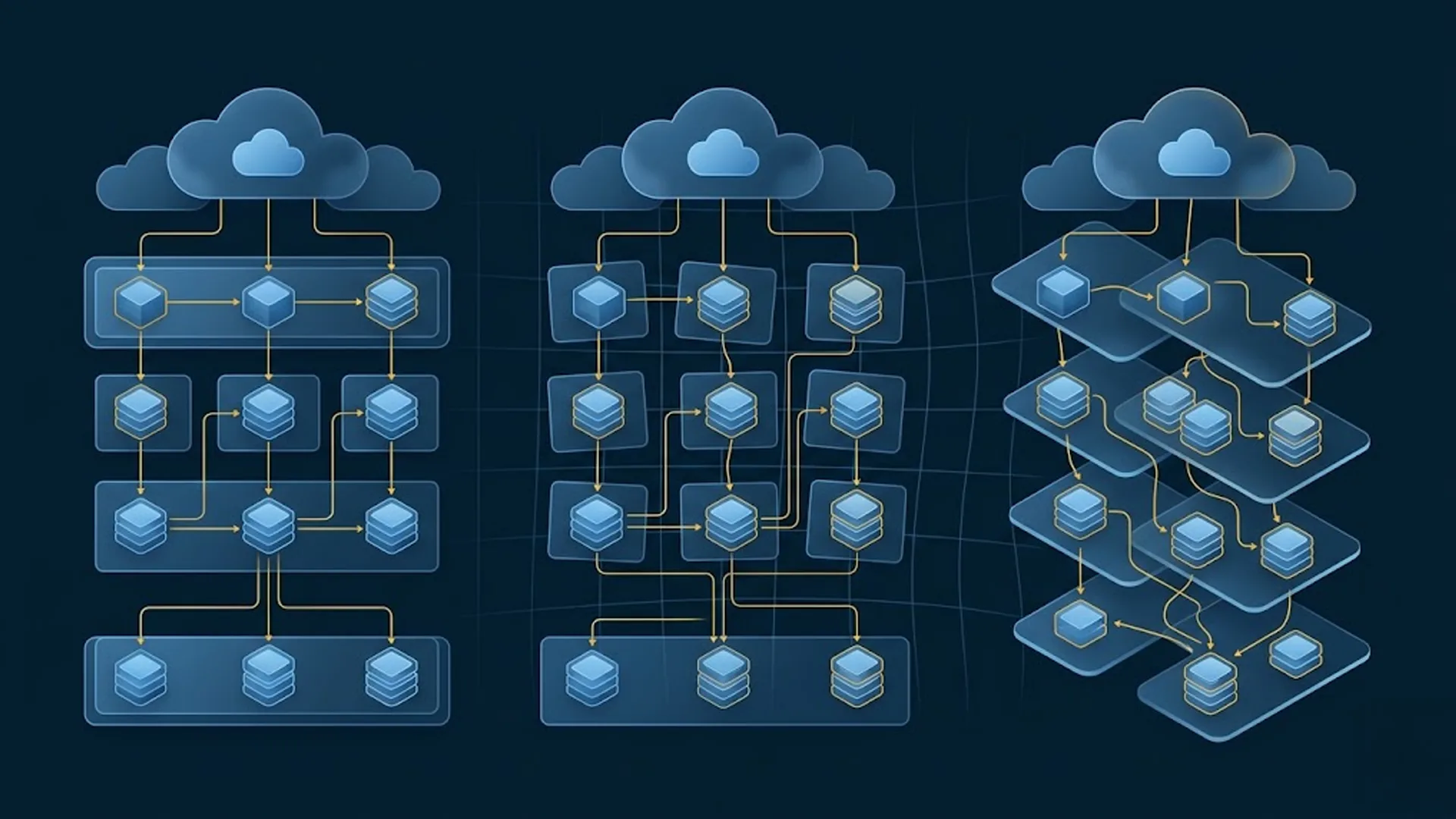
Cloud architecture drift occurs when a cloud environment gradually diverges from its intended design after cloud migration. It produces cost overruns and security gaps that were not present at go-live. It builds through untracked configuration changes and unreviewed resource additions.
Most enterprises do not notice it until the cloud bill climbs unexpectedly, or application performance drops. By then, months of accumulated drift are already driving problems. This blog covers what causes drift and the optimization strategies that bring a drifted environment back to its intended state.
What Is Cloud Architecture Drift and Why Does It Matter?
What is cloud architecture drift in practical terms? It is the gradual divergence between the cloud environment as it was designed at migration and the state it actually operates over time.
The drift does not happen in a single event. It accumulates through hundreds of small, undocumented changes made after go-live. Each individual change seems minor in isolation. The accumulated effect of those changes over months is significant and measurable.
Cloud architecture drift produces four measurable consequences:
- Rising cloud spend with no corresponding growth in business value
- Degraded application performance that is difficult to trace to a specific cause
- Security vulnerabilities created by unreviewed configuration changes
- Compliance gaps that surface during audits and require expensive remediation
Understanding what drift is sets the foundation. Understanding what causes it is what makes it preventable.
Why Do Cloud Systems Degrade Over Time After Migration?
The Post-Migration Operational Gap
Most migration projects end at go-live. The controls that guided the migration do not automatically continue into operations. That includes:
- Governance frameworks
- Architecture review processes
- Change management controls
In the absence of those controls, the cloud environment starts absorbing unreviewed changes almost immediately after the migration team moves on.
This is the core reason why cloud systems degrade over time. The migration created a well-designed environment. The absence of ongoing governance allows that design to erode steadily.
Team and Knowledge Gaps
The migration team that designed the original architecture often transitions off the project after go-live. The operations team inheriting the environment did not design it. They may not fully understand the architectural decisions behind specific configurations.
Changes are made to solve immediate problems. Those changes do not account for their effect on the broader architecture. Over time, the environment reflects the sum of those reactive decisions rather than the original design intent.
Organic Growth Without Governance
New workloads are added to the cloud environment, but an architectural review is not conducted. Resource configurations get modified to fix performance issues without documenting the change. Security groups are opened for temporary access that never closes after the temporary need passes.
None of these changes are malicious. Each one makes sense in the moment it is made. Together, they produce an environment that no longer resembles what was designed and deployed at migration.
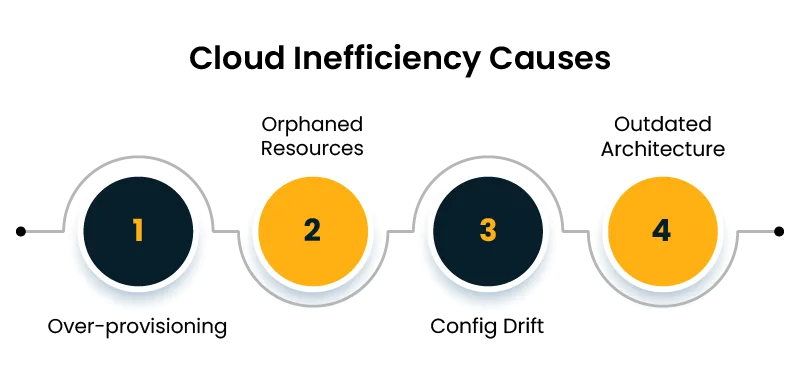
What Are the Main Causes of Cloud Inefficiency After Migration?
Resource Over-Provisioning
Migration teams provision resources conservatively to guarantee performance at go-live. Those provisions are rarely reviewed or right sized after migration is complete. Over-provisioned compute, memory, and storage run at low utilization while billing at full provisioned capacity.
Untagged and Orphaned Resources
Resources created during migration testing or temporary fixes are frequently never decommissioned. Hence, there is no reliable way to identify which resources belong to which workload or team. Orphaned resources accumulate silently and add cost.
Configuration Drift
Individual configuration changes made in the absence of architectural review create inconsistencies across the environment. A security group change applied to one instance does not automatically apply to equivalent instances running the same workload. Over time, instances that should be identical operate with different configurations. That inconsistency produces unpredictable behavior.
Architectural Decisions That No Longer Fit
The architecture designed for migration reflects workload characteristics at that specific point in time. As workloads evolve and traffic patterns change, the original architectural decisions stop being optimal. Cloud inefficiency causes accumulate fastest in environments where architecture reviews do not run on a defined schedule after go-live.
| Cloud Inefficiency Cause | Primary Driver | Financial Impact |
| Resource over-provisioning | Conservative migration sizing never reviewed | 20 to 40% excess compute spend |
| Orphaned resources | No decommission process post-migration | Accumulating idle resource cost |
| Configuration drift | Unreviewed direct console changes | Performance degradation and security cost |
| Outdated architecture | No scheduled architecture review cadence | Compounding inefficiency over time |
These causes produce real operational and financial consequences. They compound the longer drift goes unaddressed.
What Is the Real Business Impact of Cloud Architecture Drift?
Cloud architecture drift crosses into business operations faster than most teams expect.
- Rising cloud costs: Budget overruns attributed to cloud pricing are frequently drift costs in disguise
- Performance degradation: Applications slow down as configurations diverge across identical instances
- Security and compliance exposure: Unreviewed changes create gaps that auditors flag and remediation budgets absorb
The longer the drift goes undetected, the more expensive each consequence becomes to fix.
How Do Enterprise Teams Detect Cloud Architecture Drift?
Infrastructure as Code Comparison
Infrastructure as Code tools like Terraform and AWS CloudFormation define the intended state of the cloud environment. Drift detection tools compare the live environment against the IaC definition and flag every deviation from it. Any resource configuration that does not match the IaC definition is a drift event, regardless of whether the change was intentional.
Cloud Cost Anomaly Detection
Unexpected cost increases in specific services or resource types are early drift indicators. A cost anomaly is often the first visible signal of a configuration change that has not been reviewed. The following tools can flag spending patterns that deviate from historical baselines:
- AWS Cost Anomaly Detection
- Azure Cost Management
- GCP Cost Intelligence
Security Posture Assessment
AWS Security Hub, Azure Security Center, and GCP Security Command Center continuously assess configuration compliance against predefined security baselines. Every deviation from the baseline is a potential drift event. Each one requires review and resolution before it becomes a compliance finding or a security incident.
Detection identifies where drift exists. Fixing it requires a structured set of optimization strategies applied systematically across the environment.
What Post-Migration Optimization Strategies Actually Fix Cloud Architecture Drift?
1. Right-Sizing Audit
A right-sizing audit compares actual resource utilization against provisioned capacity across every compute instance, database, and storage volume in the environment.
Three specific thresholds guide the audit:
- CPU and memory utilization averaged across a 30-day period per instance
- Storage volumes running below 20% utilization flagged for consolidation or decommission
- Database instances running below 25% capacity assessed for downsizing
Post-migration cloud optimization starts here and often requires cloud engineering services
2. Resource Tagging and Governance Framework
Every resource in the cloud environment is tagged with at least 4 attributes. Those attributes are owning a team, associated workload, environment type, and cost center.
Tags get applied retroactively to existing resources. They are automatically enforced for all new resources in the future via policy controls that reject untagged resource creation. When there is no tagging, you cannot identify orphaned resources or allocate costs accurately. Tagging is the foundation that makes every other optimization strategy executable.
3. Infrastructure as Code Enforcement
Every configuration change to the cloud environment runs through Infrastructure as Code pipelines. Direct console changes are the primary mechanism through which configuration drift accumulates. IaC enforcement stops that mechanism entirely.
Any change that cannot be expressed as a code commit, reviewed, and deployed through a pipeline does not get made. The IaC definition becomes the single source of truth for what the environment should look like at any point in time.
4. Architecture Review Cadence
A scheduled architecture review runs quarterly. It covers three specific questions each time it runs:
- Which architectural decisions made at migration no longer fit current workload characteristics?
- Which resources added since the last review were not assessed for architectural fit before deployment?
- Which configuration changes since the last review created deviations from the IaC baseline?
Post-migration optimization strategies cloud teams apply most consistently are the ones built into a calendar. Quarterly reviews catch drift before it produces financial or performance consequences.
5. Automated Drift Detection and Alerting
Drift detection tools run continuously. They alert the architecture team the moment a live configuration deviate from the IaC baseline. The alert includes the specific resource, the specific deviation, and the team member whose change produced it.
Fixing cloud inefficiencies enterprise teams accumulate over months requires retroactive remediation. Preventing a new drift requires real-time detection. Both are necessary — retroactive remediation clears existing debt, and automated detection prevents new debt from accumulating.
6. Cost Governance Policy
A cost governance policy connects financial signals directly to architectural action.
| Threshold | Action Triggered |
| Monthly spend increase above 10% with no workload growth | Architecture review initiated immediately |
| Single service cost increase above 15% month over month | Resource audit on that specific service |
| Orphaned resource with no tag and no activity for 30 days | Automatic decommission workflow triggered |
Cloud architecture drift accelerates in environments where cost anomalies do not trigger architectural responses. This governance policy closes that gap systematically.
The Cost of Letting Drift Go Unaddressed
Cloud architecture drift is a governance failure that follows a predictable pattern and responds to structured intervention.
The detection tools exist and are available across every major cloud platform. The post-migration optimization strategies cloud teams need are defined and proven. What determines whether drift compounds or gets resolved is whether those strategies get applied consistently after go-live.
Cloud inefficiency causes do not resolve themselves. They compound until someone applies a structured remediation framework. The longer that framework is delayed, the more expensive the remediation becomes.
Organizations managing cloud environments where drift has already set in can connect with Cygnet.One for cloud modernization services for a structured assessment and optimization engagement.
FAQs
What causes cloud migration projects to fail?
Insufficient pre-migration assessment, inadequate production-scale testing, and no defined rollback plan are the three primary causes. Without a tested rollback procedure, recovery at cutover gets improvised, and the damage compounds quickly.
What are the challenges faced during cloud migration?
Data integrity verification at scale, managing live data changes during the migration window, and legacy systems without modern APIs are the most consistent ones. Regulated industries carry compliance requirements on top of all three.
How long does cloud architecture drift take to become a serious problem?
Measurable drift typically occurs within 3 to 6 months of go-live in environments without active governance. Financial consequences follow within six to twelve months. Security and compliance consequences take longer to remediate but cost significantly more.
Can cloud architecture drift be fixed without re-migrating workloads?
Yes. Right-sizing audits, IaC enforcement, and automated drift detection all apply to existing environments. Tagging and IaC baseline establishment must come first because every other strategy depends on knowing the intended environment state before measuring deviation from it.
Author


Yogita Jain
Content Lead
Yogita Jain leads with storytelling and Insightful content that connects with the audiences. She’s the voice behind the brand’s digital presence, translating complex tech like cloud modernization and enterprise AI into narratives that spark interest and drive action. With a diverse of experience across IT and digital transformation, Yogita blends strategic thinking with editorial craft, shaping content that’s sharp, relevant, and grounded in real business outcomes. At Cygnet, she’s not just building content pipelines; she’s building conversations that matter to clients, partners, and decision-makers alike.