



































Cloud budgets that look reasonable at project approval look very different three months later. Resources deployed for a sprint never get decommissioned, duplicate environments run across teams without anyone noticing, and untagged workloads accumulate costs that no one can attribute or eliminate.
By the time finance raises a concern, the gap between forecasted and actual cloud spend has already widened past the point of easy correction. The issue is rarely excessive usage on a single workload. It is the diffuse accumulation of small inefficiencies across dozens of teams, environments, and services running without centralized visibility or governance.
Cloud providers make provisioning fast and frictionless by design, and that same frictionlessness is what makes uncontrolled cloud spend a structural challenge for organizations operating at scale. The 2024 Flexera State of the Cloud Report found that enterprises estimate 27% of their cloud spending is waste.
This figure has remained consistent despite cost optimization ranking as the cloud industry’s most cited operational challenge year after year. This guide covers what cloud spend management includes, where governance commonly breaks down, how to build controls that hold at scale, and where FinOps practices fit into long-term cloud financial discipline.
What Is Cloud Spend Management?
Cloud spend management is the practice of monitoring, allocating, optimizing, and governing cloud costs across enterprise environments to improve financial visibility and operational efficiency. It encompasses cost allocation, tagging strategies, rightsizing, reserved instance planning, budget governance, and FinOps practices applied continuously across cloud workloads, teams, and business units.
Effective cloud spend management gives organizations visibility into which workloads, teams, and environments drive spending, and provides the governance controls to address inefficiencies before they compound into budget overruns. It operates as a continuous operational discipline rather than a periodic cost reduction exercise, improving forecasting accuracy, financial accountability, and long-term cloud efficiency as cloud environments grow in complexity and scale.
Where Cloud Spend Management Usually Breaks Down?
Cloud spend management programs fail most often because governance maturity does not keep pace with cloud growth. As teams scale infrastructure independently, the visibility frameworks and accountability structures that worked at a smaller scale stop covering the full environment, and the gaps that open are slow to surface and expensive to close.
The 2025 Flexera State of the Cloud Report found that 84% of organizations cite managing cloud spend as their top cloud challenge, with cloud budgets already exceeding planned limits by 17% on average.
Common breakdown patterns that create structural cloud cost problems include the following:
- Inconsistent tagging across teams and accounts produces cost reporting gaps that prevent accurate attribution.
- Lack of defined ownership, where teams provision resources but governance responsibility remains ambiguous across engineering, finance, and operations.
- Rightsizing deferred indefinitely because optimization competes with delivery priorities for engineering time.
- Forecasting built on incomplete or untagged usage data, producing budget projections that do not reflect actual spending patterns.
- Delayed cost reporting that surfaces overruns weeks after the spending has already occurred.
- Decentralized provisioning without approval workflows, enabling resource creation without financial accountability.
These breakdowns share a common root. Cloud spend management is treated as a periodic review exercise rather than a continuous operational discipline. Each gap compounds the next. Poor tagging breaks allocation, broken allocation breaks forecasting, and broken forecasting makes budget governance reactive by design.
Core Components Of Cloud Spend Management
Effective cloud spend management is built on five interconnected capabilities. Each addresses a different layer of the cloud cost problem (visibility, attribution, optimization, commitment management, and governance), and together they give finance and engineering teams the infrastructure needed to manage spending proactively rather than reactively.
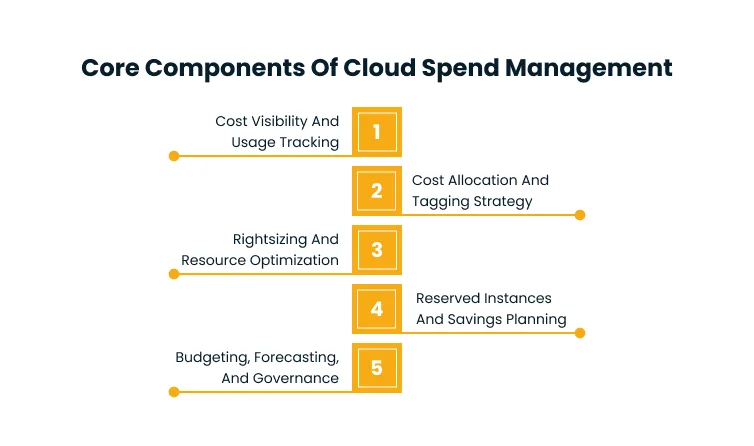
Cost Visibility And Usage Tracking
Cost visibility is the foundation on which every other cloud spend management capability depends. Without it, organizations cannot identify which workloads, teams, services, or environments drive spending, which makes optimization, accountability, and forecasting all but impossible.
Cloud cost visibility tools (including native platforms like AWS Cost Explorer, Azure Cost Management, and GCP Cost Management, as well as third-party FinOps platforms) aggregate usage data into dashboards that surface spending patterns, usage trends, and anomalies across the environment.
Real-time cost monitoring with threshold-based alerting enables teams to detect spend spikes before they compound, while historical usage data supports more accurate forecasting models. Organizations that establish comprehensive cost visibility before expanding cloud usage develop a much cleaner financial picture of what their infrastructure actually costs relative to the business outcomes it supports.
Cost Allocation And Tagging Strategy
The core question in cost allocation is which team, project, or environment owns each cloud cost. Without a structured tagging strategy, cloud costs aggregate into a single undifferentiated bill that no team can act on. Tags applied at the resource level break that aggregate into attributable spending units across a defined taxonomy.
Common mapping categories include the following:
- Projects and product lines, for workload-level cost tracking.
- Environments (production, staging, development), for environment-level governance and reporting.
- Applications and services for service-level cost visibility.
- Cost centers and departments, for finance chargeback and ownership.
- Business units, for cross-divisional cloud spending analysis.
A tagging strategy is only as useful as its enforcement. Tags applied inconsistently across services and accounts produce reporting gaps that undermine the accountability framework the allocation system was designed to support.
Organizations that implement tagging policies through automation and governance controls, rather than relying on manual compliance, maintain tagging coverage as environments scale and teams change.
Rightsizing And Resource Optimization
Rightsizing matches infrastructure capacity to actual workload requirements rather than to peak projections or initial estimates. Overprovisioned instances running continuously at 5-10% of available CPU and memory generate full infrastructure cost, a pattern that repeats across hundreds of resources in most enterprise cloud environments.
Rightsizing analysis identifies these gaps and provides specific recommendations, for instance, downsizing, family migration, or compute consolidation without impacting workload performance.
Resource optimization extends beyond compute to include storage lifecycle management, network egress optimization, and the elimination of orphaned resources such as unattached volumes, idle load balancers, and unused IP addresses that persist after workloads are decommissioned. Cygnet.One’s Cloud Operations and Optimization practice delivers continuous rightsizing analysis and resource governance as a standing engagement, ensuring inefficiencies are identified and addressed before they accumulate into material waste.
Reserved Instances And Savings Planning
On-demand pricing is the most expensive way to run stable, predictable workloads. Reserved instances and committed usage plans offer discounts of 40-70% on on-demand rates in exchange for one-year or three-year usage commitments, savings that translate directly into infrastructure cost reduction for workloads with consistent usage patterns across AWS, Azure, and GCP.
Effective savings planning requires utilization analysis and workload forecasting to avoid overcommitting to capacity that goes unused or undercommitting and leaving significant discounts unrealized.
A mixed commitment strategy (covering baseline usage with reservations and keeping variable capacity on on-demand or spot pricing) balances cost reduction with operational flexibility for workloads that scale with business demand.
Budgeting, Forecasting, And Governance
Cloud budgets set by environment, team, or workload, with automated alerts at defined spending thresholds, create early warning systems that surface cost acceleration before it becomes a finance-level escalation.
Forecasting accuracy depends on the quality of historical usage data and the governance policies that contain variance from plan across teams and environments. Organizations with weak tagging and decentralized provisioning produce forecasts with wide confidence intervals that are effectively unusable for financial planning.
For organizations still planning or stabilizing cloud adoption, understanding cloud migration costs early can prevent budget assumptions from breaking once workloads move into production.
Governance frameworks that include approval workflows for new resource creation, automated shutdown schedules for non-production environments, and team-level spending caps narrow that variance and make cloud cost forecasts operationally reliable.
How Cloud Spend Management Works As An Operating Cycle?
Cloud spend management operates as a continuous cycle of monitoring, analysis, optimization, and governance adjustment. Organizations that manage cloud costs effectively treat this cycle as a standing operational function with defined ownership, tooling, and structured review cadences, embedded into ongoing operations rather than activated after a budget escalation.
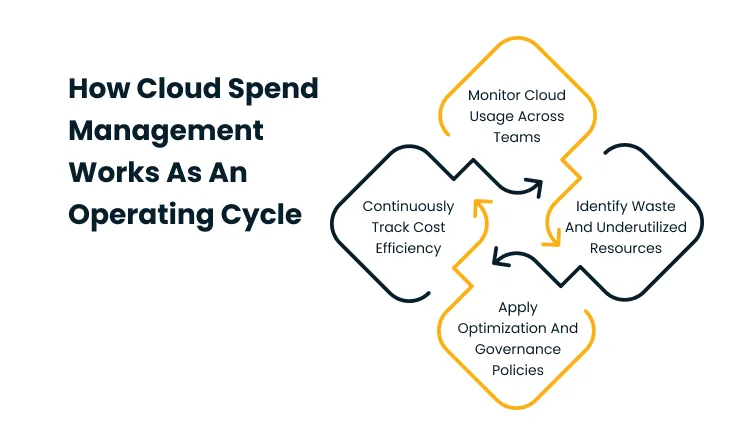
Monitor Cloud Usage Across Teams
Continuous usage monitoring tracks cloud spend across business units, environments, applications, and infrastructure services in real time. Cost dashboards segmented by tag, account, and service make spending patterns visible to both engineering and finance teams, shifting cost awareness from a monthly billing event to an ongoing operational signal.
Strong cloud infrastructure management gives teams the operational structure needed to track usage, ownership, and cost behavior consistently across growing environments.
Monitoring at this granularity enables teams to identify cost concentration areas, detect anomalies before they compound, and correlate spending changes with specific deployment or scaling events. Organizations that establish this visibility layer first have a significantly more reliable foundation for every downstream optimization and governance decision.
Identify Waste And Underutilized Resources
Idle instances, unattached storage, oversized workloads, and duplicate environments are the most common sources of avoidable cloud spending. Identifying them requires usage analysis that compares provisioned capacity against actual consumption, a gap that native cloud tools surface through utilization metrics.
FinOps platforms extend with cross-account aggregation and automated recommendation engines. The operational challenge is prioritization. Most enterprise cloud environments surface dozens of waste signals simultaneously, and engineering teams cannot act on all of them at once.
Effective waste management programs establish a prioritization framework that sequences optimization by cost impact, remediation risk, and workload criticality, ensuring the highest-value actions get executed first.
Apply Optimization And Governance Policies
Governance controls convert cost visibility into cost discipline. Core controls that reduce uncontrolled spending accumulation between review cycles include the following:
- Automated shutdown schedules for non-production environments outside business hours.
- Budget alerts with defined escalation paths when spending approaches planned thresholds.
- Provisioning approval workflows for high-cost or non-standard resource types.
- Tagging enforcement policies that flag untagged resources before they accumulate cost.
A clear cloud migration roadmap can help organizations define these governance policies before workloads scale across teams, accounts, and environments. Policy-based governance scales in ways that manual review cannot.
As cloud environments grow across multiple accounts, regions, and teams, the volume of provisioning events outpaces any governance process that depends on human review of individual resource decisions. Automated policy enforcement is what allows governance coverage to scale with the environment.
Continuously Track Cost Efficiency
Cloud environments change constantly through scaling, new deployments, workload migrations, and evolving business requirements. A rightsizing recommendation that was accurate six months ago may no longer apply to a workload that has grown or changed in character.
Continuous cost efficiency tracking recalibrates optimization recommendations against current usage rather than treating prior analysis as permanently valid. Unit economics (cost per transaction, cost per active user, cost per deployment) give engineering and finance teams a shared metric for evaluating whether cloud investment is growing in proportion with the business value it supports.
Organizations that track unit economics alongside raw spending develop a much more useful picture of cloud financial efficiency than those monitoring total spend alone.
How Enterprises Control Cloud Spend At Scale?
Scaling cloud spend management across a large enterprise requires accountability structures, automation, and governance frameworks that operate at the pace and complexity of the environment. Individual optimization actions are insufficient at scale.
What determines financial discipline is whether the systems and operating models governing resource decisions are built to hold as teams, environments, and workloads grow.
Build A Consistent Tagging Framework
A tagging framework that works at scale requires standardization, enforcement, and coverage across every account, region, and resource type in the environment. The tagging taxonomy should map to the financial reporting structure the organization needs, typically a combination of the following:
- Business unit or department for chargeback and cost center reporting.
- Application or product for workload-level cost tracking.
- Environment (production, staging, development) for environment-level governance.
- Project or initiative for time-bounded cost allocation.
Enforcement automation (using AWS Config rules, Azure Policy, or equivalent governance tools) catches untagged resources at creation rather than after they have accumulated cost without attribution.
Create Shared Cost Accountability
Cloud financial governance becomes effective when engineering, operations, and finance teams share responsibility for usage and optimization decisions. When cloud cost is treated as a finance problem alone, engineering teams lack the framing to prioritize optimization.
When it is treated as an engineering problem alone, finance teams lack the technical context to evaluate whether spending decisions are justified. Shared accountability models give each team a defined role in the cost governance process.
Engineering owns rightsizing decisions and tagging compliance, finance owns budget governance and reporting, and operations owns policy enforcement and anomaly response. Cygnet.One’s Cloud Engineering practice helps organizations design and implement the operating model that makes this accountability structure functional rather than theoretical.
Automate Budget Alerts And Governance Controls
Manual cost reviews surface overruns after spending has already occurred. Automated budget alerts, configured at the account, team, environment, or workload level, shift the intervention point to before the budget is exceeded. Alert thresholds set at 75%, 90%, and 100% of budget give teams enough lead time to investigate and act before costs escalate further.
Governance automation extends beyond alerting to include provisioning guardrails that prevent high-cost resource types from being deployed without approval, automated decommission schedules for time-bounded environments, and spending caps that pause or terminate resources when defined limits are reached.
These controls reduce the operating overhead of cost governance while improving its reliability across large environments.
Continuously Optimize Cloud Resources
Cloud optimization is not a project with a completion date. Workload characteristics evolve, usage patterns shift with business demand, and new resource types become available that offer better price-performance than the instances currently in use.
An optimization cadence (quarterly rightsizing reviews, monthly commitment analysis, and weekly waste scans) ensures the environment stays efficient as it changes. Organizations that treat optimization as continuous outperform those that treat it as periodic. Periodic optimization produces a snapshot of efficiency that decays between review cycles.
Continuous optimization maintains efficiency as a standing characteristic of the environment rather than a condition restored through occasional effort.
Align Cloud Spending With Business Value
The measure of effective cloud spend management is whether cloud investment supports the business outcomes it was designed to deliver. An organization that cuts cloud spending by eliminating infrastructure that supports a revenue-generating product has reduced cost and reduced value simultaneously.
Effective governance requires visibility into whether cloud investments support operational efficiency, scalability, and growth, alongside whether total costs are controlled. Unit economics, workload-level performance tracking, and cost-per-outcome metrics connect cloud spending to business results in terms that finance, engineering, and leadership can evaluate together.
This shared framing is what prevents cloud cost management from becoming a pure cost-cutting exercise that trades infrastructure quality for short-term savings.
Why FinOps Matters In Cloud Spend Management?
FinOps is the operating model that transforms cloud spend management from a reactive cost-cutting exercise into a shared financial discipline across engineering, finance, and operations. Without FinOps principles, cloud cost accountability defaults to the finance team (which has visibility but no technical levers) or to engineering (which has the levers but no financial framing to prioritize their use). Neither alone produces sustainable cost discipline.
The 2024 FinOps Foundation State of FinOps Report found that 50% of practitioners rank workload optimization and waste reduction as their top current priority. This concentration reflects a maturation of the practice.
Organizations that have established basic visibility and tagging are now applying FinOps methods to active optimization decisions, using unit economics, commitment planning, and anomaly detection to manage cloud investment with the same rigor applied to other capital expenditures.
FinOps also changes the pace of optimization decisions. In environments without a FinOps operating model, cost visibility reaches engineering teams through finance reports that arrive weeks after spending occurs. FinOps frameworks give engineering teams real-time cost data in the context of their delivery work, enabling optimization decisions to be made at the point of design rather than in retrospect.
How Cygnet.One Supports Enterprise Cloud Spend Management?
Cygnet.One helps enterprises build and operate the cloud spend management infrastructure that sustains cost efficiency as environments grow.
Through Cloud Operations and Optimization engagements, organizations gain continuous rightsizing analysis, tagging enforcement, governance framework implementation, and FinOps-aligned cost visibility across AWS, Azure, and multi-cloud environments.
For enterprises designing cloud financial governance from the ground up, Cygnet.One’s Cloud Strategy and Design practice builds the allocation frameworks, tooling architecture, and operating model that prevent the structural breakdowns that accumulate when cloud spend management is treated as an afterthought. Engagements are designed to deliver measurable cost governance outcomes across the organization.
Conclusion
Cloud spending without governance does not stabilize on its own. Idle resources persist, costs accumulate without attribution, and forecasting gaps widen with every workload added to an environment that lacks the visibility and accountability structures to contain them.
Organizations that manage cloud spend effectively spend with visibility, financial accountability, and the operational discipline to act on what cost data surfaces. Building that discipline requires governance structures embedded early in the cloud adoption process, before cost problems compound past the point of easy correction.
The goal is to move from reactive cost control to predictable cloud efficiency. Book a demo with Cygnet.One to build a cloud operations and cost governance strategy aligned with your organization’s actual workloads, team structure, and financial accountability requirements.
FAQs
Cloud spend management is the practice of monitoring, allocating, optimizing, and governing cloud costs across teams, workloads, and business units. It includes cost visibility, tagging, rightsizing, reserved instance planning, cloud budgets, and FinOps practices.
The goal is to help organizations understand where cloud money is going and reduce unnecessary spending. It works best as a continuous operating discipline, not a one-time cost reduction exercise.
Cloud spend management is important because it prevents cost overruns, improves financial accountability, and keeps cloud investment aligned with business value. Without it, organizations accumulate idle resources, untagged workloads, overprovisioned infrastructure, and inaccurate forecasts.
These issues become harder to fix as cloud environments scale across teams and services. A strong cloud spend management model helps finance, engineering, and operations control costs before they compound.
Cloud costs increase unexpectedly because of idle resources, overprovisioned infrastructure, inconsistent tagging, unused reserved capacity, and decentralized provisioning.
Delayed cost visibility also allows overspending to continue for weeks before teams notice the issue. Poor tagging makes it difficult to identify which team, workload, or environment owns the cost. Weak governance turns these small inefficiencies into recurring budget overruns.
FinOps is a cloud financial management practice that creates shared accountability for cloud costs across engineering, finance, and operations. It gives engineering teams real-time cost visibility while giving finance teams the context needed to evaluate cloud spending decisions.
In cloud spend management, FinOps helps teams connect usage, budgets, optimization, and business value. It shifts cost control from reactive reporting to continuous financial governance.
Enterprises optimize cloud spending through rightsizing, reserved instance planning, automated governance, consistent tagging, budget alerts, and continuous monitoring.
They identify idle resources, reduce overprovisioned capacity, enforce cost ownership, and improve usage forecasting.
Effective optimization follows a recurring cadence, such as weekly waste scans, monthly commitment reviews, and quarterly rightsizing. This keeps cloud efficiency current as workloads, teams, and business demand change.
Cloud cost allocation tags are metadata labels that assign cloud spending to specific teams, projects, applications, environments, or business units. They help organizations break down cloud bills into accountable cost categories.
Tags support chargeback, showback, budget governance, and workload-level cost visibility. When enforced through automation, they keep cost attribution accurate as cloud environments scale.
Author


Abhishek Nandan
AVP, Marketing
Abhishek Nandan is the AVP of Services Marketing at Cygnet.One, where he drives global marketing strategy and execution. With nearly a decade of experience across growth hacking, digital, and performance marketing, he has built high-impact teams, delivered measurable pipeline growth, and strengthened partner ecosystems. Abhishek is known for his data-driven approach, deep expertise in marketing automation, and passion for mentoring the next generation of marketers.