
































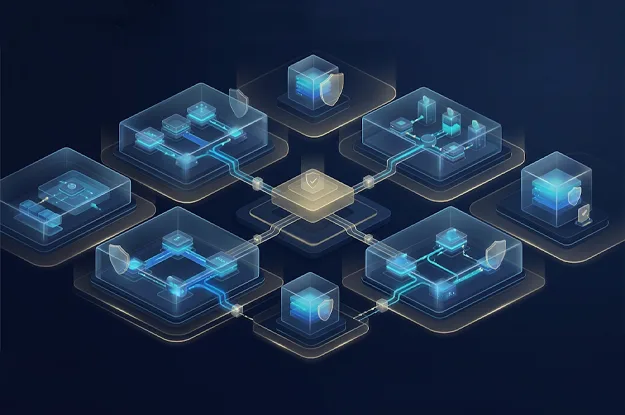
In a shared cloud environment, the boundary between one tenant’s resources and another’s does not exist by default in modern cloud environments. It has to be designed, enforced, and continuously validated. The practice of ensuring that compute, storage, network, and identity resources are kept strictly separate between tenants is what workload isolation cloud architecture addresses.
Without it, a security event in one tenant becomes a risk for every tenant sharing the same infrastructure. This blog covers the models, strategies, and platform decisions that determine whether isolation actually holds in production.
What Is Workload Isolation in Cloud Environments?
Genuine isolation is several controls working together across different infrastructure layers simultaneously.
Three conditions define whether isolation is working:
- A failure in one tenant’s workload does not propagate to another tenant’s environment
- A security event in one tenant does not give an attacker a path to adjacent tenant resources
- A performance spike in one tenant does not degrade workloads running in a separate tenant boundary
When all three hold simultaneously, the isolation boundary is functioning. When any one of them fails, an isolation gap exists, regardless of what the architecture diagram says.
The word “tenant” applies in two directions. In a SaaS product, tenants are customers. In an enterprise cloud environment, tenants are often internal business units, regulated workload categories, or product teams that require separation from each other for security or compliance reasons.
Why Does Workload Isolation Matter in Multi-Tenant Architecture?
Shared infrastructure reduces cost and increases utilization efficiency. It also creates physical and logical proximity between workloads that, without deliberate controls, generate direct security and performance risk.
For regulated industries, the stakes are specific. Financial services organizations subject to PCI DSS, healthcare organizations subject to HIPAA, and government workloads subject to FedRAMP all carry compliance requirements that mandate demonstrable tenant separation. In those contexts, isolation is an audit requirement with documented evidence expected at every review cycle.
The business consequence of poor isolation is not always a breach. Sometimes it is a performance SLA violation caused by one tenant consuming shared resources. Sometimes it is a compliance finding that surfaces during an audit because access controls were not scoped correctly at the tenant level.
Both outcomes are expensive, and both trace back to the same root cause: the multi-tenant architecture cloud environment was not designed with explicit isolation controls from the start.
| Isolation Dimension | What It Protects | Risk If Missing |
| Network | Traffic between tenants | Lateral movement, data interception |
| Compute | Processing resources | Noisy neighbor, side-channel attacks |
| Storage | Data at rest | Unauthorized data access |
| Identity | Access controls | Privilege escalation across tenants |
What Are the Security Risks of Poor Isolation in Shared Cloud Environments?
Lateral Movement
When network boundaries are not enforced at the infrastructure level, a compromised workload in one tenant can scan and attempt to reach resources in adjacent tenants. A vulnerability gets exploited, and a foothold is established in one tenant’s compute environment. Without network controls enforced below the application layer, that foothold provides direct access to the broader shared environment. This is the most documented risk in production environments built without dedicated attention to cloud security isolation.
Noisy Neighbor Performance Impact
Isolation failures are not always a security event. A tenant consuming excessive compute or network resources affects the performance of every workload sharing that infrastructure pool. For SaaS providers, noisy neighbor impact is a direct customer experience problem. For enterprise environments with internal tenants, it is a service-level agreement problem that is difficult to diagnose because the root cause sits outside the affected tenant’s own workload entirely.
Data Residency Violations
Inadequate storage isolation creates the risk that data belonging to one tenant becomes accessible through misconfigured access controls to another. For organizations operating under GDPR or HIPAA, a data residency violation carries regulatory consequences that extend well beyond the technical incident itself. These consequences are one of the primary reasons that multi-tenant cloud security architecture carries formal design requirements in regulated industries rather than being left to implementation teams to figure out on their own.
What Isolation Models Are Available to Enterprise Teams?
Three models exist. Each makes a different tradeoff between isolation strength and infrastructure cost.
The silo model gives every tenant fully dedicated infrastructure with no shared resources at any layer. It is the highest isolation level available at the highest cost.
The pool model uses shared underlying infrastructure with logical separation enforced through software controls, trading isolation strength for significantly lower cost.
The bridge model runs sensitive data and identity controls in dedicated resources per tenant while keeping compute and networking in shared pools with software-level separation.
| Model | Isolation Level | Cost | Best For |
| Silo | Highest | Highest | Regulated, high-security workloads |
| Pool | Lowest | Lowest | Internal, low-sensitivity workloads |
| Bridge | Medium | Medium | Mixed compliance requirements |
Choosing the right model is the first architectural decision. The strategies that implement isolation within that model determine whether the boundary holds in production.
What Strategies Actually Work for Workload Isolation in Production?
1. Network Isolation Through VPC and Subnet Segmentation
Every tenant gets a dedicated Virtual Private Cloud on AWS, a Virtual Network on Azure, or a VPC on GCP. Tenant VPCs operate with no peering connections between them by default. Subnet segmentation within each tenant VPC separates compute, storage, and management traffic into distinct network segments with security group rules enforced at both the subnet and instance level.
The principle behind tenant isolation strategies AWS Azure is identical on both platforms and require strong cloud engineering services — one network boundary per tenant with no default routing between them. Neither platform provides this by default. It must be explicitly designed and enforced through configuration before the first tenant’s workload is deployed.
2. Compute Isolation Through Dedicated Instances and Namespaces
For high-security workloads, physical separation is the only reliable control against side-channel attacks. AWS Dedicated Hosts, Azure Dedicated Hosts, and GCP Sole-Tenant Nodes guarantee that tenant workloads do not share physical hardware with other tenants.
For Kubernetes-based environments, namespace isolation operates at the orchestration layer:
- Each tenant gets a dedicated namespace with resource quotas applied
- Network policies block cross-namespace traffic by default
- Pod security policies restrict container behavior within each namespace boundary
- No shared service account spans multiple tenant namespaces
3. Storage Isolation Through Separate Buckets and Encryption Keys
Each tenant gets dedicated storage resources — separate S3 buckets on AWS, separate Blob containers on Azure, and separate Cloud Storage buckets on GCP. Encryption key isolation adds a second control layer. Each tenant’s data is encrypted with a tenant-specific key managed through AWS KMS, Azure Key Vault, or GCP Cloud KMS.
A key compromise for one tenant does not expose another tenant’s data because keys are never shared across tenant boundaries. Access policies on storage resources explicitly deny cross-tenant access. No shared service account holds permissions spanning multiple tenants’ storage simultaneously.
4. Identity Isolation Through Separate Accounts and IAM Roles
The strongest form of identity isolation for workload isolation cloud environments uses a dedicated AWS account per tenant within an AWS Organization, or a dedicated Azure subscription per tenant within a Management Group hierarchy. Dedicated accounts guarantee that IAM policies and role assignments in one tenant cannot affect another.
Cross-account access requires explicit, audited trust relationships. It does not happen by accident when account-per-tenant architecture is implemented correctly from the start.
5. Observability Isolation Through Separate Logging Pipelines
A tenant should not be able to observe another tenant’s logs, metrics, or traces — even accidentally. Each tenant gets a dedicated log group, dedicated metrics namespace, and dedicated tracing context. Routing tenant observability data to tenant-specific destinations from the point of collection is a core part of workload isolation best practices cloud teams implement consistently.
Shared observability infrastructure that aggregates data across tenants before filtering it creates a window where cross-tenant data is briefly co-located. Routing from the collection eliminates that window entirely.
How Should Enterprise Teams Maintain Isolation Over Time?
Isolation boundaries erode through the same mechanism as every other cloud governance control. Undocumented changes, ungoverned provisioning, and architecture decisions made without reviewing their isolation implications all contribute to boundary degradation over time.
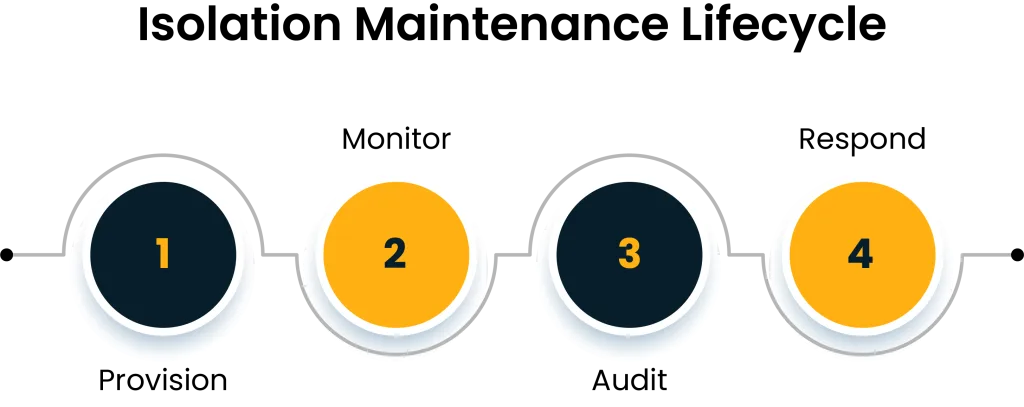
Three practices keep it intact after initial implementation. Continuous compliance scanning confirms isolation configurations match their intended state across every tenant account. Architecture review at onboarding ensures every new tenant is provisioned within the defined isolation model before receiving access. Incident response procedures define exactly how a suspected isolation breach is detected, contained, and investigated before it propagates further.
The goal of secure cloud architecture design in a multi-tenant environment is not a perfect boundary at launch. It is a boundary that holds consistently as the tenant population grows and the infrastructure evolves around it.
Organizations reviewing or designing their isolation architecture from the ground up can connect with Cygnet.One for cloud modernization services.
Isolation Is Designed In, Not Added On
The practice of workload isolation cloud architecture works when it is built into the environment before the first tenant is onboarded — not added retroactively when an incident or audit finding makes the gap visible.
The model must be chosen before architecture decisions are made. The strategies must cover all five isolation dimensions. And the boundaries must be tested continuously rather than assumed to hold because they were correctly designed at launch.
FAQs
It is the practice of ensuring that compute, storage, network, and identity resources belonging to one tenant cannot be accessed or affected by another tenant running on the same shared infrastructure
The silo model gives every tenant dedicated infrastructure with no shared resources. The pool model uses shared infrastructure with logical separation enforced through software controls. Silo provides stronger isolation. The pool provides lower cost.
No. Network isolation prevents traffic between tenants but does not address compute noisy neighbor risk, storage access misconfigurations, or identity privilege escalation. All five isolation dimensions need coverage simultaneously.
Before each new tenant is onboarded and after every infrastructure change that touches network, compute, or identity configuration. Automated compliance checks should run continuously between those manual validation points
AWS, Azure, and GCP all provide equivalent isolation capabilities when configured correctly. The strength of isolation depends on how those capabilities are implemented and governed — not which platform is chosen.
Author


Yogita Jain
Content Lead
Yogita Jain leads with storytelling and Insightful content that connects with the audiences. She’s the voice behind the brand’s digital presence, translating complex tech like cloud modernization and enterprise AI into narratives that spark interest and drive action. With a diverse of experience across IT and digital transformation, Yogita blends strategic thinking with editorial craft, shaping content that’s sharp, relevant, and grounded in real business outcomes. At Cygnet, she’s not just building content pipelines; she’s building conversations that matter to clients, partners, and decision-makers alike.