



































Cloud resource sprawl occurs when cloud resources proliferate across an organization faster than cloud governance, and visibility can keep up with them.
It is the natural result of giving multiple teams independent provisioning access without a unified oversight structure in place. Every team provision what it needs, and nobody decommissions what it no longer needs.
This blog covers what causes sprawl and the governance practices that actually bring it under control.
What Is Cloud Resource Sprawl?
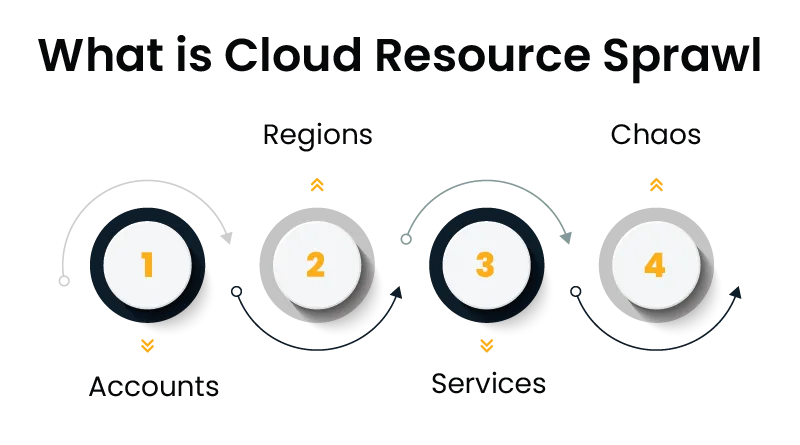
Cloud resource sprawl is the uncontrolled accumulation of cloud resources across accounts, regions, and platforms that grow faster than any governance framework can track.
Three characteristics define it:
- Resources exist without a documented owner or associated workload
- Provisioning happens faster than decommissioning, so the total resource count only grows
- No single team has visibility into the full scope of what is running across the entire cloud estate
It is worth separating sprawl from normal cloud growth. Normal growth is provisioning that is tracked, tagged, reviewed, and decommissioned when it is no longer needed. Sprawl is provisioning that is none of those things.
Why Do Enterprises Experience Cloud Resource Sprawl?
Cloud scaling is fast by design. New instances, databases, and storage volumes spin up in minutes. That speed is an operational advantage during growth periods. It becomes a governance problem when provisioning outpaces the controls designed to track it.
What causes cloud resource sprawl is not technical failure but gaps in cloud strategy. It is the absence of governance that matches the pace of cloud provisioning.
On-premises resource additions required procurement cycles, physical installation, and budget approval. Those friction points created natural governance checkpoints. Cloud removes all of that friction and with it, the visibility that keeps resource growth accountable.
What Specific Conditions Accelerate Cloud Resource Sprawl in Enterprise Environments?
Decentralized Cloud Access
When engineering, data, DevOps, and product teams all have independent provisioning access, resources multiply across accounts and regions without central visibility. Each team optimizes its own delivery speed. No team has visibility into what the others are provisioning simultaneously.
Short-Term Provisioning That Becomes Permanent
Resources provisioned for a sprint, proof of concept, or a temporary workload frequently survive long after their purpose ends. Without a defined decommission process, temporary resources become permanent by default.
Multi-Cloud Complexity
Enterprises operating across AWS, Azure, and GCP simultaneously face sprawl across three separate billing and governance environments. Cloud governance challenges multiply when each platform requires separate tagging policies, access controls, and cost tracking configurations.
No Resource Ownership Accountability
When no specific team or individual owns a resource, nobody is responsible for reviewing or decommissioning it. Flexera’s State of the Cloud Report identifies that 29% of total cloud spend goes to unused or forgotten resources across enterprise environments.
These conditions produce measurable financial and operational consequences that compound the longer sprawl goes unmanaged.
What Does Cloud Resource Sprawl Actually Cost an Enterprise?
Cloud cost sprawl accumulates through three specific resource categories and requires cloud engineering services to control it:
| Resource Category | Description | Cost Impact |
| Orphaned instances | Provisioned and never decommissioned | Full billing at zero utilization |
| Over-provisioned resources | Running at fraction of capacity | Paying for unused compute and memory |
| Duplicate services | Same service provisioned by multiple teams independently | Redundant spend with no added value |
The financial cost is the most visible consequence. Two others follow closely behind.
Operational complexity grows alongside the resource count. Support teams troubleshoot incidents across resources they did not provision and cannot trace to a specific owner. Deployment pipelines slow down when engineers cannot identify which resources are active and which are stale.
Security exposure grows at the same rate as cloud cost sprawl. Every untracked resource is a potential attack surface. Security teams cannot assess resources they do not know exist, and the same governance gap that causes financial waste also leads to unreviewed security configurations.
How Should Enterprises Control Cloud Resource Sprawl?
This section determines whether cloud resource sprawl gets managed or continues compounding. Every practice below addresses a specific cause identified earlier. Applied together, they give enterprise teams the visibility and control that scaling on cloud removes by default.
1. Enforce a Universal Tagging Policy
Every resource provisioned in the cloud environment must carry a minimum set of tags before it can be created:
- Owning team
- Associated workload
- Environment type
- Cost center
- Provisioning date
Tagging policies get enforced at the account level through AWS Service Control Policies, Azure Policy, or GCP Organization Policies. Any resource creation request missing required tags gets rejected automatically. Retroactive tagging campaigns address existing untagged resources in priority order, starting with the highest-cost resources first.
Cloud governance best practices enterprise teams apply consistently always start here. Every other governance practice depends on the ability to identify, own, and track resources accurately.
2. Implement a Resource Lifecycle Management Process
Every resource gets a defined lifecycle from provisioning to decommission. That lifecycle covers four specific steps:
- A provisioning request that documents the purpose, expected duration, and owning team
- A scheduled review date set at provisioning
- An automated alert sent to the owning team when the review date arrives
- An automatic decommission workflow triggered for resources that pass their review date without a renewal decision
Cloud cost sprawl management requires that temporary resources are treated as temporary by design. Without a lifecycle process, temporary resources become permanent ones by default.
3. Centralize Cloud Visibility Across Accounts and Platforms
A centralized cloud management platform aggregates resource inventory, cost data, and governance status across all accounts, regions, and cloud platforms simultaneously. Tools like AWS Organizations, Azure Management Groups, CloudHealth, and Apptio Cloudability provide that consolidated view.
Centralized visibility makes two things possible. It allows governance teams to identify untagged, unowned, and orphaned resources across the entire estate in a single view. It also allows cost anomalies to be traced to specific resources and teams rather than appearing as unexplained line items in a fragmented billing report.
4. Apply a Cloud Governance Policy Framework
A governance policy framework defines what is permitted, what requires approval, and what is automatically rejected across every cloud account the enterprise operates.
Cloud governance best practices enterprise frameworks cover three specific policy categories:
| Policy Category | What It Controls | Enforcement Mechanism |
| Provisioning policy | Which resource types and sizes teams can create | Account-level service control policies |
| Access policy | Who can provision, modify, and decommission resources | Role-based access control per account |
| Cost policy | Spending thresholds that trigger review before deployment | Budget alerts and approval workflows |
5. Run Quarterly Cloud Waste Audits
A quarterly cloud waste audit reviews three specific resource categories across the entire cloud estate:
- Instances running below 20% average CPU utilization over the past 30 days
- Storage volumes with no read or write activity in the past 60 days
- Resources with no associated tag that have been running for more than 30 days
Each identified resource gets classified as right-sized, consolidated, or decommissioned. The audit findings feed directly into the next quarter’s cost optimization work. Cloud cost sprawl management that runs a quarterly audit cycle catches accumulating waste before it compounds into a significant budget problem.
6. Establish Cloud FinOps Ownership
A dedicated Cloud FinOps function owns the ongoing relationship between cloud spending and business value. It is responsible for cost visibility, waste identification, and chargeback reporting to individual teams.
How to control cloud resource usage at an enterprise scale requires someone whose explicit responsibility is asking whether cloud spending is producing proportional business value. FinOps ownership makes that question a defined role rather than a general concern shared by nobody in particular.
What Should Enterprises Do When Sprawl Has Already Set In?
When cloud resource sprawl has already accumulated, the remediation sequence matters as much as the practices themselves.
Three steps in order:
- Tagging and inventory first: No remediation decision can be made reliably without knowing what exists and who owns it
- Cost and security audit second: Highest-cost and highest-risk resources get prioritized for immediate action
- Governance framework third: New sprawl stops accumulating while existing sprawl is being cleared
Remediation and governance implementation have to run simultaneously at this stage, which is operationally intensive for internal teams managing it for the first time. Organizations that need structured help can connect with Cygnet.One for an assessment of their current cloud resource sprawl across their estate.
Cloud Sprawl Is a Governance Problem, not a Cloud Problem
Cloud resource sprawl is not a consequence of scaling on cloud. It is a consequence of scaling without governance that matches the pace of that scaling.
The causes are specific, and the controls are proven. What determines whether sprawl compounds or get resolved is whether those controls get applied consistently across every account, every region, and every team with provisioning access. Better tooling alone does not resolve cloud governance challenges at enterprise scale. Structured governance applied before sprawl becomes the default state of the environment is the only intervention that holds over time.
FAQs
What is a cloud resource sprawl?
It is the uncontrolled accumulation of cloud resources across accounts and regions that grow faster than governance can keep up with.
What causes cloud sprawl in enterprises?
Decentralized provisioning access, no decommission process, multi-cloud complexity, and missing resource ownership accountability.
How do you detect cloud resource sprawl?
Infrastructure as Code comparison tools, cloud cost anomaly detection, and security posture assessments flag untracked and orphaned resources.
How much does cloud sprawl cost enterprises?
Flexera estimates 27 to 29% of total cloud spend goes to unused or forgotten resources annually.
What is the first step to fixing cloud resource sprawl?
Tagging and inventory establishment. No remediation decision is reliable without first knowing what exists and who owns it.
Author


Yogita Jain
Content Lead
Yogita Jain leads with storytelling and Insightful content that connects with the audiences. She’s the voice behind the brand’s digital presence, translating complex tech like cloud modernization and enterprise AI into narratives that spark interest and drive action. With a diverse of experience across IT and digital transformation, Yogita blends strategic thinking with editorial craft, shaping content that’s sharp, relevant, and grounded in real business outcomes. At Cygnet, she’s not just building content pipelines; she’s building conversations that matter to clients, partners, and decision-makers alike.