



































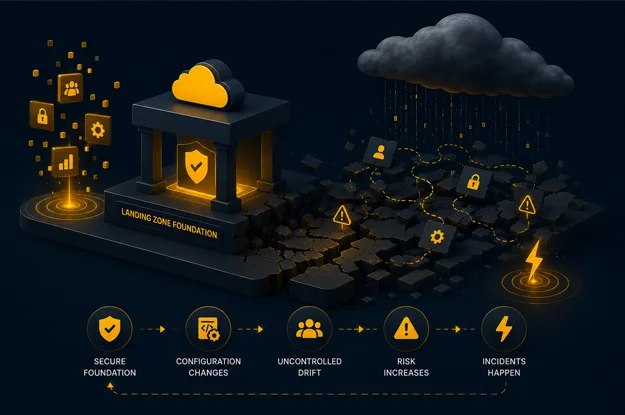
The first signs of landing zone decay usually appear after the launch work is considered complete.
The first release gets attention. Identity is clean. Network rules are debated. Security logging works, especially when teams follow AWS landing zone best practices from the start. Policies look tight. Account creation follows a defined route. Then delivery pressure returns. Teams need exceptions, regions, route changes, and urgent policy edits.
No single change looks reckless. Together, they create cloud landing zone drift.
This is where real work begins. A cloud foundation is an active control layer, not a one-time setup. It needs ownership, inspection, repair, and clear decision rights. Without that discipline, landing zone governance turns into a launch document nobody trusts six months later, which is why enterprises need a practical cloud governance framework.
What Is Landing Zone Drift?
To answer what is landing zone drift, compare the approved cloud foundation with the environment that exists after teams change accounts, policies, routes, permissions, guardrails, logging, and security controls.
The term sounds technical, but the cause is usually human. A platform team builds a clean baseline. Application teams then face delivery dates, audit gaps, vendor onboarding, data movement, and incident pressure. Small changes enter through tickets, emergency edits, local admin decisions, and one-off exceptions.
Cloud landing zone drift matters because the landing zone carries the common controls that every workload depends on. If that layer weakens, application teams begin solving foundation problems alone. That creates duplicate work, uneven controls, and higher operating costs.
The answer should be simple enough for engineering and risk teams: it is foundation decay made visible.
Where Landing Zone Drift Shows Up First
The first mistake is looking for a drift in only one console. Drifts rarely live in one place. It spreads across identity, network, security, policy, and account baselines.
| Drift area | Common symptom | Business impact |
| Identity | Extra admin roles, stale groups, direct user access | Higher privilege risk and harder access reviews |
| Network | Unapproved routes, open ingress, inconsistent endpoints | Wider attack paths and uneven traffic control |
| Security | Disabled logging, missing agents, inconsistent encryption | Weak evidence during incident response |
| Policy | Changed SCPs, skipped controls, untracked exceptions | Controls exist on paper but fail in practice |
| Accounts | New accounts missing tags, logs, budgets, contacts | Poor ownership and weak cost traceability |
In identity, drift often begins with urgency. Someone needs access today. A temporary role becomes permanent. A group is copied from another account. A break-glass permission becomes a routine path. Cloud foundation management must catch these patterns before access reviews turn into archaeology.
In network design, drift is easier to miss because changes can appear locally. One VPC peering request, one security group update, one direct internet path, one endpoint exception. Over months, traffic flow stops matching the intended design. The approved diagram becomes a memory.
Security drift is more uncomfortable because it often hides inside partial coverage. Logging may be active in core accounts but inconsistent in newer workload accounts. A few services may miss encryption checks. Findings may route to the wrong queue. The risk is not only exposure. It is the false confidence created by dashboards that show green while important accounts sit outside the pattern.
Policy drift in cloud environments is the clearest warning sign. When policies change without review, the foundation stops being a control plane. It becomes a suggestion. Service control policies, preventive controls, detective rules, tagging policies, and backup policies need the same care as application code. They should be reviewed, versioned, tested, and tied to ownership. Policy drift in cloud environments also needs expiry dates for exceptions.
Account baseline drift is the quietest problem. New accounts may miss logging, budgets, mandatory tags, identity assignments, backup defaults, or security tooling. Cloud account baseline management is where landing zone governance either becomes real or starts to fade.
Why Cloud Foundations Decay Over Time
To understand how cloud foundations decay over time, look at the gap between the operating model and the delivery model.
Application delivery has operating routines. Teams have backlogs, releases, incidents, sprint reviews, and product owners. Foundation care often has a setup project, then scattered tickets. That mismatch creates decay.
The most common drivers are easy to recognize:
- Exceptions become permanent because nobody owns expiry.
- New accounts are created faster than they are reviewed.
- Security findings are collected but not closed with engineering context.
- Tags are treated as finance detail instead of ownership data.
- Platform changes are made manually because automation is incomplete.
- Controls are added after incidents, then left untested.
- Business units duplicate patterns because the central route is too slow.
Understanding how cloud foundations decay over time helps teams spot risk while it is still small enough to fix. It does not arrive as a single failure. It shows up as small inconsistencies that become normal.
This is also why cloud landing zone best practices cannot stop at the build phase. A strong launch matters, but the operating habits after launch decide whether the foundation remains usable.
Why Drift Increases Risk and Cost
Cloud landing zone drift increases risk by weakening the shared controls that protect the estate. It also increases cost because teams spend more time proving, fixing, and explaining the basics.
A drifted foundation creates four expensive patterns.
First, investigation takes longer. During an incident, teams need to know which accounts have logs, which roles were used, which routes were open, and which policies applied. If the baseline differs by account, response work slows down.
Second, audit evidence becomes harder to defend. A policy document may say logging is mandatory. An auditor will want proof that logging is active, complete, and protected. Landing zone governance should make that proof available without heroic manual work.
Third, engineering productivity drops. Developers wait for security approvals because the platform lacks consistent patterns. Security teams repeat reviews because baseline trust is low. Finance teams chase owners because tags and account metadata are poor.
Fourth, spend becomes harder to control. Missing budgets, poor tagging, unmanaged endpoints, idle security tooling, and orphaned resources all carry cost. Cloud foundation management is part of cost hygiene.
The cost of drift is rarely a single large line item. It is the tax paid across tickets, delays, rework, review meetings, incident hours, and rushed remediation.
AWS Landing Zone Drift Needs Special Attention
AWS landing zone drift is common because AWS estates often grow through many accounts, organizational units, workloads, and exceptions. AWS Control Tower can detect certain drift conditions in the landing zone, accounts, and organizational units. AWS Config can evaluate resource compliance and connect noncompliant resources to remediation actions. Those services are useful, but they still need operating discipline.
The hard part is deciding which deviations are allowed, which must be repaired, and which require a redesign. Some drift points to control failure. Some drift shows that the original baseline no longer matches how the business now operates.
For example, if a workload needs a region that the baseline blocks, the answer may be a documented exception with expiry. If several teams need the same exception, the baseline may need a controlled change. Good landing zone governance separates those two cases. Cloud foundation management gives that decision a home instead of leaving it inside ticket comments.
This is where cloud landing zone best practices become practical. Start with a defined multi-account structure, centralized identity, secure logging, network patterns, preventive controls, detective rules, tagging standards, and automated account vending. Then add review loops that keep those decisions alive.
How to Detect Drift Before It Becomes Normal
Detection should combine automated checks with operational review. Tooling catches configuration issues. Human review catches intent, ownership gaps, and stale exceptions.
A useful detection model has six layers:
| Detection layer | What to check | Owner |
| Baseline comparison | Account setup, logging, identity, network, tags | Platform team |
| Policy review | SCP changes, control changes, exception history | Cloud governance lead |
| Security coverage | Findings, encryption, monitoring, backup, response routing | Security team |
| Cost hygiene | Budgets, tags, idle shared services, unowned spend | FinOps team |
| Network review | Routes, ingress, endpoints, peering, DNS paths | Network team |
| Evidence review | Proof packs for audits and incidents | Risk or compliance team |
The key is to treat drift detection as a cloud foundation management routine, not an annual cleanup. Monthly checks work for many foundations. High-change environments may need weekly review of new accounts, identity changes, policy changes, and security coverage.
Cloud account baseline management should produce a simple answer for every account: who owns it, what it runs, which controls apply, what exceptions exist, and whether the account matches the approved baseline.
Automated Remediation Without Breaking Delivery
Automated remediation sounds attractive until it breaks a production workload. The answer is controlled repair.
Start by classifying drift into three groups:
- Safe to auto-fix: missing tags, disabled standard logging, missing budget alerts, approved security agent gaps.
- Needs approval: policy changes, network route changes, encryption exceptions, region access.
- Needs design review: repeated exceptions, shared service gaps, control patterns that block delivery.
Cloud foundation management should automate the first group aggressively. It should route the second group through fast approval. It should treat the third group as architecture feedback.
Remediation also needs communication. If a route is closed, a role is removed, or a tag policy is enforced, the affected team should know what changed and why. Silent repair creates friction. Visible repair builds trust.
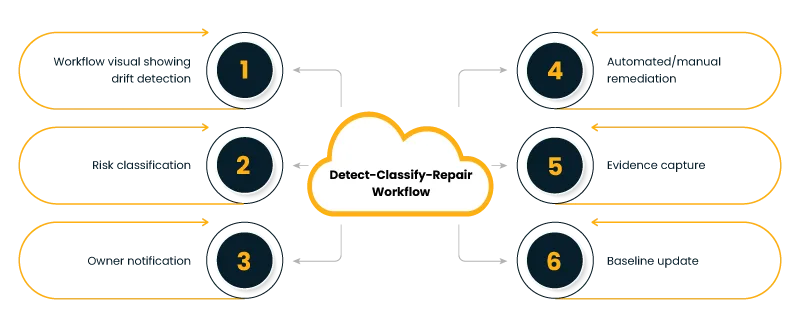
For AWS environments, remediation can use AWS Config rules, Systems Manager Automation, Control Tower reset or re-register actions, infrastructure as code pipelines, policy-as-code checks, and account vending workflows through aws cloud consulting services. The control logic matters most: detect, classify, notify, repair, document.
Governance Routines That Keep the Foundation Honest
Landing zone governance works when it becomes a small set of repeatable habits. The process should be strict enough to protect the foundation and light enough that teams do not route around it.
The routines that keep governance practical are simple:
- Weekly account baseline review for newly created or changed accounts.
- Monthly identity and privileged access review focused on drift.
- Monthly policy change review with owner, reason, risk, expiry, and rollback path.
- Quarterly network path review for routing, ingress, endpoints, and shared services.
- Quarterly evidence pack showing control coverage, exceptions, fixes, and open risks.
This operating rhythm gives cloud foundation management a pulse. It also gives leaders a cleaner story: which parts are healthy, which exceptions are accepted, and which risks need action.
A Stronger Operating Model for Landing Zone Health
A healthy cloud foundation needs ownership at three levels.
The platform team owns baseline design, account vending, guardrail deployment, and remediation workflows. Security owns control intent, risk acceptance, and incident evidence. Application teams own workload-specific exceptions and must keep them current.
Many enterprises also need a landing zone product owner. This person owns the backlog for foundation health. They decide which drift patterns deserve automation, which require policy decisions, and which should feed into architecture changes.
This role makes cloud landing zone drift visible as product work instead of background cleanup. It also prevents landing zone governance from becoming a committee with no backlog.
Metrics help if they show movement. Useful metrics include baseline compliance by account, open exceptions by age, time to remediate safe drift, privileged role count, accounts without owners, and security coverage gaps.
Conclusion: The Landing Zone Is Finished Only When It Can Repair Itself
Cloud landing zone drift is not a failure of the initial build. It happens when an active environment is managed like a completed project.
The fix is part architecture, part automation, and part operating discipline. Define the baseline clearly. Detect drift across identity, network, security, policy, and accounts. Classify what can be repaired safely. Keep exceptions visible. Make ownership impossible to miss.
Strong landing zone governance gives the enterprise a foundation that can absorb change without losing control. Strong cloud foundation management keeps that foundation useful after the launch slides are gone.
The sharp test is simple: can you prove, today, that each account still follows the controls you approved? If the answer takes days, the foundation has already started to decay. If the answer is visible, owned, and repairable, cloud landing zone drift becomes manageable instead of dangerous.
Author


Yogita Jain
Content Lead
Yogita Jain leads with storytelling and Insightful content that connects with the audiences. She’s the voice behind the brand’s digital presence, translating complex tech like cloud modernization and enterprise AI into narratives that spark interest and drive action. With a diverse of experience across IT and digital transformation, Yogita blends strategic thinking with editorial craft, shaping content that’s sharp, relevant, and grounded in real business outcomes. At Cygnet, she’s not just building content pipelines; she’s building conversations that matter to clients, partners, and decision-makers alike.