



































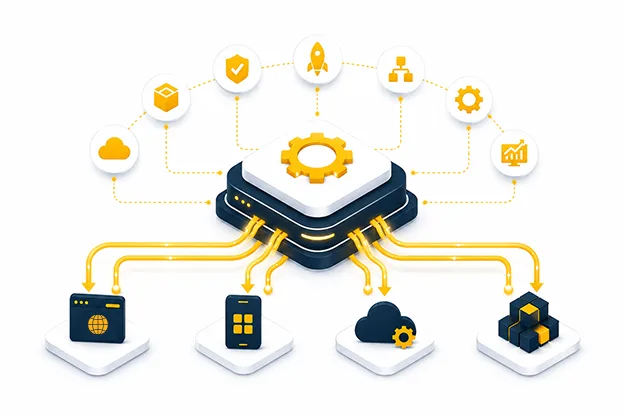
A product release often slows down before a developer writes the first line of code. The delay hides in access tickets, repository setup, environment drift, pipeline edits, security reviews, naming disputes, and unclear ownership. By the time the feature reaches production, the business sees “engineering delay.” Engineers see a supply chain problem.
That is the real case for building an AWS internal developer platform that removes delivery friction before it reaches product teams — a foundation that strong cloud engineering services teams build once and reuse across every subsequent workload.
It is a managed path for product teams to build, test, secure, deploy, and operate software without rebuilding the same delivery plumbing for each application. For US enterprises, the pressure is sharper because delivery speed now has to sit beside audit evidence, cloud cost discipline, security policy, data residency, and vendor governance.
This is where platform engineering on AWS becomes more than tooling — and where the broader discipline of cloud native development shapes how release quality, ownership, and speed are built into the path by default. It becomes the product system behind the product teams. The right platform gives developers fewer decisions during routine delivery and better decisions during production change. The wrong one becomes another portal people bypass.
The practical goal of an IDP AWS enterprise program is simple: make the approved path the easiest path.
What Is an Internal Developer Platform on AWS?
An internal developer platform is a curated operating layer for software delivery. It gives developers self-service access to golden paths, templates, environments, pipelines, observability, security checks, and documentation. It also gives platform teams a controlled way to standardize delivery without turning every release into a governance meeting.
In AWS terms, this usually means a shared services or tooling account connected to application accounts through governed access. Developers do not need to understand every IAM boundary, VPC pattern, deployment policy, or tagging requirement before they can ship. They consume approved building blocks through a portal, CLI, API, template catalog, or Git-based workflow.
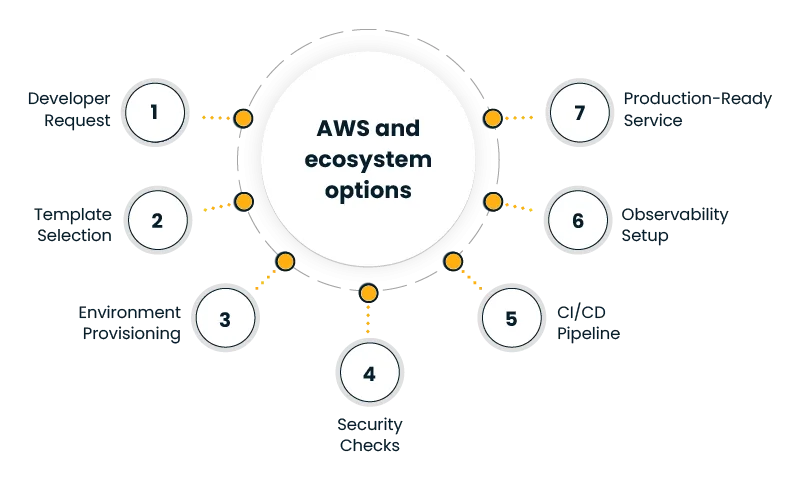
A mature AWS internal developer platform should help teams answer four routine questions quickly:
- Where is the right template for this workload?
- Which path gets me a compliant environment?
- What checks must pass before release?
- Who owns this service after it goes live?
For teams evaluating an internal developer platform for AWS US enterprises, the real work is local to the organization. A bank, healthcare payer, retailer, and SaaS firm may all use AWS, but their risk tolerance, release patterns, regulatory evidence, and operating models differ. The platform has to encode those differences without making developers read policy PDFs.
Why Platform Engineering on AWS Is Now a Delivery Priority
The 2024 DORA research reported that internal platforms can improve individual productivity, team performance, and organizational performance, while also warning that poor implementation can hurt stability and throughput. That second part matters. A platform that only speeds up provisioning may push risk downstream into review, incident handling, or rework.
Strong platform engineering on AWS programs begin with friction analysis. They do not begin with a portal demo. Look at the last ten releases. Where did work wait? Where did engineers copy YAML from older services? Where did security ask for the same evidence again? Where did a team create a custom pattern because the approved one was too slow?
| Delivery friction | What the platform should change |
| New service setup takes days | Create approved templates with repository, pipeline, runtime, tags, and observability built in |
| Security review starts late | Add policy checks, dependency checks, and evidence capture in the path |
| Environments differ by team | Provide standardized environment blueprints with controlled configuration |
| Ownership is unclear | Maintain a service catalog with owner, tier, runtime, data class, and support model |
| Cost signals arrive too late | Attach tags, budgets, and usage views from the first deployment |
This is also why developer productivity in cloud platforms should be measured through delivery flow, not activity volume. More commits do not prove faster product delivery. Shorter setup time, fewer handoffs, safer release patterns, faster rollback, and cleaner operational ownership are better signs.
The Business Benefits of an AWS Internal Developer Platform
The business case for platform engineering on AWS is strongest when the platform removes repeated work that already costs money. Most enterprises have skilled engineers spending time on account access, pipeline repair, environment setup, secrets handling, and production evidence. None of that work differentiates the product.
An AWS internal developer platform changes the economics by turning repeated delivery work into reusable capability — the same principle that underpins mature digital engineering services engagements where standardized delivery is the default, not the exception. The first workload may take effort. The fifth should take less. The fiftieth should follow a clearer path with fewer surprises.
Key benefits usually fall into five groups:
- Faster onboarding: New teams start from approved templates instead of old repositories and tribal knowledge.
- Cleaner governance: Controls are built into workflows rather than checked manually at the end.
- Better reliability: Standard observability, rollback, and runbook patterns reduce production guesswork.
- Lower cognitive load: Developers focus on product behavior instead of delivery mechanics.
- Improved cost accountability: Tagging, budgets, and usage views are attached to teams and services earlier.
For an IDP AWS enterprise initiative, the highest value often comes from consistency. When every service reports ownership, cost center, runtime, dependency, and release status in a common way, engineering leaders can manage risk with evidence rather than status calls.
This is the point where planning an internal developer platform for AWS US enterprises should include finance, security, compliance, product, and operations. The platform is not an engineering-only asset. It is the control plane for how software moves through the company.
Core Components of IDP Architecture on AWS
For platform engineering on AWS, a useful platform is a set of connected capabilities. Buying a portal and calling it done rarely works. The platform must connect identity, templates, infrastructure provisioning, deployment, policy, observability, documentation, and support ownership.
A practical IDP architecture on AWS often includes these layers:
| Layer | AWS and ecosystem options | Purpose |
| Developer portal | Backstage, AWS Service Catalog, custom portal | Entry point for templates, docs, scorecards, and service catalog |
| Account structure | AWS Organizations, Control Tower, IAM Identity Center | Account vending, access boundaries, and governance |
| Infrastructure provisioning | AWS CDK, CloudFormation, Terraform, Crossplane | Repeatable environments and workload patterns |
| CI/CD | CodePipeline, CodeBuild, GitHub Actions, GitLab, Argo CD | Build, test, release, and deployment workflows |
| Runtime platforms | ECS, EKS, Lambda, EC2, App Runner | Standard workload execution paths |
| Security controls | IAM, KMS, Secrets Manager, Security Hub, Inspector | Access, secrets, encryption, posture, and vulnerability checks |
| Observability | CloudWatch, X-Ray, OpenTelemetry, managed partner tools | Logs, metrics, traces, alerts, and service health |
| Evidence and reporting | AWS Config, CloudTrail, Cost and Usage Reports | Audit trails, configuration history, and spend visibility |
The service catalog is usually the heart of the AWS internal developer platform. It should show what exists, who owns it, where it runs, how healthy it is, what data it touches, and which dependencies matter. Without that catalog, the platform becomes a launchpad with no memory.
Search interest around platform engineering tools for AWS often pushes teams toward tool comparison. The sharper question is whether the tools can preserve context across the delivery path. A template should know the service owner. The pipeline should know the risk class. The dashboard should know the runtime. The incident view should know the support tier.
This is where architecture decisions become operational decisions.
How to Implement an IDP on AWS Without Creating Shelfware
Start with one painful delivery path. Do not start with an enterprise-wide mandate. Pick a common workload, such as a containerized API, event-driven service, data processing job, or front-end application. Then build a golden path around it.
A practical implementation sequence looks like this:
| Step | What to do | What to avoid |
| 1. Map release friction | Interview developers, SREs, security, and release managers | Assuming the platform team already knows the pain |
| 2. Choose first workload pattern | Select one high-repeat use case | Trying to cover every runtime on day one |
| 3. Build the golden path | Include repo, IaC, pipeline, secrets, tags, monitoring, and rollback | Shipping a template that stops at infrastructure |
| 4. Add policy as code | Move checks into CI/CD and provisioning | Leaving security as a late manual gate |
| 5. Publish through a portal | Make the path visible and self-service | Building a portal before the workflow is useful |
| 6. Measure adoption and friction | Track setup time, failed deployments, manual tickets, and developer feedback | Reporting only page views and template counts |
For platform engineering on AWS teams, one rule helps: never automate a broken process without fixing the ownership model. If nobody owns the template, nobody owns its drift. If nobody owns the service catalog, nobody trusts it. If nobody owns guardrail exceptions, teams route around the platform.
This is also where platform engineering tools for AWS should be chosen carefully. A tool should reduce waiting time, preserve evidence, and make the next release easier. If it adds another approval screen without removing a real bottleneck, it will become background noise.
An IDP AWS enterprise rollout also needs to be managed like a product. Platform teams need a backlog, service levels, user research, release notes, feedback channels, and adoption metrics. Developers are internal users, and they judge the platform by whether it helps them finish real work.
What Good Outcomes Look Like
The best outcomes are boring in a useful way. Teams start new services from approved paths. Security evidence is ready before audit season. Dashboards show ownership and health without detective work. Rollbacks are practiced. Cost tags are consistent. Production support does not depend on one engineer’s memory.
For developer productivity in cloud platforms, the outcome dashboard should combine speed, quality, and operational signals. A platform that improves setup time while increasing incidents has moved the pain. A platform that reduces tickets while increasing undocumented exceptions has hidden the pain.
Track a balanced set of indicators:
- Time to create a production-ready service
- Number of manual tickets per release
- Deployment failure rate by template
- Lead time from code complete to production
- Security exceptions by workload type
- Percentage of services with owner, tier, cost center, and runbook
- Mean time to rollback or restore service
- Developer satisfaction with the golden path
The outcome is stronger when leadership treats the AWS internal developer platform as a living product. It needs funding, roadmap discipline, support ownership, and periodic pruning. Old templates should retire. Unused patterns should be removed. New compliance needs should enter the platform backlog before they become release blockers.
This is where IDP AWS enterprise maturity becomes visible in daily engineering behavior. The platform stops being a side project and becomes the operating model for product delivery on AWS.
Build the Paved Road Before You Ask Teams to Use It
An internal platform should reduce the distance between idea and production without lowering engineering standards. AWS gives enterprises the services to build that path, but the value comes from how well the path fits the organization’s delivery reality.
A good platform engineering on AWS program does three things well. It removes repeated setup work. It builds security and cost discipline into normal delivery. It gives leaders reliable evidence about software ownership, risk, and readiness.
The hard part is restraint. Start with one delivery path. Make it useful. Put it in front of real teams. Measure where they still wait. Improve the path before adding another layer.
For US enterprises, IDP AWS enterprise work is no longer only about developer convenience. It is about product throughput, audit readiness, production discipline, and cloud accountability — the same outcomes that a well-executed cloud modernization services program is designed to deliver at scale. The platform earns trust when developers choose it because the IDP AWS enterprise path is faster, clearer, and safer than the workaround.
Author


Yogita Jain
Content Lead
Yogita Jain leads with storytelling and Insightful content that connects with the audiences. She’s the voice behind the brand’s digital presence, translating complex tech like cloud modernization and enterprise AI into narratives that spark interest and drive action. With a diverse of experience across IT and digital transformation, Yogita blends strategic thinking with editorial craft, shaping content that’s sharp, relevant, and grounded in real business outcomes. At Cygnet, she’s not just building content pipelines; she’s building conversations that matter to clients, partners, and decision-makers alike.