



































An AWS estate can look healthy from the console and still behave badly under business pressure. VPCs exist. Routes resolve. VPN is green. Then a product team needs shared services, security asks for east-west inspection, and one missing route table association holds up a release. The real problem is harder to spot: the network still works, but nobody can explain every path with confidence, which is why enterprises need a clear cloud governance framework.
That is the quiet nature of AWS networking challenges in large estates: the failure signs appear long before a formal outage. They rarely begin as outages. They begin as small exceptions that become policy. A one-off CIDR choice becomes an address conflict. A temporary peering link becomes a dependency. A security group rule added during an incident stays open for two years. In large US companies, this is common because AWS adoption arrives through many teams, acquisitions, compliance demands, and regional needs.
The harder truth is that enterprise AWS networking work is less about clean diagrams and more about change control, supported by aws cloud consulting services. A good design must survive account growth, application churn, audit evidence, mergers, and hybrid connectivity. That is why VPC design decisions should be treated as operating decisions rather than one-time setup work.
Networking Issues That Keep Returning
Most networking trouble is a symptom of a few deeper design gaps. The same incidents appear with different names across teams.
| Issue | What teams notice first | What usually sits underneath |
| CIDR overlap | New VPC cannot connect to another network | No central IP plan or IPAM ownership |
| Route confusion | Traffic reaches the wrong inspection path | Too many route tables without intent labels |
| DNS inconsistency | Apps work in one account and fail in another | Split DNS, resolver rules, and private hosted zones grew separately |
| Security group sprawl | Nobody can explain allowed paths | Rules were added per ticket, not per pattern |
| Hybrid instability | Data center traffic behaves differently by Region | VPN, Direct Connect, and Transit Gateway paths are mixed without clear priority |
| Inspection bottlenecks | Firewalls become a shared failure point | Traffic steering came after launch |
Many connectivity issues AWS enterprise teams deal with come from too many allowed paths and too little ownership. A mature enterprise cloud networking AWS model starts by asking whether a path should exist before asking how to connect it. The second question is who owns it after launch.
Why AWS Networking Complexity Grows in Large Enterprises
Much of the AWS networking complexity large enterprises deal with comes from normal business behavior. Product groups move fast. Security needs inspection. Compliance needs evidence. Mergers bring address ranges that nobody chose. Legacy systems need private connectivity. None of these pressures are wrong. The problem starts when each pressure creates a separate pattern.
First, account strategy and network strategy are designed apart. Landing zones create account structure, while application teams design VPCs inside those accounts. If network controls are not built into provisioning, VPC architecture AWS becomes a collection of local decisions. Subnet sizes, NAT placement, and endpoint usage vary without approval.
Second, hybrid assumptions stay undocumented. A workload may depend on on-premises DNS, mainframe access, identity services, or a third-party appliance. During migration, the team proves traffic works. Months later, nobody remembers why the route exists. This is how AWS networking challenges become the kind of AWS networking complexity large enterprises must manage after migration.
Third, security and routing are reviewed separately. Security teams ask what traffic is allowed. Network teams ask where traffic flows. In practice, those are the same decisions. A secure AWS network requires rule intent, path intent, inspection intent, and logging intent to match.
Causes Hidden Inside VPC Architecture AWS Decisions
A VPC can be technically valid and still be wrong for enterprise use, which is why VPC architecture AWS needs enterprise rules. The issue is the lack of a repeatable pattern around it.
In a stronger VPC architecture AWS model, each VPC has a declared role. Some VPCs host workloads. Some host inspection. Some provide shared services. Some isolate regulated systems. Some support development. Each role should come with standard subnet tiers, route table behavior, endpoint rules, resolver configuration, logging, and tagging.
| VPC decision | Weak version | Better enterprise version |
| CIDR assignment | Team picks a range during build | IPAM assigns approved ranges by account and region |
| Subnet layout | Public and private subnets copied from a template | Subnets reflect workload, inspection, endpoint, and availability needs |
| NAT design | NAT gateways added wherever outbound access is needed | Outbound paths are approved by traffic class |
| Endpoints | Added when someone notices data transfer or private access needs | Standard endpoint catalog by workload type |
| DNS | Private hosted zones created by teams | Resolver rules and zone ownership are centrally governed |
| Flow logs | Enabled only after an incident | Enabled by default with retention rules |
This is where VPC design best practices AWS US enterprises follow need more precision than a generic reference diagram can provide. A useful standard defines what a compliant workload VPC looks like before an engineer requests one.
My preferred test is simple: can an engineer explain the VPC purpose in five minutes by reading names, tags, routes, and diagrams? If not, tribal memory is doing too much work.
Design Patterns That Work in Real Enterprise Estates
There is no single pattern that fits every company. Strong enterprise cloud networking AWS programs usually combine a few patterns and make the boundaries explicit.
Hub-and-spoke for shared control
Transit Gateway remains a practical choice for connecting many VPCs, VPNs, and Direct Connect attachments. It gives teams a central place to manage routing. The risk is over-connection. A hub that accepts everything becomes a flat network.
Use separate route tables for domains such as production, non-production, shared services, and inspection. Route propagation should reflect policy, not convenience.
Segmented shared services
Shared services VPCs are useful for DNS, directory services, observability collectors, patch repositories, and common endpoints. The mistake is placing unrelated services in one shared VPC because it is available. That creates hidden dependencies.
A better VPC architecture AWS pattern separates shared services by sensitivity and function. Identity, logging, network inspection, and developer services do not need the same access model.
Inspection VPC for controlled traffic paths
Central inspection can help when regulated workloads need consistent traffic review. It can also damage performance and resilience if every path is forced through appliances without traffic classification.
In a secure networking AWS model, inspection should be tied to risk. Internet egress, third-party access, regulated data paths, and administrative access deserve stricter handling.
Service-level connectivity
VPC peering and broad routing are often too wide for modern application environments. For some use cases, services should be reachable without exposing whole networks. Evaluate service-level access patterns, private endpoints, and application networking options. The goal is to reduce blast radius and keep the path usable inside a cleaner VPC architecture AWS model.
Solutions for AWS Networking Challenges
Solving AWS networking challenges requires cleaner design patterns and stronger operating discipline through cloud engineering services. Tooling helps, but only after the ownership model is clear.
Start with an IP address authority. Amazon VPC IP Address Manager can help assign, track, audit, and monitor address usage across accounts and regions. The bigger value is governance. Nobody should create production CIDR ranges through guesswork. For US enterprises that expect acquisitions or multiple business units, IP planning should reserve future space and document conflict rules.
Next, define standard VPC products. A platform team should offer approved VPC patterns: workload VPC, regulated workload VPC, inspection VPC, shared services VPC, sandbox VPC, and partner access VPC. Each product should include subnet layout, endpoints, logs, route behavior, security baselines, and owner tags. This makes VPC design best practices AWS US teams rely on easier to apply during real delivery work.
Then fix DNS as a first-class service. Many connectivity issues AWS enterprise teams chase start as DNS issues, then get mistaken for routing failures. Use Route 53 Resolver rules deliberately. Define private hosted zone ownership. Document forwarding between AWS and on-premises systems. Test name resolution during failover exercises.
For secure networking AWS teams, security groups cannot remain local preferences owned only by application teams. Use naming standards that describe intent. Separate application rules from administrative rules. Review inbound and outbound paths. Pair flow logs with meaningful alerting, because raw logs without ownership become storage cost.
Finally, add route review to the release process. This does not mean adding slow approval gates. It means route changes should be visible, reviewed, and tied to a request. A failed deployment is easier to fix than an unknown route that stays active for years.
Best Practices for Enterprise Cloud Networking AWS
The best enterprise cloud networking AWS teams keep the network boring. Boring means predictable, visible, and hard to misuse.
Use these practices as operating rules:
- Keep VPC roles explicit. A VPC without a declared role becomes a junk drawer.
- Treat CIDR space as enterprise inventory. It deserves the same discipline as domains and certificates.
- Keep route tables readable. Names should show purpose, environment, and traffic class.
- Use private connectivity where it reduces exposure and audit scope.
- Prefer patterns over exceptions. Exceptions should expire or be reviewed.
- Test DNS, routing, and security rules together. Testing one layer gives false confidence.
- Make network diagrams living assets. A diagram that lags production is decoration.
- Tie cost review to design. NAT gateways, public IPv4, inter-region paths, and inspection traffic can become expensive when nobody owns the pattern.
This is also where enterprise cloud networking AWS strategy should connect to application delivery. Developers do not need unlimited network freedom. They need clear, approved ways to connect services without opening tickets for routine paths. Good enterprise cloud networking AWS design gives security more control and delivery teams fewer surprises.
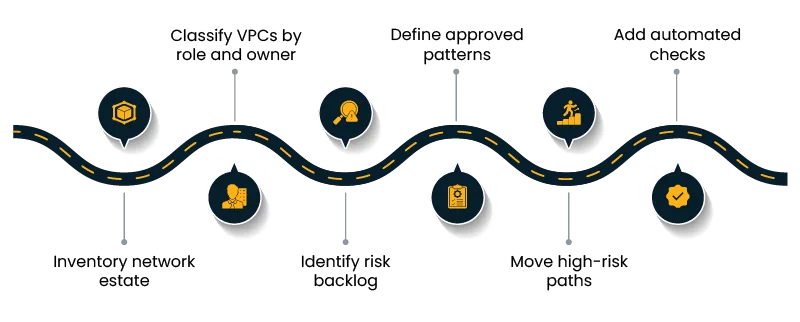
A Practical Remediation Plan
Enterprises with years of AWS growth should avoid a “redesign everything” posture. That creates fear and stalls useful work. A phased approach works better.
| Phase | Action | Output |
| 1 | Inventory VPCs, CIDRs, route tables, endpoints, resolvers, and attachments | Current network map |
| 2 | Classify VPCs by role and business owner | Ownership model |
| 3 | Identify overlapping CIDRs, unused public IPv4, stale peering, and open routes | Risk backlog |
| 4 | Define approved patterns for new VPCs | Standard build catalog |
| 5 | Move high-risk paths first | Cleaner traffic control |
| 6 | Add automated checks during provisioning | Drift prevention |
This plan respects existing systems. Many enterprises cannot pause product delivery to rebuild the network. They need a path that reduces risk while new workloads follow better standards.
The first visible win is route clarity. When teams understand which traffic flows through Transit Gateway, which traffic uses private endpoints, which traffic reaches on-premises systems, and which traffic is inspected, support conversations become shorter. The second win is security evidence through patterns, ownership, logs, and review history.
Conclusion: The Network Should Explain Itself
The long-term answer to AWS networking challenges is not another diagram or another hub. It is a network that explains itself through structure. Names, routes, logs, CIDRs, resolver rules, and security controls should tell the same story.
For large US enterprises, enterprise cloud networking AWS decisions affect release speed, audit readiness, cost control, incident response, and acquisition integration. Treating the network as plumbing is risky. It is a product surface that every workload touches.
A durable VPC architecture AWS approach begins with repeatable VPC roles, governed IP space, clear routing domains, private access patterns, DNS ownership, and security rules that show intent. That combination reduces AWS networking challenges without making engineers fight the platform.
The companies that get this right do not have perfect networks. They have networks with fewer mysteries. That is the difference between a cloud estate that grows and one that remains operable.
Author


Yogita Jain
Content Lead
Yogita Jain leads with storytelling and Insightful content that connects with the audiences. She’s the voice behind the brand’s digital presence, translating complex tech like cloud modernization and enterprise AI into narratives that spark interest and drive action. With a diverse of experience across IT and digital transformation, Yogita blends strategic thinking with editorial craft, shaping content that’s sharp, relevant, and grounded in real business outcomes. At Cygnet, she’s not just building content pipelines; she’s building conversations that matter to clients, partners, and decision-makers alike.