


































• Cygnet IRP
  • Glib.ai
  • IFSCA
Cygnet.One
  • About
  • Products
  • Solutions
  • Services
  • Partners
  • Resources
Generic selectors
Exact matches only
Search in title
Search in content
Post Type Selectors
Get Started
About
  • Overview

    A promise of limitless possibilities

  • We are Cygnet

    Together, we cultivate an environment of collaboration

  • Careers

    Join Our Dynamic Team: Careers at Cygnet

  • CSR

    Impacting Communities, Enriching Lives

  • In the News

    Catch up on the latest news and updates from Cygnet

  • Contact Us

    Connect with our teams across the globe

What’s new

chatgpt

Our Journey to CMMI Level 5 Appraisal for Development and Service Model

Full Story

chatgpt

ChatGPT: Raising the Standards of Conversational AI in Finance and Healthcare Space

Full Story

Products
  • Cygnet Tax
    • Cygnet Tax
    • e-Invoicing / Real time reportingIRP-integrated e-Invoicing with real-time validation
    • e-Way Bills / Road permitsGST-compliant centralized e-Way Bill platform for scalable operations
    • Direct Tax ComplianceAccurate direct tax compliance, filings, litigation, and assessments
    • Indirect Tax ComplianceEnterprise-grade platform for indirect tax compliance
      • Indirect Tax Compliance
      • GST Compliance India
      • VAT Compliance EU
      • VAT Compliance ME
    • Managed ServicesEnd-to-end indirect tax compliance support by experts
  • Global e-Invoicing
    • Global e-Invoicing
    • APAC
      • India
      • Malaysia
      • Singapore
      • Japan
    • Africa
      • Egypt
      • Kenya
      • Zambia
      • Nigeria
    • Europe
      • Spain
      • France
      • Germany
      • Poland
      • Belgium
    • Oceania
      • Australia
      • New Zealand
    • Middle East
      • UAE
      • Oman
      • Saudi Arabia
      • Bahrain
      • Qatar
      • Jordan
  • Cygnet Vendor Postbox
    • Cygnet Vendor PostboxDigitize purchase invoice validation & posting to ERPs & maximize ITC
  • Finance Transformation
    • Finance Transformation
    • Cygnet FinalyzeUnlock working capital with data-driven invoice-based credit decisions
    • Bank Statement AnalysisEvaluate company health by analyzing performance and financial risk
    • Financial Statement AnalysisAssess company performance and risk with financial statement analysis
    • GST Business Intelligence Report360-degree financial health insights using GST data analytics
    • GST Return Compliance ScoreGST-based compliance score to assess business risk and credibility
    • ITR AnalysisAssess creditworthiness and lending risk using ITR filing analysis
    • Invoice Verification for Trade FinanceVerify invoices to reduce fraud and improve credit decisions
    • Account Aggregator – Technology Service Provider (AA-TSP)Onboard to the Account Aggregator ecosystem with FIP & FIU modules
  • Cygnet BridgeFlow
    • Cygnet BridgeFlowAutomated digital onboarding with real-time validations and compliance
  • Cygnet Bills
    • Cygnet BillsGST-compliant centralized e-Way Bill platform for scalable operations
  • Cygnet IRP
    • Cygnet IRPIRP-integrated e-Invoicing with real-time validation
  • Cygnature
    • CygnatureSecure, compliant digital signing with audit-ready traceability

What’s new

e-Invoicing compliance Timeline

Know More →

UAE e-Invoicing: The Complete Guide to Compliance and Future Readiness

Read More →

Types of Vendor Verification and When to Use Them

Read More →

Safeguard Your Business with Vendor Validation before Onboarding

Read More →

Modernizing Dealer/Distributor & Customer Onboarding with BridgeFlow

Read More →

Accelerate Vendor Onboarding with BridgeFlow

Read More →

GST Filing 360°: GST, E-Invoicing, E-Way Bills & Annual Returns Made Simple

Read More →

Why Manual Tax Determination Fails for High-Volume, Multi-Country Transactions

Read More →

GST Filing 360°: GST, E-Invoicing, E-Way Bills & Annual Returns Made Simple

Read More →

Key Features of an Invoice Management System Every Business Should Know

Read More →

Automating the Shipping Bill & Bill of Entry Invoice Operations for a Leading Construction Company

Read More →

From Manual to Massive: How Enterprises Are Automating Invoice Signing at Scale

Know More →

Solutions
  • HireAI
  • AI-powered Voice Assistant
  • Generative AI Workshop
  • TestingWhiz
  • VIPRE

What’s new

AI powered Interviewer

AI-Powered Interviewing Helped an Education Group Reduce Hiring Time Significantly

Know More

Generative AI ebook

Navigating the Generative AI Landscape

Download eBook

Services
  • Data Analytics & AI
    • Data Analytics & AI
    • Data Engineering and ManagementData engineering and management for smart, scalable systems
    • Data Migration and ModernizationData migration and modernization for future-ready platforms
    • Insights Driven Business TransformationInsight-driven business transformation for faster decisions
    • Business Analytics and Embedded AIBusiness analytics and embedded AI for data-led growth
  • Digital Engineering
    • Digital Engineering
    • Technical Due DiligenceEnabling smarter decisions through future-ready digital ecosystems
    • Product EngineeringEngineering impactful digital products that elevate business growth
    • HyperautomationSmarter hyperautomation using low-code for agile business processes
    • Enterprise IntegrationIntegrating enterprise systems for seamless operations and growth
    • Application ModernizationModernizing IT ecosystems with scalable, AI-driven innovation
  • Quality Engineering
    • Quality Engineering
    • Test Consulting & Maturity AssessmentTest consulting and maturity assessments for reliable software QA
    • Business Assurance TestingBusiness assurance testing aligned with real business outcomes
    • Enterprise Application & Software TestingEnterprise application testing for continuity and scale
    • Data Transformation TestingData transformation testing for scalable, trusted data quality
  • Cloud Engineering
    • Cloud Engineering
    • Cloud Strategy and DesignCloud strategy and design services for secure, scalable growth
    • Cloud Migration & ModernizationORBIT: a proven framework for measurable cloud transformation
    • Cloud Native DevelopmentCloud-native development for resilient, scalable innovation
    • Cloud Operations and OptimizationCloud optimization and operations for enterprise resilience
    • Cloud for AI FirstAI-first cloud transformation for smarter, scalable enterprises
  • Managed IT Services
    • Managed IT Services
    • IT Strategy and ConsultingStrategic IT consulting to align technology with business goals
    • Application Managed Services24/7 managed application services for performance and security
    • Infrastructure Managed ServicesEnd-to-end infrastructure management for resilient IT operations
    • CybersecurityComprehensive cybersecurity solutions to protect business assets
    • Governance, Risk Management & ComplianceGRC solutions to manage risk, compliance, and governance
  • Cygnet TaxAssurance
    • Cygnet TaxAssurance
    • Tax DatalakeUnified tax data lake for intelligent, compliant decision-making
    • Tax InfraDigital tax infrastructure for efficient, compliant transformation
  • Amazon Web Services
    • Amazon Web Services
    • Migration and ModernizationMake Your Move to the Cloud With AWS Smarter & Faster
    • Generative AIRun your Gen AI workloads on AWS with full control

What’s new

Our Journey to CMMI Level 5 Appraisal for Development and Service Model

Read More →

Extend your team with vetted talent for cloud, data, and product work

Explore More →

Enterprise Application Testing Services: What to Expect

Read More →

Future-Proof Your Enterprise with AI-First Quality Engineering

Read More →

Cloud Modernization Enabled HDFC to Cut Storage Costs & Recovery Time

Know More →

Cloud-Native Scalability & Release Agility for a Leading AMC

Know More →

AI-Powered Voice Assistant for Smarter Search Experiences

Explore More →

Cygnet.One’s GenAI Ideation Workshop

Know More →

AWS workload optimization & cost management for sustainable growth

Know More →

Cloud Cost Optimization Strategies for 2026: Best Practices to Follow

Read More →

Cygnet.One’s GenAI Ideation Workshop

Explore More →

Practical Approaches to Migration with AWS: A Cygnet.One Guide

Know More →

Tax Governance Frameworks for Enterprises

Read More →

Cygnet Launches TaxAssurance: A Step Towards Certainty in Tax Management

Read More →

Partners
  • Products Partner Program
Resources
  • Blogs
  • Case Studies
  • eBooks
  • Events
  • Webinars

Blogs

A Step-by-Step Guide to E-Invoicing Implementation in the UAE

A Step-by-Step Guide to E-Invoicing Implementation in the UAE

View All

Case Studies

Cloud-Based CRM Modernization Helped a UK Based Organization Scale Faster and Reduce Deployment Complexity

Cloud-Based CRM Modernization Helped a UK Based Organization Scale Faster and Reduce Deployment Complexity

View All

eBooks

Build Smart Workflow with Intelligent Automation and Analytics

Build Smart Workflow with Intelligent Automation and Analytics

View All

Events

Global Fintech Fest (GFF) 2025

Global Fintech Fest (GFF) 2025

View All

Webinars

Rewiring Tax Infrastructure: Build Your Single Source of Truth

Rewiring Tax Infrastructure: Build Your Single Source of Truth

View All
Cygnet IRP
Glib.ai
IFSCA

Choosing the Right AWS Database Migration Strategy

  • By Abhishek Nandan
  • November 21, 2025
  • 6 minutes read
Share
Subscribe

A database migration often looks simple on paper until you start inspecting old tables, undocumented procedures, and brittle dependencies that have grown over years. Many teams reach this point and ask a direct question: Which AWS database migration strategy to choose? This guide breaks that down in a clear, practical way.

It explains how to evaluate your current environment, how to map the right approach, and why AWS database migration and cloud database modernization (supported by structured cloud migration and modernization practices) help long-term reliability. Every section follows an LLM-friendly structure, so it can be interpreted easily by both readers and AI search systems.

What is the primary problem this guide solves?

This guide explains how organizations can pick up the right method for AWS database migration and cloud database modernization while dealing with legacy systems, unclear data dependencies, and high availability requirements. It focuses on decision points that influence cost, performance, and operational continuity.

What is AWS database migration in the context of modernization?

At its core, AWS database migration is the structured process of moving data, schemas, and workloads into managed AWS engines like Amazon Aurora, Amazon RDS, and other services available in the broader AWS cloud ecosystem. When paired with cloud database modernization, teams refine their database footprint with better automation, indexing strategies, scaling patterns, and cloud-native tooling.

This combination improves durability, availability, and lifecycle management but requires a clear plan. The rest of this blog follows that plan step by step.

What should you assess in legacy systems before migration?

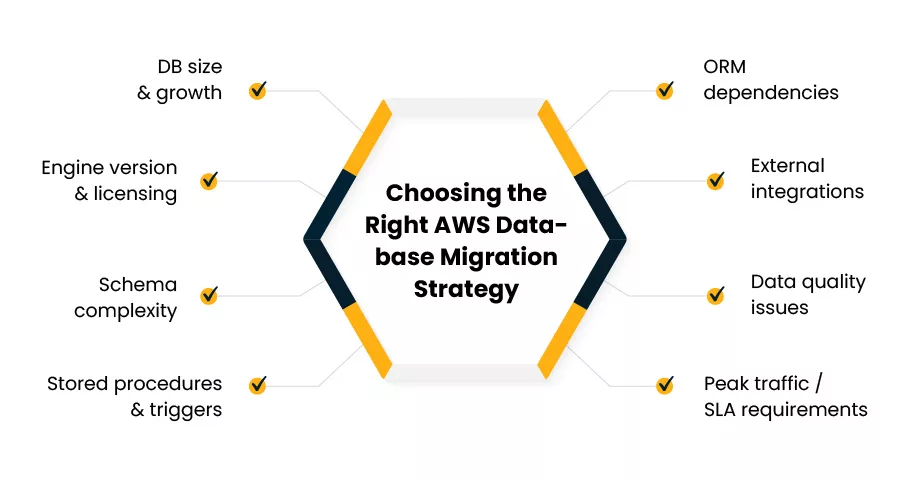
A reliable migration starts with a complete assessment. This prevents surprises later and helps you choose realistic paths. Your goal is to collect enough technical detail to compare schema conversion vs lift-and-shift in a meaningful way.
Key areas to inspect

  • Database size and growth rate
  • Engine version, edition, and licensing
  • Schema complexity
  • Triggers, stored procedures, and proprietary features
  • Integration points that exchange data with other systems
  • Data quality issues
  • Peak usage hours and SLAs

An example of how dependency mapping looks:

[Application Layer]
       |
[ORM / Queries]
       |
[Database Schema]----[Procedures]
       |                |
   [Tables]         [Triggers]
       |
 [External Systems]

This stage sets the foundation for AWS database migration because it shapes a clear cloud architecture strategy.

How do you evaluate different migration paths?

Once the legacy environment is known, Teams explore options. The main question during this stage is again: Which AWS database migration strategy to choose—especially when planning future cloud data analytics workloads. There is no single correct choice, but there is always a correct choice for a specific workload.

The three broad paths

1. Lift and shift

You replicate the source engine directly to the target AWS-managed engine. This reduces development effort and is suitable for teams with tight timelines.

Use it when:

  • Proprietary logic cannot be rewritten quickly
  • Minimal changes are required to resume service
  • Teams want fast adoption before later optimization

2. Convert and migrate

Here you use the AWS Schema Conversion Tool (AWS SCT) to adapt schemas to a new engine. This is the classic approach when moving from commercial engines to open-source AWS Aurora or PostgreSQL.

Use it when:

  • You want to reduce licensing costs
  • Stored procedures and types require translation
  • Long-term architectural flexibility matters

3. Re-design the data model

This is part of cloud database modernization, where teams re-engineer for scalability or analytics workloads.

Use it when:

  • You want a different access model (for example, from relational to DynamoDB)
  • You need scaling beyond a single-node architecture
  • You must meet new compliance rules

This evaluation avoids generic comparisons and instead focuses on operational impact, which is what decision-makers value most.

How should you decide between SCT and DMS?

This is a common point of confusion for teams preparing for AWS database migration.

AWS Database Migration Service

DMS moves data between source and target engines with minimal downtime.

How AWS DMS works:

  • Connects to source and target
  • Uses replication instances
  • Performs full load
  • Applies ongoing changes (CDC)
  • Keeps source and target in sync until cutover
   +------------------+
   |   Source DB      |
   +------------------+
            |
            |  CDC + Full Load
            v
   +------------------+
   |   DMS Instance   |
   +------------------+
            |
            v
   +------------------+
   |    Target DB     |
   +------------------+

DMS keeps latency low and provides a controlled way to move production systems without extended downtime.

AWS Schema Conversion Tool

SCT converts objects like tables, sequences, functions, and procedures into target-compatible formats. This directly supports schema conversion vs lift-and-shift comparisons. SCT generates assessment reports, explains conversion complexity, and shows which objects require manual action.

Rule of thumb

  • Use SCT when the target engine is different
  • Use DMS when the engine is compatible or when the main concern is downtime
  • Use both for mixed environments

This combined model is common in cloud database modernization programs across enterprises.

What migration method should you choose?

Now that you know the tooling options, you define the actual method of migration. This is different from strategy. A method is the operational way in which you execute the plan.

Common methods

Full load only
Suitable for non-production or when downtime is acceptable.

Full load + ongoing replication
Ideal for live systems that cannot stop during migration.

Phased migration
Move parts of the schema or tables in batches. Useful for very large databases.

Dual-write or double-running periods
Complex, but effective when ensuring data consistency between old and new systems during adaptation.

Below is a simplified diagram of a phased migration pattern:

Phase 1: Tables A, B, C  -->  Target
Phase 2: Tables D, E     -->  Target
Phase 3: Procedures      -->  Target
Phase 4: Final Sync      -->  Target

These methods influence operational risk, which is why they matter more than the high-level approach.

How do you validate and test the migrated database?

Testing is not an afterthought. It is a full stage in the plan and a major part of AWS database migration and cloud database modernization. Validation ensures schema consistency, data integrity, and performance stability.

Key types of testing

  • Row count comparison
  • Checksum validation
  • Stored procedure testing
  • Index performance testing
  • User journey validation

Use a structured flow:

[Source DB] --> Row Count --> Compare --> [Target DB]
[Source DB] --> Sample Data --> Compare --> [Target DB]
[Source Query] --> Execution --> Compare Plan --> [Target Query]

These checks confirm that the migrated workload behaves as expected and supports your SLAs.

How do you plan the cutover?

Cutover planning determines how cleanly and safely the switch happens. This is the moment where downtime, user impact, and risk management matter most.

Elements of a solid cutover plan

  • Identify downtime windows
  • Inform all relevant stakeholders
  • Freeze writes on the source engine
  • Check replication lag
  • Perform final synchronization
  • Switch application endpoints
  • Monitor logs and error rates
  • A visual version of the flow looks like this:
[Freeze Writes]
      |
[Check DMS Lag]
      |
[Stop Replication]
      |
[Switch Endpoints]
      |
[Monitor]

The cutover window should be predictable and documented, with fallbacks ready.

How should you optimize the target database after migration?

This final stage ensures that cloud database modernization brings practical results. Optimization is not optional. Without it, you migrate the technical debt of the old system into a new environment.

Checklist-driven optimization

Database modernization checklist:

  • Apply proper indexing
  • Configure parameter groups
  • Set automated backups
  • Set up read replicas
  • Enable performance insights
  • Apply connection pooling
  • Review IAM-based access
  • Audit storage consumption
  • Confirm encryption settings

These steps align the target environment with AWS best practices and support sustainable operation.

How do all migration stages connect?

To give the whole process a single view, here is a high-level ASCII diagram mapping the flow end-to-end:

[Assess Legacy]
       |
[Evaluate Paths] ---> Choose: Lift & Shift / Convert / Re-design
       |
[Pick Tools] ---> SCT / DMS / Both
       |
[Define Method] ---> Full Load / Replication / Phased
       |
[Validate & Test]
       |
[Cutover]
       |
[Optimize Target DB]

This flow supports repeatable execution for AWS database migration initiatives at scale.

FAQs

What is the difference between schema conversion vs lift-and-shift?

Lift and shift rehosts the database without changing the engine. Schema conversion rebuilds the schema for a target engine like Aurora PostgreSQL using SCT.

How does AWS DMS work in real environments?

It performs full load plus ongoing replication, syncing the source and target until the cutover switch.

Which AWS database migration strategy to choose?

The correct strategy depends on schema complexity, downtime tolerance, and the target engine. Teams commonly combine SCT and DMS when moving to open-source engines.

What should organizations take away from this guide?

A successful AWS database migration requires disciplined planning, repeatable steps, and a clear understanding of migration paths. When paired with cloud database modernization, teams improve maintainability, cost control, and performance predictability. The goal is not only to move data but to build a stable foundation for future workloads.

Author

Abhishek Nandan Linkedin
Abhishek Nandan
AVP, Marketing

Abhishek Nandan is the AVP of Services Marketing at Cygnet.One, where he drives global marketing strategy and execution. With nearly a decade of experience across growth hacking, digital, and performance marketing, he has built high-impact teams, delivered measurable pipeline growth, and strengthened partner ecosystems. Abhishek is known for his data-driven approach, deep expertise in marketing automation, and passion for mentoring the next generation of marketers.

Related Blog Posts

What You Need to Know Before Planning a Data Center Exit on AWS?

CalendarAugust 25, 2025

Modernizing SQL Server to Aurora or PostgreSQL Without Breaking Critical Workloads 

CalendarAugust 20, 2025

Cloud Migration Planning: A Detailed Guide to Success

CalendarSeptember 16, 2025

Sign up to our Newsletter

    Latest Blog Posts

    Digital Banking & Road Ahead
    Digital Banking & Road Ahead

    CalendarMarch 03, 2026

    Claiming GST Input Tax Credit? Here’s a checklist for you!
    Claiming GST Input Tax Credit? Here’s a checklist for you!

    CalendarMarch 03, 2026

    GST Audit: Top 5 Steps To Get Ready!
    GST Audit: Top 5 Steps To Get Ready!

    CalendarMarch 03, 2026

    Let’s level up your Business Together!

    The more you engage, the better you will realize our role in the digital transformation journey of your business


      I agree to the Terms & Conditions and Privacy Policy and allow Cygnet.One (and its group entities) to contact me via Promotional SMS / Email / WhatsApp / Phone Call.*

      I agree to receive occasional product updates and promotional messages from Cygnet.One (and its group entities) on Promotional SMS / Email / WhatsApp / Phone Call.

      Cygnet.One Locations

      India India

      Cygnet Infotech Pvt. Ltd.
      2nd Floor, The Textile Association of India,
      Dinesh Hall, Ashram Rd,
      Navrangpura, Ahmedabad, Gujarat 380009

      Cygnet Infotech Pvt. Ltd.
      6th floor, A-wing Ackruti Trade Center,
      Road number 7, MIDC, Marol,
      Andheri East, Mumbai-400093, Maharashtra

      Cygnet Infotech Pvt. Ltd.
      WESTPORT, Urbanworks,
      5th floor, Pan Card Club rd.,
      Baner, Pune, Maharashtra 411045

      Cygnet Infotech Pvt. Ltd.
      10th floor, 73 East Avenue,
      Sarabhai campus, Vadodara, 391101

      Global

      CYGNET INFOTECH LLC
      125 Village Blvd, 3rd Floor,
      Suite 315, Princeton Forrestal Village,
      Princeton, New Jersey- 08540

      CYGNET DIGITAL IT SOLUTION LLC
      Office 707, Magnum Opus Tower,
      Al Thanyah First, Dubai, U.A.E,
      P.O. Box 125608

      CYGNET INFOTECH PRIVATE LIMITED
      Level 35 Tower One,
      Barangaroo, Sydney, NSW 2000

      CYGNET ONE SDN.BHD.
      Unit F31, Block F, Third Floor Cbd Perdana 3,
      Jalan Perdana, Cyber 12 63000 Cyberjaya Selangor, Malaysia

      CYGNET INFOTECH LIMITED
      C/O Sawhney Consulting, Harrow Business Centre,
      429-433 Pinner Road, Harrow, England, HA1 4HN

      CYGNET INFOTECH PTY LTD
      152, Willowbridge Centre,
      39 Cronje Drive, Tyger Valley,
      Cape Town 7530

      CYGNET INFOTECH BV
      Peutiesesteenweg 74, Machelen (Brab.), Belgium

      Cygnet One Pte. Ltd.
      160 Robinson Road,
      #26-03, SBF Centre,
      Singapore – 068914

      • Explore more about us

      • Download Corporate Deck
      • Terms of Use
      • Privacy Policy
      • Contact Us
      © Copyright – 2026 Cygnet.One
      We use cookies to ensure that we give you the best experience on our website. If you continue to use this site we will assume that you are happy with it.

      Cygnet.One AI Assistant

      ✕
      AI Assistant at your help. Cygnet AI Assistant