


































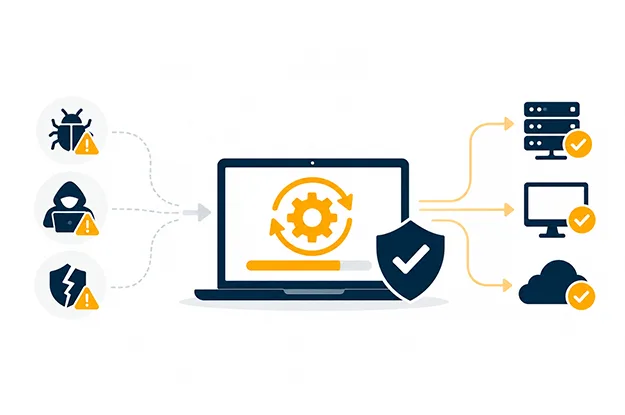
The time required to close a vulnerability often depends more on internal decisions than on the availability of a patch. A security fix may already be available, yet affected systems remain exposed while teams assess dependencies, arrange maintenance windows, secure approvals, or wait for deployment confirmation.
This delay deserves attention because vulnerability exploitation remains a significant entry point for attackers. Verizon’s 2026 Data Breach Investigations Report found that vulnerability exploitation was the initial access path in 31% of breaches. The finding raises an important operational question: how much exposure time comes from technical constraints, and how much comes from delays that enterprises could prevent?
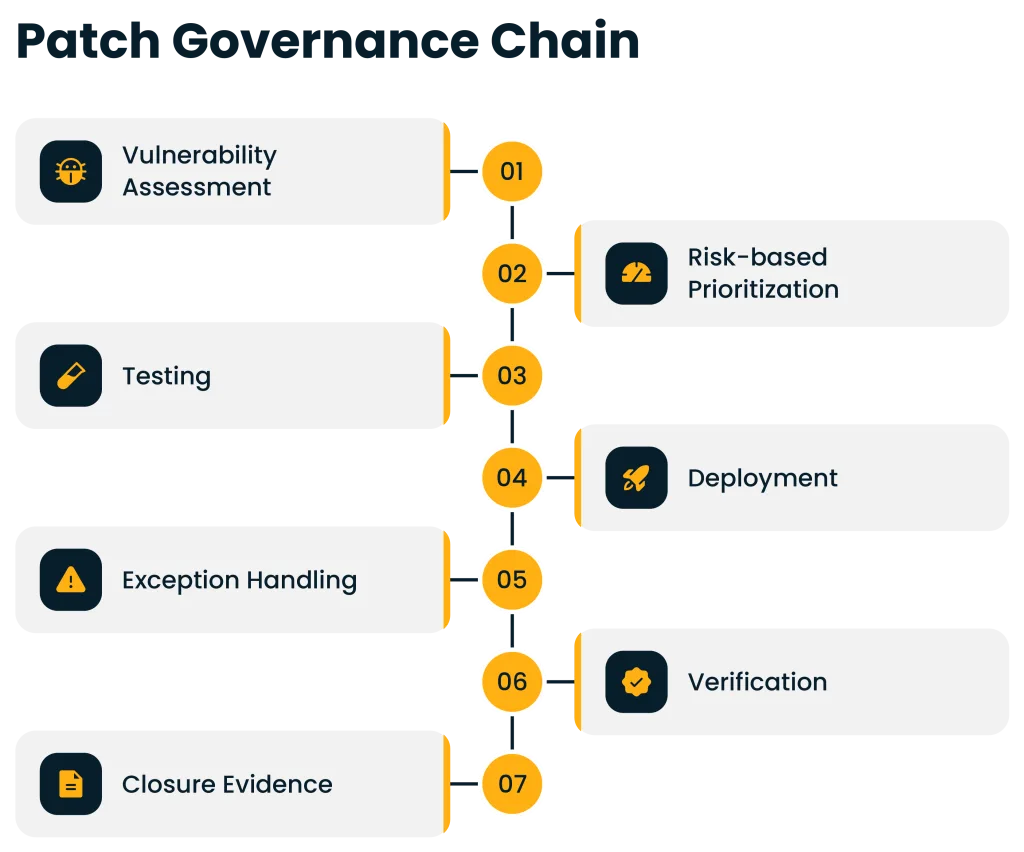
Effective patch governance addresses this question by connecting vulnerability assessment with risk-based prioritization, testing, deployment, exception handling, and verification through managed IT services. For enterprises working with managed IT providers, the objective is to reduce the time between identifying an actionable vulnerability and confirming that the affected systems are protected.
What Patch Governance Covers Beyond Software Updates
Software updates are technical events. The decisions surrounding them involve security, operations, application owners, and sometimes an external provider. Security sees exploit evidence; operations sees a maintenance window; an application owner sees a possible outage.
Patch governance establishes how those views lead to one accountable decision. It defines which assets fall under the policy, which findings warrant emergency action, who approves downtime, and who can accept a temporary exception. It also requires evidence that the chosen response worked.
NIST SP 800-40 Revision 4 describes enterprise patch management as identification, prioritization, acquisition, installation, and verification. Verification matters because a successful deployment command does not establish that an affected service is protected. The installed version may be wrong, a restart may remain pending, or the affected component may sit outside the standard deployment tool.
In enterprise patch management, each finding needs a link to an affected asset, its service, and the next decision owner. Without that link, a critical finding can move between queues while its exposure remains unchanged.
Prioritize Patches by Exploit Evidence and Business Exposure
Severity alone creates a poor work queue. A critical vulnerability in an isolated, unused component may require a different response from a lower-rated issue affecting an internet-facing authentication service. Exploit evidence, reachability, asset function, and existing controls determine the response.
Critical patch prioritization should begin with CISA’s Known Exploited Vulnerabilities catalog for evidence of exploitation in the wild. FIRST’s Exploit Prediction Scoring System, or EPSS, can add an estimate of the likelihood that a published CVE will be exploited within the next 30 days. Neither signal confirms exploitability on a specific asset. Inventory and configuration evidence complete the assessment.
| Signal to examine | What the decision should establish |
| Exploitation observed | Whether immediate mitigation or emergency deployment is required |
| Internet reachability | Whether an attacker can access the affected component |
| Service importance | What interruption or compromise could affect |
| Existing controls | Whether isolation or configuration changes reduce current exposure |
| Patch dependency | Whether firmware, restart, or vendor approval affects deployment |
Enterprise patch management becomes more precise when the queue contains decisions rather than severity labels, making IT infrastructure management important for connecting assets, services, owners, and remediation paths. A public-facing gateway with confirmed exploitation may need immediate isolation while a fix is tested. An isolated internal server may follow a scheduled window if that decision is documented and reassessed as conditions change. The fastest response belongs where delay has the greatest consequence.
Set Testing Windows Without Creating an Open-Ended Delay
Testing protects ERP platforms, clustered databases, and applications with fragile dependencies. Yet a vague instruction to “test first” can leave a high-risk finding untouched while approval passes between teams.
Enterprise patch management needs separate paths for routine updates and emergency fixes. Routine packages can pass through a representative test group; urgent patches need a focused compatibility check, a rollback procedure, and an available decision owner.
The vulnerability remediation process should state who evaluates failed tests and how quickly the decision returns to the change queue. A failure should produce an alternative action, such as restricting exposed ports, disabling an affected feature, or separating a system from untrusted traffic. Those controls need validation and reassessment. The underlying defect remains.
Approval can also outpace execution. If the change is approved before a weekend but the deployment team has no staffed window, the approval adds little protection. The conflict needs an urgent change or an accountable exception.
Make Rollout Cadence Account for Missed and Offline Assets
Monthly maintenance remains appropriate for many stable systems. The problem appears when every asset is treated as if it will connect, install, restart, and report within the same window. Laptops may remain offline, network equipment may need manual steps, and production nodes need careful sequencing to preserve application availability.
A useful cadence includes planned deployment and recovery for missed assets. The planned route covers testing, deployment groups, change notifications, and restart coordination. The recovery route picks up missed devices, failed jobs, disconnected sites, and applications whose dependencies prevented installation.
For enterprise patch management, rollout closure should be based on verified asset status. “Job completed” and “all applicable assets protected” are separate statements. Compare deployment records, inventory, and vulnerability scans to locate the gaps.
Managed IT teams can handle these gaps daily. They can investigate missing agents, repeat failed deployments, coordinate pending restarts, and raise cases that need application-owner approval. Left unattended, they become an aging backlog with little explanation.
Give Patch Exceptions an Owner and an Expiry Date
Patch governance must allow justified exceptions. A hospital application may have a vendor restriction. A manufacturing system may require a shutdown that cannot safely be arranged immediately. Forcing the update can create an outage.
Problems start when “business exception” becomes a permanent ticket status. Patch governance should require a reason, named risk owner, compensating control, review date, and clear route back to remediation. Security can recommend the treatment. The accountable business or system owner must authorize residual risk under the organization’s policy.
Critical patch prioritization cannot end when an exception is approved. A deferred item needs reassessment when exploitation appears, network exposure changes, or the temporary control fails. Exceptions cannot sit outside the prioritization queue simply because someone approved them last month.
A sound vulnerability remediation process also distinguishes a documented acceptance of residual risk from confirmed technical remediation. This prevents an accepted exception from being presented as a patched asset. Auditors and incident responders need that distinction.
Report Remaining Exposure Instead of Patch Activity Alone
Traditional patch compliance reporting often starts with deployment percentages. Those figures can conceal high-consequence systems behind completed workstation updates.
A more useful report answers four questions:
- Which affected assets remain exposed?
Show the service, exploit evidence, current mitigation, and age of the finding. - What is blocking closure?
Distinguish technical failure, pending restart, test issue, unavailable window, and awaiting approval. - Who can remove the block?
Record an individual decision owner rather than a shared mailbox or generic team. - What evidence proves closure?
Include installed version, successful restart when required, rescan results, or confirmation of a validated mitigation.
Useful patch compliance reporting separates two clocks: decision latency, from confirmed finding to authorized action, and execution latency, from authorization to verified risk treatment. Together they show observed closure time, not the unknown date when exposure first began. If approval consumes most of that time, faster deployment software will barely change the result.
This view also makes IT security hygiene more actionable when supported by cybersecurity services that connect vulnerability exposure, controls, and remediation ownership. Inventory gaps, stale agents, unreliable maintenance records, and unsupported devices appear as specific constraints on remediation. Management can then assign corrective work.
How Managed IT Services Reduce Vulnerability Windows
Outsourcing patch execution alone is unlikely to fix decision delays. Managed patching services are more useful when responsibilities span detection through verification, with clear boundaries for business approval and risk acceptance.
A managed provider can correlate vulnerability findings with an agreed asset inventory, identify likely affected systems, prepare changes, run approved deployment jobs, pursue failed installations, and present verification evidence. The client retains decisions about acceptable service interruption and residual risk unless the contract explicitly delegates specific authority.
Handoffs deserve particular scrutiny. A security alert should create an actionable record with asset ownership and an assigned response route. A failed update should produce a follow-up task, not disappear into a deployment summary. An expiring exception should return for review before its control becomes outdated.
In enterprise patch management, these details matter more than a broad promise of round-the-clock monitoring. A service agreement needs a defined inventory scope covering servers, endpoints, cloud workloads, applications, and network devices. Responsibility for vendor-managed systems should be explicit.
The agreement should also specify urgent-review triggers, triage commitments, emergency change authority, and duties for testing, rollback, restarts, rescanning, and exception follow-up as part of IT strategy and consulting. Reports need to identify unresolved cases and ownership gaps between tools and teams. If those responsibilities remain vague during procurement, they usually remain difficult during an emergency.
Managed patching services can reduce the interval between a finding and effective control when these duties are staffed, measured, and acted upon. Incomplete asset coverage, unavailable owners, and unpatchable systems can still hold up remediation.
Questions That Expose Weaknesses in a Managed Patching Proposal
An enterprise patch management provider should be assessed beyond tools and deployment frequency. Ask for a sample report showing a failed critical update through detection, retry, decision, and verified closure. Request the procedure for an emergency vulnerability discovered outside the normal maintenance calendar. Check whether an exception can expire without generating a new action.
The strongest evidence is the handling of awkward cases: an unsupported appliance, a database restart postponed for a major business process, or an endpoint that has been offline for weeks. These cases reveal accountability beyond automated jobs.
Another useful test is ownership of the inventory. If asset discovery sits with one supplier, deployment with another, and application approval with an internal group, the proposal needs named handoffs and shared records. Otherwise, outsourcing adds a queue without reducing exposure.
This is also where IT security hygiene and commercial accountability meet. Reports must expose overdue decisions in both service reviews and security discussions.
Reduce Vulnerability Windows with Clear Ownership and Faster Action
A patching program can be busy and still leave important vulnerabilities open, which is why enterprises need to understand how managed IT services work beyond deployment activity.. The test is the time from confirmed finding to verified protection, especially when testing fails or approvals stall.
Patch governance provides the decision rules and evidence required to keep that work moving. With managed IT support, those rules can become repeatable daily operations, provided the agreement covers exception follow-up, verification, and difficult assets alongside deployment. The result worth measuring is fewer days of avoidable exposure on the services that matter most.
Author


Yogita Jain
Content Lead
Yogita Jain leads with storytelling and Insightful content that connects with the audiences. She’s the voice behind the brand’s digital presence, translating complex tech like cloud modernization and enterprise AI into narratives that spark interest and drive action. With a diverse of experience across IT and digital transformation, Yogita blends strategic thinking with editorial craft, shaping content that’s sharp, relevant, and grounded in real business outcomes. At Cygnet, she’s not just building content pipelines; she’s building conversations that matter to clients, partners, and decision-makers alike.