

































Cloud cost models often stop at the resource, while the bill continues along the network path. Data can cross Availability Zones, gateways, inspection layers, regions, and the public internet before reaching its destination. The payload stays the same. Its route changes the cost.
That distinction is where forecasts fail. Compute and storage appear as named resources; network movement hides inside replication, routing, service calls, inspection, and customer delivery. AWS data transfer is not a minor billing category, where aws cloud consulting services help enterprises model traffic paths, transfer pricing, architecture trade-offs, and cost controls. It is a record of architectural behavior.
Model traffic by journey, not by service. A payload crossing Availability Zones, a Transit Gateway, a NAT Gateway, and the internet may incur a separate charge at each boundary. That is how egress costs grow without a rise in users or transactions.
What Actually Sits Inside an AWS Cloud Bill?
Cost models start with instances, databases, storage, requests, and support. Network expense requires five more fields: source, destination, direction, path, and intermediary. Miss one, and the estimate can be wrong.
Transfer and processing are also different charges. A NAT Gateway, Transit Gateway, interface endpoint, or inspection layer may bill for processed bytes even when the route has a low or zero transfer rate. A sound cloud cost optimization AWS review separates these meters.
Use this diagnostic during design:
Network cost ≈ (billable GB × transfer rate) + (processed GB × intermediary rate)
Billable volume includes every crossing, copy, retry, and repeated read.
How AWS Data Transfer Pricing Works by Traffic Path
The answer depends on where data starts, ends, and which services handle it. AWS recommends modeling source, destination, classification, frequency, and expected usage, then comparing options with the Pricing Calculator or billing data.
| Traffic path | Typical billing behavior | Common modeling error |
| Into AWS from the internet | Often no inbound transfer charge | Assuming the return path is also free |
| Between Availability Zones | Regional charges may apply to both sides | Treating one region as one free network |
| Between regions | Outbound transfer is usually charged by the source | Pricing replication once instead of continuously |
| Through NAT or Transit Gateway | Processing can sit beside transfer charges | Counting only the final internet rate |
| Through CloudFront | Delivery pricing applies; AWS-origin transfer is waived | Comparing CDN cost without origin savings |
The working answer to how AWS data transfer pricing works is to follow every hop and check each service’s pricing page. Service exceptions matter; a clean diagram can still hide an expensive route.
Where Hidden Network Charges Accumulate
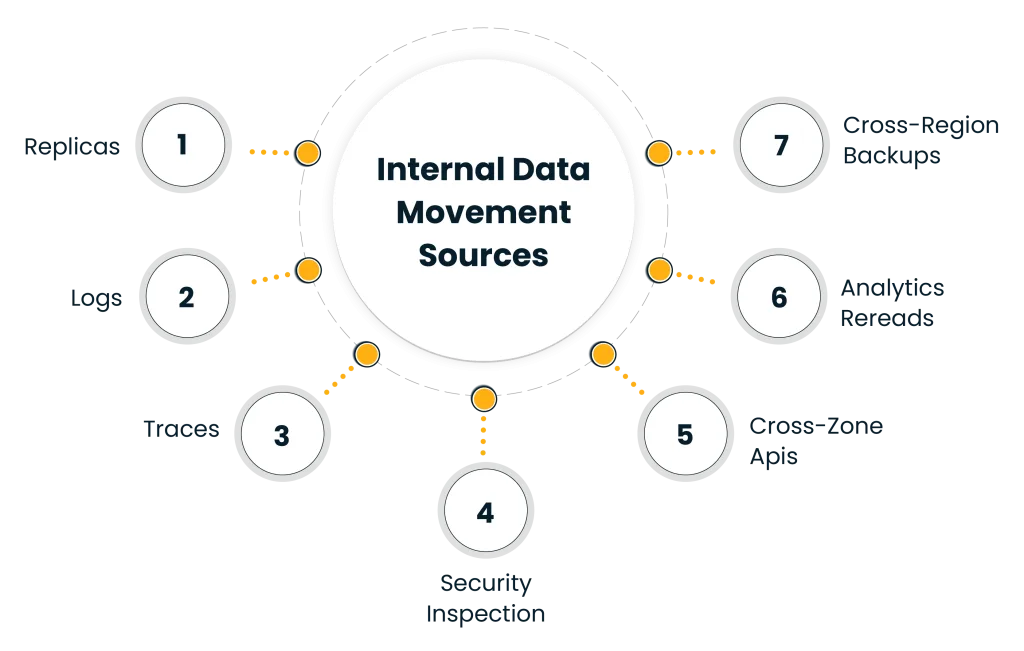
The largest surprises often come from repeated internal movement. Replicas receive writes. Agents ship logs and traces. Security tools inspect traffic. Services call APIs across zones. Analytics jobs reread objects. Backups leave their home region.
Four patterns deserve scrutiny:
- Cross-zone chatter: Small service calls become large monthly totals when request volume, retries, and response bodies are counted in both directions.
- NAT hairpinning: Private workloads reach S3 or DynamoDB through a NAT path instead of a gateway endpoint.
- Centralized routing: Fewer gateways reduce hourly resources, yet Transit Gateway processing can make high-volume traffic more expensive.
- Unbounded delivery: APIs return oversized payloads, media bypasses caching, and clients repeatedly download unchanged content.
AWS billing records identify cross-zone usage with regional byte line items and can show both inbound and outbound entries for metered resources. That detail is why AWS Cost and Usage Reports reveal more than a top-level service chart.
Architecture Trade-offs Behind AWS Egress Charges
Cost reduction cannot become a disguised reliability cut. Multi-AZ placement protects service continuity, while cross-zone traffic may carry a charge. The correct response is not to collapse the workload into one zone. Keep redundant capacity but preserve zonal affinity for high-volume paths and cross zones when failure handling requires it.
The same judgment applies to internet access. A Regional NAT Gateway can simplify multi-AZ operations and maintain zonal affinity automatically, but AWS bills hourly per active Availability Zone and charges for each gigabyte processed. Simpler operations do not guarantee a lower bill.
Multi-region designs have a similar tension. Replication, read locality, recovery objectives, and regulatory needs can justify the expense. The mistake is copying every dataset at the same frequency. Define which data must be current, which can lag, and which can be rebuilt. That decision often matters more than negotiating a lower per-gigabyte rate.
Reducing AWS Egress Costs Without Weakening the Design
Effective optimization removes unnecessary movement before seeking cheaper movement, supported by cloud engineering services that improve routing, endpoint design, caching, compression, and workload placement. Start with these actions:
- Build a traffic ledger
Record producer, consumer, direction, daily gigabytes, zone, region, route, and business purpose. Review it beside the application dependency map. - Keep frequent exchanges local
Place tightly coupled components near each other while retaining tested failover paths. - Use the right endpoint
Gateway endpoints for S3 and DynamoDB have no hourly or data-processing charge, while interface endpoints require a volume-based comparison. - Cache repeated delivery
CloudFront waives transfer between the distribution and AWS origins, while cached responses also reduce origin requests. - Reduce the byte count
Compress responses, paginate APIs, remove duplicate events, tune log verbosity, and stop unnecessary retries. - Assign cost ownership
Report network spend by product, environment, and traffic purpose, not only by AWS account, where AWS managed services help maintain cost visibility, anomaly response, and operational governance after deployment.
A disciplined AWS data transfer review should also track cost per business activity: per order, device, report, tenant, or streamed hour. Raw spend says what happened. Unit cost shows whether the architecture is becoming less efficient.
Inter-Region Data Transfer Costs AWS Teams Commonly Underestimate
An analytics platform may replicate source data to a second region, then copy curated outputs, replay failed batches, and support queries against the remote copy. The resulting transfer volume can exceed the original ingestion volume because the model priced the dataset rather than its operating behavior.
A better design classifies flows. Critical recovery data receives continuous replication. Derived tables are rebuilt in the target region. Analyst access uses local summaries. Failed jobs resume from checkpoints instead of retransmitting complete files. These are practical AWS cost optimization strategies for data transfer reviews and architecture planning.
In a container platform, unrestricted cross-zone service calls and S3 traffic routed through NAT can create both regional transfer and gateway-processing charges. Zonal routing for routine calls, resilient cross-zone failover, and an S3 gateway endpoint reduce unnecessary movement without weakening availability. This is the real work of reducing AWS egress costs.
Make Network Movement a First-Class Cost Driver
Cloud cost models break when bytes are treated as passive. They are active participants in replication, resilience, security, analytics, and customer experience. Every copy and route expresses a design decision.
The strongest control is a pre-deployment traffic model verified against Cost and Usage Report 2.0, VPC Flow Logs, and service metrics after release, supported by cloud governance models that make cost ownership visible. AWS Data Exports for CUR 2.0 provides detailed billing data that teams can use to investigate transfer charges by service, account, and usage type.
When AWS data transfer becomes part of architecture review, egress costs stop arriving as unexplained variance. Teams can defend necessary movement, remove accidental movement, and connect each network charge to a business outcome. That is the difference between trimming a bill and building a cloud cost model that survives real traffic.
Author


Yogita Jain
Content Lead
Yogita Jain leads with storytelling and Insightful content that connects with the audiences. She’s the voice behind the brand’s digital presence, translating complex tech like cloud modernization and enterprise AI into narratives that spark interest and drive action. With a diverse of experience across IT and digital transformation, Yogita blends strategic thinking with editorial craft, shaping content that’s sharp, relevant, and grounded in real business outcomes. At Cygnet, she’s not just building content pipelines; she’s building conversations that matter to clients, partners, and decision-makers alike.