




































An identity bridge can remain green while access is wrong. A contractor may retain an AWS permission set after leaving Active Directory; a WAN failure may block Kerberos; a valid SAML assertion may map the user to an excessive role.
Microsoft recorded a 32% rise in identity-based attacks during the first half of 2025, with password attacks making up more than 97%.
The key design questions begin after authentication: which directory owns the identity record, which system governs access entitlements, and which controls fail closed when connectivity is lost?
A dependable hybrid identity AWS design answers those questions before connecting a directory, which is why enterprises need a strong cloud security architecture across identity, access, workloads, and governance. It treats identity as an operating system for workforce access, not plumbing between login screens.
Why Hybrid Identity Fails at the Boundary
The difficult part is rarely password validation. Trouble appears where identity data, group membership, network availability, and AWS permissions meet.
An on-premises directory may remain authoritative for employees, while contractor identities are created and managed in a cloud identity provider. Group names may describe job titles rather than access intent. Deprovisioning may remove an account but leave an active AWS session. During a network incident, administrators may discover that every privileged sign-in depends on one damaged circuit.
This is why on prem to cloud identity management should be reviewed as a lifecycle. Joiner, mover, leaver, privilege change, session revocation, and emergency access need named owners and measurable completion times. The directory record is only the first event.
How Hybrid Identity Works Between Active Directory and AWS
A useful cloud identity architecture separates three planes. Combining them creates hidden coupling.
| Plane | Architectural question | Typical failure |
| Identity authority | Where are people, groups, and status mastered? | Duplicate or stale identities |
| Authentication path | Which system verifies the user and MFA? | Sign-in outage or weak factor |
| Authorization fabric | How does business intent become AWS access? | Excessive or orphaned permissions |
In hybrid identity AWS, Active Directory or a corporate provider usually remains the identity authority. AWS IAM Identity Center becomes the access broker for AWS accounts and applications. Permission sets convert group assignments into managed IAM roles across member accounts. Users receive temporary credentials instead of permanent IAM user keys.
Authentication can remain with the enterprise provider while authorization is expressed in AWS-native policies, following AWS landing zone best practices for account access, permissions, and governance. A directory team can own identity status without becoming responsible for every S3, KMS, or database permission.
A practical rule: synchronize identity facts, not infrastructure history. Old organizational units, nested groups, and inherited privileges should not cross the boundary automatically.
Which AWS Federation Model Fits Your Environment?
Three models cover most enterprise requirements.
1. External identity provider to IAM Identity Center
Use SAML 2.0 for sign-in and SCIM for user and group provisioning. This suits Microsoft Entra ID, Okta, Ping, and other supported providers. AWS permits one identity source per IAM Identity Center organization instance, so ownership must be settled early.
This is the preferred AWS identity federation pattern when the enterprise provider already handles MFA, conditional access, device policy, and account lifecycle.
2. Active Directory through AWS Directory Service
AD Connector proxies requests to on-premises domain controllers without storing directory data in AWS. It reduces duplication, but authentication still depends on network reachability, DNS, and domain controller health.
AWS Managed Microsoft AD provides managed domain controllers in AWS. A trust can connect its forest with the on-premises forest. Hybrid Edition extends an existing self-managed AD domain into AWS, reducing the need for a separate forest.
3. Direct federation into individual AWS accounts
SAML providers can be configured in each account and mapped to IAM roles. This works for isolated accounts but creates repeated trust configuration and uneven policy handling. AWS guidance favors the IAM Identity Center for centralized workforce access as accounts and application numbers grow.
Searches for identity federation AWS SSO still surface older terminology. AWS Single Sign-On is now IAM Identity Center. Documents should use the current name and retain redirects.
AWS Active Directory Integration Without Duplicate Identity Stores
Choose AD Connector when AWS services must validate existing AD users and the on-premises directory will remain available. Choose AWS Managed Microsoft AD when Windows workloads need domain services near AWS resources, forest trust or group policy. Choose an external provider when workforce access is the main requirement and applications do not need Kerberos or LDAP.
Good AWS Active Directory integration starts with traffic analysis, supported by cloud engineering services that design secure connectivity, DNS, directory integration, and resilient access paths. Map DNS, Kerberos, LDAP, Global Catalog, certificate, and time dependencies. Test both VPN or Direct Connect paths. Measure authentication latency from the AWS workload, not an administrator laptop.
For hybrid identity AWS, the directory location decision and workforce access decision are separate. A Windows server may need domain membership even when engineers reach the AWS console through a cloud provider.
Security Controls That Matter After Successful Sign-In
MFA is necessary, but it does not correct bad authorization. External providers should enforce MFA before issuing SAML assertions because IAM Identity Center does not apply its own MFA to external identity sources. For AD Connector, AWS Managed Microsoft AD, or the Identity Center directory, MFA can be configured within IAM Identity Center.
Apply these controls:
- Map groups to job functions, not individuals.
- Separate read, operator, administrator, and security duties.
- Keep privileged permission sets short-lived.
- Test leaver revocation against console and CLI sessions.
- Maintain monitored emergency roles outside federation.
- Record SAML, SCIM, IAM Identity Center, IAM, and STS activity in CloudTrail.
IAM Identity Center records successful and failed sign-ins, while CloudTrail captures administrative and SCIM API activity. Session duration can reach 12 hours, so a disabled account may retain valid role credentials until expiry unless sessions are actively ended.
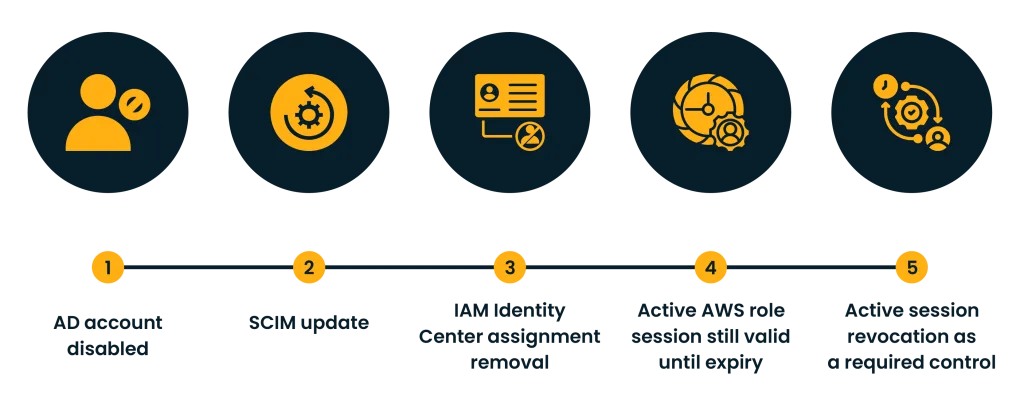
These controls define hybrid identity architecture AWS best practices better than a diagram of directories and arrows.
Implementation Sequence for Hybrid Identity AWS
Start with access outcomes, then choose technology.
- Inventory workforce populations, directories, applications, AWS accounts, and privileged paths.
- Declare one authoritative source for each identity type.
- Design permission sets from tasks and risk, not existing AD group sprawl.
- Select SAML and SCIM, AD Connector, managed AD, or direct federation by workload need.
- Build redundant DNS and network paths before production authentication depends on them.
- Pilot with one business group and one noncritical account.
- Test joiner, mover, leaver, expired certificate, failed SCIM token, WAN outage, and IdP outage scenarios.
- Add CloudTrail alerts, access reviews, and ownership records before wider rollout.
For business-critical access, identity federation needs a continuity plan, and AWS managed services help monitor access health, privileged activity, operational resilience, and incident response. IAM Identity Center supports replication to additional AWS Regions for organization instances, helping users retain account access during a primary-region disruption. The external provider and network path still require their own resilience design.
A hybrid identity AWS implementation is complete only when operations can explain failure behavior without opening the architecture diagram.
Design the Failure Path First
A sound hybrid identity AWS architecture keeps one identity truth, uses temporary credentials, expresses authorization through reviewed permission sets, and treats network dependency as a security concern. Directory availability and access availability are not identical.
The final operational test for identity federation is not whether an employee can sign in on launch day. It is whether access changes quickly after a role change, disappears after departure, survives a contained outage, and leaves enough evidence for an investigator to reconstruct every decision.
Author


Yogita Jain
Content Lead
Yogita Jain leads with storytelling and Insightful content that connects with the audiences. She’s the voice behind the brand’s digital presence, translating complex tech like cloud modernization and enterprise AI into narratives that spark interest and drive action. With a diverse of experience across IT and digital transformation, Yogita blends strategic thinking with editorial craft, shaping content that’s sharp, relevant, and grounded in real business outcomes. At Cygnet, she’s not just building content pipelines; she’s building conversations that matter to clients, partners, and decision-makers alike.