
































3:07 a.m. A payment fails.
Not in your app. In your data warehouse.
No one planned for that delay. The dashboard updates every four hours. Finance spots the anomaly the next morning. By then, the marketing team has already doubled the ad spend based on yesterday’s numbers.
This is not a tooling problem. It is an architecture choice.
When teams debate event-driven data pipelines versus AWS ETL, they often discuss modern aws cloud consulting services and tooling trade-offs. Few talk about unit economics. Fewer talk about engineering cost drivers. Almost no one ties it back to FinOps.
Let’s fix that.
Unit Economics: What Does One Data Event Actually Cost You?
Every data system has a unit.
For batch systems, the unit is usually a job run.
For streaming systems, it is an event.
The difference sounds subtle. It is not.
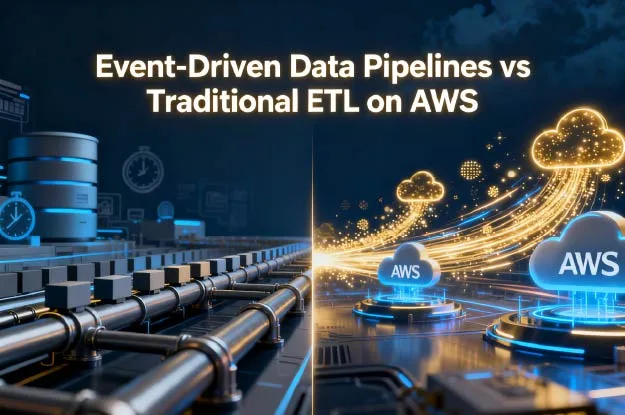
In traditional AWS ETL, you extract data from sources, stage it, clean it, and load it into a warehouse using structured data analytics services. Hourly. Daily. Sometimes weekly. The unit cost is tied to compute hours, storage scans, and job orchestration.
In event-driven data pipelines, the unit cost is tied to each event published, processed, enriched, and stored. The architecture is built around triggers. A new order arrives. A file lands in S3. A row changes in DynamoDB. Something happens immediately.
From a finance lens, this becomes a math problem:
- Cost per batch job run
vs - Cost per event processed
Now imagine 50 million small events per day. Or five large batch runs scanning terabytes.
Which is cheaper?
The honest answer: it depends on workload shape, latency tolerance, and how clean your architecture is.
This is where most blog posts stop. They say, “real-time is better.” That is lazy thinking.
Engineering Cost Drivers You Should Not Ignore
Let’s get specific.
1. Compute Consumption Patterns
Traditional AWS ETL tools like AWS Glue often run on provisioned or job-based compute. You pay when the job runs. Long-running transformations increase cost. Poor partitioning increases the cost. Reprocessing increases the cost.
With real-time data pipelines AWS, compute is often tied to services like Lambda, Kinesis, MSK, or EventBridge. You pay per invocation, per shard hour, or per message volume.
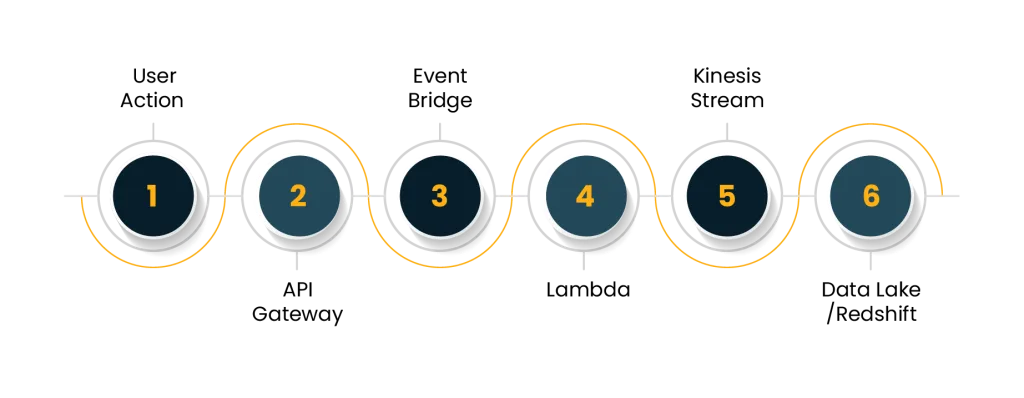
Batch systems concentrate cost into time windows.
Event systems distribute cost across the day.
The shape of your workload matters more than ideology.
2. Data Volume Variability
If your traffic is spiky, batch vs streaming data processing becomes a financial discussion.
Batch systems do not care about micro-spikes. They scan what is there when they run.
Streaming systems care deeply. A flash sale can multiply event volume. That means more Lambda invocations. More Kinesis throughput. More downstream writes.
If you design poorly, your real-time pipeline becomes a real-time bill shock.
3. Operational Complexity
Traditional ETL pipelines are predictable. Schedules. Dependencies. Logs. Reruns.
AWS event-driven architecture data flows are different. They are distributed. Asynchronous. Often multi-service. Debugging can mean tracing an event from API Gateway to Lambda to SQS to Glue to Redshift.
Operational overhead is not always visible in cost reports. But it shows up in engineering hours.
If your team spends nights debugging distributed event flows, that is a cost driver.
Architecture Trade Offs: What Are You Actually Buying?
The decision is rarely about speed alone. It is about trade-offs.
Latency vs Aggregation Efficiency
Batch jobs aggregate data in bulk. That makes warehouse writes efficient. It reduces fragmentation. It simplifies downstream BI queries.
Event-driven data pipelines prioritize immediacy. That means more frequent writes. Smaller payloads. Potentially higher I/O operations.
If your analytics use case does not require second-level freshness, real-time might not justify the cost.
State Management
In AWS ETL, the state is usually implicit. Each run processes a defined dataset. Partition boundaries help manage incremental loads.
In streaming pipelines, state management becomes explicit. Windowing. Deduplication. Idempotency. Late event handling.
These are not academic details. They affect engineering effort and runtime stability.
Failure Handling
Batch failures are loud and centralized. The job fails. You rerun it.
Streaming failures are quiet and distributed. A dead-letter queue fills slowly. An event type fails only under certain payload conditions. The issue may surface hours later.
When comparing modern data integration AWS approaches, ask how failure visibility aligns with your team’s maturity in cloud-native architecture environments.
Measuring Unit Cost: A Practical Framework
Here is a simple way to compare architectures.
Step 1: Define the Unit
For batch:
Cost per GB processed per run.
For streaming:
Cost per 1 million events processed end-to-end.
Step 2: Map All Services Involved
For AWS ETL:
- Glue job runtime
- S3 storage
- Redshift or Snowflake compute
- Step Functions orchestration
For event-driven data pipelines:
- EventBridge or Kinesis
- Lambda invocations
- Downstream processing
- Storage writes
- Monitoring services
Do not forget logging and observability costs.
Step 3: Simulate Real Traffic
Run numbers based on actual traffic patterns. Not peak marketing slides. Not best-case assumptions.
Many teams are surprised. Small events can cost more in aggregate than a few well-optimized batch runs.
On the other hand, heavy reprocessing in batch systems can quietly drain budgets.
FinOps Alignment: Architecture Is a Financial Decision
Architecture without cost visibility is guesswork.
FinOps forces clarity.
With real-time data pipelines AWS, costs are variable. They grow with event volume. That aligns well with revenue-linked systems. More users. More events. More revenue. More cost. That symmetry can be healthy.
With AWS ETL, costs are more predictable. Scheduled runs. Known resource windows. That predictability helps finance teams plan.
The real question is this:
Does your business value freshness enough to pay for it?
If fraud detection improves by 3% because you process transactions instantly, that may justify a streaming pipeline.
If executive dashboards are reviewed weekly, daily batch loads are probably enough.
The decision should not be technical first. It should be economic first.
Continuous Optimization: The Work Never Ends
Choosing event-driven data pipelines does not mean you are done. Nor does sticking with AWS ETL.
Optimization is ongoing.
For Batch Systems
- Partition data correctly in S3.
- Avoid full table scans.
- Use incremental loads.
- Monitor Glue job duration trends.
Even small inefficiencies compound over time.
For Streaming Systems
- Tune Kinesis shard counts.
- Right-size Lambda memory.
- Filter events early.
- Archive infrequently used streams.
In AWS event-driven architecture data environments, small configuration choices affect monthly spend.
Do not treat streaming as set-and-forget.
Where Do Hybrid Models Win?
The debate is often framed as binary. That is misleading.
Many strong architectures combine both.
For example:
- Use streaming for operational alerts and user-facing features.
- Use batch aggregation for warehouse loads and reporting.
- Use CDC pipelines to capture changes but load warehouses in micro-batches.
This approach respects both latency needs and cost efficiency.
In modern organizations, modern data integration AWS rarely means abandoning batch entirely. It means choosing the right processing style per workload.
A Reality Check for 2026
In 2026, most AWS-native data platforms support both paradigms seamlessly. The tooling is mature. The marketing noise is loud.
What still separates strong teams from average ones is clarity on trade-offs.
When comparing batch vs streaming data processing, do not ask which is newer. Ask:
- What is the business latency requirement?
- What is the acceptable unit cost?
- What is the team’s operational maturity?
- How variable is traffic?
- What does failure look like?
These questions matter more than architecture diagrams.
A Short Case Reflection
One retail client moved entirely to streaming. Every click. Every cart change. Every inventory update. Processed instantly.
Their monthly cloud bill increased sharply. Not because streaming is bad. But because they streamed data that did not need real-time handling.
They later shifted to a mixed approach:
- Real-time only for payment validation and inventory locks.
- Hourly aggregation for marketing dashboards.
- Daily consolidation for finance reporting.
The result was lower cost and simpler operations. Not less modern. Just more intentional.
So, Which Should You Choose?
If your system depends on immediate reactions, dynamic pricing, fraud checks, or live personalization, event-driven data pipelines make sense.
If your workflows revolve around reporting, compliance, periodic reconciliation, or large historical transformations, AWS ETL remains practical.
T The strongest data platforms on AWS today are not dogmatic. They are deliberate—often designed using modern aws migration and modernization strategies.
They measure unit cost.
They align architecture with revenue.
They review cost per event.
They review cost per batch.
They iterate.
Final Thought
The real debate is not real-time versus batch.
It is discipline versus impulse.
Streaming feels advanced. Batch feels old. But architecture maturity shows in cost awareness, not buzzwords.
Before you redesign your platform around real-time data pipelines AWS, run the numbers. Before you dismiss streaming as expensive, test it against actual business impact.
Data engineering is not about speed alone. It is about intent.
And intent shows up clearly on your AWS bill.
Author


Yogita Jain
Content Lead
Yogita Jain leads with storytelling and Insightful content that connects with the audiences. She’s the voice behind the brand’s digital presence, translating complex tech like cloud modernization and enterprise AI into narratives that spark interest and drive action. With a diverse of experience across IT and digital transformation, Yogita blends strategic thinking with editorial craft, shaping content that’s sharp, relevant, and grounded in real business outcomes. At Cygnet, she’s not just building content pipelines; she’s building conversations that matter to clients, partners, and decision-makers alike.