
















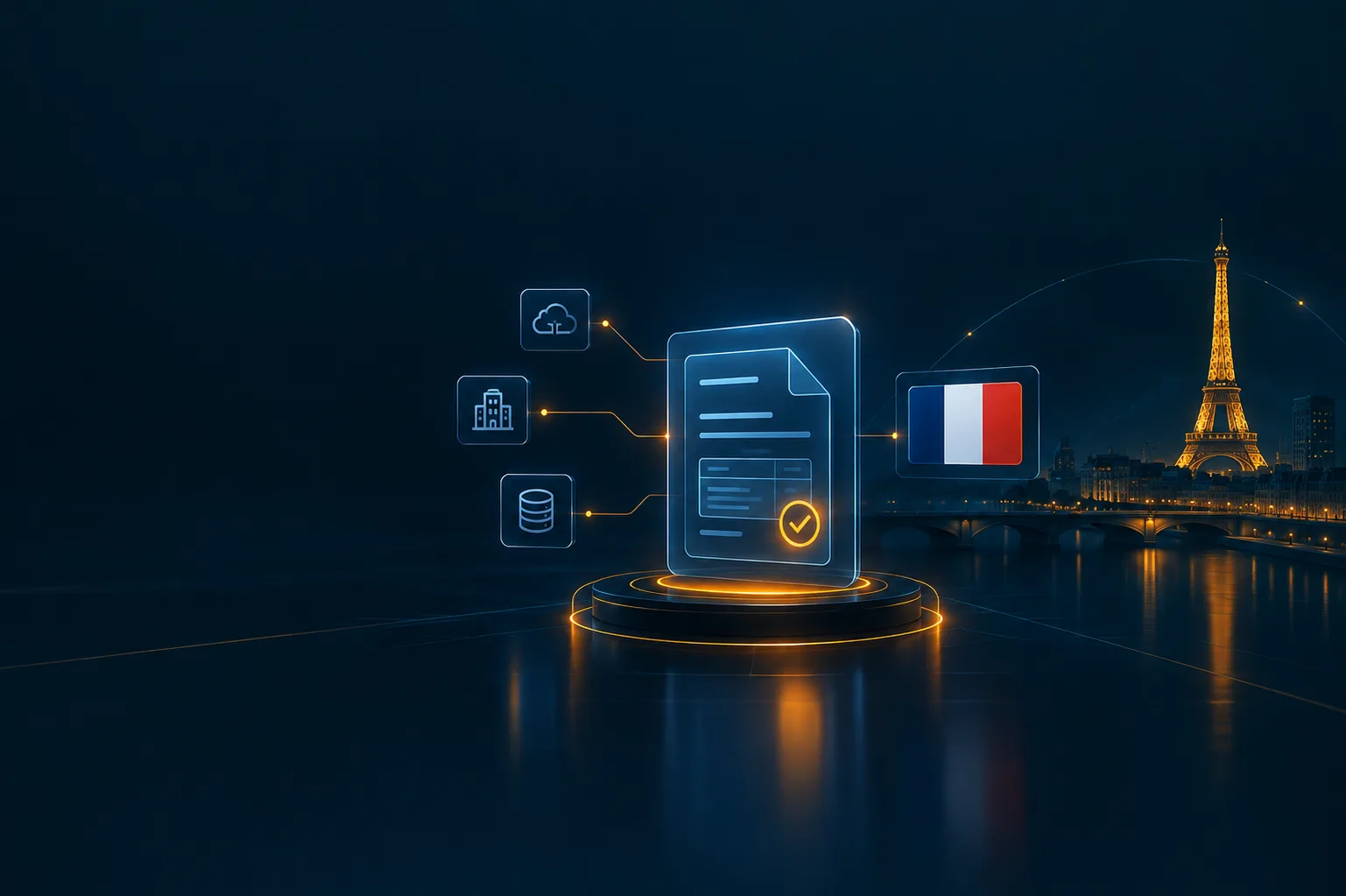
France’s e-Invoicing reform changes how invoice data moves between enterprise systems, platforms and business partners. For large and complex organizations, the ERP remains the primary source of commercial and tax data, but it cannot work in isolation. France e-Invoicing integration needs to connect ERP or billing systems with a registered Partner Dematerialisation Platform (PDP), support applicable e-reporting, and return processing information to the source system.
The core flow is:
ERP → Integration/API Layer → PDP → Customer / Tax Administration → Status & Response → ERP
What Does France e-Invoicing Integration Actually Connect?
Rather than beginning with invoice formats, it helps to start with the systems involved.
ERP, Accounting or Billing System
The ERP or billing environment is normally the source of customer data, invoice details, tax information, line items, payment information and transaction references. Data quality at this stage directly affects downstream processing.
Integration Layer
The integration layer extracts data, transforms and maps fields, validates the payload, and manages API connectivity. It can also receive responses and route exceptions back to the appropriate business system or team.
PDP
A registered PDP is the platform through which businesses exchange electronic invoices and transmit applicable e-reporting data to the French tax administration. The France e-Invoicing solution therefore becomes a critical exchange and reporting point in the architecture.
Recipient and Tax Administration
The destination depends on the transaction. A domestic B2B transaction within e-invoicing scope follows an electronic invoice exchange flow, while certain B2C and international transactions require applicable e-reporting.
The France e-Invoicing Integration Architecture
The ERP provides the underlying transaction data. The integration layer extracts and maps that data. The validation layer checks completeness and business rules before transmission. The API provides the technical interface with the approved platform, while the PDP manages invoice exchange and applicable reporting flows.
The response should then return to the ERP so that status, exceptions and accounting records remain synchronized. France e-Invoicing integration is therefore a bidirectional process rather than a simple outbound connection.
France’s published technical framework includes an API for interfacing enterprise information systems with approved platforms.
What ERP Data Must Be Ready for French e-Invoicing?
A strong data-mapping exercise should establish where each required element originates and whether it can be transferred consistently.
| ERP data | Integration consideration |
| Supplier information | Legal entity and required identification |
| Customer information | SIREN and recipient data |
| Invoice number | Unique invoice identification |
| Invoice date | Correct date mapping |
| Line items | Product or service, quantity and pricing |
| VAT data | Tax category, rate and amount |
| Invoice totals | Net, VAT and gross values |
| Payment information | Payment terms and applicable data |
| Delivery information | Delivery address where applicable |
| Transaction type | e-Invoicing or e-reporting classification |
| References | PO, contract or related document |
| Status | Processing, acceptance, rejection and lifecycle status |
Under France e-Invoicing requirements, structured invoices include information such as supplier and customer SIREN numbers, invoice date, and applicable delivery information. The structured data requirements are also being introduced progressively, with the French administration describing 26 mandatory structured data points in 2026 and 34 from 2027.
The practical integration question is therefore not only whether a field exists in the ERP. Teams need to know whether the value is complete, correctly maintained, consistently populated and available for mapping.
France e-Invoicing API: How Should the ERP Connect to the PDP?
The France e-Invoicing API layer should support both outbound invoice transmission and inbound status or invoice reception.
Outbound Invoice Transmission
ERP → API → PDP
The process should extract invoice data, transform it, validate the resulting payload and submit it to the relevant platform. Pre-submission validation can reduce avoidable downstream rejection.
Inbound Invoice Reception
PDP → API → ERP
The integration should also receive supplier invoices and relevant structured data, update accounts payable workflows, route documents for processing and capture lifecycle information.
Status and Lifecycle Updates
Integration should not stop after submission. The ERP should consume relevant acceptance, rejection, processing and exception information. This creates a closed loop between the source transaction and its downstream outcome.
E-Reporting Data
The architecture may also need to support transaction and payment data reporting, depending on the transaction and applicable obligation. The French administration distinguishes e-Invoicing from e-Reporting, so the integration layer must support the correct flow after transaction classification.
France e-Invoice ERP Integration: How Data Moves From ERP to PDP
A typical France e-Invoice ERP integration journey can be broken into eight stages.
Step 1: Invoice Created in ERP
The ERP generates the commercial transaction using customer, product, pricing, tax and transaction information.
Step 2: Data Extracted
Relevant fields are sent to the integration layer through the configured connectivity mechanism.
Step 3: Data Validated and Mapped
The integration layer checks mandatory fields, tax information, customer identifiers, totals and transaction classification.
Step 4: Structured Invoice Generated
The data is transformed into the applicable French structured representation.
Step 5: Invoice Sent to PDP
The integration layer submits the invoice through the relevant connectivity mechanism.
Step 6: PDP Processes and Routes the Invoice
The platform manages the required exchange and applicable reporting flow.
Step 7: Status Returned to ERP
The relevant lifecycle information is returned to the source system.
Step 8: Accounting and Reconciliation
Invoice data, processing status and accounting records are reconciled so that the ERP remains aligned with the e-Invoicing process.
How Should SAP Teams Approach e-Invoicing Integration in France?
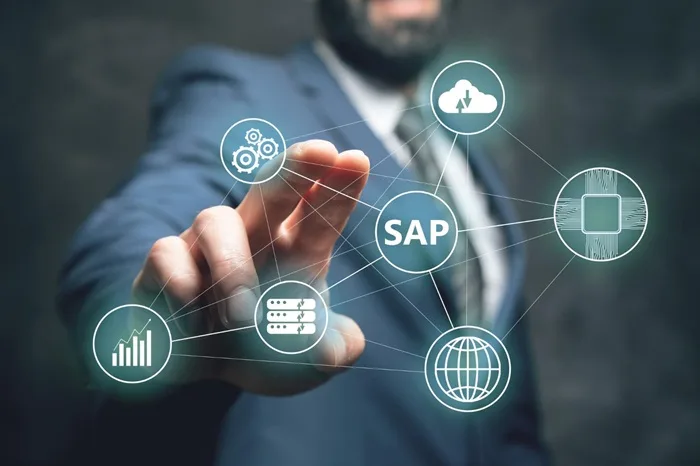
For organizations running SAP, SAP e-Invoicing France projects should begin with business processes and data sources rather than a particular SAP module or product.
Assess Where Invoice Data Is Generated
Identify billing processes, legal entities, customer master data, tax configuration, invoice output and relevant transaction types.
Map SAP Data to the French e-Invoicing Model
Focus on customer and SIREN data, VAT information, invoice lines, totals, payment information and transaction classification. Each required data element should have a clear source and mapping rule.
Handle Responses Back in SAP
The integration should support:
PDP response → Integration layer → SAP
Status and exception information should not remain outside the ERP environment.
France e-Invoicing Formats: What Does the ERP Need to Generate?
France supports three invoice formats within the reform’s technical framework: UBL, CII and Factur-X. UBL and CII provide structured representations for automated processing, while Factur-X combines a readable PDF with embedded structured XML data.
For the ERP, the important consideration is not simply selecting a format. The integration architecture needs to transform accurate source data into the applicable representation and validate it before exchange.
The practical flow is:
ERP data → Transformation → UBL / CII / Factur-X → Validation → PDP
e-Invoicing vs e-Reporting: What Should the ERP Integration Handle?
The ERP must classify the transaction correctly before deciding which data flow applies.
| Transaction | Integration outcome |
| Domestic B2B within e-Invoicing scope | Electronic invoice exchange |
| B2C transaction | Applicable e-Reporting |
| Certain international transactions | Applicable e-Reporting |
| Payment information | Applicable payment e-Reporting |
The French administration distinguishes e-Invoicing for transactions within the domestic B2B scope from e-Reporting for specified transactions outside that scope. E-reporting can include transactions with private customers and certain transactions involving foreign operators.
This distinction matters because the ERP cannot simply send every transaction through the same invoice-exchange flow. Transaction classification needs to happen upstream so the integration layer knows which information must be exchanged and which must be reported.
What Happens When France ERP Integration Fails?
Integration failures can occur at several points.
Data Failure
The ERP contains incomplete or incorrect customer, tax, transaction or invoice information.
Mapping Failure
An ERP field cannot be correctly mapped to the required structured invoice representation.
API or PDP Failure
Transmission fails because of connectivity, authentication, availability or payload issues.
Response Synchronization Failure
The invoice is processed externally, but its resulting status does not reach the ERP correctly.
A practical recovery sequence is:
Detect → Identify → Correct → Revalidate → Resubmit → Synchronize
The objective is not simply to resend an invoice. Teams should identify the root cause, correct the underlying issue, prevent duplicate processing and ensure the final status is reflected in the ERP.
How to Prepare an ERP for France e-Invoicing Integration
A structured preparation sequence can help enterprises identify gaps before production:
- Inventory ERP and billing systems.
- Map legal entities and transaction flows.
- Audit customer and supplier master data.
- Map French invoice fields.
- Identify e-Invoicing and e-reporting scenarios.
- Select and connect to the appropriate PDP.
- Configure API and integration flows.
- Validate invoice formats and business rules.
- Test inbound and outbound transactions.
- Test status, rejection and exception handling.
- Reconcile ERP and e-Invoicing records.
- Prepare production monitoring.
This approach turns ERP readiness into an end-to-end implementation exercise rather than a simple connectivity project.
What Should Enterprises Look for in a France e-Invoicing Integration Solution?
| Enterprise requirement | Capability to evaluate |
| Multiple ERP systems | Multi-system integration |
| SAP and non-SAP landscape | Flexible connectors and APIs |
| Poor master data | Data validation |
| Format transformation | UBL, CII and Factur-X support |
| PDP connectivity | API integration |
| e-Invoicing and e-Reporting | Transaction classification |
| Rejected invoices | Exception management |
| Status visibility | Lifecycle tracking |
| Audit requirements | Audit trail and archival |
| Multi-country operations | Scalable compliance architecture |
For enterprises with complex ERP environments, the integration layer should ideally be decoupled from individual ERP implementations. This allows businesses to preserve existing systems while creating a consistent compliance architecture.
Cygnet.One’s France e-Invoicing capabilities include ERP integration, structured invoice formats, validation, PDP connectivity, e-reporting, reconciliation and archival. Its broader platform supports multiple integration methods and enterprise systems, allowing organizations to connect different source systems through a common compliance layer.
France e-Invoicing ERP Integration Checklist
Before production, enterprises should confirm that:
- ERP and billing systems are mapped.
- Legal entities and transaction flows are identified.
- Customer and SIREN master data is validated.
- French invoice fields are mapped.
- e-Invoicing and e-reporting scenarios are identified.
- A suitable PDP is selected.
- API and integration architecture is defined.
- Inbound, outbound, status, rejection and reconciliation flows are tested.
Conclusion
Connect the ERP to the French E-Invoicing Ecosystem. France e-Invoicing integration is fundamentally a dataflow and systems-integration challenge. The ERP is the source of transactional data, and the PDP is the layer for exchange and reporting. To make it successful, the master data is mapped to the API, format handling is done, validation and status synchronization and reconciliation is done. A properly designed integration layer can help companies adapt to the French e-Invoicing ecosystem without treating compliance as a separate invoice generation process.
FAQ's
France e-Invoicing integration connects ERP or accounting systems with the technology layer used to transform, validate, exchange, receive, report and reconcile electronic invoice data through the French e-Invoicing ecosystem.
France e-Invoice ERP integration typically extracts invoice data from the ERP, maps and validates it, transforms it into an applicable structured representation, sends it through the relevant PDP and returns status information to the ERP.
France e invoicing API connectivity is based on the technical framework published for interfacing enterprise information systems with approved platforms. The exact implementation depends on the enterprise architecture and selected PDP.
Author


Kesha Shah
General Manager - Products Marketing
Kesha Kumar leads the global products marketing team at Cygnet.One, where she turns the complexity of tax and finance transformation into stories that resonate with the people who matter most. She’s the strategic force behind the brand’s presence across India, the GCC, Southeast Asia, and Europe, translating dense subjects like e-Invoicing mandates, digital engineering, and enterprise AI into narratives that inform and drive action. With expertise spanning tax and finance transformation, quality, enterprise applications, and data and AI, Kesha blends sharp strategic thinking with a marketer’s instinct for what truly connects. At Cygnet.One, she does more than build campaigns and content; she shapes the conversations that help enterprises navigate compliance with clarity and confidence, propelling the brand to the forefront of the industry along the way.