




































A useful enterprise GenAI answer has to do more than sound plausible. It has to draw from approved business knowledge, respect permissions, reflect current information, and show enough evidence for someone to verify the result. That requirement changes the architecture. The model becomes only one part of a larger knowledge system.
This is where RAG system design earns its place. The job is not simply to connect documents to a language model. The real work is deciding which sources deserve authority, how content should be prepared for retrieval, which users may retrieve it, how relevance should be tested, and when the system should refuse to answer.
Retrieval Augmented Generation (RAG) can support that structure because it retrieves enterprise content at query time and places relevant context in the model prompt. According to AWS, the pattern grounds model responses in external, domain-specific knowledge, while Microsoft’s current guidance treats chunking, vectorization, search, reranking, and citations as distinct parts of the retrieval pipeline.
Start RAG System Design With Source Authority
The first design question should be simple: which source wins when two documents disagree?
Many enterprise repositories contain duplicate policies, old presentations, regional variants, draft procedures, copied wiki pages, and files with unclear ownership. Feeding all of them into one index gives the retriever more material, yet also gives it more opportunities to surface the wrong version.
A sound RAG system design needs a source hierarchy before ingestion begins. A practical hierarchy might distinguish approved policy repositories, governed operational systems, team knowledge bases, working documents, and archived content. Each source should carry an owner, business domain, approval state, effective date, review date, and sensitivity label.
This makes enterprise knowledge retrieval easier to govern because relevance is no longer based only on semantic similarity. The retrieval layer can also consider authority and status.
A useful rule is to treat ingestion as an editorial decision. Content should earn a place in the knowledge base. Unsupported drafts, duplicate exports, and documents with no accountable owner create retrieval noise long before the model generates a response.
Preserve Context When Dividing Content
How content is divided directly affects retrieval quality. If related information is separated without enough context, the system may retrieve an incomplete passage that changes the meaning of the source.
Microsoft notes that chunking helps large documents fit model input limits and can improve representation when a whole document is poorly captured by a single vector. Its current guidance lists an 8,191-token input limit for the text-embedding-3-small model, which is one practical reason large documents cannot simply be embedded whole. It also supports overlap between chunks where context needs to carry across boundaries.
The better design question is not “How many tokens should each chunk contain?” It is “What unit of meaning should remain intact?”
Policy documents may work best when clauses, exceptions, and applicability notes stay together. Product manuals may need task steps and warnings in the same chunk. Contracts may require a section heading, clause text, amendment reference, and effective date to travel together.
For retrieval augmented generation, fixed-size splitting can still be useful for predictable material, but semantic boundaries usually deserve more attention in enterprise content. A chunk that begins halfway through an exception clause may rank well while giving the model an incomplete rule.
A practical chunk record should keep:
- Chunk text
- Parent document ID
- Section or heading path
- Source URL or repository location
- Version and effective date
- Owner and business domain
- Permission metadata
- Citation label
These fields later support secure document retrieval and more reliable citations.
Treat Embeddings as One Retrieval Signal
Embeddings are good at finding semantic similarity. They are less reliable when the query depends on an exact identifier, product code, policy number, error message, legal phrase, or uncommon acronym.
This is why a vector store should rarely become the only search mechanism. Microsoft’s current Azure AI Search guidance recommends hybrid approaches that combine full-text and vector search, then merge or rerank the results. Hybrid retrieval helps capture both conceptual similarity and exact lexical matches.
That distinction matters in business systems. A query such as “What does POL-247 say about contractor access?” contains both a semantic intent and an exact reference. Pure vector search may find general access-control guidance while missing the named policy.
The vector database for RAG should therefore sit inside a broader retrieval strategy. Keyword search, metadata filters, semantic search, and reranking can each contribute. The system can choose different retrieval paths based on query type instead of forcing every request through one ranking method.
This is also where evaluation becomes practical. Retrieval quality can be measured before generation by asking whether the correct passages appear in the top results for known questions.
Make Access Control Part of Retrieval
Security controls cannot stop at the chat interface. A user who lacks permission to open a document should not receive content from that document simply because an embedding search found it relevant — a data exposure risk that sits squarely within the scope of AI-powered data governance frameworks designed to enforce access at the retrieval layer, not just the interface.
AWS recommends validating authorization against authoritative access rules before retrieved content is passed to the model. Its security guidance also describes controls at ingestion, storage, retrieval, and inference, including metadata filtering and role-based restrictions.
For permission-aware retrieval, identity should travel with the query. The retriever should filter candidates according to the caller’s department, role, tenant, clearance, project membership, or other approved attributes. Microsoft similarly describes document-level access control that carries permission metadata into query-time filtering.
The search index cannot be treated as an unrestricted copy of enterprise knowledge. Permission metadata, authorization checks, and audit events belong inside the retrieval path.
Secure document retrieval also needs a response rule for partial access. If five relevant documents exist and only two are permitted, the system should answer from the permitted evidence without hinting at restricted material.
Freshness Needs an Operating Policy
A RAG knowledge base can become stale quietly. The model may still answer fluently, citations may still resolve, and search may still return high similarity scores. None of those signals prove that the underlying content is current — the same invisible drift that data observability practices address by giving teams visibility into pipeline health before stale data reaches downstream consumers.
In retrieval augmented generation, freshness should be designed as policy, not housekeeping.
Each source type needs an ingestion cadence that reflects how often the source changes. Product specifications may need event-driven updates. HR policies may need scheduled checks. Support knowledge may change throughout the day. Historical records may remain static.
RAG system design should also define what happens when a document is replaced, revoked, or superseded. Old chunks need to be removed or marked inactive, embeddings need reindexing, and cached answers may need expiry rules.
AWS guidance explicitly calls out versioning, freshness policies, and automated reindexing as controls for grounded enterprise systems.
A useful freshness record includes the source update time, ingestion time, effective date, expiry date where relevant, and superseded-by relationship. Those fields make enterprise knowledge retrieval more sensitive to business reality instead of repository history.
Build Citations Into the Data Model
In retrieval augmented generation, citations are often added late as a user-interface feature. That is too late.
Reliable source traceability in AI begins during ingestion. Each chunk needs enough metadata to reconnect the generated statement to its origin. A source title alone may be insufficient when the same document has multiple versions or when only one section supports the answer.
For grounded responses, a citation should ideally resolve to the exact supporting passage, document version, section, and source location. Microsoft’s guidance recommends storing links between source data and embeddings as metadata so responses can generate citations.
This matters because citation presence and citation quality are different things. A response can display three links and still make a claim none of them support.
Good source traceability in AI therefore needs validation at claim level. The system should be able to test whether the retrieved passage actually supports the statement attached to it. High-risk workflows may also require a visible excerpt or document preview so reviewers can inspect the evidence without searching manually.
Validate Retrieval Before Judging the Model
When a RAG application gives a poor answer, teams often change the prompt or switch the model first. That can miss the real failure.
A better diagnostic sequence separates the pipeline:
| Layer | Question to test | Typical failure |
| Source | Is the correct information present and approved? | Missing or conflicting content |
| Chunking | Is the needed context kept together? | Fragmented rule or procedure |
| Retrieval | Did the right passages rank highly? | Irrelevant top results |
| Permissions | Were only allowed sources returned? | Restricted content exposure |
| Generation | Did the answer stay within retrieved evidence? | Unsupported synthesis |
| Citation | Does each important claim point to support? | Decorative or weak citation |
This separation makes retrieval augmented generation easier to improve because each defect has a clearer owner.
Microsoft’s architecture guidance makes a similar distinction between retrieval recall and precision. Broad retrieval can return useful candidates along with marginally relevant chunks, while reranking can improve the ordering before context reaches the model.
Response validation should then check factual support, citation coverage, refusal behavior, and whether the answer introduces claims absent from the retrieved context. For sensitive use cases, grounded GenAI responses may need human review when evidence is incomplete or contradictory.
Use Confidence to Decide When the System Should Answer
A trustworthy RAG application needs an answer threshold.
If retrieval finds weak evidence, conflicting sources, outdated content, or only partially relevant passages, the safest behavior may be to return a constrained response rather than fill gaps with model knowledge.
This is one of the most useful design patterns in retrieval augmented generation: confidence should govern response behavior.
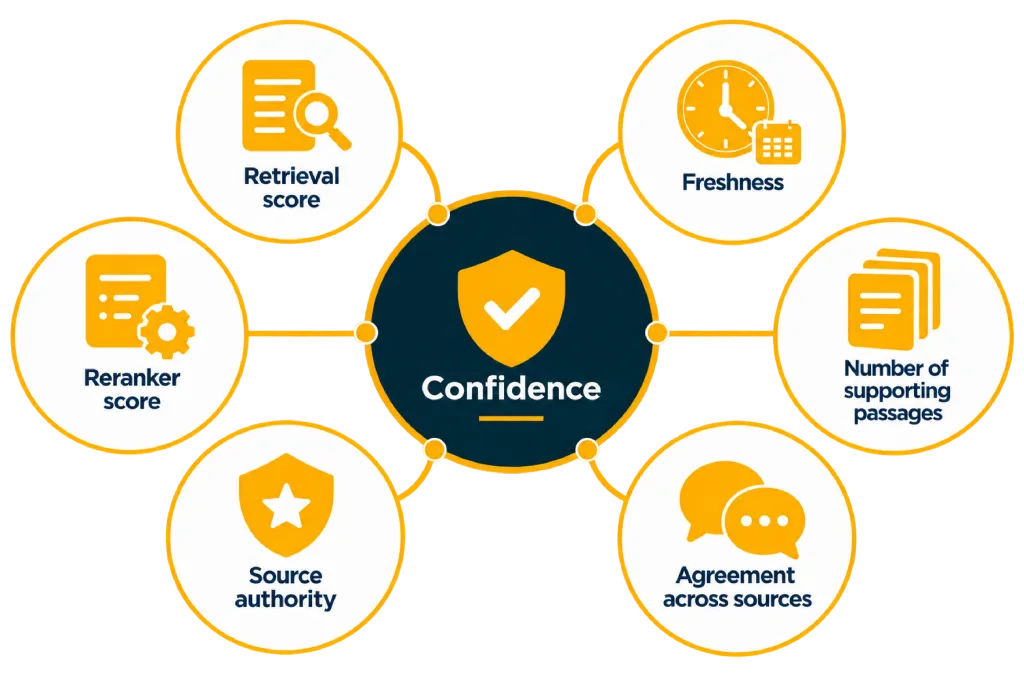
Confidence can combine retrieval score, reranker score, source authority, freshness, number of supporting passages, and agreement across sources. The aim is to make uncertainty visible inside the pipeline.
For example:
- High-confidence evidence can support a direct answer with citations.
- Medium-confidence evidence can support a qualified answer that states the limitation.
- Conflicting evidence can trigger comparison of source versions.
- Low-confidence evidence can return a refusal or route the question to a human owner.
This pattern keeps the language model from becoming the final judge of whether enterprise evidence is sufficient.
Design the Knowledge Layer as a Product
The hardest RAG problems usually appear after the first successful demo. New sources arrive. Permissions change. Documents are rewritten. Teams ask different questions. A retrieval pattern that worked for policy search performs poorly on troubleshooting content.
RAG system design therefore needs an operating model, not just an architecture diagram.
Ownership should be explicit across content quality, ingestion pipelines, search tuning, security, evaluation, and user feedback. Query logs should be reviewed for failed searches, ambiguous questions, missing sources, repeated refusals, and citations that users open frequently.
A production backlog may include:
- Adding authoritative sources for recurring unanswered questions
- Revising chunking where context is repeatedly fragmented
- Tuning hybrid retrieval for exact business terms
- Removing stale or duplicate content
- Updating access rules as roles change
- Expanding evaluation sets with real business questions
This is where the knowledge layer starts to behave like a maintained enterprise product — the same shift that data product thinking drives across analytics teams by making datasets accountable, versioned, and purpose-fit for the teams consuming them. The model can change later without losing the retrieval discipline built around trusted information.
Design RAG Around Evidence, Permissions, and Freshness
Enterprise GenAI becomes more useful when answers can be traced to knowledge the organization already trusts — the foundation that Enterprise AI solutions build on by combining governed retrieval with production-grade security and access controls. Retrieval augmented generation provides the retrieval pattern, but trust depends on the surrounding decisions.
Strong RAG system design starts with authoritative sources, meaningful chunks, hybrid retrieval, permission-aware search, freshness controls, citation metadata, and response validation. A vector database for RAG supports semantic retrieval, yet it is only one component in that system.
The result is a clearer standard for grounded GenAI responses: each answer should have relevant evidence, the caller should be allowed to see that evidence, the evidence should still be current, and important claims should remain traceable to source material.
That is the point where enterprise GenAI stops behaving like an isolated model interface and starts functioning as a governed knowledge application.
Author


Yogita Jain
Content Lead
Yogita Jain leads with storytelling and Insightful content that connects with the audiences. She’s the voice behind the brand’s digital presence, translating complex tech like cloud modernization and enterprise AI into narratives that spark interest and drive action. With a diverse of experience across IT and digital transformation, Yogita blends strategic thinking with editorial craft, shaping content that’s sharp, relevant, and grounded in real business outcomes. At Cygnet, she’s not just building content pipelines; she’s building conversations that matter to clients, partners, and decision-makers alike.