




































A metric becomes risky the moment its meaning travels farther than its controls. A finance dashboard may be accurate for monthly planning, then get copied into a sales forecast, reused in an executive review, and quoted weeks later after the source logic has changed. The number itself has not been corrupted. Its context has.
This is where data consumption governance becomes a distinct operating discipline — one that sits inside the broader scope of data analytics services that help enterprises move beyond availability and into accountable insight use. And what evidence should remain attached as it moves between teams. In Salesforce research published in 2025, 54% of data and analytics leaders said their organizations occasionally or frequently draw incorrect conclusions from data that lacks sufficient business context.
The issue is larger than data availability. Analytics governance has to follow information into the decisions it influences — a principle at the heart of AI-powered data governance, where automated controls track how information moves and is acted upon across the enterprise.
Why Governance Has to Extend Beyond Data Storage
Permission is only the first gate. A regional manager may be authorized to view customer profitability data and still misuse it by comparing regions built on different allocation rules. An analyst may have legitimate access to an operational KPI and reuse a screenshot after the metric definition has changed. A planning team may receive an approved forecast and treat a scenario output as a committed target.
A mature data consumption governance model therefore treats an insight as something with conditions attached. Those conditions may include its purpose, valid time window, source version, permitted audience, decision sensitivity, and reuse rules.
This broadens analytics governance from platform administration into business use. The governing question changes from “Can this person see the data?” to “What decisions can this person reasonably make from it?”
Control Who Can Access, Interpret, Reuse, and Act
Access rights alone create an incomplete control model. Insight consumption usually involves four separate rights.
| Consumption right | Governance question | Typical control |
| Access | Who may view the insight? | Role, domain, geography, sensitivity |
| Interpretation | Who may certify its meaning? | Stewardship, metric owner, semantic definition |
| Reuse | Where may it be copied or embedded? | Export policy, downstream usage rule |
| Action | Which decisions may rely on it? | Approval threshold, decision owner |
A manager who can view a fraud-risk score may lack authority to change a customer status. A business analyst may explain a margin metric without being allowed to redefine it. A dashboard can be open to a broad audience while exports remain restricted because the data loses context outside the governed interface.
These insight usage controls separate viewing, interpretation, reuse, and action according to risk.
The same principle improves data access accountability. Access logs reveal who opened a report. They rarely show whether the report was then used for pricing, staffing, customer treatment, or budget approval. High-impact insights should therefore be tied to the business processes and decision classes they are permitted to support.
Treat Important Metrics as Versioned Business Definitions
Revenue, active customer, churn, utilization, backlog, and margin can all appear straightforward until two teams calculate them differently.
A glossary helps, but a definition stored in a catalog is not enough. The metric displayed at the point of use should carry enough context to make its meaning difficult to miss.
For decision-sensitive metrics, the governed object should include:
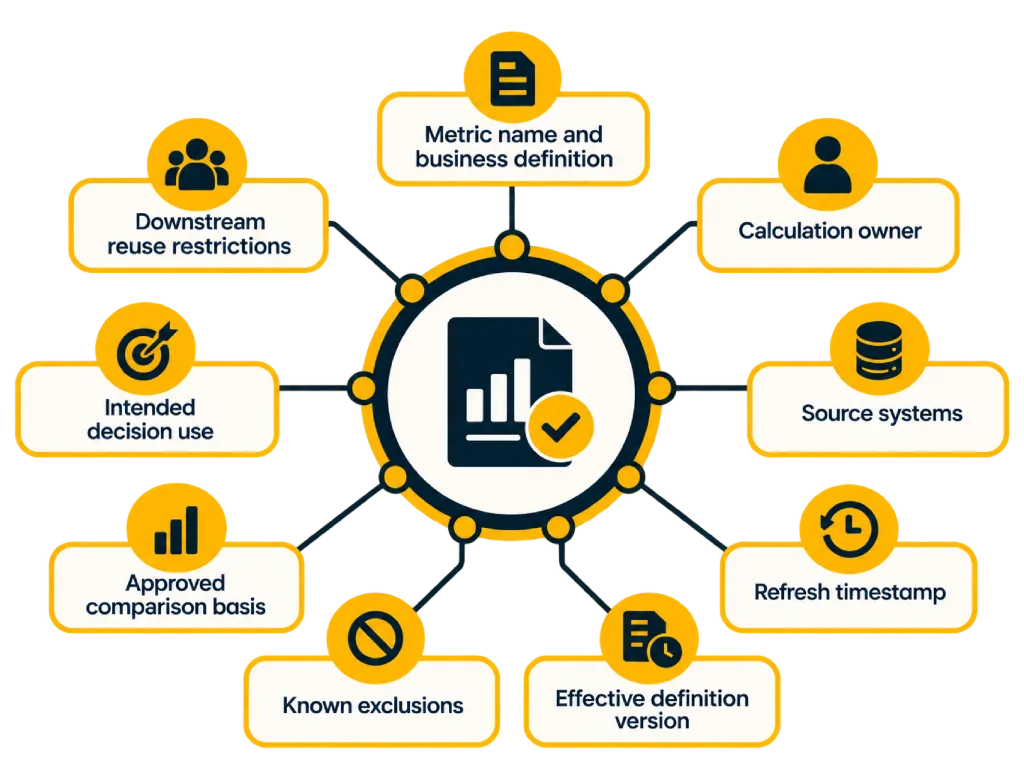
- Metric name and business definition
- Calculation owner
- Source systems
- Refresh timestamp
- Effective definition version
- Known exclusions
- Approved comparison basis
- Intended decision use
- Downstream reuse restrictions
This is where business data interpretation needs more structure. Meaning should travel with the metric rather than depend on whichever team presents the dashboard.
Under analytics governance, semantic definitions also need lifecycle control. When a formula changes, old reports cannot silently inherit the new label while retaining the old logic. Versioning should preserve which definition supported a decision at a given point in time.
Stop Outdated Metrics Before They Reach Active Decisions
A dataset can be technically valid and still be too old for the decision in front of it. Quarterly supplier performance may suit a sourcing review but be unsuitable for an urgent capacity decision. Yesterday’s inventory view may work for trend analysis and still be unsafe for a same-day fulfillment commitment.
A useful data consumption governance rule is to define freshness against the decision rather than the dataset alone. The same insight can have different validity windows in different workflows.
Three controls help:
- Freshness labels at the point of use
A timestamp should be visible where the insight is consumed. - Decision-specific expiry
High-risk workflows should define how old an input may be before review or refresh becomes mandatory. - Stale-use logging
If an expired metric is used, the exception should capture who accepted the risk and why.
This makes governed analytics workflows stronger because freshness is connected directly to action.
Put Reuse Under Governance
Insights rarely stay where they were created. A chart is exported to a presentation. A KPI is pasted into a spreadsheet. A model output is copied into an operating plan. A screenshot moves through email or chat without its filters, refresh date, or caveats.
Governance should classify reuse by consequence. Low-risk descriptive information may move freely. Sensitive or decision-critical insights may need the definition, date, source, and usage note to travel with them.
Effective insight usage controls can include watermarking, embedded metadata, export restrictions, expiry notices, and rules that require a live link instead of a copied figure. For high-impact use, a downstream consumer may also need to acknowledge the metric version before action is approved.
This gives data access accountability a downstream dimension. Governance should identify who reused the insight, where it appeared next, and whether its original conditions remained intact.
Build Governance Around Decisions
Governance becomes easier to enforce when it is built into the workflow that consumes the insight.
Consider a pricing decision. The workflow might require current cost data, approved margin logic, competitor context, and a named approver above a specified discount threshold. A dashboard can surface the inputs, while the workflow carries the controls that determine what happens next.
This is where governed analytics workflows become more useful than generic dashboard governance. They connect data controls to the point where business consequences begin.
| Decision element | Governance requirement |
| Trigger | Define when the decision is required |
| Approved inputs | Specify which metrics or models may be used |
| Interpretation | Record assumptions, thresholds, and definitions |
| Authority | Assign who can recommend, approve, or override |
| Evidence | Preserve inputs used at decision time |
| Review | Compare the decision with later outcomes |
This structure also clarifies decision accountability in analytics. A data team can own the quality of an input without owning the commercial decision made from it. Responsibility should remain with the role authorized to commit the action.
Separate Data Quality From Decision Quality
A metric can be accurate, current, and fully documented while still being irrelevant to the choice being made. A forecast can be statistically sound and still be applied outside the population for which it was designed. A customer segment can be well governed and still be interpreted without enough operational context.
For this reason, analytics governance should test two different things:
- Was the information fit for its stated purpose?
- Was the stated purpose appropriate for the decision?
This distinction strengthens business data interpretation because it forces teams to examine how meaning changes across functions. Finance may read variance as a control issue. Operations may read the same variance as a capacity signal. Both interpretations can be reasonable, yet they should not automatically produce the same action.
Make Decision Ownership Visible
When an insight prompts action, there should be a named role with authority to accept, reject, defer, or override the recommendation. Without that role, analytics can influence a decision without anyone being clearly accountable for how the information was used.
A strong data consumption governance model maps high-impact insights to decision owners. The mapping should identify the decision class, required evidence, approval level, and escalation path.
This is the operational side of decision accountability in analytics. Data owners remain responsible for input integrity, while the decision owner remains accountable for action.
Consumption governance creates a traceable link between the insight presented, the decision made, the person accountable for that decision, and the outcome reviewed later. This makes it easier to identify whether a poor result came from unreliable data, incorrect interpretation, or the decision itself.
Create a Consumption Contract for High-Impact Insights
One practical way to operationalize analytics governance is to give important insights a consumption contract: a compact set of rules attached to a metric, model output, or analytical product.
The contract should answer:
- What business question does this insight support?
- Which teams may use it?
- How fresh must it be for each use?
- Which definition version applies?
- Where may it be reused?
- What actions require approval?
- What exceptions require documentation?
- Which outcome should be reviewed afterward?
This contract gives data consumption governance a repeatable unit of control and keeps policy close to the point of use.
The same approach supports analytics governance without turning each analytical interaction into an approval queue. Controls can be lighter for descriptive reporting and tighter for pricing, credit, compliance, workforce, customer eligibility, or other consequential decisions.
Measure What Happens After the Insight
Governance metrics often stop at catalog coverage, policy compliance, access reviews, or data quality scores. They say little about responsible use after access — a gap that data observability practices address by giving teams visibility into how data moves and where its integrity degrades across pipelines.
Consumption-focused measures should examine:
- High-impact decisions using approved inputs
- Expired insights used in active workflows
- Conflicting metric definitions found in decision forums
- Overrides without documented rationale
- Reused insights missing source or freshness context
- Decisions reviewed against later outcomes
Govern Insight Use Alongside the Data Behind It
Enterprise data can be secure, well documented, and technically accurate while still contributing to a poor decision. The missing control often sits in the consumption layer: who interpreted the insight, whether it was current, where it was reused, which definition applied, and who had authority to act.
Analytics governance becomes more effective when it follows information through those steps. The aim is to place control where misuse can create financial, operational, regulatory, or customer consequences.
A mature data consumption governance model combines access policy with interpretation rules, reuse boundaries, decision ownership, and outcome review.
Governed data is the starting point. Governed use is what makes the decision defensible.
Author


Yogita Jain
Content Lead
Yogita Jain leads with storytelling and Insightful content that connects with the audiences. She’s the voice behind the brand’s digital presence, translating complex tech like cloud modernization and enterprise AI into narratives that spark interest and drive action. With a diverse of experience across IT and digital transformation, Yogita blends strategic thinking with editorial craft, shaping content that’s sharp, relevant, and grounded in real business outcomes. At Cygnet, she’s not just building content pipelines; she’s building conversations that matter to clients, partners, and decision-makers alike.