


































Cloud adoption has expanded far beyond infrastructure hosting. Enterprises now run applications, data pipelines, customer platforms, and AI workloads across hybrid and multi-cloud environments. As cloud environments grow, security becomes more difficult to manage through isolated tools or perimeter-based controls alone.
This is why cloud security architecture has become a foundational part of enterprise cloud strategy. Instead of treating security as a separate layer, organizations now design cloud environments with identity protection, segmentation, encryption, monitoring, and compliance built directly into the architecture itself.
The stakes have risen sharply. In the 2024 IBM Cost of a Data Breach Report, the global average data breach reached $4.88 million in 2024, a 10% increase over the prior year and the largest single-year jump since the pandemic. That cost trajectory reflects how directly architectural decisions translate into financial and operational exposure across cloud environments.
This guide explains what cloud security architecture includes, how the shared responsibility model shapes design choices, the core components that protect enterprise cloud workloads, and the best practices used to keep cloud environments secure as they scale.
What Is Cloud Security Architecture?
Cloud security architecture is the structured framework for protecting cloud environments through layered security controls spanning identities, networks, applications, workloads, and data. It combines technologies, policies, and operational practices to reduce risk, enforce compliance, and secure enterprise cloud operations across hybrid and multi-cloud deployments.
Modern cloud security architecture is built around zero trust principles, identity-first access control, encryption, continuous monitoring, and the shared responsibility model between cloud providers and customer organizations. Instead of relying only on perimeter defense, it protects identities, APIs, workloads, and cloud traffic continuously across distributed enterprise environments.
Why Cloud Security Architecture Matters For Enterprises?
Enterprise cloud environments operate across multiple applications, regions, devices, and user groups. Without a centralized security architecture, visibility gaps and inconsistent controls increase operational risk across distributed cloud environments.
The gap between cloud adoption speed and cloud security maturity has widened across most enterprises. The 2025 Accenture State of Cybersecurity Resilience Report found that 83% of organizations had not established a secure cloud foundation with integrated monitoring, detection, and response capabilities. That gap underlines why a structured architectural approach matters more than tool-by-tool security purchases.
A strong cloud security framework helps organizations achieve the following outcomes:
- Reduce unauthorized access risks through identity-first controls
- Improve cloud visibility and governance across multi-cloud environments
- Protect sensitive enterprise data with encryption and access policies
- Support compliance requirements such as GDPR, HIPAA, and SOC 2
- Detect threats earlier across hybrid and multi-cloud workloads
This becomes especially important for organizations adopting multi-cloud, remote access, SaaS applications, and AI-driven workloads where security boundaries cross organizational and technical lines.
How The Shared Responsibility Model Shapes Cloud Security Design?
The shared responsibility model in cloud security defines which security responsibilities belong to the cloud provider and which belong to the customer. Cloud providers secure the underlying cloud infrastructure, while customers are responsible for securing identities, data, applications, configurations, access policies, and workloads they run in the cloud.
This model is important because cloud security gaps often happen when organizations assume the provider secures everything. In reality, the responsibility changes depending on whether the business uses IaaS, PaaS, or SaaS services.
What The Cloud Provider Secures?
Cloud providers typically secure the foundational layers of the platform that all customers share. These provider-managed layers usually include the following:
- Physical data centers, networking equipment, and facility security
- Server hardware, storage arrays, and host infrastructure
- Virtualization layer and hypervisor security
- Core cloud platform services and managed service backplanes
- Region-level redundancy and underlying network availability
This reduces the customer’s burden of managing foundational infrastructure security, but it does not remove customer responsibility for cloud usage and configuration.
What Does The Customer Secure?
Organizations are responsible for securing the parts of the cloud environment they directly control. Customer-managed security responsibilities typically include the following:
- IAM policies, user access, and role-based permissions
- Data encryption at rest and in transit, plus key management
- Workloads, applications, and operating system patching
- API security, network configuration, and security group rules
- Cloud configurations and policy compliance settings
Strong cloud migration security helps enterprises apply these customer-owned controls before workloads move into production cloud environments. Microsoft has stated that customers are responsible for protecting their data and identities, on-premises resources, and the cloud components they control across IaaS, PaaS, and SaaS workloads.
How Responsibility Changes Across IaaS, PaaS, And SaaS?
Customer responsibility is highest in IaaS because the organization controls more of the operating system, network settings, applications, and data. The provider secures only the underlying infrastructure layer beneath the virtual machines.
In PaaS and SaaS, the provider manages more platform layers, but the customer still controls access, data protection, identity governance, and configuration choices. The shared boundary moves up the stack as service abstraction increases, yet customer responsibility for identity and data never disappears.
Why This Matters For Cloud Security Architecture?
The shared responsibility model helps teams design cloud security architecture with clear ownership at each layer. It shows where controls such as IAM, encryption, network segmentation, monitoring, and compliance policies must be implemented by the organization instead of being assumed to be handled by the cloud provider.
This clarity matters because architectural assumptions made early in cloud adoption often persist for years. Misreading the responsibility line at design time typically surfaces years later as a security incident or a failed audit, by which point the remediation cost is significantly higher.
Core Components Of Cloud Security Architecture
Modern cloud security architecture uses multiple security layers working together rather than relying on a single control point. Each component addresses a specific risk category, and the strength of the overall architecture depends on how well these layers integrate across cloud workloads.
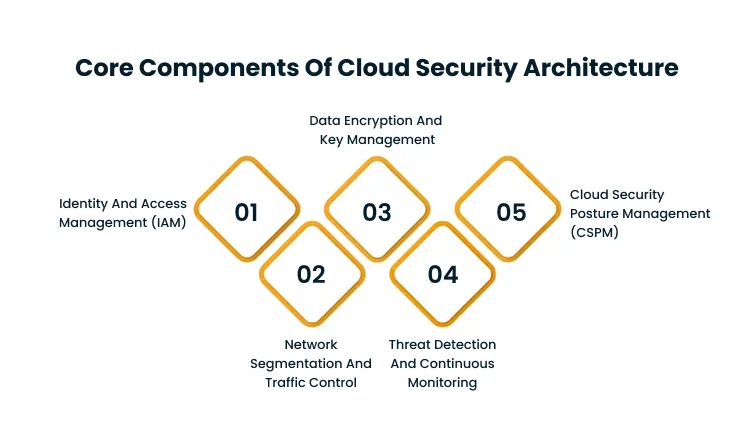
Identity And Access Management (IAM)
IAM controls who can access cloud resources and what actions they can perform. Strong IAM is the foundation of cloud security architecture because identity has replaced the network perimeter as the primary access boundary. Core IAM controls typically include the following:
- Role-based access control (RBAC) aligned with job functions
- Multi-factor authentication (MFA) is enforced for privileged accounts
- Least privilege enforcement across services and resources
- Just-in-time access for temporary elevated permissions
- Federated identity and single sign-on (SSO) across cloud platforms
Zero trust models strengthen IAM further by continuously validating users, devices, and workloads before granting access to cloud resources.
Network Segmentation And Traffic Control
Network segmentation isolates workloads, applications, and environments to reduce lateral movement during attacks. Cloud security architecture typically applies segmentation through the following controls:
- Virtual private cloud (VPC) boundaries for environment isolation
- Security groups and network ACLs for instance-level firewall rules
- Microsegmentation for workload-to-workload policy enforcement
- Web application firewalls (WAF) for application-layer traffic filtering
This improves workload isolation while reducing exposure across production, development, and testing environments running in the same cloud account or subscription.
Data Encryption And Key Management
Encryption protects sensitive enterprise data both at rest and in transit. Cloud security architecture also includes centralized key management to control how encryption keys are generated, stored, rotated, and monitored across cloud services.
This layer becomes critical for protecting regulated data and maintaining compliance across distributed cloud systems. Key management decisions often determine how easily security teams can rotate keys after an incident, revoke access during a personnel change, or meet audit requirements for cryptographic control.
Threat Detection And Continuous Monitoring
Continuous monitoring helps organizations identify suspicious behavior, configuration drift, and active threats across cloud workloads. Security teams rely on multiple telemetry sources to improve response times, including the following:
- Cloud-native logs from compute, storage, and identity services
- Network traffic flows and DNS query telemetry
- Application and workload behavioral analytics
- Configuration drift detection across infrastructure-as-code deployments
- Threat intelligence feeds are integrated into SIEM platforms
Platforms such as AWS Security Hub and Azure Defender help centralize visibility across cloud environments, while extended detection and response (XDR) tools correlate signals across multiple layers.
Cloud Security Posture Management (CSPM)
CSPM tools continuously assess cloud configurations for security risks, policy violations, and compliance gaps. They help organizations detect exposed storage, excessive permissions, and insecure cloud settings before they become exploitable. CSPM platforms typically scan for the following issues:
- Publicly exposed storage buckets and unrestricted database access
- Overly permissive IAM policies and unused privileged credentials
- Unencrypted resources and missing key rotation policies
- Disabled logging or monitoring across critical services
- Compliance baseline drift against frameworks such as CIS, NIST, or PCI
Cloud-native services such as AWS Security Hub, Microsoft Defender for Cloud, and Google Security Command Center can centralize these findings, but they still need clear ownership, response workflows, and governance rules to become operationally useful.
CSPM strengthens governance by improving visibility across large-scale cloud deployments, especially in multi-account or multi-cloud environments.
How Is Enterprise Cloud Security Architecture Designed?
Enterprise cloud security architecture is built through layered planning across governance, identity, infrastructure, monitoring, and operational security. The design process typically follows a sequence that aligns architectural choices with business and compliance requirements before any controls are deployed across the cloud environment.
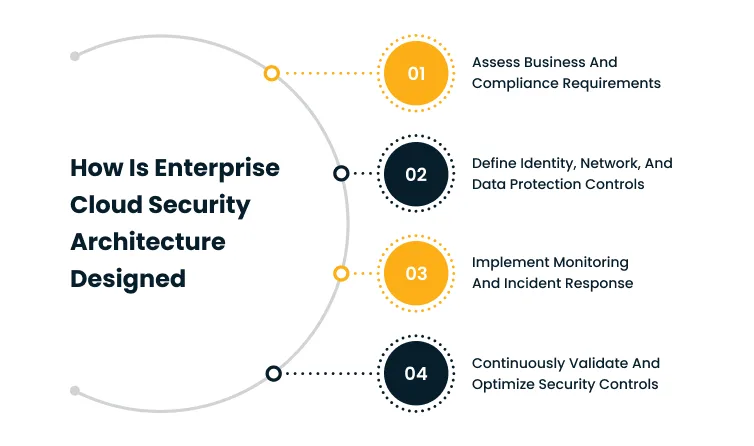
Assess Business And Compliance Requirements
Organizations first identify regulatory obligations, workload sensitivity, access patterns, and operational risks. Security architecture decisions often vary between healthcare, finance, SaaS, and enterprise environments. Common compliance frameworks that shape architectural choices include the following:
- GDPR for data protection across EU customer data
- HIPAA for healthcare data confidentiality and integrity
- SOC 2 for security, availability, and processing integrity
- PCI DSS for payment card data environments
- ISO 27001 for information security management systems
Cygnet.One’s Governance, Risk Management, and Compliance practice supports this assessment phase, helping enterprises map regulatory obligations to cloud architectural controls before implementation begins.
Define Identity, Network, And Data Protection Controls
Cloud security architecture should define how identities, workloads, applications, networks, and data are protected across the environment. IAM policies, role-based access, network segmentation, encryption standards, and workload protection controls should be designed together instead of handled as separate security tasks.
This creates a more consistent security model across cloud accounts, applications, APIs, and data flows. It also reduces the risk of gaps between identity access, network exposure, and data protection controls as the environment scales.
Implement Monitoring And Incident Response
Monitoring systems collect telemetry across workloads, networks, endpoints, and applications. Security operations teams use this data to detect anomalies and accelerate incident response. A mature monitoring stack typically includes the following components:
- Centralized log aggregation across cloud accounts and regions
- SIEM platforms correlating telemetry from multiple sources
- Behavioral analytics for identity, workload, and network anomalies
- Automated playbooks for common incident scenarios
- Dashboards showing real-time security posture and active incidents
Cygnet.One’s Cybersecurity practice helps enterprises design monitoring architectures and incident response workflows aligned with existing security operations capabilities.
Continuously Validate And Optimize Security Controls
Cloud environments change constantly as workloads scale and new services are deployed. Organizations continuously audit permissions, validate configurations, and test security controls to reduce evolving risks across the environment. The validation cadence usually scales with environment complexity, but a baseline of monthly configuration scans, quarterly access reviews, and annual penetration testing applies to most enterprise cloud programs.
Security architecture becomes an ongoing operational process rather than a one-time implementation project. Regular tabletop exercises, configuration drift reviews, and red-team simulations help catch architectural gaps before threat actors find them, and the feedback loop from each exercise informs the next round of control adjustments across IAM, network, and workload layers.
Common Cloud Security Architecture Challenges
Many organizations struggle with cloud security because cloud environments evolve faster than the security models, tooling, and operating practices built for static perimeters. The challenges that surface most often share a common root cause. They appear when security architecture cannot keep pace with how quickly cloud workloads are deployed, modified, and scaled.
Six patterns recur across enterprise cloud programs:
- Misconfigured cloud services where a single permissive setting (an exposed storage bucket, an open security group, a weak IAM policy) creates direct data exposure
- Excessive user permissions that started broadly during initial cloud adoption and never tightened as roles, workloads, and service accounts evolved over time
- Shadow IT and unmanaged SaaS usage adopted by business teams outside central IT review, identity governance, or security monitoring
- Limited visibility across multi-cloud environments where each provider’s native tools produce different telemetry formats, dashboards, and alerting workflows
- Inconsistent policy enforcement between documented standards and actual cloud configurations as teams scale across accounts, regions, and product lines
- Alert fatigue from fragmented tools producing duplicate, low-context signals that bury real threats inside operational noise
These challenges compound each other in predictable ways. Misconfigurations create permissions gaps that go undetected without unified visibility. Shadow IT expands the unmonitored surface further. Inconsistent enforcement allows the next misconfiguration to slip through, and the resulting alert volume erodes the SOC’s ability to triage what actually matters.
Each missed control multiplies the cost of the next one, which is why isolated tool investments rarely solve the underlying issue. The root pattern is the same across most enterprise programs. The cloud environment keeps changing, but the security architecture often does not.
The distance between the two becomes the operational risk surface that security teams ultimately have to defend, and that distance grows fastest in organizations that treat cloud security as a one-time project rather than an evolving discipline that needs continuous architectural attention.
Best Practices For Secure Cloud Architecture
Strong cloud security architecture depends on consistent governance, identity protection, visibility, and automation across cloud environments. Security controls work best when they are integrated directly into cloud operations rather than added later as isolated layers.
Enforce Least Privilege Access
Users and workloads should only receive the minimum level of access required for their roles. This reduces exposure if credentials or accounts become compromised.
Least privilege enforcement extends beyond human users to service accounts, automation pipelines, and workload-to-workload communication. Each access grant should have an explicit business justification and a review cadence built into governance workflows.
Apply Zero Trust Principles
Zero trust continuously validates users, devices, and workloads before granting access to cloud resources. This strengthens protection across distributed cloud environments where the traditional network perimeter no longer defines the trust boundary.
Zero trust has moved from an emerging practice to a mainstream approach. The 2024 Gartner Survey on Zero-Trust Adoption found that 63% of organizations worldwide had implemented a zero-trust strategy, signalling that the model has become a standard reference point for enterprise security design.
Zero-trust implementations typically rest on the following pillars:
- Continuous identity verification across users and workloads
- Device health checks before granting resource access
- Microsegmentation to limit lateral movement
- Encrypted communication for every internal and external connection
- Continuous monitoring and adaptive access policies
Centralize Visibility And Monitoring
Organizations need unified monitoring across workloads, APIs, networks, identities, and cloud configurations. Centralized visibility improves threat detection and response efficiency.
Strong cloud infrastructure management gives security teams the operational visibility needed to track cloud resources, ownership, configuration changes, and risks across growing environments.
Fragmented monitoring tools create blind spots between control planes, especially in multi-cloud environments where each provider has its own telemetry format. Centralizing telemetry into a single observability layer reduces alert fatigue and helps security teams prioritize real incidents.
Encrypt Sensitive Data Across Environments
Encryption protects enterprise data both at rest and in transit. Strong key management practices help secure regulated and business-critical information.
Key rotation, separation of duties, and centralized key management services determine how easily the organization can respond to credential exposure, employee changes, or regulatory audits. Encryption alone is necessary but not sufficient without disciplined key management behind it.
Continuously Validate Cloud Configurations
Cloud environments change frequently as services scale and workloads evolve. Continuous validation helps identify misconfigurations, policy drift, and security gaps before they create operational risks.
Cloud-native security best practices help teams extend this validation across containers, APIs, microservices, and infrastructure-as-code pipelines as applications evolve.
Automated CSPM tools, infrastructure-as-code policy scanning, and periodic security audits all contribute to this validation layer. The cost of catching a misconfiguration during a routine scan is dramatically lower than discovering it through an incident.
How Cygnet.One Supports Enterprise Cloud Security Architecture?
Cygnet.One helps enterprises design secure cloud architecture that brings identity, network, data protection, monitoring, compliance, and governance controls into one operating model. This helps organizations avoid fragmented security decisions across cloud accounts, workloads, and platforms.
Through cloud security assessment, architecture design, governance mapping, and secure cloud implementation, Cygnet.One helps enterprises define the right controls before workloads scale. The focus is on building security into the cloud foundation rather than adding controls after deployment.
Cygnet.One also supports zero trust alignment, IAM governance, network segmentation, encryption strategy, CSPM enablement, and monitoring workflows across enterprise cloud environments. This gives security and engineering teams a clearer way to manage cloud security posture as applications, users, and infrastructure grow.
Conclusion
Cloud security architecture is no longer limited to protecting infrastructure alone. It now forms the foundation for securing identities, workloads, applications, data, and cloud operations across increasingly distributed enterprise environments.
Organizations adopting cloud at scale need layered security controls, continuous monitoring, zero trust principles, and governance-driven design to reduce risk effectively. A strong cloud security framework improves visibility, strengthens compliance, and helps enterprises operate cloud environments with greater resilience and confidence.
As enterprise cloud environments grow across multi-cloud and AI-driven workloads, the gap between secure and insecure architectures becomes increasingly difficult to close after the fact. Book a demo with Cygnet.One to explore how our Cybersecurity and Cloud Strategy and Design practices can help your organization build a cloud security architecture aligned with your compliance, governance, and operational requirements.
FAQs
The shared responsibility model divides cloud security duties between the cloud provider and the customer. Cloud providers secure the underlying infrastructure, hardware, and managed platform services, while customers secure identities, data, applications, configurations, network rules, and access policies across the workloads they run.
Zero trust is a cloud security model that verifies every user, device, workload, and access request before granting permission. It replaces perimeter-based trust with identity-first access, least privilege controls, microsegmentation, continuous monitoring, and repeated validation across cloud, hybrid, and SaaS environments.
Cloud Security Posture Management, or CSPM, is a tool category that continuously checks cloud environments for misconfigurations, compliance gaps, and insecure settings. CSPM helps detect exposed storage, excessive permissions, disabled logging, missing encryption, and policy drift before they become exploitable security risks.
Encryption supports cloud security architecture by protecting sensitive data at rest and in transit. It reduces exposure if access controls fail, while centralized key management, key rotation, and audit controls help enterprises manage encryption consistently across cloud workloads, storage, databases, and applications.
Cloud security architecture protects distributed cloud workloads through identity, encryption, network segmentation, continuous monitoring, and policy-based controls. Traditional perimeter security depends on a fixed trusted network boundary, which is less effective for multi-cloud, SaaS, remote access, and API-driven enterprise environments.
Cloud security architecture uses similar principles across AWS, Azure, and Google Cloud, but implementation differs by platform. Each provider has its own IAM, encryption, segmentation, monitoring, and CSPM services, so enterprises need consistent security policies mapped to provider-specific tools and controls.
Author


Abhishek Nandan
AVP, Marketing
Abhishek Nandan is the AVP of Services Marketing at Cygnet.One, where he drives global marketing strategy and execution. With nearly a decade of experience across growth hacking, digital, and performance marketing, he has built high-impact teams, delivered measurable pipeline growth, and strengthened partner ecosystems. Abhishek is known for his data-driven approach, deep expertise in marketing automation, and passion for mentoring the next generation of marketers.