






























Every quarter, the pattern repeats. Engineering receives an ambitious roadmap. Leadership expects AI capabilities, cloud migration, and faster release cycles. And the team spends the majority of its capacity maintaining legacy systems rather than building new ones.
The constraint is not talent. It is the underlying architecture. Legacy systems, manual processes, and disconnected teams mean every cloud migration becomes a multi-month planning exercise and every AI initiative stalls before reaching production.
Digital engineering services break that cycle. They bring the modernization, DevOps, and AI depth that most enterprises cannot realistically build in-house. The best partners do not treat this as a one-off project. They run it as an ongoing, AI-first practice where AI is built into how they design, test, and improve systems from the start.
This guide covers what digital engineering services include, how they differ from traditional IT, and when they make sense for your organization.
What Are Digital Engineering Services?
Digital engineering services encompass the design, development, modernization, and management of software systems using modern practices: cloud-native architecture, DevOps, CI/CD pipelines, microservices, and embedded AI.
Delivered by specialist technology partners, they provide end-to-end capability from architecture design through continuous optimization, enabling enterprises to build, ship, and scale faster without expanding internal headcount proportionally.
The term has three distinct components:
- Digital: Cloud, AI, data, and APIs as the engineering foundation, not a layer added after the fact.
- Engineering: Disciplined, repeatable processes for building, testing, deploying, and evolving software systems at scale.
- Services: The full delivery scope: strategy, architecture, build, deploy, operate, and optimize.
The scope can be as narrow as setting up a single CI/CD pipeline or as broad as re-architecting an entire application portfolio. These services support greenfield builds, where new products are built on modern architecture from scratch. They also support brownfield evolution, where existing systems are extended or modernized without a complete restart.
Core characteristics
- End-to-end ownership across design, build, test, deploy, and optimize
- Cloud-native by default: microservices, containers, serverless, with AWS as the most common enterprise foundation
- Continuous delivery is replacing waterfall and quarterly release cycles
- AI embedded into the engineering workflow, not added afterward, from code generation and test automation to production monitoring
- DevSecOps integrating security into every pipeline stage, not as a release-gate review
How Digital Engineering Differs from Traditional IT Services
Traditional IT covers infrastructure management, patching, helpdesk, and incident response. Its core purpose is to keep existing systems operational. The model is reactive and stability-first. Digital engineering operates on a proactive, product-led model: building, modernizing, and continuously improving software using modern architectures and automated delivery.
The practical difference is that an IT services team maintains your ERP. A digital engineering team re-architects it for cloud deployment on AWS, integrates AI-driven workflow automation, and ships updates continuously rather than quarterly.
| Aspect | Traditional IT Services | Digital Engineering Services |
| Focus | Maintaining existing systems and infrastructure | Building, modernizing, and scaling software products |
| Operating Model | Reactive, ticket-driven, stability-first | Proactive, product-led, delivery-first |
| Architecture | Monolithic, on-premises, legacy-bound | Cloud-native, microservices, API-first |
| Delivery | Quarterly releases, manual deployment | CI/CD pipelines, continuous delivery |
| AI and Automation | Limited or bolt-on | Embedded into engineering, testing, and operations |
| Outcome | Uptime, stability, compliance | Speed to market, scalability, product innovation |
Core Capabilities of Digital Engineering Services
A comprehensive digital engineering provider works across the full technology stack: frontend, backend, data, cloud, and DevOps. The four capability areas below define what a complete engagement delivers, whether the scope is a single application or an enterprise-wide portfolio.
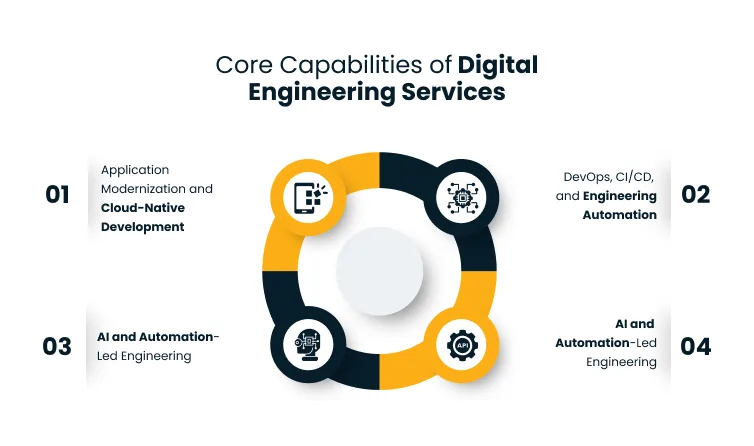
Application Modernization and Cloud-Native Development
This covers re-architecting legacy monoliths into domain-aligned microservices using Docker and Kubernetes, migrating on-premises workloads to cloud platforms (AWS being the most common enterprise choice) with architectural redesign rather than lift-and-shift, and building new applications on API-first, horizontally scalable foundations. Database modernization, moving from Oracle or MSSQL to cloud-managed alternatives like Aurora or PostgreSQL, is typically part of the same workstream.
For AWS-centric modernization, structured migration frameworks align with AWS MAP (Migration Acceleration Program) to reduce migration risk and accelerate execution. The framework covers assessment, architecture planning, migration execution, and post-migration optimization as a single governed workstream rather than a series of disconnected phases.
The cloud-native architecture decisions made here determine delivery speed, infrastructure cost, and scalability ceiling across the product lifecycle. These are the choices that either enable or constrain everything that follows.
DevOps, CI/CD, and Engineering Automation
This involves designing and implementing CI/CD pipelines that automate build, test, and deployment cycles, provisioning infrastructure through version-controlled IaC (Terraform, Pulumi) for fully reproducible environments, and embedding automated testing (unit, integration, regression, performance) directly into the pipeline rather than as a separate QA gate.
AI-augmented testing is increasingly central to this capability. Tools like TestingWhiz enable codeless and low-code test automation, making it practical to maintain comprehensive test coverage without scaling QA teams proportionally. When test automation is codeless, non-developer team members can contribute to coverage, which accelerates release cycles without sacrificing quality.
DevSecOps layers SAST, DAST, and container scanning into every build. Distributed tracing, metrics collection, and alerting close the loop so teams catch failures before users do.
AI and Automation-Led Engineering
This is where the AI-first approach becomes most visible. Rather than treating AI as a feature to be added to finished applications, AI-first engineering embeds machine learning and intelligent automation into the architecture from the design phase.
That includes recommendation engines, predictive analytics, intelligent document processing, NLP search, and conversational AI built as native capabilities rather than external add-ons. For enterprises exploring conversational interfaces, show what this looks like in production: natural-language search, contextual query handling, multilingual input, and integration with catalogs, CRM, and ERP systems.
Hyperautomation combines AI, ML, RPA, and orchestration to automate complex business processes end to end, not just individual tasks.
AI-augmented engineering uses generative AI to accelerate code generation, test creation, and review cycles. And underpinning all of it: data pipeline engineering, covering ingestion, transformation, feature engineering, and production monitoring. AI in production is only as reliable as the data infrastructure feeding it.
Enterprise Integration and API Architecture
This is the connective tissue. Enterprise integration involves designing the integration layer that connects ERP, CRM, SCM, HR, and finance systems through APIs, event-driven messaging, and middleware, without requiring full rewrites of those systems.
This covers API design, versioning, gateway configuration, and lifecycle governance. It covers event streaming platforms (Kafka, EventBridge, Service Bus) for real-time data flow. And it covers abstraction layers that let modern applications consume data from legacy systems without tight coupling, so changing one system does not cascade failures across the estate.
The goal is interoperability. When integration is done well, the enterprise can modernize incrementally: replacing or upgrading individual systems without disrupting everything connected to them.
Capabilities at a Glance
| Capability Area | What It Covers |
| Application Modernization and Cloud-Native Development | Legacy re-architecture, AWS/cloud migration (ORBIT framework), database modernization, greenfield builds |
| DevOps, CI/CD, and Engineering Automation | Automated pipelines, IaC, DevSecOps, observability, AI-augmented testing (TestingWhiz), automated testing at every layer |
| AI and Automation-Led Engineering | Embedded AI/ML, hyperautomation, AI-augmented development, conversational AI, data pipeline engineering |
| Enterprise Integration and API Architecture | System integration, API lifecycle management, event-driven architecture, legacy connectivity |
How Digital Engineering Services Work in Practice
Digital engineering engagements follow a consistent five-step lifecycle. The example threaded through each step: an enterprise modernizing a legacy order management system, moving to cloud-native deployment on AWS, adding AI-driven inventory forecasting, and replacing quarterly releases with continuous delivery.
Step 1: Technical Due Diligence and Assessment
The partner audits the existing system, mapping architecture, identifying coupled components, documenting dependencies, and measuring engineering maturity: deployment frequency, test coverage, and incident recovery time. The output is a prioritized modernization roadmap. For the OMS, this surfaces the monolith’s data coupling and the absence of any automated testing pipeline.
This is also where AI readiness is assessed. Can the current data infrastructure support ML workloads? Are APIs structured for AI consumption? These questions determine whether AI capabilities can be integrated during the modernization or need their own workstream.
Step 2: Architecture Design
The target architecture is designed before a line of code is written. For the OMS: decomposing into domain-aligned microservices, selecting AWS-managed services (Aurora for the database, ECS or EKS for container orchestration, Lambda for event-driven functions), defining API contracts, and laying out the CI/CD pipeline. Security and observability requirements are specified here, not retrofitted after the system is live.
For AWS migrations, frameworks like ORBIT structure this step around AWS MAP alignment, ensuring the architecture plan maps to proven migration pathways rather than starting from a blank canvas every time.
Step 3: Build and Migrate
Engineering teams build new services and migrate data in phases, non-critical workloads first, core transaction systems last. Legacy and new systems run in parallel during transition, with automated tests validating each phase before migration continues. Cloud migration, database modernization, DevSecOps pipeline setup, and API integration work happen in parallel, not sequentially.
Step 4: Continuous Delivery and Iteration
With the CI/CD pipeline live, releases shift from quarterly cycles to weekly or daily. The AI inventory forecasting module is deployed, monitored, and iterated based on production data. This is possible because the data pipelines were built during migration, not deferred to a follow-on AI project. AI readiness was part of the architecture from step two, not a separate initiative bolted on after go-live.
Step 5: Optimization
The engagement shifts from build to optimization: resolving performance bottlenecks, right-sizing infrastructure through FinOps, expanding test coverage, and maturing observability tooling. The partner contributes to roadmap planning alongside enterprise leadership, aligning future investment with business priorities.
Assess → Design → Build → Deliver → Optimize
Cygnet.One structures engagements around this full lifecycle through their COSMOS framework (Co-Ideate, Co-Create, Co-Innovate, Co-Evolve) and uses ORBIT specifically for AWS migration and modernization workstreams. Together, these ensure the engagement matures from project delivery into a strategic engineering partnership rather than ending at go-live.
Benefits of Digital Engineering Services for Enterprises
The shift to a modern engineering model changes four things in parallel: delivery speed, cost structure, risk profile, and AI readiness. These compounds, over time, become the new architecture and delivery infrastructure mature.
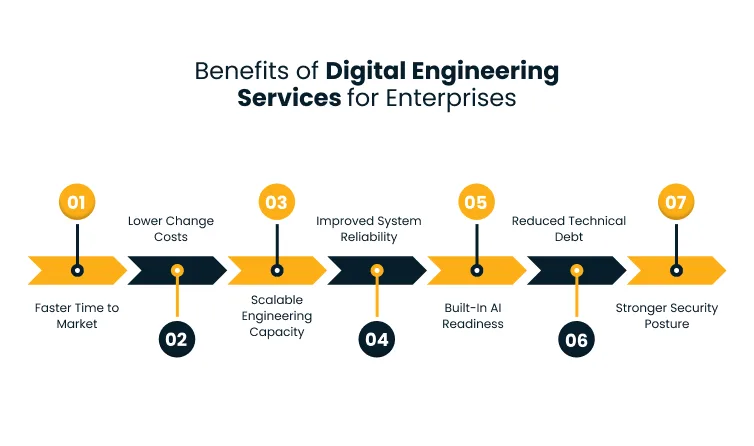
Faster time to market: Feature releases shift from quarterly cycles to weeks. Changes go live as soon as they pass automated quality gates. CubeResearch Report found that elite performers deploy 182x more frequently than low performers, a gap driven almost entirely by delivery automation.
Lower cost per change: Updating one microservice no longer triggers regression testing across the entire system. Each release costs less and carries less risk than it did on a monolithic architecture. AWS-native services like Lambda and Fargate further reduce overhead by eliminating idle compute costs.
Delivery capacity without proportional hiring: Automation and platform engineering create leverage. Teams ship more output without growing headcount at the same rate. The efficiency comes from the delivery system (CI/CD pipelines, codeless testing, IaC), not team size.
Built-in AI readiness: Modern data pipelines, clean APIs, and cloud infrastructure are the prerequisites AI workloads actually require. When the engineering foundation is AI-first from day one, AI use cases deploy incrementally rather than requiring a separate transformation program.
Reduced technical debt compounding: Continuous refactoring and enforced governance stop debt from accumulating. Without this discipline, the cost adds up fast. A 2025 Pega study estimated that the average global enterprise wastes over $370 million annually on inefficiencies caused by legacy systems and unmanaged technical debt.
Security shifted left: Vulnerabilities caught at commit time cost a fraction of those found post-deployment. IBM’s 2025 Cost of a Data Breach Report found that the average breach costs $4.44 million globally, while organizations using a DevSecOps approach saved over $227,000 per breach compared to those without one.
Common Challenges in Digital Engineering Adoption
Poorly planned or under-governed engagements generate their own problems. These are the failure patterns that appear most consistently across enterprise modernization programs.
Legacy decomposition is harder than it looks. Tightly coupled business logic, undocumented dependencies, and legacy data structures make monolith decomposition slower than initial estimates. Architecture discovery has to come before decomposition planning, not during it. This is exactly why structured frameworks like ORBIT front-load the assessment and architecture phases before any migration begins.
Cultural resistance slows adoption more than tooling does. Moving from quarterly releases to CI/CD requires behavioral change, not just pipeline setup. Teams built around the old model can stall adoption even after the infrastructure is in place.
Speed under pressure generates new debt. Rapid delivery without enforced architecture standards and code quality gates trades one form of technical debt for another. Governance must be non-negotiable from day one. CMMI Level 5 process maturity is one of the clearest signals that a provider enforces this discipline structurally rather than relying on individual heroics.
Parallel systems multiply attack surfaces. Running legacy and new environments simultaneously during transition creates security exposure. Security-by-design must be built into the migration plan, not addressed after the cutover.
Accountability gaps create long-term risk. If the partner does not build in structured knowledge transfer, the enterprise becomes dependent on external teams for systems it does not fully understand. Similarly, without feedback loops between engineering metrics and business outcomes, teams can optimize for technical quality while drifting from commercial priorities.
Most of these trace to the same root cause: a provider that treats the engagement as a time-boxed project rather than an accountable partnership. A well-structured engagement, built on a lifecycle model like COSMOS, addresses these upfront rather than managing consequences.
Digital Engineering Use Cases Across Industries
Four industries where digital engineering demand is consistently high, and what the engagement actually addresses in each.
1. BFSI: Modernizing Core Systems and Data Infrastructure
Core banking systems (loan origination, risk management, compliance reporting) run on legacy monoliths that cannot support real-time data requirements or absorb increasing regulatory demands. Digital engineering phases these toward cloud-native architecture on AWS, adds API-led integration with fintech and payment platforms, and embeds live compliance analytics.
The outcome is faster product launches, real-time regulatory reporting, and a platform ready for AI-driven credit decisioning. A Cygnet.One led the modernization of a large bank’s legacy CRM migrated the system to a cloud-native, multi-tenant architecture with centralized deployment, improving scalability and compliance management while eliminating the overhead of a fragmented monolith.
2. Retail and E-Commerce: Scalable Platform Engineering
Monolithic commerce platforms hit architectural ceilings during traffic spikes and create release bottlenecks that delay every product update. Digital engineering migrates to an autoscaling microservices architecture on AWS, builds event-driven integration between order management, inventory, and fulfillment, and delivers CI/CD for continuous feature releases. Each service scales independently based on load.
The outcome is peak traffic resilience, real-time inventory sync across channels, and a platform architecture that grows with the business rather than requiring re-engineering at each new threshold.
3. Healthcare: Interoperable Systems and Compliance Engineering
Patient data fragmented across EHR, lab, and billing systems creates both operational inefficiency and compliance risk. HIPAA, HL7, and FHIR requirements add engineering complexity to every integration. Digital engineering builds FHIR API integration layers, modernizes clinical applications for cloud deployment, and embeds compliance controls into CI/CD pipelines so every release is audit-ready from the moment it enters the deployment process.
Outcome is unified patient records, automated compliance validation, and faster clinical application updates without manual sign-off cycles.
4. Manufacturing: IoT, ERP Modernization, and Process Automation
Legacy ERP and SCM systems cannot process real-time IoT data, support predictive maintenance, or provide cross-plant production visibility. Digital engineering modernizes ERP infrastructure, builds IoT-to-cloud data pipelines, integrates AI predictive maintenance, and automates workflows through hyperautomation.
A Cygnet.One engagement with an outdoor gear manufacturer centralized data on AWS Redshift, automated pipelines via AWS Glue and Lambda, and deployed Power BI dashboards with a governance framework. The engagement delivered 25% cost savings and a 20% improvement in customer satisfaction scores.
Do You Need Digital Engineering Services? Signs to Look For
Digital engineering services are not the right answer at every stage. The following signals help clarify when external engineering capability creates genuine value.
Signals Your Engineering Model Needs External Support
Consider engaging a digital engineering partner when multiple of these apply:
- Release cycles run in months or quarters, and competitive pressure to accelerate is increasing
- Legacy application maintenance is consuming the majority of the engineering budget, leaving little capacity for new development.
- Cloud migration or modernization is on the roadmap, but internal teams lack the architecture and migration depth to execute without significant delivery risk.
- AI or automation initiatives are blocked by data infrastructure gaps, not strategy or funding.
- Persistent talent gaps across DevOps, cloud-native, or AI/ML are expensive to close through hiring alone.
- Technical debt is compounding to the point where it slows every initiative, regardless of prioritization.
You likely do not need external services if your portfolio is small and already cloud-native, your team has genuine full-stack and DevOps depth with available bandwidth, or you are still in early advisory stages before engineering execution begins.
What a Good Digital Engineering Partner Should Bring
Full-stack depth: Delivery across frontend, backend, data, cloud, AI, and DevOps simultaneously. Single-layer specialists introduce coordination gaps in multi-capability engagements.
Cloud-native as the default: Not a premium option or an upsell, but the standard architecture approach from day one. Look for deep expertise in AWS (or your primary cloud), including migration frameworks, managed services, and FinOps.
Process maturity evidence: CMMI Level 5, ISO certifications, and structured delivery frameworks signal predictable execution rather than delivery-by-heroics.
AI embedded in delivery, not offered as an add-on: AI should be part of how they architect, test, and automate. An AI-first partner treats AI readiness as a default engineering requirement, not a premium service activated after the core engagement is scoped.
Post-launch ownership: Continuous optimization, FinOps, and engineering maturity improvement after go-live, rather than handoff at the delivery milestone.
Cross-industry regulated-sector experience: Delivery at scale across BFSI, healthcare, and manufacturing demonstrates the compliance and governance depth that complex enterprise environments require.
Cygnet.One addresses these criteria through CMMI Level 5 process maturity, an AI-first engineering model, AWS Advanced Tier partnership with migration competency, cross-industry enterprise delivery across BFSI, manufacturing, retail, healthcare, and ISVs, and lifecycle ownership from technical due diligence through continuous optimization.
Conclusion
Digital engineering services represent the shift from maintaining what exists to continuously building what the business needs. The outcome is not a modernized system. It is a repeatable engineering capability: continuous delivery, AI-ready infrastructure, and an architecture that reduces the cost of every change rather than increasing it over time.
The right scope depends on where your systems are and how far they need to go. What does not change is this: treating digital engineering as a one-time modernization project, rather than an ongoing discipline, is what causes most enterprises to repeat the same modernization cycle every five years.
Cygnet.One provides end-to-end digital engineering across application modernization, cloud-native development, DevOps, AI integration, and enterprise integration, backed by CMMI Level 5 process maturity, AWS Advanced Tier partnership, and lifecycle ownership from due diligence through optimization. Start with Cygnet.One’s Generative AI Ideation Workshop to assess where AI-first engineering can create the most value for your organization.
FAQs
Digital engineering services cover the design, development, modernization, and management of software systems using modern practices: cloud-native architecture, DevOps, CI/CD, microservices, and embedded AI. Specialist partners deliver end-to-end capability from architecture design through continuous optimization, enabling faster delivery without proportional headcount growth
Traditional IT services maintain existing systems through infrastructure management, patching, and incident response. Digital engineering services build, modernize, and continuously improve software products using modern architectures. The core distinction is the operating model: IT services preserve what exists; digital engineering builds what comes next.
ROI is measured across four dimensions: speed (reduced time to market), cost (lower infrastructure spend and maintenance overhead), quality (improved uptime and mean time to resolution), and capacity (output per engineer enabled by automation). The strongest signal comes from comparing pre- and post-engagement metrics across all four, not infrastructure cost reduction in isolation.
Yes, in most enterprise contexts. Digital engineering partners augment internal teams rather than replace them. Most enterprises lack simultaneous depth across cloud-native architecture, DevOps, AI/ML, and full-stack development. A partner fills those gaps and accelerates delivery while internal teams retain ownership, context, and product direction.
AI workloads require clean data pipelines, modern APIs, cloud-native infrastructure, and continuous delivery systems. Digital engineering builds that foundation. Without it, AI initiatives stall because models run on incomplete data, deploy on fragile infrastructure, or cannot connect to the operational systems they are meant to improve. An AI-first engineering approach builds these prerequisites into the architecture from the start rather than treating AI readiness as a separate project.
Author


Abhishek Nandan
AVP, Marketing
Abhishek Nandan is the AVP of Services Marketing at Cygnet.One, where he drives global marketing strategy and execution. With nearly a decade of experience across growth hacking, digital, and performance marketing, he has built high-impact teams, delivered measurable pipeline growth, and strengthened partner ecosystems. Abhishek is known for his data-driven approach, deep expertise in marketing automation, and passion for mentoring the next generation of marketers.