




































According to the 2024 ITIC Hourly Cost of Downtime Survey, 91% of mid-sized enterprises report that a single hour of downtime costs their organization $300,000 or more. Performance failures are not just a QA concern; they are now becoming a business hindrance.
Most enterprise applications do not fail because of bad code. They fail because the failure conditions were never tested under peak load, across API dependencies, or against cloud infrastructure under real traffic. By the time those failures reach production, the damage is already done.
That is where performance testing services come in. The right provider does not just run a load test and hand over a report. They help you understand how your application behaves under pressure before that pressure arrives.
This guide covers what performance testing services enterprise applications actually need, what to evaluate before selecting a provider, and how the top companies compare so your team can make a more confident shortlisting decision.
Essential Performance Testing Services For Enterprise Applications
Enterprise applications need different types of performance testing depending on traffic patterns, architecture, release goals, and business risk. A strong provider should help you choose the right testing mix rather than running every test by default. The goal is targeted validation, matching each service to a specific risk your application carries.
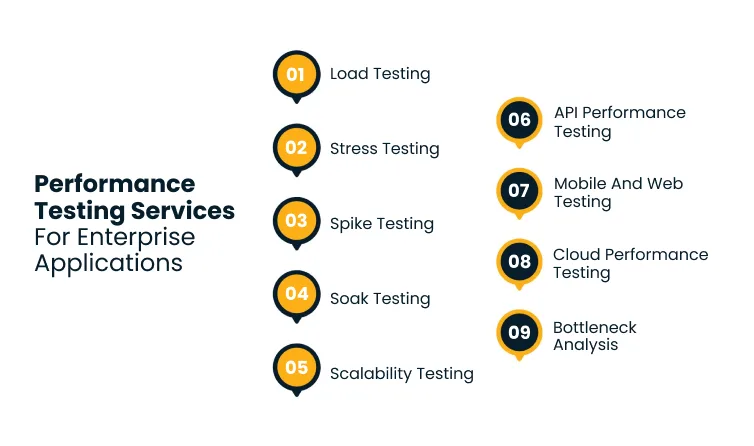
- Load Testing Services: Validates whether an application can sustain expected and peak user traffic before a launch, migration, or major release. Without this, teams ship without knowing whether the system holds under real-world demand.
- Stress Testing Services: Stress testing pushes the application beyond normal operating limits to expose breaking points, failure behavior, and recovery patterns. For enterprises, understanding how the system fails is as important as knowing when it slows.
- Spike Testing: This testing simulates sudden, sharp increases in traffic that mirror flash sales, product launches, or seasonal campaigns. Applications that handle steady load well can still collapse under an unplanned traffic surge.
- Soak and Endurance Testing: Soak and endurance testing run the application under sustained load over several hours or days to surface memory leaks, resource exhaustion, and performance degradation that only appear over time. Short test runs will not catch these issues.
- Scalability Testing: Scalability testing confirms whether the application scales predictably as user volumes, transaction counts, or infrastructure capacity grow. This is especially important ahead of enterprise customer onboarding or platform expansion.
- API Performance Testing: It measures how APIs, microservices, third-party integrations, and payment systems hold up under concurrent load. In API-heavy architectures, a single slow endpoint can cascade into application-wide slowdowns.
- Mobile and Web Application Performance Testing: Evaluates speed and responsiveness across browsers, devices, locations, and network conditions. Performance gaps that go unnoticed in a single-browser test can affect large segments of your actual user base.
- Cloud and Infrastructure Performance Testing: Tests how cloud workloads, auto-scaling rules, containers, databases, and distributed systems behave under load. Auto-scaling that works in theory may not trigger at the right thresholds when real traffic arrives.
- Performance Monitoring And Bottleneck Analysis: Identifies what is slowing the application down, whether the cause sits in the code, database, API layer, infrastructure, or caching layer. This turns test results into actionable fixes rather than raw metrics.
Industry requirements also shape the right testing mix. E-commerce teams may prioritize checkout stability, BFSI teams may focus on transaction throughput and secure test data, and SaaS platforms may need multi-tenant load testing.
Knowing which services your application needs is the first step. Choosing a provider qualified to deliver these services at enterprise scale requires a separate and equally rigorous evaluation.
What To Look For In A Performance Testing Services Provider
Choosing a performance testing services provider is a business-critical decision. Inadequate testing leads to missed bottlenecks, unreliable release decisions, and production failures that compound with every outage.
Before signing a contract, enterprise teams should evaluate whether the provider understands their application architecture, testing goals, industry needs, reporting expectations, automation maturity, and security requirements.
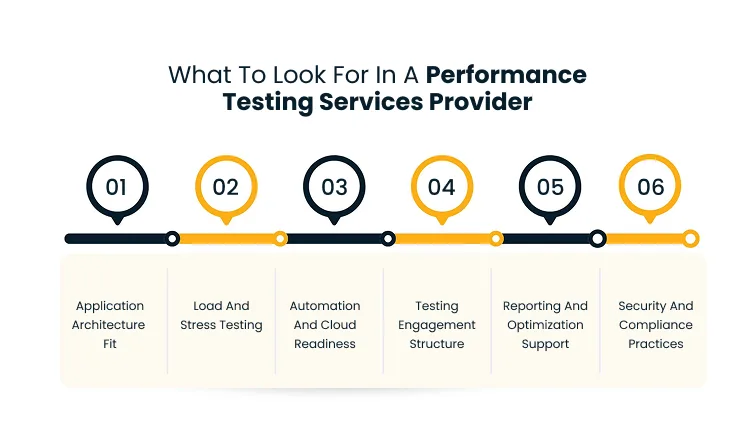
Match The Provider To Your Application Architecture
The provider should have experience testing applications similar to yours. Enterprise applications often include web apps, mobile apps, APIs, databases, microservices, legacy systems, third-party integrations, cloud infrastructure, and complex business workflows.
A qualified provider tests the complete transaction flow, not just the front end. An e-commerce checkout, banking transaction, insurance claim, SaaS dashboard, or ERP workflow may involve multiple systems that need to work together.
If a provider only validates front-end response times without tracing what happens in the database, API layer, or middleware, the results will not reflect production conditions.
Verify Load And Stress Testing Experience
Load testing and stress testing are the foundation of any serious performance testing engagement. The provider should know how to define realistic user loads, ramp-up patterns, transaction volumes, test data, failure thresholds, and pass or fail criteria.
A strong provider does not just report response times. They help identify whether a slowdown originates in the application code, database queries, API layer, infrastructure, caching layer, or a third-party dependency.
The difference between a provider that surfaces a bottleneck and one that diagnoses its root cause is often the difference between a useful report and one that your engineering team actually acts on.
Assess Automation, AI, And Cloud-Native Readiness
Performance testing confined to a single pre-release window is a structural mismatch for enterprises shipping multiple times per sprint. Teams that release frequently need performance QA embedded inside CI/CD pipelines so regressions are caught at the point where they are cheapest to fix, not after they reach production.
Look for providers that work with automation frameworks, DevOps pipelines, cloud workloads, Kubernetes, microservices, distributed tracing, and monitoring platforms.
Ask specifically how their approach handles auto-scaling environments, where performance behavior changes dynamically, and a one-time test result can be outdated by the next infrastructure event.
Review The Engagement Structure
A well-structured performance testing engagement starts before a single script is written. It should begin with application discovery, business goal alignment, workload modeling, and user journey selection, before moving into test environment setup, scripting, execution, monitoring, bottleneck analysis, retesting, and final reporting.
The provider should define performance goals before execution begins. These may include page load targets, API response time limits, concurrent user expectations, throughput goals, error rate thresholds, and infrastructure utilization limits.
A provider that skips workload modeling and goes straight to scripting is likely to test the wrong scenarios entirely. How a provider structures the preparation phase tells you a great deal about the quality of the results you will receive.
Check Reporting And Optimization Support
Performance testing results should be readable by both engineering and business teams. The final report should explain the test scope, workload model, environment setup, key metrics, failures, bottlenecks, risks, and recommended next steps.
Providers that offer root cause analysis and optimization guidance help teams understand what needs to be fixed, how urgently, and what the impact on user experience and release readiness looks like. A report that surfaces a bottleneck without explaining what to do about it transfers the entire analytical burden back to the team that hired the provider.
For a detailed breakdown of what deliverables and artifacts to ask for from a provider, this guide on enterprise application testing services covers the full checklist from discovery through reporting.
Confirm Security And Compliance Practices
Enterprise performance testing often involves sensitive workflows, regulated data, secure environments, and production-like test conditions. The provider should clearly explain how they handle access, credentials, test data, masking, compliance requirements, and auditability.
This is especially important for BFSI, healthcare, insurance, enterprise SaaS, and public sector applications where data privacy and operational risk are primary concerns. A provider that cannot articulate their data handling posture in concrete terms is not ready for enterprise engagements.
With a clear picture of what to evaluate, the next question is which providers in the market actually meet those criteria at enterprise scale. The section below compares the most relevant options.
Top Companies Offering Performance Testing Services For Enterprises
The right performance testing services provider depends on your application complexity, industry, traffic patterns, release goals, compliance needs, and internal QA maturity. Here are some companies enterprises can consider when evaluating performance testing services.
Use this list to compare providers based on your application architecture, testing maturity, release goals, and need for ongoing performance QA. For complex enterprise systems, prioritize providers that combine load testing, stress testing, bottleneck analysis, automation, and Quality Engineering expertise.
| Provider | Best Fit For | Core Capabilities | Enterprise Strengths |
| Cygnet.One | Enterprises needing performance testing within Quality Engineering | Performance testing, performance engineering, automation-led QA, enterprise application testing | Quality Engineering, DevOps alignment, continuous QA, business assurance testing |
| KiwiQA | Businesses needing dedicated QA and performance testing support | Load testing, performance testing, web and app validation | QA-focused delivery and software testing experience |
| Qualitest | Large enterprises needing a global Quality Engineering partner | Load testing, performance testing, managed testing | Global delivery, QA consulting, managed testing services |
| TestingXperts | Enterprises needing independent QA and digital assurance | Performance testing, cloud testing, mobile testing, automation testing | Digital assurance, cloud QA, enterprise application testing |
| Abstracta | Teams needing performance engineering depth | Real-load testing, bottleneck detection, performance consulting | Technical consulting, test strategy, root cause analysis |
| ScienceSoft | Mid-market and enterprise teams needing structured testing | Load testing, stress testing, stability testing, scalability testing | QA experience, structured reporting, optimization guidance |
| iBeta Quality Assurance | Teams needing independent load and performance testing | Load testing, performance testing, scalability testing | QA lab infrastructure, software testing experience, and independent validation |
Cygnet.One
Cygnet.One is a strong fit for enterprises that want performance testing as part of a broader Quality Engineering approach. Rather than treating performance validation as a standalone exercise, its Quality Engineering services focus on robust test strategies, scalable automation frameworks, and QA processes aligned with DevOps delivery cycles.
The platform is especially relevant for enterprises that need performance testing connected to broader application quality, business process testing, and release readiness.
For enterprises evaluating providers that go beyond standalone load or stress test execution, Cygnet.One connects performance validation to the wider quality programme, keeping it tied to release cycles and engineering workflows rather than isolated from them.
Key Strengths:
- Quality Engineering-Led Performance Testing: Performance validation sits within a Quality Engineering model that ties test results to release quality, reliability, and business assurance goals, rather than existing as a separate activity.
- Enterprise Application Testing Experience: The service portfolio covers complex business systems, multi-system integrations, and enterprise workflows where performance behavior across the full transaction stack matters.
- Automation and DevOps Alignment: Automation frameworks built into the Quality Engineering practice support continuous testing across CI/CD pipelines, helping enterprise teams catch performance regressions earlier in the delivery cycle.
- Performance-Sensitive Workflow Testing: Client work includes business-critical financial workflows, including a 3-minute checkout and automated debt recovery system, demonstrating capability in testing performance-sensitive enterprise processes end-to-end.
- Broader Non-Functional Testing Fit: Coverage extends across performance, compatibility, accessibility, automated, and continuous testing pipelines, which makes it relevant for enterprises that need more than basic test execution.
Best Fit For: Enterprises looking for a Quality Engineering partner that connects performance testing with automation, enterprise application testing, DevOps-aligned QA, and release readiness.
Shortlisting a performance testing services provider? Book a demo with Cygnet.One to explore how the Quality Engineering team can help validate performance, scalability, and release readiness for your next launch or migration.
KiwiQA
KiwiQA is a software testing company offering performance testing and load testing services for businesses looking to validate application speed, stability, and scalability. Its performance testing practice focuses on validating how apps, software, and websites hold up under realistic usage conditions, with a QA-first service model that suits teams looking for focused testing support.
For organizations that need performance testing without a broader managed testing engagement, KiwiQA offers dedicated QA delivery across web, software, and application environments.
Key Strengths:
- Load testing and performance testing coverage
- QA-focused service model
- Suitable for web, software, and application performance validation
- Useful for businesses that want focused performance testing support without a broader managed testing engagement
Qualitest
Qualitest is a global Quality Engineering company with performance testing and managed testing capabilities for enterprise applications. Its service model is built around Quality Engineering strategy, managed testing, risk-based testing, global delivery, and QA transformation programmes for large-scale organizations.
For enterprises running complex, multi-year QA transformation programmes or those that need managed testing at a global scale, Qualitest brings both the delivery footprint and the consulting depth to support that scope. Performance testing sits within a wider enterprise QA capability rather than as an isolated offering.
Key Strengths:
- Enterprise-grade Quality Engineering services
- Load and performance testing support
- Managed testing capabilities
- Experience with large-scale QA transformation programmes
TestingXperts
TestingXperts provides software testing and digital assurance services, including performance testing services designed to identify and resolve performance issues so applications perform reliably under varied conditions.
The company positions itself around digital assurance for modern enterprise applications, with capabilities spanning cloud, mobile, and automation testing.
For enterprises with cloud-native or mobile-first applications that also need performance validation as part of a broader digital assurance programme, TestingXperts covers the technical depth and the QA methodology to support enterprise release cycles.
Key Strengths:
- Performance testing services across web, mobile, and cloud environments
- Digital assurance experience for modern enterprise applications
- Cloud and automation testing capabilities
- QA support aligned to enterprise release cycles
Abstracta
Abstracta offers performance testing services built for production-grade load scenarios, with a focus on detecting bottlenecks early and validating how software behaves before users are affected.
The firm leans toward performance engineering and technical consulting rather than broad managed testing, making it a stronger fit for teams with engineering maturity who need expert guidance on test design and root cause analysis.
Organizations that have struggled to get actionable findings from previous performance testing engagements may find Abstracta’s consulting-led approach more useful. The emphasis on detecting and diagnosing bottlenecks, rather than just reporting on them, is what differentiates the offering.
Key Strengths:
- Performance engineering consulting
- Production-grade load testing with a focus on bottleneck detection
- Practical optimization recommendations for engineering teams
- Strong technical depth in root cause analysis
ScienceSoft
ScienceSoft offers software performance testing services covering load, stress, stability, and scalability testing. Its approach focuses on validating performance metrics across different load scenarios and providing a structured view of software performance with reporting built for both technical and business stakeholders.
For mid-market and enterprise teams that need a methodical testing partner with clear documentation and optimization guidance, ScienceSoft offers structured delivery across a broad range of industries.
The reporting quality and optimization recommendations make it a practical choice for teams that need to share findings across engineering and non-technical decision-makers.
Key Strengths:
- Load and stress testing services
- Stability and scalability testing coverage
- QA and software testing experience across industries
- Structured reporting with optimization guidance
iBeta Quality Assurance
iBeta Quality Assurance offers load and software performance testing services for websites, applications, and networks. Its testing practice is built around independent validation with dedicated QA lab infrastructure for load, performance, and scalability testing, making it well-positioned for teams that need third-party verification rather than in-house capability.
For organizations that require an independent auditor for performance results, whether for compliance purposes, vendor validation, or release sign-off, iBeta provides the infrastructure and independence that makes its findings credible to external stakeholders.
Key Strengths:
- Load and performance testing services
- Application, website, and network performance validation
- Independent QA and software testing experience
- Well-suited for teams that need third-party performance testing without building an in-house capability
Conclusion
Choosing a performance testing services provider should not be treated as a routine QA procurement decision. For enterprise applications, the right partner can reduce release risk, improve application reliability, validate scalability, and prevent performance failures before they reach users.
According to McKinsey’s 2024 Research on IT Productivity, enterprises with high-performing IT organizations see up to 35% higher revenue growth and 10% higher profit margins than their peers. Performance testing is one of the clearest levers for keeping enterprise applications on that trajectory.
Before signing a contract, evaluate whether the provider understands your application architecture, supports load and stress testing, offers performance QA maturity, delivers actionable reporting, and can align testing with your release process.
Cygnet.One is a strong option for enterprises that want performance testing within a broader Quality Engineering model. Its capabilities across Quality Engineering, enterprise application testing, automation, and continuous QA make it well-suited for teams preparing for launches, migrations, and high-traffic release cycles.
Talk to Cygnet.One’s Quality Engineering team to assess your application’s load, scalability, and performance risks before your next launch or migration. Book a demo now.
FAQs
Performance testing services evaluate how an application performs under expected, peak, and extreme usage conditions. These services measure speed, scalability, stability, response time, throughput, and error rates so teams can identify bottlenecks before production.
Load testing checks whether an application can handle expected or peak traffic volumes. Stress testing pushes the application beyond normal operating limits to identify breaking points, failure behavior, recovery patterns, and infrastructure thresholds.
Enterprises need performance testing services to reduce release risk, prevent downtime, improve user experience, validate scalability, and ensure business-critical applications can handle production traffic, transaction volumes, and system dependencies.
Look for experience with enterprise applications, load testing, stress testing, workload modeling, cloud-native testing, automation, bottleneck analysis, structured reporting, and documented data handling practices for regulated environments.
Yes. Cygnet.One provides performance testing as part of its broader Quality Engineering and Testing Services. Its collateral lists performance testing under non-functional testing and includes automated testing and continuous testing pipelines in DevOps.
Enterprises should invest in performance testing before major launches, cloud migrations, infrastructure changes, peak traffic events, enterprise customer onboarding, and high-risk releases where speed, stability, and scalability are non-negotiable.
Author


Abhishek Nandan
AVP, Marketing
Abhishek Nandan is the AVP of Services Marketing at Cygnet.One, where he drives global marketing strategy and execution. With nearly a decade of experience across growth hacking, digital, and performance marketing, he has built high-impact teams, delivered measurable pipeline growth, and strengthened partner ecosystems. Abhishek is known for his data-driven approach, deep expertise in marketing automation, and passion for mentoring the next generation of marketers.