



































An application deployment can change who has access to enterprise data before it changes a line of application code. A new IAM role, an updated trust policy, or permission to pass a role to an AWS service may open a path to resources outside the workload. These changes often arrive inside an ordinary infrastructure pull request, where attention is focused on whether the deployment succeeds.
This creates a difficult choice for platform and security teams. Central approval of every role slows delivery. Broad role-creation rights leave too much to individual judgment. AWS IAM governance works better when security defines the limits and application teams remain responsible for the permissions their workloads actually need, supported by AWS consulting services that align cloud governance with engineering requirements.
The permission boundaries AWS enforces can support this separation. Their value, however, depends on how role creation, role assumption, policy changes, and exceptions are handled together. A boundary attached during provisioning is only part of the control.
Why IAM Access Becomes a Delivery Bottleneck
Application teams regularly need IAM roles for functions such as reading objects from S3, publishing events, or writing logs. Waiting for a central administrator to author each role creates repeated handoffs. Yet allowing teams to attach unrestricted policies invites overly broad access, especially when deployments fail because a service action was overlooked.
The tension often comes from mixing two decisions. The security function needs to decide which capabilities an application team may authorize. The application owner needs to decide which of those capabilities a particular workload requires. Putting both decisions into one approval queue makes every routine permission change a governance question.
An effective AWS IAM governance model separates them, while cloud engineering services help establish reusable permission boundaries, role templates, and deployment guardrails. Platform teams can establish permission ceilings, protected resource categories, and rules for role creation. Developers can then create task-specific roles inside those limits using reviewed templates and infrastructure as code.
AWS IAM governance also requires accountability. Every role should have a named service owner, a documented purpose, and a defined method for requesting access outside its usual scope. Without those details, decentralization merely moves the access backlog into the cloud account.
How Permission Boundaries Limit IAM Role Permissions
A permissions boundary is a managed IAM policy that sets the maximum permissions an IAM user or role can receive through identity-based policies. Each IAM role can have one permissions boundary. It grants no access by itself. An attached identity policy must also allow the requested action, and other applicable controls can still prevent it.
The permission boundaries AWS evaluates therefore serve a different purpose from workload policies. A boundary may permit selected S3 and DynamoDB operations, while the application’s identity policy grants access only to a particular bucket and table. If an engineer accidentally adds a broader S3 statement, the boundary limits the role’s identity-based permissions to the approved ceiling.
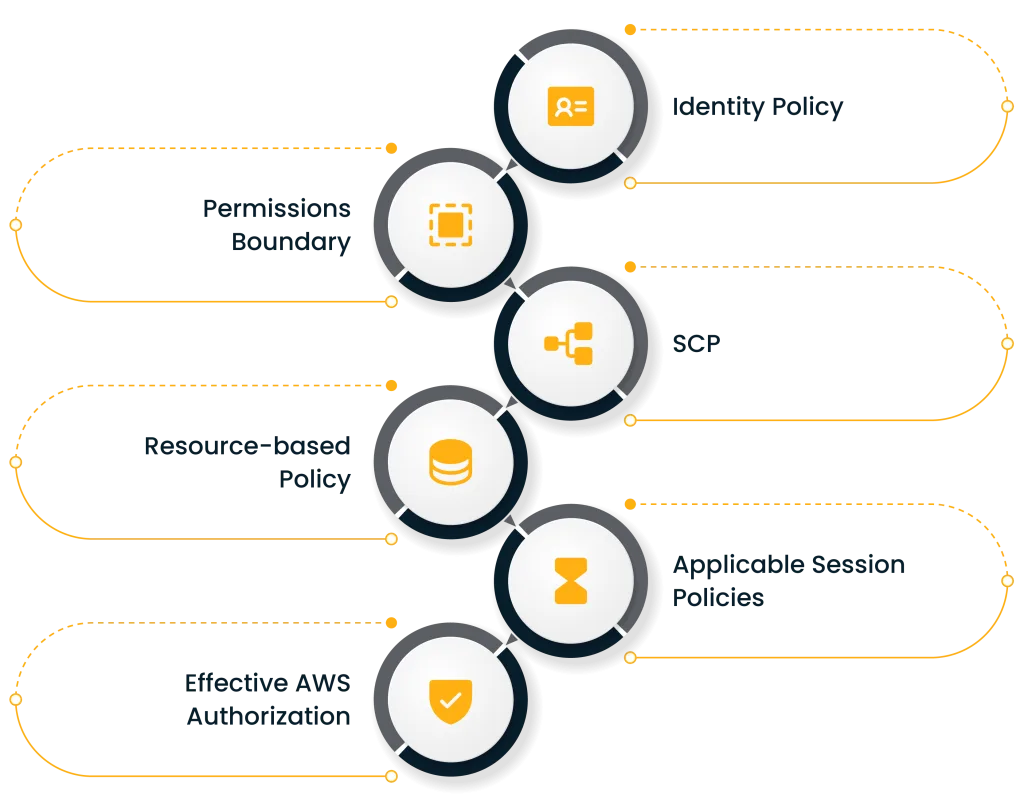
The main policy layers serve different decisions:
| Control | What it decides | Typical owner |
| Identity-based policy | Which actions a workload role may perform | Application team |
| Permissions boundary | Maximum identity-based permissions a role may receive | Platform or security team |
| Service control policy (SCP) | Organization-wide limits for principals in member accounts | Central cloud governance |
| Resource-based policy | Which principals may access a particular resource | Resource owner |
| Role trust policy | Which principals may assume a role | Role owner under central rules |
This distinction matters for IAM policy design. Boundaries are especially useful when application teams can create roles within an account. They do not replace SCPs, resource policies, session policies, or controls on who can assume a role.
Resource-based access creates an important exception. Within the same AWS account, permissions granted directly to an assumed-role session through a resource-based policy are not restricted by an implicit deny in the role’s permissions boundary. Explicit denies still matter. Access reviews must therefore consider the complete authorization path instead of treating the boundary as a universal firewall.
Design IAM Roles Around Workloads and Trust Relationships
A service role should describe a workload responsibility rather than copy the permissions of the employee deploying it. An application that publishes events does not automatically need to manage IAM policies, inspect unrelated storage, or administer network settings.
The principle of least privilege AWS recommends is easier to apply when workload roles have clearly defined purposes and descriptive names. Separate deployment roles from runtime roles. Keep production access distinct from development access when the business risk differs. Record the resources and actions each role needs, along with the service or principal expected to assume it.
Trust policies deserve equal attention. The identity policy may be appropriately narrow while its trust policy permits an unexpected principal to assume the role. Cross-account access, service principals, and federated deployment identities need specific review. A permissions boundary on the target role cannot correct an overly permissive trust relationship by itself.
For AWS identity access management, this is the essential design unit: the role, its trust relationship, its attached permissions, and its boundary. Reviewing any one element in isolation produces an incomplete account of access.
Enforce Permission Boundaries During Role Creation
A documented standard cannot stop an unbounded role from being created. Enforcement needs to happen in the permissions assigned to whoever creates or manages roles, including automation identities.
The permission boundaries AWS checks can be required at creation time by using the iam:PermissionsBoundary condition key on iam:CreateRole. A platform team can permit the operation only when the request specifies an approved boundary policy ARN. Developers retain the ability to provision application roles without selecting their own maximum authority.
Creation-time checks are the beginning of the workflow. A delegated role administrator must also be prevented from removing the boundary or changing the managed policy that defines it. AWS documents relevant actions including iam:DeleteRolePermissionsBoundary, iam:CreatePolicyVersion, and iam:SetDefaultPolicyVersion. Controls should also govern replacing a boundary and deleting protected policy resources.
A practical implementation has four checks:
- Before deployment: Require an approved boundary ARN in role templates and validate policies in the delivery pipeline.
- At creation: Enforce the boundary condition through the permissions of the role creator.
- After creation: Restrict boundary removal and policy-version changes to authorized administrators.
- During review: Detect roles without their required boundaries and investigate how the deviation occurred.
The permission boundaries AWS enforces are effective only when the surrounding administration rights remain constrained. A role that begins with a safe boundary but can later discard it has a preventable control gap.
Close Privilege Escalation Paths Without Blocking Delivery
Privilege escalation can follow a route other than attaching AdministratorAccess. Consider a developer who can create a role, modify its trust policy, and assume it, or pass it to a service. The real question is whether that chain permits actions outside the developer’s approved authority.
For this reason, AWS IAM governance must cover sts:AssumeRole, iam:PassRole, trust-policy updates, and permissions to modify IAM policies. Restrict passing roles to identified role ARNs and intended AWS services where supported by conditions such as iam:PassedToService. Examine which principals can update trust policies or use service-linked access paths.
The permission boundaries AWS evaluates for workload roles should also reflect deliberate exclusions. Roles intended for application runtime may have no reason to administer IAM. Explicit denies can be appropriate for particularly sensitive operations, but they should be tested against legitimate deployment and recovery tasks.
Cloud access control is weakened when administrators treat a successful policy attachment as proof of effective restriction. AWS evaluates identity policies, boundaries, SCPs, applicable resource-based grants, and sometimes session policies. Clear IAM policy design keeps those differences visible when access changes. An unexpected allow or deny is often the result of their interaction.
Test representative access paths with the IAM policy simulator and IAM Access Analyzer. Include expected approvals, prohibited actions, cross-account scenarios, and changes to role trust. Tests should cover deployed behavior where simulation has limitations.
Build a Review Cadence Around Access Changes
Quarterly certification alone cannot address a risky policy introduced immediately after review. AWS IAM governance checks should follow the points at which permissions actually change: new roles, modified trust policies, updated managed policies, and changed resource policies.
The permission boundaries AWS evaluates on IAM roles should be reviewed alongside actual role usage. IAM Access Analyzer can identify unused access, validate policies, and generate policy suggestions from up to 90 days of CloudTrail activity. Those suggestions need engineering review because observed activity may exclude infrequent recovery or seasonal business functions.
A useful review cadence combines different triggers rather than repeating the same checklist:
- On each change: Check boundary attachment, new privileges, trust relationships, and any expansion in iam:PassRole scope.
- On a scheduled cycle: Review unused permissions, inactive roles, ownership records, and unresolved exceptions.
- After an incident or architecture change: Reassess access paths that cross accounts, teams, or sensitive data boundaries.
For AWS security operations, the record should show who approved a deviation, why it was needed, what was tested, and when the approval expires. A review that produces no action owner or closure decision becomes reporting rather than governance.
Give Developers a Faster Route to Approved Access
Guardrails help delivery only when approved work has a clear path. If a required permission falls outside a boundary, the team needs to know whether the request is blocked by an enterprise rule or whether the approved role pattern is incomplete.
The permission boundaries AWS uses for delegated administration should be organized around meaningful workload groups where their risk profiles differ. Data processing, deployment automation, and application runtime may require different ceilings. Avoid creating a unique boundary for each role, which leaves central teams maintaining the same complexity they were trying to remove.
A useful developer experience includes preapproved role modules, documented examples, policy checks in continuous integration, and error messages that identify the denied action and responsible control. Requests for exceptions should capture the business need, affected resources, required duration, and proposed compensating controls.
The least privilege AWS guidance encourages is easier to sustain when teams can see why an operation was denied and can correct the policy without opening another general-purpose access request. Where an exception is justified, granting it through a separate, narrowly scoped role may be safer than widening a shared boundary for unrelated workloads.
A reliable AWS identity access management process also treats exception closure as part of delivery. Temporary access must have an owner and an end condition. Otherwise, an emergency grant can become an undocumented permanent entitlement.
Make Delegated IAM Access a Repeatable Operating Practice
AWS IAM governance succeeds when responsibility stays clear after a role is deployed. Security teams own the approved ceilings and high-risk restrictions. Platform teams maintain enforceable templates and validation. Application owners remain accountable for the access their services request and use.
These boundaries make that division technically possible. They cannot compensate for unrestricted role assumption, unmanaged resource policies, or approvals that are never revisited. Effective cloud access control requires those pieces to be evaluated together, making cybersecurity services important for validating privileges, trust relationships, and access risks.
A practical next step is to examine a small set of developer-created roles from provisioning through runtime. Check the boundary, identity policy, trust policy, pass-role permissions, and exception history. Then correct the workflow that allowed any gap. That approach gives AWS security operations a manageable starting point while keeping routine delivery within established limits.
Author


Yogita Jain
Content Lead
Yogita Jain leads with storytelling and Insightful content that connects with the audiences. She’s the voice behind the brand’s digital presence, translating complex tech like cloud modernization and enterprise AI into narratives that spark interest and drive action. With a diverse of experience across IT and digital transformation, Yogita blends strategic thinking with editorial craft, shaping content that’s sharp, relevant, and grounded in real business outcomes. At Cygnet, she’s not just building content pipelines; she’s building conversations that matter to clients, partners, and decision-makers alike.