


































The first time an AI agent makes a decision you cannot explain, it feels less like innovation and more like risk.
Not because the model is wrong.
But because you do not know why it did what it did.
In 2026, AI agents are no longer answering simple prompts. They are booking shipments. Adjusting credit limits. Negotiating vendor terms. Orchestrating cloud workflows. Triggering downstream systems without waiting for human approval. That shift changes the conversation. Performance alone is not enough. Accuracy is not enough. Even cost efficiency is not enough.
What matters now is visibility.
That is where agentic AI observability enters the picture.
If your enterprise is deploying autonomous agents on AWS or anywhere else, you need more than logs—you need structured visibility enabled by modern Enterprise AI solutions. You need to understand decisions, actions, and outcomes in context. You need structured insight into how agents reason, what tools they call, how they collaborate, and whether the results align with business intent.
This blog breaks that down in a practical way. Not theory. Not surface-level guidance. Real operational clarity.
The Growing Need for Observability in Agentic Systems
AI used to be reactive. A prompt went in. A response came out. The blast radius was limited.
Agentic systems changed that. They plan. They select tools. They write code. They call APIs. They retry. They learn from state. Sometimes they even negotiate with other agents.
When that happens, traditional monitoring fails.
A standard application dashboard shows CPU usage and response times. That tells you nothing about why an agent decided to cancel a shipment or escalate a ticket.
That gap is why AI agent monitoring is becoming a board-level concern. Enterprises are asking new questions:
- Why did the agent choose this path?
- What inputs shaped the decision?
- Which tools were called?
- Did the action align with policy?
- What was the business outcome?
Without clear answers, AI adoption stalls. Not because it does not work. But because no one can trust it at operational depth.
True agentic AI observability is about tracing reasoning, not just tracking system health.
What Should You Actually Observe?
Most teams start in the wrong place. They track latency and token usage. Useful, yes. Sufficient, no.
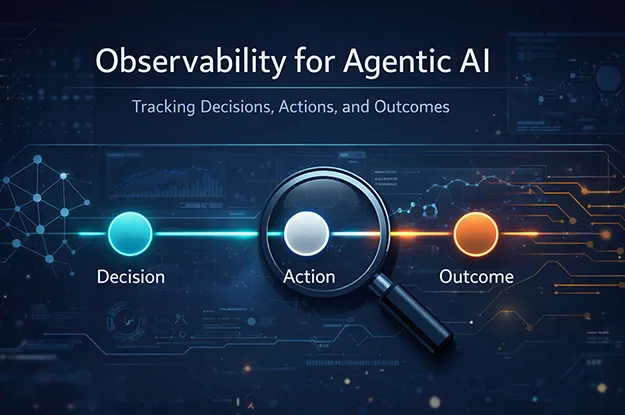
Observability for agents has three layers.
1. Intent and Planning
Agents often break tasks into subtasks. They create intermediate plans. They revise them. That planning layer is invisible unless you capture it deliberately.
You need structured capture of:
- Original goal
- Decomposed plan
- Tool selection logic
- Prompt variations over retries
This is where AI decision traceability becomes critical. If an agent rejected one plan and selected another, you should see that reasoning path.
Not vague summaries. Actual traceable steps.
2. Actions and Tool Calls
Agents interact with APIs, databases, search engines, cloud services, and internal systems built on scalable cloud engineering services.
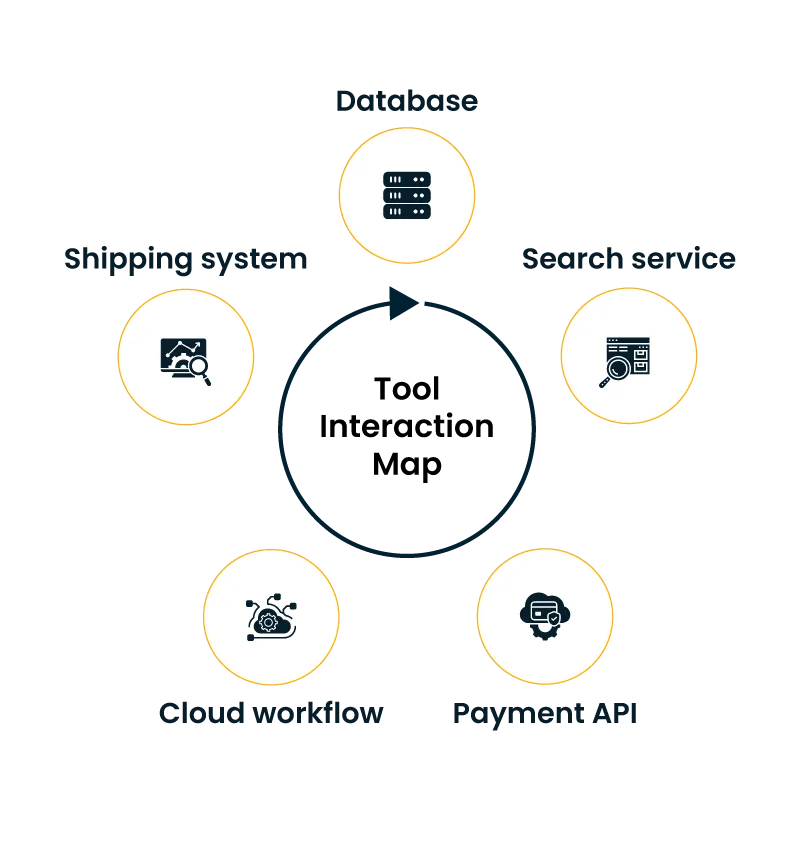
For effective AI agent monitoring, each action must include:
- Tool invoked
- Parameters passed
- Response received
- Error handling logic
- Retry patterns
This is not just debugging data. It is compliance evidence.
In regulated industries, monitoring autonomous AI agents means you can reconstruct exactly how a financial decision or operational change occurred.
3. Outcomes and Impact
The final response is only part of the story. What happened after?
- Did the workflow complete successfully?
- Did downstream systems accept the update?
- Was there a human override?
- Was the business KPI affected?
This outcome layer is often ignored. It should not be.
Without tying agent decisions to real-world results, observability remains technical. It must be business aware.
Metrics That Actually Matter
Metrics for agentic systems look different from traditional AI models.
Accuracy still matters. So does latency. But they are incomplete.
Here are deeper metrics that enterprises should track.
Decision Stability
How often does the same input produce similar planning structures? Wild variation signals brittleness.
Tool Efficiency
Are agents calling too many tools? Are they retrying excessively? That suggests poor reasoning or prompt drift.
Policy Adherence Rate
This is where AI governance metrics enter the conversation. Track how often agent decisions align with defined guardrails.
For example:
- Did the agent stay within budget thresholds?
- Did it follow access control policies?
- Did it avoid restricted data?
Human Override Frequency
If humans frequently step in, something is misaligned. Either the agent lacks context, or trust is low.
Cross-Agent Coordination Quality
In observability for multi-agent systems, you must measure coordination of success. Are agents duplicating tasks? Are they conflicting?
This matters more than raw output quality.
Traces Over Dashboards
Many enterprises think observability means a dashboard.
That mindset limits progress.
Agentic systems require trace graphs, not just charts—a concept often discussed in multi-agent workflows with AWS Bedrock.
A trace should show:
User request → Agent planning step → Tool call → External API → Response → Agent revision → Final action → Business system update.
All connected. Time-sequenced. Searchable.
This is where agentic AI observability becomes a design discipline, not a monitoring add-on.
On AWS, this often integrates with distributed tracing frameworks used in aws managed services environments. But the key difference is semantic tagging. Each node in the trace must include reasoning metadata.
Without reasoning context, you are just tracking infrastructure.
Tooling Patterns That Actually Work
Let us move beyond abstract advice.
Here are practical patterns enterprises are using.
Pattern 1: Structured Reasoning Logs
Instead of dumping free-text chain-of-thought into logs, teams create structured JSON schemas:
- intent
- constraints
- selected tools
- fallback logic
- confidence score
This makes AI decision traceability queryable.
You can search for all decisions made under a specific risk threshold.
Pattern 2: Observability Wrappers Around Tools
Each tool call is wrapped with:
- Pre-call policy validation
- Post-call validation checks
- Metadata tagging
- Risk classification
This improves AI agent monitoring without modifying core agent logic.
Pattern 3: Business KPI Mapping
Every agent workflow maps to one or more business indicators.
For example:
- Time-to-resolution
- Cost per transaction
- Revenue impact
- SLA adherence
This creates feedback loops.
Pattern 4: Coordination Observers for Multi-Agent Systems
In observability for multi-agent systems, a supervising observer tracks:
- Message exchange frequency
- Conflict resolution events
- Task handoff efficiency
- Idle time
This prevents silent coordination failures.
Governance Is Not a Separate Layer
Many organizations treat governance as paperwork.
That approach fails with autonomous systems.
Governance must be encoded into runtime observability.
Here is what that means.
Policy-Aware Tracing
Every decision trace includes policy references.
If an agent declines an action due to compliance rules, the trace should show which rule is applied.
This supports AI governance metrics in real time.
Bias and Risk Flags
Agents should attach risk indicators to decisions.
For example:
- Low confidence classification
- Limited training data relevance
- Sensitive domain inference
These signals support monitoring autonomous AI agents responsibly.
Audit-Ready Logs
Regulated industries require replay capability.
If an auditor asks how a pricing decision was made, you should reconstruct the full reasoning path.
That is not optional.
This is where strong agentic AI observability differentiates experimental AI from enterprise AI.
Explainability That Makes Sense to Humans
Explainability often gets reduced to model interpretability.
That is too narrow.
In agentic systems, explainability includes:
- Why this plan?
- Why this tool?
- Why this retry?
- Why this final action?
The explanation must be understandable to non-technical stakeholders.
This is where structured summaries help. Each workflow can produce a human-readable explanation generated from trace metadata.
Clear. Direct. No jargon.
When implemented well, AI decision traceability becomes a confidence driver, not a compliance burden.
Enterprise Readiness: The Real Test
Before deploying autonomous agents widely, enterprises should answer five questions.
- Can we reconstruct any decision within minutes?
- Do we measure policy adherence continuously?
- Can we detect abnormal coordination patterns?
- Are outcomes tied to business metrics?
- Do we have defined thresholds for human intervention?
If the answer to any of these is no, observability is incomplete.
Enterprise-grade AI agent monitoring is not about watching everything. It is about watching what matters.
On AWS environments, this often means integrating cloud-native telemetry with reasoning-level metadata. Logs, traces, and metrics must align.
Without integration, data remains fragmented.
A Different Way to Think About Observability
Here is the shift.
Stop thinking of observability as “seeing inside the system.”
Start thinking of it as “building evidence for trust.”
- Every trace is evidence.
- Every policy check is evidence.
- Every override event is evidence.
That evidence supports internal stakeholders, auditors, regulators, and customers.
This is why agentic AI observability is not a technical upgrade. It is an operational safeguard.
Common Mistakes Teams Make
Even strong engineering teams fall into traps.
They log everything but structure nothing.
They track model accuracy but ignore coordination failures.
They collect data but never tie it to AI governance metrics.
They deploy multiple agents without planning observability for multi-agent systems.
These gaps surface later. Usually during incidents.
Better to design observability alongside the agent architecture.
Where Is This Headed?
In 2026, autonomous systems are moving into procurement, healthcare triage, cybersecurity response, and financial operations.
The tolerance for black-box reasoning is shrinking.
Boards want accountability. Regulators want auditability. Customers want assurance.
The enterprises that move confidently into this phase will not be the ones with the most agents. They will be the ones with the clearest visibility.
- Strong AI agent monitoring creates that clarity.
- Structured monitoring autonomous AI agents reduces operational risk.
- Clear AI decision traceability builds internal trust.
- Mature observability for multi-agent systems prevents silent coordination breakdowns.
- Defined AI governance metrics tie technology back to responsibility.
And comprehensive agentic AI observability connects all of it into one coherent discipline.
Author


Yogita Jain
Content Lead
Yogita Jain leads with storytelling and Insightful content that connects with the audiences. She’s the voice behind the brand’s digital presence, translating complex tech like cloud modernization and enterprise AI into narratives that spark interest and drive action. With a diverse of experience across IT and digital transformation, Yogita blends strategic thinking with editorial craft, shaping content that’s sharp, relevant, and grounded in real business outcomes. At Cygnet, she’s not just building content pipelines; she’s building conversations that matter to clients, partners, and decision-makers alike.