



































An exception approved for a weekend migration can remain open long after the migration ends. The business need has disappeared, but the system continues operating with a weaker control. The record still says approved, although nobody has checked whether the original decision remains defensible.
Verizon’s 2026 Data Breach Investigations Report found that vulnerability exploitation was the initial access route in 31% of breaches. The finding does not attribute those breaches to approved exceptions. It does show why known exposure demands active oversight.
Effective IT security exception management starts with a simple principle: permission to deviate must remain tied to the conditions that justified it, supported by GRC services that establish risk ownership and control oversight. A risk acceptance workflow should establish who owns the decision, what protection remains, and exactly when the approval stops being valid.
When a Security Exception Is Legitimate
Some deviations have a defensible business reason. A supplier may need time to support multifactor authentication. A legacy manufacturing application may require an outdated protocol until its replacement is tested. A patch may disrupt a production cycle.
Each case needs evidence, a defined constraint, and a route to resolution. Convenience is a weak justification, especially when a control was already bypassed without authorization.
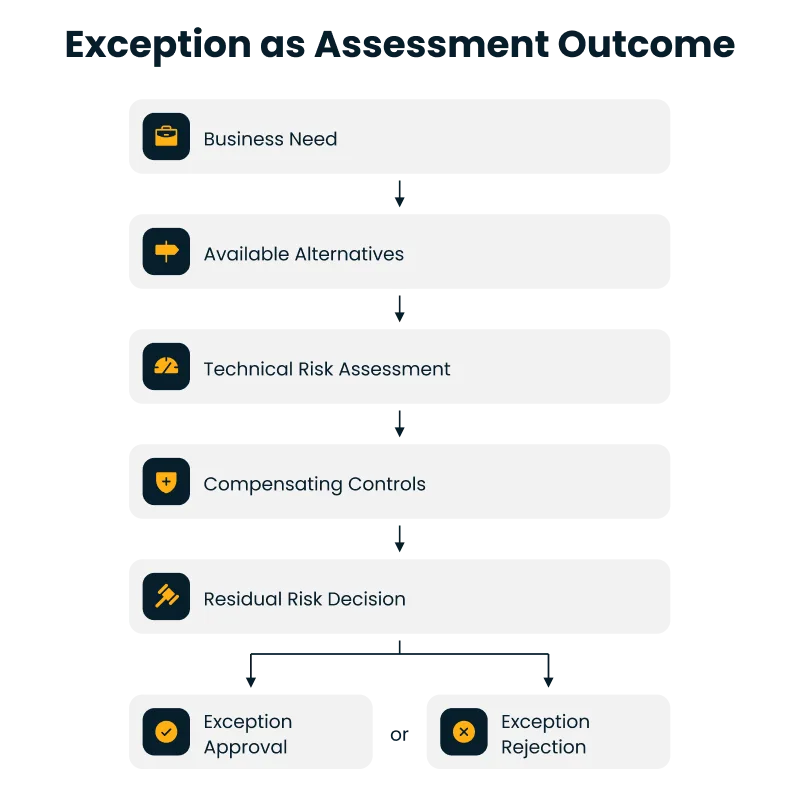
Before granting an exception, consider alternatives through cybersecurity services that assess exposure and identify suitable protective controls. Could network segmentation restrict access? Could a vendor connection be limited by identity and operating window? Could a vulnerable service be removed from external reach?
These questions keep IT security exception management focused on managing exposure rather than processing requests. An exception should be the documented result of an assessment, not the starting assumption.
Policy Exceptions and Residual Risk Acceptance Are Different Decisions
A policy exception permits a departure from a rule. Residual risk acceptance acknowledges exposure remaining after safeguards and treatment are considered. They answer different questions, even when recorded together.
| Decision | What it establishes | Example |
| Policy exception | Which requirement cannot be met, and for which assets | Temporary departure from a mandatory MFA policy for a named service account |
| Residual risk acceptance | Whether the remaining exposure is tolerable to the business | Approval of the assessed account-compromise risk after network and activity restrictions |
| Remediation commitment | How the deviation will be corrected or retired | Replace the integration and remove the account exemption |
A security architect may verify a workaround but lack authority to accept its business consequences. A business owner may accept risk without understanding the underlying weakness. Neither decision substitutes for the other.
The ISO 27001 risk acceptance process provides an important reference. Clause 6.1.3 of ISO/IEC 27001:2022 calls for risk owners to approve the treatment plan and accept residual information security risks. The organization must define its own approval periods and forms.
A sound risk acceptance workflow therefore separates technical assessment from accountable business approval, even when both happen within the same ticket.
What Every Security Exception Request Must Contain
An exception record should make sense without contacting its requester. That is the test behind security exception register best practices: preserve the reasoning alongside the decision.
Each request should record:
- Business rationale: What activity is affected and why a compliant alternative is unavailable.
- Affected scope: Named assets, identities, vendors, environments, and data categories.
- Control deviation: The requirement that cannot be met.
- Risk assessment: Failure scenarios, impact, likelihood, safeguards, and residual exposure.
- Accountability: Business risk owner, security reviewer, implementer, and remediation owner.
- Exit evidence: Remediation task, verification method, review triggers, and expiry.
IT security exception management becomes difficult when records describe a technical weakness without identifying the business process behind it. For example, “database encryption deferred” says little about sensitive information, connected services, or who would bear the impact of disclosure.
Link the request to the related change, vulnerability, incident, or project ticket. Reviewers can then identify duplicate exceptions and follow remediation progress. A risk acceptance workflow should return incomplete requests before an approver has to infer their business impact.
Who Should Approve IT Security Exceptions
The question of who approves IT security exceptions needs an authority matrix agreed in advance. Approval rights should follow business impact and risk tolerance.
| Role | Expected responsibility |
| Requesting service owner | Explains operational need and affected business activity |
| Security or GRC reviewer | Tests the assessment, required safeguards, and policy implications |
| Technical control owner | Confirms restrictions are feasible and can be verified |
| Authorized business risk owner | Accepts or rejects residual risk within delegated authority |
| Senior risk authority | Reviews cases above tolerance or outside delegated limits |
Security teams can challenge unsupported assessments and escalate unacceptable exposure. Maintaining the register does not make security accountable for the business decision.
A risk acceptance workflow must also address conflicts. A project sponsor should not be the sole assessor. Exposure above tolerance may require narrower scope, stronger treatment, or refusal rather than another signature.
Documenting who approves IT security exceptions makes decisions traceable when ownership changes or an incident prompts retrospective review.
Compensating Controls Need Evidence of Operation
A compensating measure must address the failure scenario associated with the missing control. Reviewing access logs cannot replace multifactor authentication. Detection improves, but credential misuse remains possible.
For a legacy application, temporary safeguards might include a managed gateway, limited identities, no direct internet access, and alerts for unusual sessions. Reviewers must test these restrictions.
Compensating control documentation should answer three questions: which specific risk is reduced, how the measure works, and what evidence proves it remains active. A firewall rule export might establish configuration, while connection logs and alert tests support an operational claim. Neither should be confused with proof that the original security requirement has been fully met.
A gateway migration or monitoring outage may remove the protection that justified approval. Link the exception to control health checks and specify the response to safeguard failure. For example, loss of gateway logging might require the vendor connection to be suspended until monitoring is restored.
The purpose of compensating control documentation is to make these dependencies testable throughout the approval period, rather than persuasive only during the initial review.
Expiry Dates Must Be Paired With Reapproval Triggers
An expiry date cannot establish whether an exception remains safe until that date. Use two limits: a deadline and the conditions behind approval. Review the exception when either limit fails.
Temporary control exception expiry dates should reflect a remediation milestone and an approval limit. A delayed patch release must prompt another decision, rather than silently extend permission.
Reassessment is also necessary when a service becomes internet-facing, a supplier changes access methods, sensitive data enters the workload, or evidence of exploitation emerges. The record should identify which changes invalidate approval, so routine maintenance does not trigger unnecessary reassessment.
IT security exception management should connect these triggers to vulnerability alerts, asset changes, and monitoring through managed IT services. Notifications can reopen reviews, but approval remains a human decision.
Expiry requires action. Closing a record does not restore the missing control. If remediation remains incomplete, flag the expired approval, reassess exposure, notify the owner, and contain risk where necessary. Continued operation requires fresh authority where permitted.
Repeated extensions may expose an unfunded fix or an unrealistic policy. Neither problem disappears by changing temporary control exception expiry dates in a spreadsheet. Within the risk acceptance workflow, reapproval should preserve the prior decision and attach a new assessment, rationale, and approval timestamp.
Connect Exception Evidence to Audit and GRC Reporting
Auditors need to reconstruct the approval and subsequent changes. A current status cannot prove that safeguards operated during an earlier reporting period.
Security exception register best practices should include approval history, assessment versions, dated tests, change references, and closure evidence. New approvers need a change history, not a record marked only “renewed.”
The ISO 27001 risk acceptance process also makes documented risk treatment and ownership relevant to audit preparation. NIST CSF 2.0 reinforces the operating principle through ID.RA-07, which addresses assessment, recording, and tracking of changes and exceptions. They support disciplined records without prescribing a universal register format.
Useful GRC reporting should distinguish:
| Measure | What it reveals |
| Active exceptions by critical service and risk level | Where approved exposure is concentrated |
| Approvals nearing expiry | Where decisions need attention before permission lapses |
| Expired cases with unresolved deviations | Where exposure may continue without valid approval |
| Repeat renewals for the same control weakness | Where temporary treatment has become routine |
| Compensating controls with failed or missing tests | Where the assumed protection may no longer exist |
A low exception count could indicate compliance or underreporting. Assess whether deviations are identified, owned, contained, and resolved.
A Practical Security Exception Approval Workflow
A risk acceptance workflow can follow six stages:
| Stage | Required decision or output |
| Submit | Requester defines deviation, business need, scope, and planned exit |
| Assess | Security and technical owners evaluate risk and verify proposed safeguards |
| Decide | Authorized risk owner approves, rejects, or requests a narrower proposal |
| Activate | Teams implement safeguards and record evidence before permitted operation |
| Monitor | Owners check control health, changed conditions, and approaching deadlines |
| Close or renew | Reviewers verify remediation or conduct a fresh assessment before reapproval |
A submitted request must remain distinct from an active approval. Until authorization and safeguards are verified, the exception should not permit production changes. Urgent requests need an accelerated path, immediate safeguards, and retrospective review. An approval recorded after unauthorized activity must not be backdated to make prior exposure appear approved.
IT security exception management improves when safeguard failures and scope changes reach the exception register before the next committee meeting, reinforcing the importance of understanding how managed IT services work across monitoring and escalation.
Keep Temporary Risk Acceptance Temporary
Temporary permission remains defensible while its business rationale, safeguards, and accountable approval remain valid.
A risk acceptance workflow needs fresh evidence when circumstances change. Remediation remains open until the original control or an approved permanent alternative is verified.
That is the practical standard for IT security exception management: fewer inherited exposures, clearer accountability, and an audit trail that explains why the organization continued operating under a known risk.
Author


Yogita Jain
Content Lead
Yogita Jain leads with storytelling and Insightful content that connects with the audiences. She’s the voice behind the brand’s digital presence, translating complex tech like cloud modernization and enterprise AI into narratives that spark interest and drive action. With a diverse of experience across IT and digital transformation, Yogita blends strategic thinking with editorial craft, shaping content that’s sharp, relevant, and grounded in real business outcomes. At Cygnet, she’s not just building content pipelines; she’s building conversations that matter to clients, partners, and decision-makers alike.