



































Software testing services are third-party QA engagements that help businesses validate whether their applications are functional, secure, performant, and ready to release. You bring them in when your internal team lacks the capacity, specialisation, or independence to test thoroughly before every launch.
However, not all software testing services deliver the same depth. The difference between a provider that runs test cases and one that genuinely reduces release risk comes down to how well they understand your product, which testing types they apply, and how clearly they report what they find. Most teams only discover that gap after a defect reaches production, a release gets rolled back, or a QA cycle starts slowing down delivery.
This guide covers when to bring in a software testing services partner, which QA services to compare before shortlisting, how to evaluate providers on the criteria that actually matter, and which companies are worth considering.
When Should You Hire A Software Testing Services Partner?
You should hire a software testing services partner when your internal team needs more QA capacity, specialized testing expertise, independent validation, or faster release support. This usually happens when products become more complex, release cycles get shorter, or production defects start affecting users.
According to Forrester’s Continuous Automation and Testing Services Landscape, Q4 2023, over 69% of organizations are still on a transformation journey to effectively leverage agile, DevOps, and continuous delivery, which means structured QA support remains one of the most common gaps teams need to close. Here are the four most common triggers.
When You Are Preparing For A Major Product Release
A major release brings higher business risk because new features, workflows, integrations, and user journeys all need validation. External QA support can help test critical flows, catch blockers, and confirm whether the product is ready for launch.
Use this when you are launching a new product, releasing a major feature, migrating platforms, or rolling out a business-critical application. Attempting to run full validation with an already-stretched internal team is one of the most common reasons production bugs slip through.
When Your Internal Team Lacks Specialized QA Expertise
Internal teams may not always have specialists for automation testing, performance testing, API testing, security testing, accessibility testing, or mobile testing. These are distinct disciplines, and the gap between a generalist tester and a specialist becomes visible fast when something breaks at scale or in an edge case your team never anticipated.
A software testing company can bring these skills without requiring you to hire and train a full in-house QA team. For most organizations, that is a faster and more cost-effective path to quality coverage.
When You Need Faster Regression Testing Across Releases
If regression testing is slowing down releases, a QA partner can help create a stronger regression suite and automate high-value test cases. Slow regression cycles are a growth bottleneck. They delay feedback, hold up deployments, and frustrate both engineering and product teams.
This is especially relevant for SaaS companies, product teams, and agile teams that release updates frequently. A well-structured regression automation suite, maintained by a dedicated QA partner, can cut release validation time significantly while improving the consistency of results.
For a practical breakdown of how automation fits into this, here’s a guide on how continuous testing fits into a DevOps pipeline.
When You Need Independent Validation Before Launch
Independent validation helps catch issues internal teams may miss because they are too close to the product. Engineers who built a feature often test it along the path they intended, not the path a user will actually take.
A third-party QA team can review your application objectively, test critical workflows, report release risks, and give stakeholders more confidence before launch. For businesses where a failed release would carry commercial or reputational consequences, independent QA is not an optional step.
Knowing you need external QA support is step one. The more consequential decision is which testing services to actually prioritize, because bringing in a partner for the wrong scope solves the wrong problem.
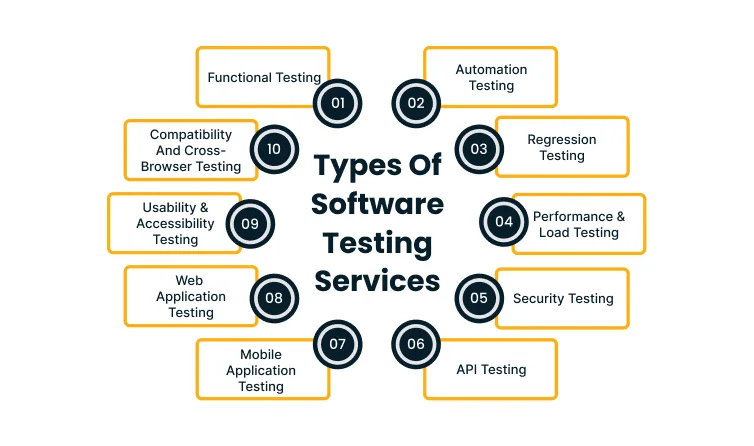
Software Testing Services To Compare Before Shortlisting
Once you know you need external QA support, the next step is understanding which testing services your product actually requires. Different software testing companies offer different levels of QA depth, and shortlisting without this clarity leads to mismatched engagements.
Functional Testing
Functional testing checks whether the software works according to business requirements. It validates user flows, forms, workflows, dashboards, transactions, permissions, and integrations. A product that behaves incorrectly in any of these areas, even if it loads quickly and looks polished, fails the user.
Compare providers based on how they design test cases, document defects, validate business logic, and cover critical user journeys.
Automation Testing
Automation testing uses scripts and frameworks to run repetitive tests faster and more consistently. It is useful for regression testing, CI/CD pipelines, frequent releases, and stable product workflows where running the same test manually every sprint is a waste of QA time.
Compare providers based on automation framework design, tool expertise, script maintenance approach, CI/CD integration capability, and how they decide what to automate and what not to.
Regression Testing
Regression testing ensures that new code changes do not break existing functionality. It is important for any product that releases updates frequently, and the more features you have, the more surface area exists for unintended breakage.
Compare providers based on how they prioritize regression test cases, automate repeatable checks, and validate high-risk workflows before release.
Performance And Load Testing
Performance and load testing measure how an application behaves under expected and peak traffic conditions. A product that works perfectly for 10 users may degrade badly under 10,000, and that failure tends to happen at the worst possible moment.
Compare providers based on whether they test response time, throughput, stability, scalability, spike traffic handling, and system behavior under stress.
Security Testing
Security testing identifies vulnerabilities that could expose systems, users, or business data to risk. According to the IBM Cost of a Data Breach Report 2024, the global average cost of a data breach reached $4.88 million, a 10% increase from the prior year and the largest single-year jump since the pandemic.
With software supply chain attacks growing and regulatory requirements tightening, security testing is no longer a specialty concern. It is a release standard.
Compare providers based on authentication testing, authorization checks, API security validation, vulnerability assessment, compliance awareness, and data protection practices.
API Testing
API testing validates whether APIs return the right data, handle errors correctly, protect access, and perform reliably across integrations. As applications become more API-dependent, API defects increasingly have downstream consequences that are harder to trace.
Compare providers based on their ability to test request-response behavior, authentication, error handling, data accuracy, performance under load, and third-party integration behavior.
Mobile Application Testing
Mobile application testing checks how an app performs across devices, operating systems, screen sizes, networks, and real user scenarios. Emulator testing only goes so far. Real-device coverage reveals issues that simulated environments miss.
Compare providers based on device coverage, OS version coverage, push notification testing, offline behavior handling, and mobile-specific performance testing.
Web Application Testing
Web application testing validates browser-based software across functionality, usability, performance, security, and compatibility. This applies to customer portals, SaaS platforms, admin dashboards, ecommerce flows, and any web product with a user base.
Compare providers based on their ability to test forms and workflows, integrations, authentication flows, responsive behavior, and cross-browser rendering.
Usability And Accessibility Testing
Usability testing checks whether users can complete tasks easily. Accessibility testing checks whether the application can be used by people with different abilities and assistive technologies, including screen readers, keyboard navigation, and contrast requirements.
Compare providers based on their ability to identify friction points, accessibility gaps, confusing flows, unclear messaging, and barriers to task completion.
Compatibility And Cross-Browser Testing
Compatibility and cross-browser testing check whether the application works across browsers, devices, screen sizes, operating systems, and environments. A layout or functionality that works perfectly in Chrome may break in Firefox or Safari, or on older OS versions that your users still run.
Compare providers based on the browsers, devices, OS versions, and environments they include in their testing scope, and how that scope aligns with your actual user base.
How To Choose The Right Software Testing Services Company?
According to a 2024 Gartner survey of software engineering leaders, 65% of software engineering leaders rank meeting business objectives as one of their top three performance priorities, a shift that places release quality and test coverage directly in the path of business outcomes, not just technical delivery.
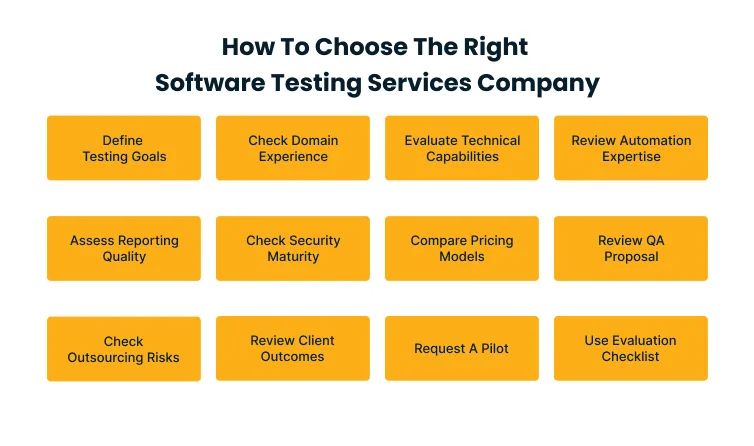
The right software testing services company should match your product type, release goals, technical stack, compliance needs, and communication style.
Do not choose a QA vendor based only on cost or the list of tools in their pitch deck. Choose one that understands your product risks, recommends the right testing approach, and can show evidence of successful QA delivery.
Define Your Testing Goals And Risk Areas
Start by identifying what you need to test and what risks matter most. Your testing goals may include reducing production defects, improving regression coverage, validating a new release, testing performance under load, improving security posture, or building automation coverage.
Before speaking to any provider, define:
- Application type (web, mobile, API, enterprise software)
- Release deadline and release frequency
- Critical workflows and user journeys
- Known defect areas or recurring failure patterns
- Testing types you need covered
- Devices, browsers, and platforms in scope
- Compliance or security requirements
- Expected QA deliverables and reporting format
Going into vendor conversations with this defined gives you a filter. Providers that cannot address your list clearly should not move to the shortlist.
For teams building this foundation for the first time, Cygnet.One’s enterprise software testing strategy guide walks through how to structure testing priorities and risk areas before engaging any vendor.
Check Domain And Application Experience
Choose a provider with experience in your type of application and your industry. Domain experience matters because different product types carry different risk profiles.
A fintech product may need stronger testing around transactions, audit trails, role-based access, and regulatory compliance. An e-commerce platform may need checkout, payment, inventory, search, and traffic spike validation. A SaaS product may need API testing, integration reliability, recurring regression cycles, and user permission validation.
A provider who has handled these scenarios before will ask better questions, design better test cases, and catch things a generalist team will miss.
Evaluate Technical Testing Capabilities
A good QA provider should clearly explain how they approach manual testing, automation testing, API testing, performance testing, security testing, mobile testing, and test environment setup.
Look for clear, specific answers on test planning methodology, test case design standards, defect reporting format, test data management practices, CI/CD integration approach, and how they communicate release readiness. Vague or generic answers here are a signal to keep looking.
Review Automation And Tool Expertise
Automation expertise matters if you release often or have a large regression suite. The question is not which tools a vendor lists. It is whether they can build frameworks that hold up over time.
Ask whether the provider can build scalable automation frameworks, integrate tests into CI/CD pipelines, maintain test scripts as the application changes, and make intelligent decisions about what to automate and what to leave as manual.
Cygnet.One’s quality engineering services, for example, include scalable automation frameworks and DevOps-aligned QA processes, built to fit into existing delivery pipelines, not run alongside them.
Assess Communication And Reporting Quality
Good QA reporting should help your team make better release decisions. It should not require interpretation or follow-up questions to understand.
Look for clear defect reports with screenshots, videos, logs, severity levels, test execution summaries, blocked test cases, open risks, and release recommendations. A provider should also integrate into your existing workflow through tools such as Jira, Azure DevOps, Slack, Teams, TestRail, GitHub, or GitLab.
Look For Security, Compliance, And Data Handling Maturity
Security and data handling should be reviewed before giving a QA partner access to your systems. This is not a formality. QA teams work inside your test environment with real or near-real data.
Ask how they manage test data, credentials, access permissions, environment setup, NDAs, and data deletion after the project closes. This matters most if your application handles financial, healthcare, customer, employee, or confidential business data. A provider without clear answers here is a liability, not a resource.
Compare Pricing Models And Cost Factors
Software testing services may be priced hourly, monthly, project-based, or through a dedicated QA team model. Cost usually depends on application complexity, number of platforms in scope, testing depth, automation requirements, environment readiness, timeline urgency, and reporting expectations.
Instead of choosing the lowest-cost provider, compare what is included in the scope, who will actually work on the project, what deliverables you will receive, and how changes and overruns are handled.
Review The QA Testing Proposal And Scope Of Work
A strong QA testing proposal should clearly define scope, testing types, team structure, tools, timeline, deliverables, assumptions, exclusions, communication plan, and pricing model.
Be cautious if the proposal is vague, does not define responsibilities, skips reporting details, or does not explain how defects and release risks will be escalated and tracked. A weak proposal reflects how the engagement will actually run.
Check For Outsourcing Risks Before You Sign
Outsourced software testing can fail when expectations are unclear. Common risks include weak product understanding, poor communication, unclear ownership, limited reporting quality, data security concerns, and over-reliance on automation for things that need human judgment.
Reduce these risks by defining roles clearly, agreeing on reporting formats upfront, sharing relevant product context before work begins, setting access controls, and starting with a pilot project before committing to a long-term engagement.
Look For Relevant Case Studies And Client Outcomes
Case studies show whether a provider has solved similar QA challenges before. Look past the headline metrics and check whether the domain, application type, and problem described match yours.
When reviewing case studies from any provider, look for domain relevance, the specific testing challenges they solved, and whether the outcomes map to metrics your team actually cares about, such as defect reduction, release velocity, or coverage improvement.
For example, Cygnet.One worked with a US-based interest-free credit solutions provider whose platform handled real financial transactions across a network of retail partners. The QA scope covered a fast application process, a real-time credit decision engine, a debt recovery system, and the end-to-end checkout experience.
The result was a3-minute checkout flow with automated collections, validated through functional, performance, and integration testing on a platform where a slow or broken flow had direct commercial consequences.
Request A Pilot Project Or Proof Of Concept
A pilot project is the most reliable way to evaluate a QA partner before a long-term commitment. Use it to assess communication quality, defect depth and reporting, testing thoroughness, how well the team understands your product, and how well they integrate with your existing processes.
A good pilot should focus on a real product workflow, not a generic test assignment designed to showcase the vendor’s tooling. The pilot should tell you something about the product you did not already know.
Before shortlisting any software testing services company, use this checklist.
- Service fit: Does the provider actually offer the testing types your product needs, or are they stretching to fit your brief?
- Domain experience: Have they tested similar applications or worked in your industry before? A provider who has handled your product type will ask sharper questions and design better test cases.
- Technical capability: Can they support the full range of manual, automation, API, performance, and security testing, or do certain areas get subcontracted or skipped?
- Reporting quality: Do their defect reports and release summaries help your team make decisions, or do they generate more questions than answers?
- Security maturity: If your product handles sensitive data, ask directly how they manage test environments, credentials, and data deletion after the project closes.
- Pricing clarity: Are costs, assumptions, and exclusions clearly defined upfront, not discovered mid-project?
- Relevant case studies: Can they show work in your domain and product type, not just a generic portfolio?
- Pilot option: Will they let you run a scoped project before signing long-term? A provider confident in their work will say yes without hesitation.
With your evaluation criteria set, let’s look at the top software testing service providers worth considering across different product and engagement types.
Top Software Testing Companies To Consider
The best software testing company depends on your product type, budget, testing scope, release frequency, and whether you need one-time testing support or an ongoing QA partner.
Use this table to compare providers based on fit.
| Provider | Best Fit | Core Testing Services | Notable Strength |
| Cygnet.One | Enterprises and product teams needing quality engineering | QA consulting, automation, performance, security, DevOps-aligned testing | Strong quality engineering and enterprise QA focus |
| Testlio | Global apps and digital products | Managed crowdsourced testing, localization, and functional testing | Vetted expert testing community across 150+ countries |
| Qualitest | Enterprise QA and digital assurance | AI-led quality engineering, test automation, performance, cybersecurity, mobile, and web testing | Broad enterprise testing portfolio including mobile, web, accessibility, and cybersecurity |
| QA Mentor | Companies needing broad QA testing support | Functional testing, mobile testing, automation, QA outsourcing | Broad QA testing services and global delivery positioning |
| a1qa | Independent software QA support | Full-cycle QA, test automation, and software testing services | Pure-play QA company suitable for long-term software testing support |
Before you commit to a software testing company, use the evaluation criteria to pressure-test each provider, not just their pitch, but their proposal, their case studies, and how they respond to specific questions about your product.
Conclusion
Choosing the right software testing company starts with understanding why you need QA support, which testing services matter for your product, and how much risk your team can realistically absorb internally.
A strong QA partner should offer the right mix of manual testing, automation testing, regression testing, performance testing, security testing, and reporting. It should also understand your domain, communicate clearly, protect your data, and show relevant client outcomes, not just a tool list and a credential slide.
Before committing, compare providers based on service fit, technical depth, pricing clarity, proposal quality, case studies, and pilot project performance. The right partner should help you release faster, reduce defects, and improve confidence before every launch.
Cygnet.One’s Quality Engineering services are worth evaluating if your product needs more than test execution. The practice is built to embed QA into your delivery pipeline, covering test strategy, automation frameworks, DevOps-aligned continuous testing, performance and security validation, and release readiness reporting.
If your team is dealing with complex release cycles, growing regression debt, or gaps in specialist testing coverage, book a demo with Cygnet.One to get structured QA support.
FAQs
Choose a software testing services provider by checking service fit, domain experience, technical capabilities, reporting quality, security practices, pricing model, case studies, and pilot project availability. The best provider should understand your product risks and recommend a testing approach based on your release goals, not offer a one-size-fits-all engagement.
Software testing services cost depends on application complexity, testing scope, number of platforms, level of automation, timeline, team size, and reporting needs. A small one-time testing project may need a limited QA team, while ongoing product testing may require dedicated QA engineers, automation specialists, and regular regression cycles. The more clearly you define the scope before requesting a quote, the more accurate the pricing you will receive.
A QA testing proposal should include scope, testing types, team structure, tools, timeline, deliverables, communication plan, pricing, assumptions, exclusions, and reporting format. It should also explain how defects will be reported, prioritized, retested, and summarized before release. Proposals that skip any of these areas should be treated as incomplete.
Outsourced software testing is better when you need specialized expertise, faster QA capacity, independent validation, or short-term testing support. In-house QA works better when your product requires deep daily context and long-term ownership. Many companies use a hybrid model where internal teams own product knowledge and external QA partners support automation, regression, performance, or security testing.
The main risks include poor product understanding, weak communication, unclear ownership, data security concerns, vague reporting, and low-quality defect documentation. You can reduce these risks by defining the scope clearly, setting reporting expectations upfront, reviewing security practices, and starting with a pilot project before signing a long-term contract.
A good QA provider asks detailed questions about your product, users, release process, risks, and business goals. They should provide clear test plans, strong defect reports, practical recommendations, relevant case studies, transparent pricing, and measurable QA outcomes. If the conversation stays generic and tool-focused, that is a warning sign.
Author


Abhishek Nandan
AVP, Marketing
Abhishek Nandan is the AVP of Services Marketing at Cygnet.One, where he drives global marketing strategy and execution. With nearly a decade of experience across growth hacking, digital, and performance marketing, he has built high-impact teams, delivered measurable pipeline growth, and strengthened partner ecosystems. Abhishek is known for his data-driven approach, deep expertise in marketing automation, and passion for mentoring the next generation of marketers.