



































A recovery plan is easy to approve when the dashboard is green. The harder question is whether the same plan still works when identity access is degraded, a regional service is unstable, the newest deployment has changed dependencies, and the person who wrote the runbook is offline.
That is where cloud resilience testing earns its place.
For leadership, the question is simple: can the business keep operating inside the agreed recovery window? For engineering, the answer takes evidence. That evidence comes from disaster recovery testing, controlled fault injection, restore drills, dependency checks, and cloud reliability validation that reflects production behavior.
This article explains how enterprises can validate recovery before failure, separate test types, prove RTO and RPO, and report readiness while applying cloud migration security best practices.
What Resilience Testing Actually Proves
Cloud resilience testing is the controlled validation of how a cloud workload behaves under disruption. It checks whether the system can absorb, route around, recover from, or safely degrade during failure.
It should prove four things:
- The application can stay available or recover within an approved time window.
- Data loss stays within the approved tolerance.
- Recovery steps can be executed by the current team, using current access and tooling.
- Monitoring, escalation, and business communication work during the event.
The best way to answer how to test cloud resilience is to start with the business process, then trace the technical recovery path behind it. For example, “customer checkout must recover in 30 minutes with no more than five minutes of committed order data loss” gives teams something measurable. A broad statement like “the platform must be resilient” does not give engineers a testable recovery target.
Good tests separate assumptions from evidence. “Backups run daily” is an assumption. “A clean restore completed last Thursday, the application connected to it, data integrity checks passed, and access logs were retained” is evidence.
Disaster Recovery, Chaos, Failover, and Restore Testing Are Different Jobs
Many teams use one recovery exercise to cover everything. That creates false confidence. Each test type answers a different question, and mature cloud resilience testing programs keep those questions separate.
| Test type | What it checks | Evidence it should create |
| Disaster recovery testing | Whether a workload can be recovered after a major disruption | Runbook timing, recovery logs, restored service checks, business sign-off |
| Chaos testing | Whether the workload tolerates controlled failure | System behavior, alerts, auto-healing proof, user impact |
| Failover testing | Whether traffic and services move to the intended standby path | Failover timing, routing proof, application reconnection results |
| Restore testing | Whether backup data can be recovered and used | Restore logs, data checks, access proof, application validation |
The distinction matters. Disaster recovery testing supports business continuity evidence by validating a planned recovery sequence after a severe interruption. Chaos testing is narrower and more frequent, designed to expose weak assumptions before they become incidents. Failover testing validates switching behavior. Restore testing proves that backup data is usable, complete, and reachable under pressure.
RTO and RPO Validation Cannot Stay on Paper
RTO and RPO are often defined during architecture planning, then copied into compliance documents. That is where they lose value.
RTO is the maximum acceptable recovery time after disruption. RPO is the maximum acceptable data loss measured in time. RTO and RPO validation checks whether tested recovery can meet those targets for the actual workload.
The test should answer these questions:
- When does the recovery clock start?
- Which user journey proves service recovery?
- Which data checkpoint proves acceptable loss?
- Which dependencies must be available before the application counts as recovered?
- What manual steps still sit in the recovery path?
A common mistake is measuring only infrastructure recovery. A database may fail over in six minutes, but the application may need 28 minutes before transactions clear safely. That difference matters. Leadership does not buy database availability. It depends on business service continuity.
Strong cloud reliability validation records the target, the tested result, and the gap between them. Cloud reliability validation also shows whether the recovery plan still matches the current release. If the target is 30 minutes and the tested recovery is 42 minutes, the report should say so. A failed test is useful when it changes investment, design, or runbook ownership.
How to Test Cloud Resilience Without Creating Theatre
The worst resilience program looks busy and proves little. It has calendar invites, long calls, and a final document full of green status. It avoids broken access, missing owners, stale dependencies, and systems that recover technically while the business process stays down.
Start with one critical service. Pick the user journey that matters. Define the failure mode. Agree on the success criteria before the test begins. Then run the exercise with enough realism to expose friction.
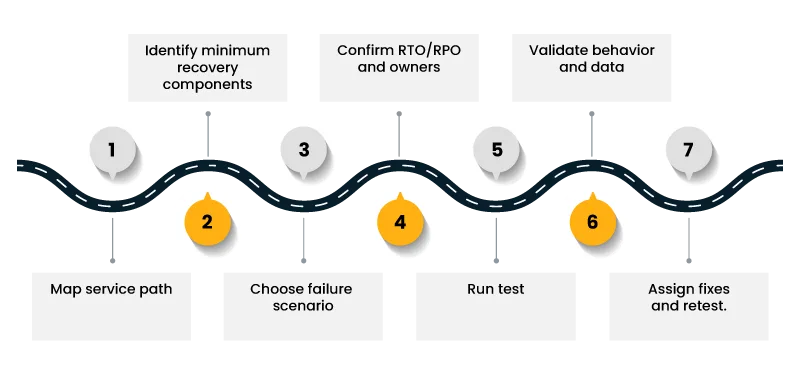
For practical testing, use this sequence:
- Map the service path from user request to data write, notification, reporting, and support visibility.
- Identify the minimum components required for service recovery.
- Choose one failure scenario that matches a credible business risk.
- Confirm the target RTO, target RPO, owners, access, and rollback path.
- Run the test and record timestamps without cleaning up the story.
- Validate application behavior, data quality, monitoring, and customer-impact assumptions.
- Assign fixes with owners and retest the weak link.
This keeps the exercise grounded. It also stops teams from hiding behind architecture diagrams. The value of cloud reliability validation is that it exposes where recovery still depends on memory, special access, timing, or undocumented steps.
The Cadence: What to Test Weekly, Monthly, Quarterly, and Annually
Testing cadence should follow business criticality and change frequency. A payment service that changes every week needs a different rhythm than an internal reporting tool with a two-day recovery tolerance.
| Cadence | What to test | Best fit |
| Weekly | Backup completion checks, restore sample checks, alert routing, dependency health | Critical systems with frequent change |
| Monthly | Backup restore testing, failover of selected components, access checks, runbook dry runs | Tier-1 and Tier-2 workloads |
| Quarterly | End-to-end disaster recovery testing, business workflow validation, communications rehearsal | Revenue, customer, compliance, and operationally sensitive systems |
| Twice yearly | Regional failover, cross-account recovery, multi-team incident simulation | High-impact enterprise platforms |
| Annually | Full recovery audit, resilience roadmap review, leadership readiness report | Board-level continuity and audit requirements |
The cadence should also respond to change. A major architecture release, new data platform, identity migration, network redesign, or backup tooling change should trigger targeted cloud resilience testing during Cloud modernization services. Waiting for the next annual test is a governance failure.
Useful cloud recovery testing best practices include testing after major changes, rotating test owners, validating restore paths in isolated environments, and measuring business recovery rather than tool completion.
Backup restore testing deserves special discipline. Backups should be restored into a controlled environment, checked for integrity, connected to the application when possible, and reviewed for permissions, encryption, retention, and malware exposure. A backup that cannot be safely restored is storage, not recovery.
Where Chaos Testing Fits Without Becoming Reckless
Chaos testing for cloud systems is useful when it is bounded. The point is not to break production for drama. The point is to learn how systems behave when expected protections are stressed.
Start small. Inject latency into a non-critical dependency. Shut down one instance behind a load balancer. Break a queue consumer. Impair a zone in a controlled environment. Watch how alerts fire, how retries behave, how dashboards represent impact, and how the application responds.
Good chaos tests have guardrails:
- Clear abort conditions
- Approved test window
- Known owners
- Customer-impact threshold
- Monitoring ready before the test
- Rollback steps tested in advance
- Post-test action tracking
Chaos testing for cloud systems works best when paired with normal engineering work. It should inform retry policies, timeout settings, circuit breakers, threshold rules, queue design, and alert quality. If an experiment finds the same failure twice, the problem is no longer discovery. It is prioritization.
What Resilience KPIs Should Tell Leadership
Leadership does not need raw logs. It needs a truthful view of readiness, exposure, trend, and decision points. That is where resilience KPIs matter.
Avoid vanity metrics. “Number of tests completed” means little if the tests were shallow. “Backup success rate” means little if restores fail.
| KPI | Why it matters |
| Tested recovery time versus target RTO | Shows whether the business can recover within tolerance |
| Tested data loss versus target RPO | Shows whether data protection matches business need |
| Recovery automation coverage | Shows how much recovery depends on manual action |
| Restore success rate by workload tier | Shows whether backup strategy is usable |
| Open critical recovery gaps | Shows unresolved risk |
| Mean time to detect test failure | Shows monitoring quality |
| Runbook accuracy score | Shows whether procedures reflect the current environment |
| Retest closure rate | Shows whether findings are fixed |
Executive reporting should translate technical recovery into business impact. If a database failover works but the ordering journey still fails because the application cannot authenticate to the restored service, the report should say that clearly.
A Practical Readiness Report Leaders Can Use
A resilience readiness report should fit on one page before it links to technical evidence. The first page should answer five questions:
- Which services were tested?
- What failure scenario was used?
- Did tested recovery meet RTO and RPO?
- What business impact remained after recovery?
- What decisions or funding are needed?
| Section | What to include |
| Service tested | Business process, owner, criticality tier |
| Scenario | Region impairment, data corruption, ransomware recovery, dependency failure |
| Result | Pass, partial pass, fail |
| Target versus actual | RTO target, tested recovery time, RPO target, tested data loss |
| Evidence | Logs, screenshots, monitoring links, restore records, sign-off |
| Open gaps | Root cause, owner, due date |
| Business decision | Accept risk, fund the fix, redesign, or change the target |
This is where cloud recovery testing best practices become useful beyond engineering, because leadership can see which risks are fixed, accepted, or still open. The report should not punish teams for finding weaknesses. It should punish ambiguity. A failed test with clear evidence is better than a green report built on assumption.
Strong cloud reliability validation also links readiness to release governance through AWS managed services. A high-impact workload should not move into production with untested recovery assumptions, which is why teams need a clear cloud governance framework for release and recovery evidence. A major change should not close until recovery evidence is updated.
Common Recovery Gaps That Testing Exposes
Runbooks name people who have changed roles. Break-glass access exists but has not been tested. DNS updates need approval from a team outside the incident bridge. Replicas are available, but application connection strings are fixed. Backups are encrypted, but the key recovery path is unclear. Monitoring shows infrastructure health while business transactions fail quietly.
Another frequent issue is overconfidence in managed services. Managed infrastructure reduces some operational burden. It does not validate application recovery, data consistency, identity access, customer communication, or cross-service dependencies.
This is why disaster recovery testing must include application owners, platform teams, security, database teams, network teams, and business representatives. Recovery is a chain. The weakest link sets the real recovery time.
Recovery Confidence Has to Be Earned
A cloud environment can look healthy and still be unready for failure. The difference is evidence.
Cloud resilience testing gives enterprises evidence. It shows whether recovery targets are real, whether backups can be used, whether failover works beyond infrastructure, and whether people can execute the plan under pressure. It also gives leadership a clear view of risk before it affects customers, regulators, or revenue.
The best programs do not chase perfect test reports. They build a habit of finding weak recovery paths early, fixing them, and proving the fix. That habit turns resilience from a claim into an operating discipline.
For enterprises running critical workloads, disaster recovery testing should no longer sit inside an annual compliance folder. It should be part of how cloud teams govern change, protect business continuity, and prove readiness before the incident arrives.
That is the real purpose of cloud reliability validation. It proves whether the business can keep moving when systems are under stress.
Author


Yogita Jain
Content Lead
Yogita Jain leads with storytelling and Insightful content that connects with the audiences. She’s the voice behind the brand’s digital presence, translating complex tech like cloud modernization and enterprise AI into narratives that spark interest and drive action. With a diverse of experience across IT and digital transformation, Yogita blends strategic thinking with editorial craft, shaping content that’s sharp, relevant, and grounded in real business outcomes. At Cygnet, she’s not just building content pipelines; she’s building conversations that matter to clients, partners, and decision-makers alike.