


































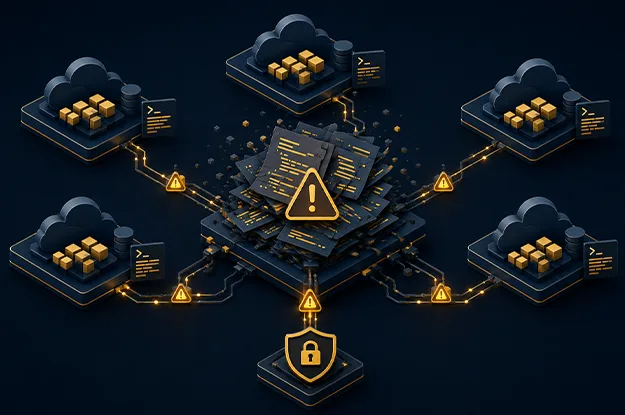
A small automation shortcut can look harmless until it becomes the only path people trust during a production issue. Automation is usually reviewed when it fails. It should be reviewed when people begin to depend on it.
Cloud teams rarely create risk on purpose. They create helpers: a restart script, a cleanup job, a copied Terraform module, and a patched pipeline. Each decision feels practical. The problem begins when these fixes become hidden production control points.
This is cloud automation debt: the gap between what automation does and what the organization can safely understand, test, own, change, and recover through cloud engineering services.
- In 2024, HashiCorp reported that only 8% of surveyed organizations qualified as highly cloud mature, while 91% said they experienced at least some cloud waste.
- Perforce’s 2026 DevOps coverage also pointed to fragmented governance and incomplete audit trails.
This article looks at automation debt from an operational lens: where it comes from, how to spot it, and how infrastructure automation can be brought back under control through a practical cloud automation strategy.
Define Automation Debt Before It Defines Your Operations
Many teams ask what automation debt in cloud is only after a failed deployment, a broken environment build, or an audit request nobody can answer. A cleaner definition is this:
Automation debt is accumulated operational risk created when scripts, pipelines, templates, and IaC assets continue running without enough ownership, testing, documentation, review, and retirement discipline.
That definition matters because automation debt is not the same as technical debt in application code. Cloud automation debt affects the systems that create, change, protect, and remove infrastructure.
The risk sits one level deeper. If automation provisions networks, secrets, IAM roles, backups, logging, or deployment routes badly, many services can inherit the same weakness at once.
| Question | Healthy answer | Debt signal |
| Who owns it? | Named team and backup owner | “Ask whoever wrote it” |
| Where is it stored? | Version-controlled repository | Laptop, shared drive, old runner |
| How is it tested? | Pre-merge checks and safe dry runs | Tested only in production |
| What can it change? | Clear scope and permissions | Broad access with unclear blast radius |
| When is it removed? | Review date or lifecycle rule | It stays because nobody is sure |
Good infrastructure automation reduces repetition. Bad automation reduces visibility. That is the dividing line.
Ad Hoc Scripts, Duplicated Pipelines, and Unmanaged IaC
The first layer of cloud automation debt often starts outside formal platforms. A team needs a fix faster than the platform queue can handle, so it writes a script. Another team copies it. Someone adds an environment flag. Six months later, the script is business-critical, but it still behaves like a workaround.
Duplicated pipelines create a similar problem. One product team builds a deployment workflow. Another clones it and changes the approvals. A third changes secrets handling. From a distance, the organization says it has pipeline standardization. In practice, it has many similar pipelines with different risk behaviors.
Unmanaged IaC adds the hardest version. Terraform, CloudFormation, Bicep, Pulumi, and similar tools make infrastructure readable and repeatable. They also make risky patterns easy to repeat.
This is why IaC governance must cover more than repository access. It should define module ownership, state handling, drift checks, provider versioning, approval paths, policy checks, and exception expiry. Without that, infrastructure automation becomes a fast way to distribute mistakes.
The risks of unmanaged automation scripts become serious when nobody knows which script has the authority to alter production, rotate credentials, change firewall rules, or destroy unused resources. These are not small utilities anymore. They are operational control points.
Symptoms That Automation Has Become Operational Risk
Automation debt rarely announces itself. It shows up as delay, fear, strange exceptions, or recovery work that takes longer than expected.
| Symptom | What it usually means |
| Engineers avoid rerunning a script | The outcome is uncertain |
| Only one person can explain a pipeline | Ownership is too narrow |
| Terraform plans are too large to review | Modules and state boundaries are weak |
| Change tickets mention automation but not impact | Review quality is shallow |
| Manual steps exist after automated runs | The workflow is incomplete |
| Production fixes bypass IaC | Trust in the code path is low |
One symptom deserves special attention: people stop asking whether automation is right and start asking who has the courage to run it. That is a cultural signal. It means brittle automation in cloud operations has moved from a tooling issue to a delivery constraint.
Another signal is the audit panic. If a compliance or security team asks how an environment was created, who approved it, which policy checks ran, and why an exception exists, the answer should not require interviews across five teams. IaC governance should make the answer visible from records.
Good infrastructure automation leaves evidence. Weak automation leaves guesswork.
Governance Should Make Automation Safer, Not Slower
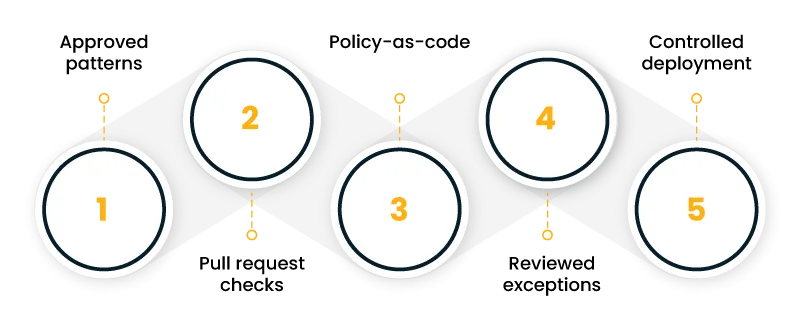
Many teams hear governance and think about delays. Plenty of governance models add forms without reducing risk. For automation, the useful version is direct: make the safe path easier than the risky path.
IaC governance should answer four practical questions:
- What patterns are approved for common infrastructure?
- Which changes need review, and by whom?
- Which checks must run before code reaches shared environments?
- How are exceptions recorded, reviewed, and removed?
This is where infrastructure as code governance becomes more than a policy document. It should sit inside pull requests, module registries, CI checks, policy-as-code, state access, secrets boundaries, and environment promotion rules.
Terraform governance is a good example because Terraform often becomes the default provisioning language across mixed cloud estates. Strong Terraform governance usually includes version-pinned providers, remote state controls, workspace rules, module publishing standards, plan review, policy checks, and controlled credentials for runners through aws cloud consulting services.
| Control area | Practical rule |
| Modules | Use approved modules for networks, IAM, logging, and storage |
| State | Keep state remote, access-controlled, and backed up |
| Plans | Require review for production changes |
| Policy | Block public exposure, weak encryption, and broad IAM |
| Exceptions | Add owner, reason, expiry date, and compensating control |
| Runners | Use short-lived credentials and limited permissions |
Controls should live where engineers already work. A separate approval maze creates shadow automation.
Testing Automation Like Production Code
The phrase “it is only a script” has caused more operational pain than many failed releases. If automation can change production, it deserves production-grade review.
Testing for infrastructure automation should cover four layers:
- Static checks for syntax, policy, secrets, naming, and risky defaults.
- Plan review for impact, dependencies, and blast radius.
- Sandbox runs for resource creation or deletion.
- Post-run validation for monitoring, backup, tags, and logging.
A successful run does not prove the environment is usable. It only proves that the tool has completed its instructions. The real test is whether the result meets operational requirements.
For example, a Terraform application can succeed while a workload has weak alerts, missing backup policy, or excessive permissions. That is why IaC governance needs post-provision validation.
Testing also helps reveal brittle automation in cloud operations. If a script depends on a fixed region, a hardcoded subnet, a personal token, a manual file, or an undocumented order of execution, it is not ready for shared use.
Ownership and Documentation Save Incidents
Automation without ownership becomes abandoned machinery. It may still run, but nobody wants to touch it.
Each automation asset should have three named facts:
- Service owner.
- Technical owner.
- Business impact if it fails.
That sounds basic, but it changes behavior. A cleanup script for stale volumes is different from a pipeline that can update network routes. Ownership should match risk.
Documentation should be short and useful. Teams need enough context to decide whether to run, change, pause, or retire it.
| Documentation field | Why it matters |
| Purpose | Prevents misuse |
| Inputs and outputs | Makes behavior clear |
| Required permissions | Exposes access risk |
| Failure mode | Helps incident response |
| Rollback path | Reduces fear during change |
| Owner and review date | Keeps it alive or removes it |
This is where cloud automation debt becomes manageable. The goal is to remove dangerous mystery from tools that affect production.
The risks of unmanaged automation scripts rise sharply when documentation lives in chat history, old tickets, or the memory of a person who has moved to another role. That is not knowledge. It is dependency hidden inside payroll.
A Cleanup Roadmap for Automation Debt
The mistake many organizations make is trying to fix all automation at once. That creates inventory theater and loses momentum.
A better roadmap starts with blast radius.
1. Build a Risk-Based Inventory
List automation that can affect production, security, cost, data, or customer-facing availability. Begin with tools that can create damage.
| Tier | Automation type | Priority |
| Tier 1 | Changes production access, networking, data, or deletion | Immediate review |
| Tier 2 | Provisions shared infrastructure | High |
| Tier 3 | Supports deployment or rollback | Medium |
| Tier 4 | Reporting, tagging, cleanup with narrow access | Lower |
This gives IaC governance a practical entry point.
2. Freeze the Most Dangerous Patterns
Pause new copies of unapproved modules, broad-permission scripts, and pipelines with manual credential handling. Stop fresh debt while cleanup begins.
3. Create Approved Paths
Replace scattered automation with approved modules, reusable pipeline templates, and documented runbooks. This is where infrastructure automation earns trust. Engineers should have a clear default path for common tasks.
4. Add Tests and Policy Checks
Use static analysis, policy-as-code, secret scanning, dependency checks, and plan review. Tie checks to risk.
This is also where infrastructure as code governance should connect with security and platform teams. Security defines non-negotiable controls. Platform teams turn them into usable checks.
5. Retire, Rewrite, or Own
Every risky automation asset needs one of three decisions:
- Retire it because it is no longer needed.
- Rewrite it because the current design is unsafe.
- Keep it with named ownership, tests, and documentation.
Do not leave risky automation in place simply because it has not failed yet. That is how cloud automation debt turns from a known issue into an operational dependency.
Cloud Automation Best Practices That Actually Hold Up
The most useful cloud automation best practices are the ones teams can follow during releases, audits, and incidents.
First, treat automation as product code when it affects production. It needs review, tests, ownership, and rollback thinking.
Second, separate experimentation from shared use. A quick prototype still needs a promotion path before shared use.
Third, limit permissions. Automation should have the narrowest access needed for its job. Broad credentials make small defects dangerous.
Fourth, design for evidence. Logs, approvals, plans, tests, and policy decisions should be easy to retrieve.
Fifth, schedule retirement. Automation has a lifecycle. If a script has no owner and no recent run history, it should be reviewed before it becomes an incident artifact.
Clean Automation Is an Operating Standard
The question is no longer what automation debt in cloud is. Most mature teams already feel it. The better question is which parts of the estate now depend on automation that nobody fully trusts.
Cloud automation debt is dangerous because it hides inside success. Deployments run. Environments get built. Reports arrive. Then one change exposes the weak joint.
The fix is not to reject automation. The fix is to make automation accountable.
Strong infrastructure automation should create repeatability, evidence, and confidence. Strong IaC governance should make safe patterns normal and risky exceptions visible. When that happens, automation stops being a pile of helpful scripts and becomes part of the operating model.
Cloud teams do not need more clever scripts. They need automation they can defend during a release, an audit, a cost review, and an incident as part of Cloud modernization services. That is the difference between the speed that holds and the speed that breaks.
Author


Yogita Jain
Content Lead
Yogita Jain leads with storytelling and Insightful content that connects with the audiences. She’s the voice behind the brand’s digital presence, translating complex tech like cloud modernization and enterprise AI into narratives that spark interest and drive action. With a diverse of experience across IT and digital transformation, Yogita blends strategic thinking with editorial craft, shaping content that’s sharp, relevant, and grounded in real business outcomes. At Cygnet, she’s not just building content pipelines; she’s building conversations that matter to clients, partners, and decision-makers alike.