



































Cloud spending often grows faster than expected, even when teams believe they have control over their infrastructure. Monthly bills increase, yet the drivers behind those costs remain unclear. Finance teams push for answers, while engineering teams struggle to map usage to actual business value.
This disconnect comes from how cloud environments evolve. New services are added, workloads scale across regions, and multiple teams operate independently. Cost data exists across dashboards, billing tools, and reports, though it rarely connects into a single, reliable view.
Without that clarity, decisions rely on partial information, which leads to inefficient resource allocation and delayed action.
2022 analysis by McKinsey & Company on cloud value creation says that companies can unlock up to $3 trillion in value from cloud, though a significant portion remains unrealized due to inefficient adoption and cost management practices.
Cloud cost optimization brings structure to this challenge by connecting usage data with cost accountability and operational decisions. It helps teams move from reactive cost tracking to proactive cost management across workloads, environments, and services.
This blog will give you a clear understanding of how cloud cost optimization works and how to reduce cloud costs without affecting performance or scalability.
What Is Cloud Cost Optimization?
Cloud cost optimization improves cloud efficiency by reducing unnecessary spend while maintaining performance and scalability. Organizations track usage, monitor billing, and align resources with actual workload demand.
Teams use cost monitoring, rightsizing, and automation to control cloud costs across infrastructure, compute, and storage. Effective cloud cost optimization strengthens cost visibility, prevents waste, and supports predictable scaling across multi-cloud environments.
Key components include:
- Monitoring cloud usage and cost patterns
- Identifying unused or inefficient resources
- Applying better pricing models, such as reserved instances
- Continuously refining resource allocation
Cloud cost optimization is an ongoing process. Cloud environments change frequently, so efficiency needs regular attention.
Why Cloud Cost Optimization Matters?
Cloud usage expands quietly. New services are added, environments grow, and workloads scale across teams. Costs rarely spike overnight. They build gradually through small inefficiencies that remain unnoticed without strong visibility.
Limited visibility creates a compounding effect. Teams continue provisioning resources based on assumptions rather than actual usage patterns. Over time, this leads to overprovisioning, unused assets, and misaligned cost allocation across business units.
The 2023 report by Deloitte on cloud cost management says up to 30% of cloud spend is wasted due to a lack of visibility, overprovisioning, and poor cost control.
Several operational challenges begin to surface as this inefficiency grows:
- Rising and unpredictable cloud bills that are difficult to explain
- Limited visibility into spending across teams and environments
- Idle or underutilized resources consume budget without value
- Difficulty forecasting future costs due to inconsistent usage patterns
Finance teams often see the impact first. Budgets are exceeded without clear accountability. Engineering teams face a different challenge. They struggle to connect infrastructure usage with actual cost impact. This disconnect slows decision-making and creates friction between teams.
Cloud cost optimization addresses these gaps by aligning usage, cost, and business outcomes. Visibility into usage allows teams to identify inefficiencies early and correct them before they scale.
Improved cost visibility also strengthens operational efficiency. Teams gain a clearer understanding of how resources are consumed across applications, services, and environments. This clarity enables faster decisions, better resource planning, and more predictable financial outcomes.
Organizations that actively manage cloud spend gain a structural advantage. They can scale infrastructure without losing control over costs. They can also respond faster to changes in demand since resource allocation is based on real usage rather than assumptions.
How Does Cloud Cost Optimization Work?
Cloud cost optimization operates as a continuous cycle rather than a one-time effort. Each stage builds on the previous one, gradually improving visibility, control, and efficiency.
A structured approach helps teams move from reactive cost management to proactive optimization. The process typically evolves through three key stages.
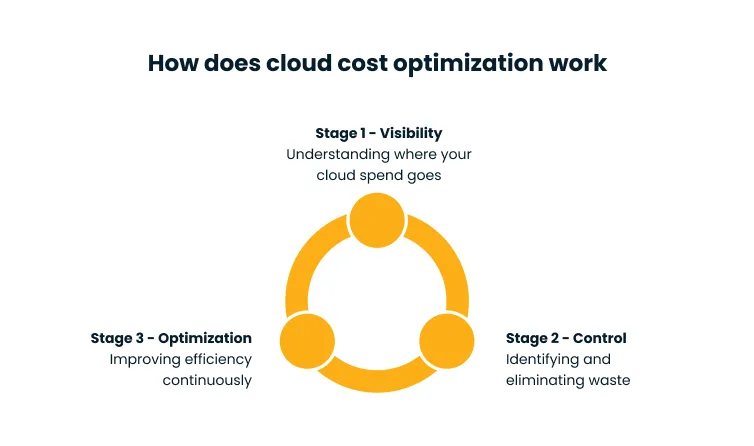
Stage 1: Visibility: Understanding Where Your Cloud Spend Goes
Before any optimization can begin, teams need a clear view of how cloud resources are used. Without this visibility, cost decisions are based on incomplete or inaccurate information.
Cloud environments include multiple cost drivers such as compute, storage, networking, and data transfer, each contribute to the overall spend. These costs are distributed across applications, teams, and environments, which makes tracking them complex.
Cost monitoring tools provide the foundation for visibility. They track usage across services and break down costs into meaningful categories. Tagging strategies further enhance this visibility by assigning costs to specific teams, projects, or workloads.
A well-structured tagging system allows organizations to answer critical questions:
- Which services contribute the highest cost
- Which teams or departments consume the most resources
- Where sudden cost spikes originate
- How usage patterns change over time
Visibility also exposes hidden inefficiencies. For example, development environments may run continuously even when not in use. Data storage may grow without lifecycle policies in place. These patterns are difficult to detect without detailed monitoring.
Clear visibility shifts decision-making from assumptions to data-backed insights. Teams can identify cost drivers with precision and prioritize optimization efforts based on actual impact.
Stage 2: Control: Identifying And Eliminating Waste
Once visibility is established, attention shifts toward controlling unnecessary spend. At this stage, inefficiencies become easier to identify, though their impact is often larger than expected.
Cloud environments tend to accumulate waste over time. Resources are provisioned quickly but are not always decommissioned when no longer needed. This leads to ongoing costs without corresponding value.
Common sources of waste include:
- Idle compute instances running without active workloads
- Unused storage volumes that continue to incur charges
- Over-provisioned environments are sized for peak demand but rarely utilized
Addressing these inefficiencies requires more than manual cleanup. Structured cost-control practices need to be embedded in daily operations.
The 2023 report by McKinsey & Company on FinOps and cloud cost management says organizations that implement FinOps effectively can reduce cloud costs by 20-30%.
FinOps introduces accountability into cloud cost management. It brings finance, engineering, and operations together to manage spending collaboratively. Cost ownership is clearly defined, and decisions are aligned with business priorities.
Budgets and alerts play a key role in this stage. They provide guardrails that prevent unexpected cost escalation. Teams receive notifications when spending approaches predefined limits, which allows them to take corrective action early.
Governance policies further strengthen cost control. These policies standardize how resources are provisioned, used, and decommissioned. For example, policies may require
- Mandatory tagging for all resources
- Automatic shutdown of idle environments
- Approval workflows for high-cost resource allocation
These controls reduce unnecessary spending while improving accountability across teams. Cost management becomes a shared responsibility rather than a reactive task handled by a single function.
Stage 3: Optimization: Improving Efficiency Continuously
After waste is controlled, the focus shifts toward long-term efficiency. Optimization ensures that resources are used most cost-effectively as workloads evolve.
Cloud environments are dynamic, so the usage patterns change based on user demand, application updates, and business growth. Static configurations cannot keep pace with these changes.
Continuous optimization involves regularly reviewing resource usage and making adjustments based on real data. Cygnet.One’s cloud operations and optimization support this process by improving resource utilization, automation, and ongoing cloud efficiency as workloads change.
Key optimization actions include:
- Rightsizing resources based on actual utilization
- Using pricing models such as reserved instances for predictable workloads
- Automating scaling to match demand in real time
Rightsizing ensures that resources match workload requirements. Over-provisioned instances are scaled down, while under-provisioned resources are adjusted to maintain performance.
Pricing optimization reduces cost without affecting performance. Reserved instances and savings plans provide lower pricing for long-term commitments. These models are effective for workloads with consistent usage patterns.
Automation plays a critical role in maintaining efficiency. Auto-scaling adjusts resources dynamically based on demand. This prevents both over-provisioning and underutilization.
Continuous optimization transforms cost management into an ongoing capability. Efficiency improves over time as teams refine their usage patterns and adapt to changing requirements.
8 Cloud Cost Optimization Best Practices
Applying best practices consistently helps maintain cost efficiency while supporting performance and scalability. Each practice targets a specific inefficiency within cloud environments.
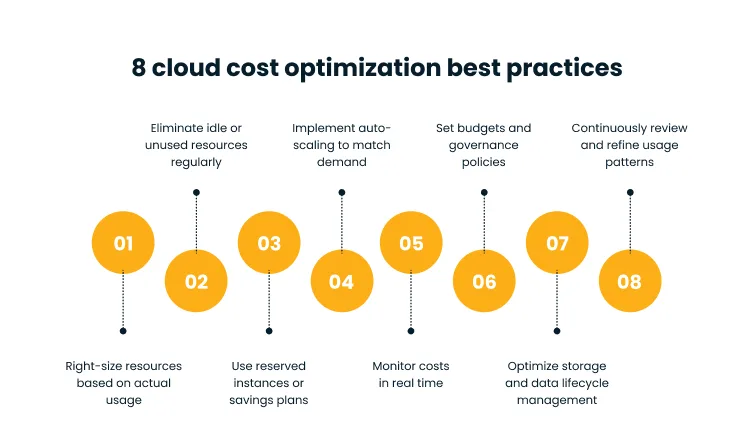
1. Right-Size Resources Based On Actual Usage
Provisioning decisions are often based on peak demand scenarios. Actual usage remains significantly lower in many cases, leading to wasted capacity.
Rightsizing involves analyzing usage metrics such as CPU, memory, and storage utilization. Resources are then adjusted to match real demand rather than estimated requirements.
Benefits include:
- Reduced over-provisioning and unnecessary cost
- Improved resource efficiency across workloads
- Better alignment between infrastructure and usage patterns
Regular rightsizing keeps resources aligned with changing workload demands.
2. Eliminate Idle Or Unused Resources Regularly
Unused resources generate ongoing costs without delivering value. These resources accumulate quickly in dynamic cloud environments.
Common examples include:
- Virtual machines left running after testing or development
- Old environments that are no longer required
- Detached storage volumes that remain active
Regular audits help identify these inefficiencies. Automated cleanup processes further improve efficiency by removing unused resources without manual intervention.
3. Use Reserved Instances Or Savings Plans
Pricing models play a significant role in cloud cost optimization. On-demand pricing offers flexibility but is often more expensive for predictable workloads.
Reserved instances and savings plans provide lower pricing in exchange for a long-term commitment. These models are well-suited for workloads with stable usage patterns.
Key advantages include:
- Lower cost compared to on-demand pricing
- Greater predictability in cloud spend
- Improved financial planning for long-term workloads
Selecting the right pricing model requires analyzing workload consistency and usage trends.
4. Implement Auto-Scaling To Match Demand
Workload demand fluctuates over time. Static resource allocation leads to inefficiencies during both peak and low usage periods.
Auto-scaling dynamically adjusts resources based on real-time demand. Resources scale up during high usage and scale down during low activity.
This approach ensures:
- Efficient use of resources across varying workloads
- Reduced cost during periods of low demand
- Maintained performance during peak usage
Auto-scaling aligns infrastructure with actual workload requirements, which improves both cost efficiency and performance.
5. Monitor Costs In Real Time
Delayed visibility into costs increases the risk of overspending. Real-time monitoring helps teams identify anomalies before they escalate.
Monitoring tools provide insights into:
- Cost trends across services and environments
- Alerts for unusual spending patterns
- Visibility into resource utilization
Cygnet.One’s cloud operations and optimization strengthen real-time monitoring by connecting usage visibility with optimization actions that reduce cost drift over time.
Early detection allows teams to take immediate corrective action. This prevents minor inefficiencies from turning into significant cost issues.
6. Set Budgets And Governance Policies
Clear cost controls are essential for managing cloud spend at scale. Budgets define spending limits, while governance policies ensure consistent usage practices.
Effective controls include:
- Budget thresholds for teams and projects
- Mandatory tagging policies for cost allocation
- Restrictions on high-cost resources
These measures improve financial discipline and reduce the risk of uncontrolled spending.
7. Optimize Storage And Data Lifecycle Management
Data storage grows continuously as applications generate and retain more information. Without proper management, storage costs increase over time.
Lifecycle management aligns storage costs with data usage. It involves moving infrequently accessed data to lower-cost storage tiers and removing outdated data.
This approach helps:
- Reduce long-term storage expenses
- Improve efficiency in data management
- Align storage costs with actual usage patterns
Effective storage optimization ensures that data growth does not lead to uncontrolled cost increases.
8. Continuously Review And Refine Usage Patterns
Cloud environments evolve as applications change and workloads expand. Static optimization strategies become less effective over time.
Regular reviews help identify new inefficiencies and opportunities for improvement. Teams can adjust configurations, update policies, and refine resource allocation based on current usage.
Consistent review ensures that optimization remains aligned with changing business needs. It also prevents inefficiencies from reappearing as environments grow.
Why Do Most Cloud Cost Optimization Efforts Fail? (Even When Companies Follow Best Practices)
Initial optimization efforts often deliver quick results. Removing idle resources and rightsizing instances creates immediate cost savings. Over time, these gains begin to fade as environments grow more complex.
The challenge lies in sustaining efficiency. Cloud usage continues to expand, and new inefficiencies emerge if optimization practices are not maintained consistently.
Fragmented execution is a key reason behind this pattern. Different teams manage their own cloud environments with limited coordination. Engineering focuses on performance, finance tracks budgets, and operations manage infrastructure.
Without alignment, cost decisions remain isolated. Resource provisioning, usage, and cost control are handled independently, which leads to inconsistent outcomes.
Several recurring challenges limit long-term success:
- Lack of clear ownership for cloud costs across teams
- Limited visibility into usage across environments
- Focus on short-term savings rather than long-term efficiency
- Inconsistent monitoring that allows inefficiencies to return
Another challenge lies in how optimization is approached. Efforts are often reactive and triggered by rising bills. Teams address visible issues without building systems that prevent inefficiencies from recurring.
Sustainable optimization requires a coordinated approach. Teams need shared goals, clear ownership, and consistent governance. Regular review cycles ensure that inefficiencies are identified and addressed continuously.
When accountability is defined and monitoring becomes ongoing, cloud cost optimization evolves into a stable capability. Efficiency improves over time, and cost control becomes embedded in how teams operate rather than treated as a separate task.
Conclusion
Cloud cost optimization challenges rarely come from a lack of tools. They come from a lack of alignment between usage, ownership, and decision-making.
Real progress starts when cloud cost optimization moves from isolated actions to a structured, repeatable system. That shift allows teams to connect cost with business outcomes, not just infrastructure activity.
If your cloud costs are already growing faster than your ability to explain them, building that structure becomes critical. This is where Cygnet.One’s Cloud Operations & Optimization fits in by helping align visibility, governance, and continuous optimization into a single operating model.
The next step is turning cost visibility into consistent control and long-term efficiency. So, the goal is to create a system where every cloud decision is informed, accountable, and scalable. You can book a demo with Cygnet.One to design a cloud cost optimization approach that reduces waste while supporting performance and growth.
FAQs
Cloud cost optimization means using cloud resources efficiently so you only pay for what you actually need. It involves matching usage with demand, removing unused resources, and selecting cost-effective pricing models. This helps reduce waste while maintaining performance. It also improves visibility into how cloud resources are consumed.
Cloud cost optimization is important because it prevents small inefficiencies from turning into high, uncontrollable costs. It helps identify unused resources, reduce over-provisioning, and improve cost visibility. Early optimization keeps spending predictable and aligned with actual usage. It also supports better planning and avoids sudden billing spikes.
You can start reducing cloud costs quickly by removing unused resources and rightsizing instances. Focus on identifying idle virtual machines, unused storage, and oversized workloads. Monitor cost trends to detect inefficiencies early. These quick actions deliver immediate savings without affecting performance.
Cloud cost optimization is not a one-time process. It requires continuous monitoring and adjustment as workloads and usage change. Without regular review, inefficiencies return, and costs increase over time. Ongoing optimization ensures resources stay aligned with actual demand.
The easiest ways to reduce cloud costs include removing unused resources, rightsizing instances, and monitoring usage regularly. Applying cost-efficient pricing models for predictable workloads also helps. These steps improve efficiency without requiring major changes. They create a strong foundation for long-term cost control.
Cloud cost optimization tools help track usage, monitor spending, and identify inefficiencies. Tools like AWS Cost Explorer and Azure Cost Management provide visibility into cost trends, resource usage, and budget alerts. They highlight idle resources and unusual spending patterns. This enables teams to take corrective action and control costs effectively.
Cloud cost optimization does not reduce performance when done correctly. It aligns resources with actual workload needs, which often improves efficiency. Removing waste and optimizing configurations can enhance performance consistency. The goal is to use resources more smartly while maintaining scalability.
Author


Abhishek Nandan
AVP, Marketing
Abhishek Nandan is the AVP of Services Marketing at Cygnet.One, where he drives global marketing strategy and execution. With nearly a decade of experience across growth hacking, digital, and performance marketing, he has built high-impact teams, delivered measurable pipeline growth, and strengthened partner ecosystems. Abhishek is known for his data-driven approach, deep expertise in marketing automation, and passion for mentoring the next generation of marketers.