




































Cloud adoption moves faster when teams know where the exits are.
The absence of an exit path creates hesitation around core platforms, regulated workloads, data-heavy systems, and customer-facing services. Leaders approve the first migration. They hesitate on the second wave because the estate starts to feel permanent before anyone has tested whether it can move.
A cloud exit strategy is often treated as a defensive document for procurement, auditors, or the risk office. That view is too small. A good cloud exit strategy helps engineering teams make cleaner decisions during adoption. It separates acceptable dependencies from dangerous dependencies. It also gives finance, legal, security, and product teams a shared language for vendor lock-in cloud concerns before renewal pressure begins.
The goal is to design with enough control that staying is a choice. That is the practical value of cloud portability. It does not mean every workload can move overnight. It means the business knows which workloads can move, which ones would be expensive to move, and which dependencies were accepted intentionally.
Why Cloud Exit Planning Matters Before the Estate Gets Too Deep
The worst time to ask how an exit would work is during a dispute, outage, audit, acquisition, divestiture, or price negotiation. By then, the architecture has already shaped what is easy, expensive, or risky to change. Data has gravity. Contracts have dates. Skills have narrowed around one provider. The exit conversation becomes emotional because the facts are missing.
A strong exit plan answers direct questions: what moves first, what cannot move cleanly, how much data must be extracted, which contracts restrict movement, and what evidence proves readiness.
This is where cloud exit planning for enterprises becomes a control discipline. It helps teams avoid two bad habits: adopting every native service without an escape route or rejecting useful native services because someone fears lock-in in theory.
The better position sits between those extremes. Use what creates business value. Document what it would take to leave. Keep the exit cost visible.
Assess Data, Application, Contract, and Architecture Lock-In
Most vendor lock-in cloud discussions are too vague. They treat lock-in as a yes-or-no condition. In practice, lock-in is layered. One workload may be portable at the compute layer and stuck at the data layer. Another may run on containers but depend on a proprietary queue, identity pattern, monitoring model, or deployment workflow.
A useful assessment breaks dependency into four areas.
Data lock-in
Data is usually the hardest part of the exit. Compute can be rebuilt. Pipelines can be rewritten. Data must be located, extracted, validated, protected, and reconciled. Good data portability in cloud starts with knowing where critical records live, which formats are used, how retention rules apply, and how much history must move, making cloud data migration best practices critical.
Teams should check export formats, API limits, replication options, encryption key ownership, backup restoration, classification, and residency rules.
A lakehouse, warehouse, or object store may look portable until metadata, access controls, lineage, and quality rules are included. Real cloud portability includes those operational layers, not only the files.
Application lock-in
Vendor lock-in cloud pressure often appears when code depends heavily on provider-specific services. This may be acceptable. A payment risk engine may justify a managed analytics or AI service because speed, reliability, and feature depth matter. The problem starts when no one records the trade-off.
A healthy review classifies services into three groups:
| Dependency type | Example | Exit treatment |
| Low dependency | Virtual machines, containers, managed PostgreSQL | Keep deployment scripts portable. |
| Medium dependency | Managed Kubernetes, provider messaging, native CI/CD | Add abstraction where it protects delivery. |
| High dependency | Proprietary databases, serverless workflows, native AI services | Record the business reason and estimated exit cost. |
Vendor lock-in cloud risk is acceptable when the business benefit is explicit and the replacement path is known.
Contract and commercial lock-in
Some vendor lock-in cloud dependencies are commercial before they are technical. Minimum spend commitments, marketplace agreements, software licenses, support tiers, renewal windows, data egress terms, audit rights, and termination support all shape exit readiness. These risks usually surface late, when renewal dates, egress costs, support terms, or minimum spend commitments start shaping technical choices.
This is where cloud vendor lock in risks become concrete. A workload may be technically movable but financially painful to move during a committed spend period. A provider may support export, yet the contract may lack clear support obligations during transition. Legal, procurement, and architecture need one shared register. Otherwise, each team sees only part of the exposure.
Architecture lock-in
Architecture lock-in hides in small choices. Naming standards, IAM assumptions, observability tools, DNS patterns, secrets handling, network segmentation, and image builds can tie a system to one provider. The issue is not using native primitives. The issue is scattering provider assumptions across code, pipelines, runbooks, and team habits.
A practical plan should map these assumptions by workload. Do not ask whether the whole estate can move. Ask whether one important application can be rebuilt elsewhere with known effort, clear data steps, and understood business impact.
Define Portability Patterns That Fit the Workload
A serious multi cloud portability strategy does not mean copying the same application into three clouds; it requires a practical hybrid cloud strategy based on workload risk and business value. That approach burns money and gives little control. Portability should be designed by the workload pattern.
For stable systems, infrastructure as code and standard runtime images may be enough. For customer-facing platforms, containers, externalized configuration, portable observability, and tested pipelines matter more. For data platforms, schema control, open table formats, export rehearsal, and independent metadata may decide whether exit is possible.
The most useful cloud portability patterns are usually simple: keep source code and deployment definitions outside any single cloud console, store configuration in version control, use open data formats where the data has long-term value, document identity patterns, test backup restoration outside the primary boundary, and maintain runbooks for rebuild, cutover, and rollback.
These patterns support data portability in cloud without forcing teams to avoid useful managed services. The point is to prevent silent dependency. A managed database can still fit a cloud exit strategy when schema exports, replication, backup restoration, and cutover steps are tested.
For some workloads, abstraction is the right move. For others, abstraction adds noise. A generic database access layer may help. A generic storage layer that hides useful native controls may create more risk than it removes.
Balance Adoption Speed With Exit Readiness
Exit planning slows adoption only when it arrives as paperwork after the design is finished. When it is built into engineering decisions, it usually removes delay. Teams stop reopening the same arguments because the rules are visible.
A practical adoption model uses exit tiers.
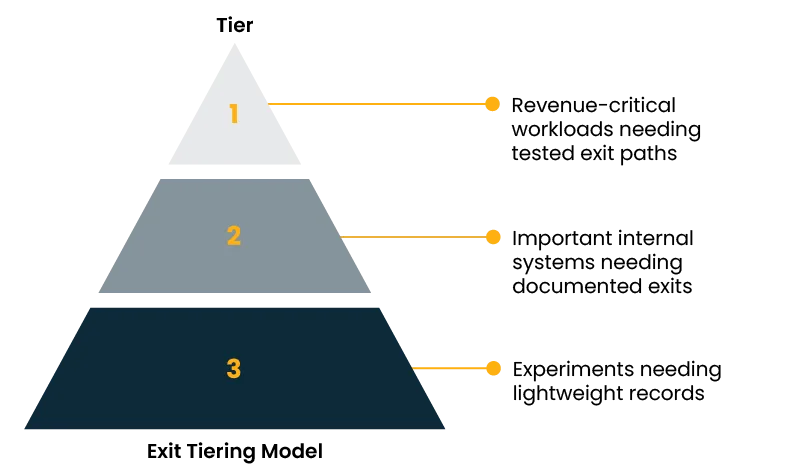
| Tier | Workload profile | Exit expectation |
| Tier 1 | Regulated, revenue-critical, customer-facing | Tested exit path and recovery evidence. |
| Tier 2 | Important internal systems | Documented exit path and dependency register. |
| Tier 3 | Low-risk tools or experiments | Lightweight owner, data, and spend record. |
This tiering keeps cloud exit planning for enterprises realistic. A temporary analytics sandbox should not carry the same exit burden as a claims platform, payment system, or trading workflow.
This is also how cloud portability protects adoption speed. The architect does not need to design every workload for complete movement. The architect needs to match exit discipline to business exposure.
One useful rule: if a team cannot explain how it would extract data, rebuild runtime, restore access, and redirect traffic, the workload is not ready for a critical dependency decision.
Build Exit Governance Without Slowing Cloud Programs
Governance fails when it behaves like a late-stage approval desk. Exit readiness should sit inside the work already happening: landing zone reviews, architecture decisions, procurement checkpoints, data governance, resilience testing, and renewal planning.
A lean governance model needs three artifacts.
1. Workload exit register
This register should be short. It should list workload owner, business criticality, key services, data location, portability tier, contract exposure, exit owner, last test date, and known blockers. Anything longer will decay.
2. Architecture decision record
Each high-dependency choice should include the reason, rejected options, expected benefit, exit cost, and review trigger. The trigger matters. A decision may be valid today and risky after user growth, acquisition, new regulation, or regional expansion.
3. Exit test evidence
Evidence should come from action. Can the team restore a backup elsewhere? Can it export data in a usable format? Can it rebuild an environment from code? Can access be recreated without tribal knowledge? This is where regulatory cloud exit requirements become practical for financial services, healthcare, public sector, and other controlled industries.
This approach keeps vendor lock-in cloud risk visible without turning every design meeting into a debate. It also gives procurement better footing. A team with tested exit evidence has more credibility than a team asking for better terms while fully dependent.
Regulatory Expectations Are Becoming More Operational
Regulated firms already know that outsourcing risk is not solved by a contract clause. Supervisors increasingly expect continuity, concentration risk management, third-party oversight, and exit evidence. Regulatory cloud exit requirements are pushing exit planning closer to engineering because the proof sits in systems, not policy binders.
This is no longer a banking-only concern. Any enterprise handling sensitive data, critical services, public infrastructure, or cross-border operations should expect sharper questions:
| Regulatory question | Engineering evidence |
| Can the provider dependency be replaced? | Workload exit register and dependency map |
| Can critical data be recovered? | Export test, restore result, reconciliation report |
| Can service continue during exit? | Cutover plan and traffic routing design |
| Can third-party concentration be explained? | Provider exposure view across business services |
| Can named owners execute the plan? | Runbook, roles, recent test record |
The regulator, auditor, or board does not need an elegant diagram. They need evidence that the plan can survive contact with the environment.
How to Build a Cloud Exit Strategy That Teams Will Use
A document that nobody opens is not a strategy. A practical answer to how to build a cloud exit strategy starts with the workloads that matter most.
Start with ten high-exposure workloads. For each one, answer what business process it supports, which services would be hardest to replace, where the critical data sits, which contracts affect movement, what the target landing option would be, and what must be tested in the next 90 days.
This creates a usable baseline. Add exit checks to existing delivery gates.
A practical multi cloud portability strategy should also define when portability is not worth the cost. Some services are worth adopting deeply because they improve security, reliability, analytics, or delivery speed. Avoiding them only to satisfy a vague portability principle can damage the business. The issue is not native service use. The issue is native service use without decision memory.
The cleanest test is this: would the same team make the same decision if the exit cost were shown beside the adoption benefit during AWS migration and modernization? If yes, proceed. If not, redesign.
The Best Exit Strategy Makes Adoption Easier
A cloud exit strategy is not a retreat plan. It is a confidence mechanism. It tells leaders where dependency is acceptable, where it is dangerous, and where more proof is needed before the next commitment.
The companies that handle vendor lock-in cloud concerns well do not avoid every provider-specific service. They make dependencies visible. They keep control of data, contracts, deployment, evidence, and decision records. They treat cloud portability as an engineering and governance habit, not a slogan.
Cloud adoption should not slow down because the business asks for exit readiness. It should become cleaner. The right exit work removes uncertainty before it turns into delay, audit pressure, renewal weakness, or architectural regret.
Author


Yogita Jain
Content Lead
Yogita Jain leads with storytelling and Insightful content that connects with the audiences. She’s the voice behind the brand’s digital presence, translating complex tech like cloud modernization and enterprise AI into narratives that spark interest and drive action. With a diverse of experience across IT and digital transformation, Yogita blends strategic thinking with editorial craft, shaping content that’s sharp, relevant, and grounded in real business outcomes. At Cygnet, she’s not just building content pipelines; she’s building conversations that matter to clients, partners, and decision-makers alike.