


































Cloud growth becomes expensive when governance stays behind adoption. Teams keep launching workloads, opening access, expanding environments, and consuming services, while cost ownership, compliance evidence, and security controls remain scattered across departments.
The problem persists because cloud decisions happen faster than traditional approval models can manage. Finance needs cost visibility, security needs enforceable controls, compliance needs audit evidence, and engineering needs freedom to move without waiting on every request.
The 2023 McKinsey report on cloud value found that only 10% of companies had fully captured cloud’s potential value, while 40% had seen no material value from cloud adoption.
A cloud governance framework helps close this gap by defining how cloud policies, IAM governance, cost controls, tagging strategy, compliance rules, and resource ownership work together. It gives enterprises a practical way to manage cloud usage without slowing down every team through manual review.
This blog explains how to build and evaluate a cloud governance framework that improves cost control, security governance, compliance readiness, and multi-cloud accountability.
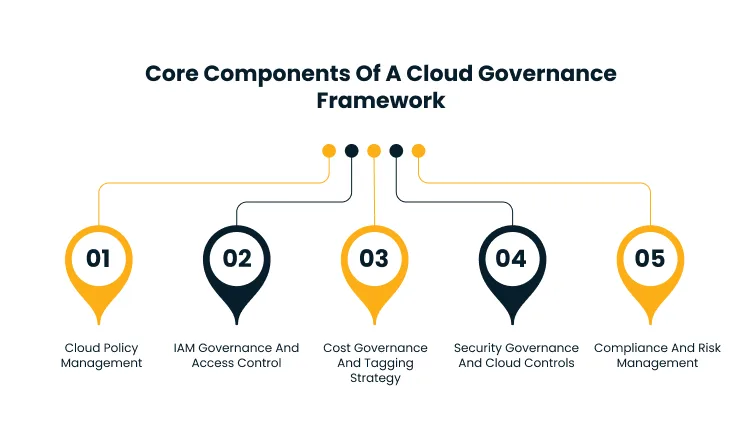
Core Components Of A Cloud Governance Framework
A cloud governance framework defines the policies, controls, ownership, and automation needed to manage cloud cost, security, compliance, access, and resource usage across enterprise environments. It helps teams evaluate how cloud decisions are made, who owns them, how policies are enforced, and how risks are tracked.
A strong framework connects cloud policy management, IAM governance, tagging strategy, cost governance, cloud controls, compliance evidence, and remediation workflows into one operating model. This gives enterprises the structure to scale cloud adoption without losing visibility, accountability, or control.
The framework works only when its controls are connected to how teams actually use cloud environments. Policies, access rules, cost controls, security baselines, and compliance requirements cannot sit in separate silos because cloud decisions often affect all of them at once.
For example, a new production workload may require approved regions, role-based access, encryption, budget tags, logging, backup rules, and compliance evidence from the start. If these controls are handled separately, teams create gaps that are difficult to fix later.
The core components below help enterprises turn governance from documentation into a daily operating discipline across cloud policy management, IAM governance, cost governance, security controls, compliance, and resource accountability.
Cloud Policy Management
Cloud policy management defines what teams are allowed to create, access, modify, and operate in cloud environments. These policies set boundaries for approved services, regions, encryption, tagging, backups, access levels, and workload deployment patterns.
In practice, policy management should be specific enough to guide teams without forcing every decision through manual approval. A policy that says “secure cloud usage” is too vague. A policy that requires encryption for all production databases is enforceable.
Strong cloud policy management should include:
- Approved cloud services by workload type
- Region and data residency rules
- Resource creation standards
- Backup and retention policies
- Tagging requirements
- Access approval rules
- Exception approval workflows
Cloud policy management becomes stronger when policies are translated into guardrails. AWS Organizations, Azure Policy, and similar platform controls can help apply restrictions, detect violations, and standardize governance across accounts and subscriptions.
IAM Governance And Access Control
IAM governance defines who can access cloud resources, what they can do, and how access is reviewed over time. It is one of the most important parts of a cloud governance framework because identity is often the main control point in cloud environments.
The goal is to reduce unnecessary permissions without slowing legitimate work. Role-based access, least privilege permissions, multi-factor authentication, just-in-time access, and periodic access reviews all support this goal.
A practical IAM governance model should answer these questions.
- Who approves privileged access?
- Which roles can create or delete resources?
- How are service accounts monitored?
- How are inactive users removed?
- How is emergency access logged?
- How are access exceptions reviewed?
IAM governance should also cover machine identities. Automation workflows, CI/CD pipelines, containers, APIs, and third-party integrations often use non-human identities. These accounts need ownership, rotation policies, scoped permissions, and monitoring.
Weak IAM governance creates hidden risk. Teams may remove excessive user permissions but leave powerful automation credentials unmanaged. A mature cloud governance framework treats both human and workload identities as governance priorities.
Cost Governance And Tagging Strategy
Cost governance helps enterprises understand who owns cloud spend, why costs are increasing, and whether usage is aligned with business value. It turns cloud spending from a monthly finance surprise into a measurable operating signal.
Tagging is the foundation of cost visibility. Without a consistent tagging strategy, finance and engineering teams cannot reliably map cloud costs to applications, teams, environments, projects, or business units.
A deeper approach to smarter cloud cost optimization helps teams connect tagging, budget controls, rightsizing, and resource cleanup into one measurable cost governance model.
A strong tagging strategy should define mandatory tags such as:
- Application
- Environment
- Owner
- Cost center
- Business unit
- Project
- Compliance status
- Lifecycle stage
Cost governance should also include budget alerts, resource lifecycle rules, idle resource cleanup, rightsizing reviews, and reserved capacity planning. These controls help teams manage cloud consumption before waste accumulates.
Cost governance should not be owned only by finance. Engineering teams control most usage decisions, while finance teams need accurate allocation and forecasting. Governance works better when both teams share visibility and accountability.
Security Governance And Cloud Controls
Security governance defines how cloud environments prevent, detect, and respond to security risks. It covers IAM, encryption, network segmentation, logging, vulnerability management, threat detection, and configuration controls.
A cloud governance framework should enable repeatable security controls across accounts, subscriptions, workloads, and regions. Security cannot depend on each team remembering a checklist during deployment.
Core cloud controls usually include:
- Encryption for sensitive data
- Logging for critical services
- Network segmentation
- Threat detection
- Vulnerability scanning
- Secure configuration baselines
- Incident response workflows
- CSPM checks for misconfigurations
Strong cloud migration security depends on these repeatable controls because data, access, and workload protection need to be enforced before applications move deeper into cloud environments.
Cloud Security Posture Management can support governance by detecting exposed resources, excessive permissions, missing encryption, disabled logging, and policy drift. These findings need ownership and remediation rules, not just dashboards.
Compliance And Risk Management
Compliance governance maps cloud controls to internal policies, industry standards, and regulatory requirements. It helps teams prove that cloud workloads are operated within approved security, privacy, and risk boundaries.
A cloud compliance framework should convert compliance requirements into measurable controls. For example, a requirement for access control should become IAM policies, access reviews, privileged access monitoring, and audit logs.
Common compliance mapping areas include:
- CIS benchmarks
- NIST controls
- ISO 27001
- SOC 2
- PCI requirements
- HIPAA requirements were relevant
- Data residency rules
- Internal audit policies
The key is evidence. Compliance teams need proof that controls exist, operate consistently, and are reviewed. Cloud governance should define how evidence is collected, where it is stored, who reviews it, and how exceptions are closed.
Compliance governance also needs escalation paths. When a control fails, teams should know who owns the issue, how quickly it must be remediated, and how the remediation will be verified.
How To Build A Cloud Governance Framework?
Building a cloud governance framework starts with ownership, then moves into policies, controls, automation, reporting, and continuous improvement. The work should begin before cloud usage scales across teams, accounts, and platforms.
The framework should be practical enough for engineering teams to follow. Overly rigid governance creates delays. Weak governance creates risk. The right model gives teams guardrails that support speed while keeping cloud usage controlled.
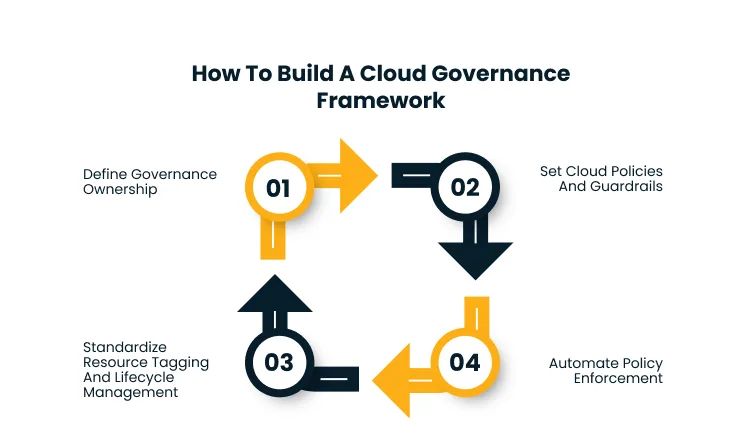
Define Governance Ownership
Governance ownership should be shared across IT, security, finance, compliance, engineering, and business teams. Shared ownership does not mean unclear ownership. Each control area should have a named decision owner.
A useful model separates policy ownership from execution ownership. A Cloud Center of Excellence or central platform team may define standards, while application teams execute within approved patterns.
Ownership should cover:
- Policy creation
- Exception approval
- Cost accountability
- Security control ownership
- Compliance evidence
- Remediation tracking
- Governance reporting
Without clear ownership, governance turns into advice. Teams may agree with policies but ignore them when delivery pressure increases. Accountability gives governance the authority to work in daily operations.
Set Cloud Policies And Guardrails
Cloud policies define the rules. Guardrails enforce or monitor those rules. Both are needed for enterprise cloud governance.
Preventive guardrails stop risky actions before they happen. Detective guardrails identify violations after they occur. Corrective guardrails trigger remediation workflows when risks are detected.
Examples of useful guardrails include:
- Blocking unapproved regions
- Requiring encryption for production data
- Preventing public storage exposure
- Enforcing mandatory resource tags
- Restricting privileged access
- Detecting disabled logging
- Alerting on budget threshold breaches
Guardrails should be risk-based. Not every workload needs the same control level. Production, regulated, customer-facing, and business-critical workloads usually require stronger controls than development or sandbox environments.
Standardize Resource Tagging And Lifecycle Management
Resource governance defines how cloud assets are created, classified, monitored, and retired. Tagging is only one part of this model, but it is often the first control that exposes whether governance is working.
A resource without an owner tag creates cost ambiguity. A resource without an environment tag creates operational risk. A resource without a lifecycle status may remain active long after it is needed.
Strong cloud infrastructure management helps teams maintain this ownership, lifecycle visibility, and operational control as cloud resources grow across teams and environments.
Lifecycle governance should define:
- Who owns each resource?
- Which resources require approval?
- How are unused assets detected?
- How do temporary environments expire?
- How are costs and compliance tracked?
- How are resources retired safely?
Good resource governance reduces cloud waste and improves accountability. It also helps teams investigate incidents faster because ownership and context are already attached to the infrastructure.
Automate Policy Enforcement
Manual governance does not scale across modern cloud environments. As teams create resources through portals, pipelines, templates, APIs, and automation workflows, policy enforcement needs to happen close to the point of creation.
Policy-as-code, infrastructure-as-code scanning, CSPM, budget alerts, and automated tagging checks all help enforce governance earlier. These controls reduce the need for manual audits after problems already exist.
Automation should be applied carefully. A policy that automatically blocks every exception can slow delivery. A better model defines approved paths, exception workflows, and escalation rules.
Governance automation should support three outcomes.
- Stop high-risk actions before deployment
- Detect medium-risk violations quickly
- Route exceptions to the right owner
This makes governance more consistent without turning every cloud decision into a ticket.
How Cloud Governance Works In Multi-Cloud And Hybrid Environments?
Enterprise cloud governance becomes harder when workloads span AWS, Azure, Google Cloud, SaaS, private cloud, and on-premises systems. Each platform has different services, policies, identity models, logging formats, and compliance capabilities.
The goal is not to make every cloud provider identical. The goal is to define common governance principles and map them to provider-specific controls.
Gartner’s 2025 report on cloud trends identified multicloud and cross-cloud as a major cloud trend and noted that many organizations struggle to connect across providers. This makes multi-cloud governance critical for standardizing policies, ownership, and controls across fragmented cloud environments.
A multi-cloud governance model should standardize:
- Identity and access principles
- Tagging and cost allocation rules
- Data classification policies
- Region and residency controls
- Security baselines
- Logging and monitoring standards
- Compliance evidence requirements
- Incident response workflows
Provider-specific tools can then enforce these policies locally. AWS Organizations, Azure Policy, and cloud-native security services can support implementation, but the enterprise governance model should sit above individual platforms. This prevents governance from fragmenting as cloud adoption expands.
Common Cloud Governance Challenges
Cloud governance often breaks down when policies are documented but not embedded into daily cloud operations. Teams may support the idea of governance, yet still create resources manually, bypass tagging rules, or request broad access to avoid delays.
These issues become harder to control in multi-cloud and hybrid environments where each platform has different policy models, identity structures, and reporting formats. Challenges usually appear when governance is treated as a control function separate from engineering execution.
Cygnet.One’s cloud strategy and design service helps define governance ownership, policy structure, and operating standards before these gaps spread across cloud teams.
Weak Ownership Across Teams
Governance fails when no team owns the full control lifecycle. Security may define IAM policies. Finance may request cost tags. Engineering may manage deployment templates. Compliance may ask for evidence.
Without coordination, controls become disconnected. A working governance model needs clear ownership across policy design, enforcement, reporting, remediation, and exceptions. Otherwise, risks move between teams without resolution.
Inconsistent Tagging And Cost Visibility
Tagging problems usually look small at first. A few untagged resources may not seem urgent. As cloud usage grows, those gaps make cost allocation, ownership, forecasting, and compliance harder. Inconsistent tagging also weakens automation.
Budget alerts, lifecycle rules, resource cleanup, and reporting depend on accurate metadata. Governance should define mandatory tags and enforce them at provisioning. Teams should not wait until the finance review to discover that cost ownership is unclear.
Manual Governance Processes
Manual governance creates delays and inconsistency. Ticket-based approval may work for a small number of workloads, but it slows down when teams deploy frequently across multiple environments. Manual review also increases the risk of missed violations.
Teams cannot reliably inspect every configuration, permission, tag, and deployment pattern at scale. Automation should handle repeatable checks. Human review should focus on high-risk exceptions, architecture decisions, and business tradeoffs.
Poor Exception Management
No governance framework can cover every legitimate business situation. Teams will sometimes need exceptions. The risk comes when exceptions are informal, permanent, or invisible.
A strong exception process should define:
- Who can request an exception
- Who approves it
- How long does it last
- What risk is accepted
- How it is monitored
- When it must be closed
Exception governance protects delivery teams and risk owners. It allows flexibility without letting temporary decisions become permanent.
Cloud Governance For AI Workloads
AI workloads are increasing pressure on cloud governance because they combine large data movement, high compute demand, broad access needs, and new security risks. These workloads often scale faster than existing governance policies can adapt.
Cloud governance for AI should cover data access, identity controls, cost limits, approved environments, model-related risks, logging, and auditability. It should also address shadow AI usage, where teams use tools or models outside approved governance channels.
IBM’s 2025 Cost of a Data Breach Report found that 63% of organizations lacked AI governance policies, while 97% of organizations with AI-related security incidents lacked proper AI access controls. This makes AI workload governance a necessary extension of cloud governance, especially for access control, data movement, logging, and cost visibility.
AI governance should not sit outside cloud governance. It should extend existing policies for IAM, data classification, logging, cost control, compliance evidence, and workload ownership.
Best Practices For Enterprise Cloud Governance
An enterprise cloud governance framework should help teams make better cloud decisions without slowing every request. The strongest frameworks are practical, measurable, automated where possible, and owned by the right teams.
Governance should start with the controls that reduce the biggest operational risks. Teams can then expand toward more advanced automation, reporting, and cross-cloud standardization.
Start With High-Impact Controls
Early governance should focus on controls that protect the business from the most visible risks. IAM, tagging, encryption, logging, cost allocation, and region restrictions usually come first. These controls create the baseline needed for deeper governance.
Starting too broadly can slow adoption. Starting too narrow can leave major exposure. The right first phase should reduce risk while creating momentum.
Build Governance Into Delivery Workflows
Governance works better when it is embedded into the way teams provision, deploy, and operate cloud resources. CI/CD pipelines, infrastructure templates, service catalogs, and platform engineering workflows can all carry governance controls.
This approach avoids late-stage policy enforcement. Teams receive approved paths before they create risk. Cygnet.One’s cloud strategy and design service helps translate governance requirements into cloud operating models, platform standards, and delivery-ready controls.
A cloud compliance framework becomes stronger when checks happen before deployment. Remediation after deployment should be the fallback, not the standard process.
Keep Governance Federated But Consistent
Central teams should define standards, but delivery teams need room to execute. Federated governance gives teams controlled flexibility while keeping policies consistent across the enterprise.
For example, a central team may define encryption, tagging, and access standards. Application teams can then deploy through approved templates that already include those controls. This model supports cloud adoption without forcing every decision through a central queue.
Review And Improve Governance Continuously
Cloud governance is not a one-time setup. Workloads change, cloud services evolve, compliance expectations shift, and business priorities move.
Governance reviews should examine policy violations, cost trends, access exceptions, audit findings, resource waste, and remediation timelines. These reviews help teams adjust controls before small issues become systemic.
A framework becomes mature when it improves with the environment it governs.
How To Measure Cloud Governance Success?
Cloud governance should be measured through risk reduction, cost visibility, compliance readiness, operational consistency, and business accountability. If governance cannot be measured, teams cannot prove whether it is working.
Useful metrics include:
- Policy compliance rate
- Untagged resource count
- Cost allocation coverage
- Budget variance by team
- Access review completion rate
- Privileged access exceptions
- Misconfiguration remediation time
- Audit finding reduction
- Idle resource cleanup rate
- Exception closure time
Metrics should be reviewed by control owners, not only dashboard viewers. A report that shows violations without action does not improve governance. Cygnet.One’s cloud operations and optimization service helps teams connect governance metrics with remediation, cost visibility, and continuous cloud performance improvement.
Cloud governance metrics should also connect to business outcomes. Faster audit preparation, fewer cost surprises, lower security exposure, and clearer ownership are all signs that the framework is improving how the business operates in the cloud.
How Cygnet.One Supports Cloud Governance Framework Implementation?
Cygnet.One helps enterprises turn cloud governance from a policy document into an operating model that works across teams, workloads, and cloud platforms. The focus is on defining governance ownership, cloud policies, security controls, cost accountability, compliance mapping, and reporting structures before cloud usage scales further.
Through its cloud strategy and design expertise, Cygnet.One supports governance models that connect IAM governance, tagging strategy, cloud policy management, cost controls, compliance evidence, and resource lifecycle rules. This helps enterprises avoid fragmented cloud decisions across security, finance, engineering, and operations teams.
For organizations managing multi-cloud or hybrid environments, Cygnet.One helps standardize governance principles while mapping them to provider-specific controls across platforms such as AWS and Azure. The result is a cloud governance framework that is practical, auditable, and easier to improve as cloud adoption grows.
Conclusion
Cloud governance becomes valuable when it stops acting like a control layer and starts shaping how cloud decisions are made every day.
The next step is choosing a governance approach that can work across security, cost, compliance, engineering, and operations without adding unnecessary friction. For MOFU readers, the priority is not more policy documentation. It is building a framework that teams can actually follow, measure, and improve.
This is where cloud strategy and design fit naturally. It helps enterprises define governance ownership, cloud policies, operating models, compliance controls, and platform-level standards before cloud usage becomes too fragmented to manage efficiently.
The goal is to move from scattered cloud control to a governance model that improves accountability, visibility, and decision-making at scale. Book a demo with Cygnet.One to build a cloud governance framework aligned with your compliance, cost, security, and operational priorities.
FAQs
A cloud governance framework is a structured set of policies, controls, ownership rules, and processes for managing cloud usage across cost, security, compliance, and operations. It helps enterprises define who owns cloud decisions, how resources are controlled, and how governance performance is measured.
The main components of cloud governance include cloud policy management, IAM governance, cost governance, tagging strategy, security controls, compliance management, resource lifecycle rules, and continuous monitoring. Together, these components help enterprises manage cloud usage without relying only on manual reviews.
You build a cloud governance framework by defining ownership, setting cloud policies, standardizing tagging, enforcing IAM controls, automating policy checks, and measuring governance performance. The framework should connect security, finance, compliance, engineering, and operations into one practical operating model.
Tagging supports cloud governance by assigning cloud resources to owners, teams, applications, environments, projects, and cost centers. A consistent tagging strategy improves cost allocation, resource accountability, lifecycle management, compliance reporting, and visibility across cloud environments.
Cloud governance improves security and compliance by turning access rules, encryption standards, logging, monitoring, and policy controls into repeatable operating practices. It helps teams reduce excessive permissions, detect misconfigurations, maintain audit evidence, and enforce consistent controls across cloud environments.
Cloud governance fails when ownership is unclear, tagging is inconsistent, permissions are excessive, policies are manually enforced, and teams operate without shared accountability. It also breaks down when governance rules stay in documents instead of being embedded into provisioning, deployment, monitoring, and remediation workflows.
Author


Abhishek Nandan
AVP, Marketing
Abhishek Nandan is the AVP of Services Marketing at Cygnet.One, where he drives global marketing strategy and execution. With nearly a decade of experience across growth hacking, digital, and performance marketing, he has built high-impact teams, delivered measurable pipeline growth, and strengthened partner ecosystems. Abhishek is known for his data-driven approach, deep expertise in marketing automation, and passion for mentoring the next generation of marketers.