



































When testing starts holding up every release, coverage gaps are routine, and bugs are reaching production on a regular basis, the problem is structural. Most enterprises that struggle with outsourced QA made one of three decisions badly. They chose an engagement model that did not match their release pace, accepted SLAs defined by activity counts rather than quality outcomes, or brought in a vendor who filled seats without taking ownership of the process.
Structured outsourced software testing addresses all three. It gives enterprises SLA-backed QA coverage, access to specialized testing expertise spanning functional, automation, performance, and security domains, predictable operating costs, and a testing function that scales with product complexity.
This guide covers the four primary QA outsourcing engagement models, a benchmark for what a well-scoped engagement delivers against what a weak one misses, and a practical evaluation framework for selecting a testing partner on criteria that predict actual performance. Providers like Cygnet.One approach outsourced QA as a structured, SLA-driven engagement with defined quality gates, governance frameworks, and delivery accountability at the process level.
What Is Outsourced Software Testing?
Outsourced software testing is the practice of delegating some or all of an organization’s QA operations to a third-party testing partner. The external provider takes ownership of test planning, execution, automation, and defect management under defined SLAs and engagement models. This gives enterprises access to specialized QA expertise and scalable testing capacity without building every capability in-house.
Core characteristics of outsourced software testing:
- SLA-backed delivery with measurable quality targets, including defect escape rate, test cycle time, and coverage percentages
- Engagement model flexibility matched to release cadence, product complexity, and team structure
- Specialized expertise across functional, automation, performance, security, and API testing
- Scalable capacity that adjusts with release volume, feature growth, and integration depth
- Structured reporting with dashboards, defect lifecycle tracking, and sprint-level quality metrics
How Outsourced QA Differs From Staff Augmentation
Enterprises evaluating outsourced testing often conflate it with offshore staff augmentation. Both involve external people doing testing work. The difference is ownership. With staff augmentation, individual QA engineers join your existing team, and you manage them directly, keeping process ownership, tool decisions, and outcome accountability within your organization.
With outsourced testing, the partner owns the QA process end to end, covering strategy design, framework selection, team management, and SLA delivery. This distinction shapes how you scope the engagement and what you hold the partner accountable for.
| Aspect | Staff Augmentation | Outsourced Software Testing |
| Ownership | Client manages testers directly | Partner owns the QA process and outcomes |
| Accountability | Individual performance | SLA-defined delivery and quality metrics |
| Scope | Filling headcount gaps | End-to-end QA operations |
| Scalability | Linear: add more people | Model-driven: adjust engagement scope |
| Best For | Short-term capacity needs | Sustained QA transformation |
QA Outsourcing Engagement Models
The engagement model you choose shapes everything that follows. It determines how the team is managed, how testing scales as your product grows, how product knowledge builds over time, and what a transition looks like if your needs change. Getting this wrong creates friction at every delivery cycle.
The four models below cover the full range of how enterprises structure outsourced QA, from long-term dedicated teams to enterprise-wide centers of excellence.
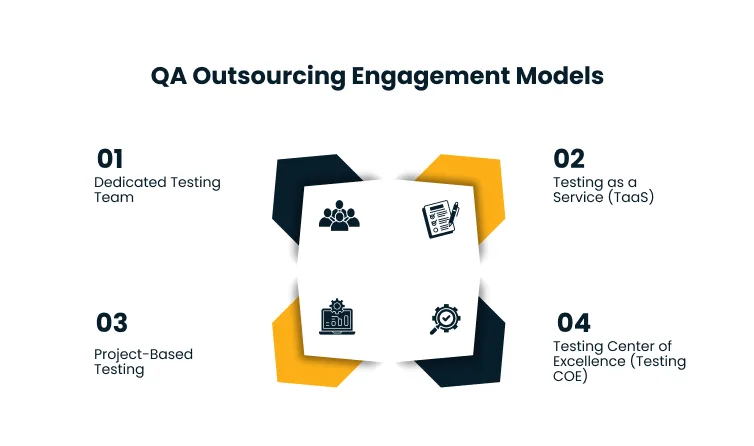
Dedicated Testing Team
A dedicated testing team allocates QA engineers, test leads, and test managers exclusively to your product. The partner recruits a team matched to your tech stack and domain, manages hiring and replacements, and integrates the team directly into your engineering organization.
They follow your release cadence, join standups, and work within your existing delivery pipeline. Product knowledge builds over time because the team stays with the same codebase across multiple release cycles.
This model works best for products with continuous release cycles that need consistent test coverage and sustained product familiarity. The main limitation is that it requires a stable, predictable scope. If testing demand shifts significantly between quarters, a fixed team may have more capacity than you can use during slower periods.
Clear onboarding and a well-defined sprint integration process are what separate a team that contributes from day one from one that takes months to become productive.
Testing as a Service (TaaS)
TaaS is a consumption-based model where the partner provides on-demand QA capacity from a shared pool of testing specialists covering functional, automation, performance, and security testing.
Requests flow through a service portal or ticketing system, and the partner delivers within contracted SLAs. Billing is based on test cycles, test hours, or outcome metrics rather than headcount, which gives teams the ability to scale testing up or down without a long-term team commitment.
This model suits products with variable testing demand, release-specific spikes, or regulatory audit windows that do not justify a permanent QA function. The trade-off is product depth.
A shared pool of specialists serves multiple clients, so familiarity with your product builds more slowly. Complex products with many interconnected workflows need well-defined scopes and clear acceptance criteria to get reliable, consistent results.
Project-Based Testing
Project-based testing is a time-bound engagement built around a specific deliverable, whether that is a new product launch, a platform migration, a compliance audit, or a major release. The partner defines deliverables, timelines, and completion criteria before execution begins, and the engagement closes once the work is done.
This model fits one-time or infrequent testing needs where concentrated QA capacity is required for a fixed window with no ongoing requirement afterward. The main limitation is continuity.
Product knowledge leaves when the project ends. Without a formal handover built into the engagement scope from the beginning, the organization retains very little of what the testing team learned, which creates problems if similar work comes up later.
Testing Center of Excellence (Testing COE)
A Testing COE is a centralized QA function managed by the outsourced partner that serves multiple products, teams, or business units across the enterprise. The partner establishes testing standards, tool choices, automation frameworks, quality gates, and reporting templates.
Individual product teams draw on testing services from the COE, while the partner manages staffing, continuous improvement, and quality reporting across the entire function.
This model is built for large enterprises where testing maturity, tooling, and governance vary widely across teams and products. A COE addresses that inconsistency by bringing QA operations under a single managed structure. The setup investment is significant.
Governance design, team onboarding, and cross-team adoption all take time. If product teams are used to running QA independently, building buy-in for a centralized delivery model needs to be treated as a deliberate change effort from the start.
Engagement Model Comparison
| Model | Commitment | Best For | Scalability | Domain Knowledge |
| Dedicated Testing Team | Long-term | Continuous release cycles | Medium | High |
| Testing as a Service (TaaS) | On-demand | Variable testing demand | High | Low to Medium |
| Project-Based Testing | Fixed-term | Launches, migrations, audits | Low | Low |
| Testing COE | Long-term | Multi-product enterprises | Very High | High |
What a Well-Structured QA Engagement Covers (and What a Weak One Misses)
The engagement model covers structure. The scope covers what the partner actually delivers within that structure. Each area below describes what good execution looks like and what signals in a proposal or running engagement indicate the scope is weaker than it appears.
Use this as a benchmark when reviewing vendor proposals or auditing an existing engagement against what was originally agreed.
Test Strategy and Planning
A well-run engagement starts with a QA maturity assessment that examines current processes, tools, coverage gaps, and what is slowing testing down, all before any execution begins.
From that baseline, the partner designs a test strategy around the product’s release schedule, risk areas, and integration complexity, and produces a test plan covering functional, regression, integration, performance, and security testing. SLAs should be agreed upon before execution starts and cover coverage targets, defect response timelines, automation goals, and reporting frequency.
A partner who moves straight to execution without completing an assessment has no baseline to measure progress against. There is no way to know whether coverage is improving, whether the right risks are being tested, or whether the engagement is delivering measurable improvement over time.
Test Execution Across the Stack
Full-stack test execution covers more than functional and regression validation. A well-structured engagement covers the complete test surface:
- Functional testing: feature validation, business logic checks, cross-browser and cross-device coverage
- Regression testing: verifying that new changes do not break existing functionality
- Performance testing: load, stress, and scalability testing under realistic production conditions
- Security testing: vulnerability assessments, penetration testing, and compliance validation
- API testing: endpoint validation, contract testing, and integration verification
- UAT support: structured workflows with defined stakeholder sign-off at key checkpoints
When reviewing a proposal, ask specifically what happens with performance, security, and API testing. Many vendors default to functional and regression testing because those are easiest to scope and price. Leaving the rest undefined creates gaps that show up at the worst possible time, particularly in regulated industries where untested security or compliance workflows carry direct legal and financial consequences.
Automation Framework Setup and Maintenance
Automation only delivers value when it is maintained as the product evolves. A structured partner selects tools suited to your tech stack, builds reusable test scripts for regression, smoke, and sanity testing, and connects the framework to your CI/CD pipeline so tests run on every build. Ongoing responsibility covers updating scripts as the product changes, investigating failing tests, and expanding coverage as new features are added.
For teams moving away from largely manual QA processes, TestingWhiz by Cygnet.One offers a codeless and low-code automation platform that reduces the technical effort of building and maintaining a test suite without compromising on CI/CD integration.
An automation setup with no maintenance plan becomes a liability within months. Scripts break as the product changes, and a test suite that requires constant repair costs more time to manage than it saves. Ask any automation partner how they handle script updates and framework maintenance over the life of the engagement.
Defect Management and Reporting
Structured defect management covers severity-classified bug logging with reproducibility steps and environment details, a full defect lifecycle from triage through closure, and sprint-level quality reports tied to SLA targets. Dashboards should surface defect density, escape rate, and test cycle time alongside execution status and coverage data. These are the numbers that make it possible to hold the engagement accountable beyond raw test case counts.
If a partner cannot produce a sample reporting dashboard or explain how they measure defect escape rate, reporting is informal. Activity-based reports that count tests run without tracking quality outcomes give no visibility into whether the engagement is delivering or simply staying busy.
QA Scope Benchmark
| Service Area | What Good Looks Like | What to Watch For |
| Test Strategy and Planning | QA maturity assessment, risk-aligned test plan, and SLAs defined before execution starts | No assessment or SLAs; execution begins without a documented baseline |
| Test Execution | Full-stack coverage: functional, regression, performance, security, API, UAT | Only functional and regression scoped; remaining areas left undefined |
| Automation Framework | Tool selection, CI/CD integration, ongoing maintenance, and coverage expansion plan | Scripts built during the engagement with no update or maintenance strategy |
| Defect Management and Reporting | SLA-tracked dashboards, defect escape rate and cycle time metrics, sprint-level reports | Activity-based reporting with no measurable quality outcomes |
A well-run outsourced QA engagement follows a clear sequence. The team begins with a maturity and coverage assessment, agrees on SLAs and quality targets before execution starts, and then completes a structured onboarding that connects them to your delivery pipeline.
Execution and automation are built in parallel as the team develops product knowledge, with regular review cycles to improve coverage and address what the data shows is not working. Skipping the first two steps removes the ability to measure anything that follows.
Cygnet.One’s Quality Engineering practice supports this full scope through CMMI Level 5 process maturity, SLA-backed delivery, and cross-industry QA engagements spanning BFSI, healthcare, retail, and manufacturing, from dedicated testing teams to full testing COEs.
How to Evaluate and Choose an Outsourced Testing Partner
With a clear picture of engagement models and what a structured scope covers, the remaining question is which partner can actually deliver it. This section covers the signals that indicate outsourcing QA is the right move for your organization, and the criteria that separate a capable testing partner from a vendor operating on minimums.
Signals You Are Ready to Outsource QA
Outsourcing QA delivers the most value when the gap between your testing capacity and your release pace is real and growing. Common signals that point to readiness:
- Developers are picking up testing work because the QA function cannot keep up with the build output
- Releases are regularly delayed at the testing phase, with QA consistently identified as the slowest step
- Bugs are reaching production more often, and post-release fixes are becoming a regular part of every sprint
- Your team has little to no test automation and does not have the time or skills to build it internally
- The product is growing in scope (more features, more integrations, more users) while the QA function stays flat
- Compliance or regulatory requirements call for testing rigor that your current setup cannot reliably deliver
The same logic applies in the other direction. A small, early-stage product with low complexity, a capable engineering team, and existing automation that handles most of your regression testing does not need an outsourced QA layer. The coordination overhead will outweigh the benefit.
Outsourcing makes most sense when internal testing capacity has a clear, measurable gap with your delivery pace, and filling it through hiring alone would take longer than the product can wait.
Evaluation Criteria That Separate Partners From Vendors
The eight criteria below are designed to surface the gap between what a partner promises and what they actually deliver. Each one includes what to ask and what the answer reveals.
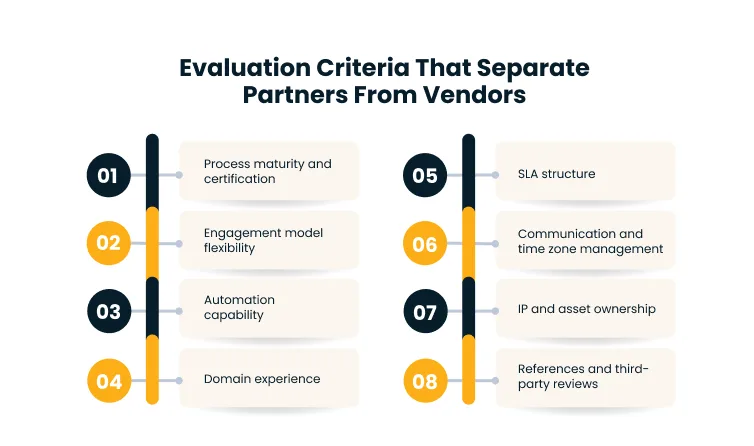
- Process maturity and certification. Ask whether the partner has a documented testing methodology that runs consistently across engagements. Certifications like CMMI Level 5, ISO 9001, and ISO 27001 are evidence that QA operations are governed by defined standards and continuously improved. If they cannot walk you through how they run a test cycle from planning through final reporting, delivery quality will depend on which individuals are assigned rather than on a reliable process.
- Engagement model flexibility. Your testing needs will shift as the product grows, compliance requirements change, or new teams come on. A partner who can support dedicated teams, TaaS, project-based testing, and COE structures can adapt as those needs evolve. Partners who offer only one engagement format will create pressure to fit your situation into their preferred structure.
- Automation capability. Verify which frameworks the partner builds in and whether they can connect automation to your CI/CD pipeline. Ask how they handle script updates as the product changes and what their process is for investigating failing tests. Teams that build automation without a maintenance plan are a common source of post-engagement problems, where scripts stop working on every release and cost more to repair than they save in execution time.
- Domain experience. In regulated industries like BFSI, healthcare, or insurance, limited product knowledge leads to shallow test coverage. Ask for specific examples of prior work in your industry and find out how the partner manages knowledge retention for long-term dedicated teams. General capability claims are common among vendors; relevant, verifiable experience is harder to fake.
- SLA structure. SLAs tied to quality outcomes, such as defect escape rate, test cycle time, and coverage percentage, give you a way to measure performance. SLAs built around activity metrics (hours logged, test cases run) make it easy for a partner to report high volume while quality problems go undetected. A partner who cannot commit to outcome-based SLAs during the proposal stage is signaling something about how they expect to be measured.
- Communication and time zone management. Offshore and distributed QA teams need a structure to work well across time zones. Confirm whether working hours overlap, whether defect triage happens within a predictable window, and whether there is a single named lead on the partner side who owns the communication rhythm. Rotating contacts and coverage gaps across time zones create slow defect resolution and coordination problems that compound over a long engagement.
- IP and asset ownership. Test scripts, automation frameworks, test plans, and documentation should belong to you when the engagement ends. Confirm this contractually before signing. Partners who rely on proprietary platforms that are not widely portable can effectively lock you in. Open-source frameworks and clearly documented asset ownership terms eliminate that risk.
- References and third-party reviews. Check Clutch and G2 for verified reviews from organizations with comparable product complexity and industry context. Ask for direct references you can speak with, rather than relying on prepared case studies. A partner with no verifiable client references or third-party review presence has no track record you can independently confirm.
Providers like Cygnet.One addresses these criteria through CMMI Level 5 certified QA operations, flexible engagement models covering dedicated teams and testing COEs, cross-industry expertise spanning BFSI, healthcare, retail, and manufacturing, and the TestingWhiz low-code automation platform for teams moving away from manual-heavy test processes.
Conclusion
Outsourced software testing is a structural decision about where QA ownership and delivery accountability should sit within your engineering organization. The financial benefits follow naturally when the engagement model matches your release pace, SLAs are tied to quality outcomes, and your partner takes full process ownership. The right model depends on product complexity, release cadence, and how much QA governance you want to retain internally. Across all models, the consistent differentiator is whether the partner owns the outcome or simply fills the seats.
If your current QA setup cannot keep pace with your release schedule, the first step is identifying which testing gaps are structural and which are capacity-related.
Working with Cygnet.One’s Quality Engineering practice gives you:
- SLA-backed QA delivery across dedicated teams, TaaS, and testing COE models
- CMMI Level 5 process maturity with structured test governance and continuous optimization
- Cross-industry QA expertise covering BFSI, healthcare, retail, and manufacturing
- In-house automation capabilities, including the TestingWhiz low-code test automation platform
To explore what a structured outsourced QA engagement looks like for your product, book a demo with Cygnet.One today.
FAQs
Costs vary by engagement model, testing scope, and delivery geography. Offshore QA teams typically run 40% to 60% less than equivalent in-house teams. Pricing structures include fixed monthly retainers for dedicated teams, per-cycle or per-hour billing for TaaS, and fixed-price contracts for project-based engagements. Outcome-based contracts tied to coverage targets and defect metrics are available from mature testing partners.
Yes, when the engagement is built with defined SLAs, overlapping working hours, shared defect tracking tools, and a dedicated QA lead who owns the communication and triage cadence on the partner side. A team operating under clear accountability structures will deliver consistently regardless of location. Reliability depends on how the engagement is designed, not where the team sits.
Most engagements require two to four weeks for knowledge transfer, environment setup, and initial test execution. Products in regulated industries or with complex integration surfaces typically need a longer onboarding window. A QA maturity assessment at the start shortens that ramp time by directing onboarding effort toward the highest-risk coverage areas first.
Yes. Dedicated testing teams and TaaS models are designed to work within sprint cadences, attend ceremonies, and deliver test results within each iteration. The prerequisites are overlapping working hours and a shared defect tracking tool. Most mature QA partners have standard integration templates for Jira, Azure DevOps, and similar platforms.
Ownership must be defined contractually before the engagement begins. Best practice is for the client to retain full ownership of all test assets, scripts, frameworks, and documentation produced during the engagement. Prioritize partners who build on open-source and widely adopted frameworks over those who use proprietary platforms that restrict portability and raise switching costs.
CMMI Level 3 or higher indicates repeatable, defined QA processes. ISO 9001 covers quality management system governance, and ISO 27001 covers information security practices relevant when test environments handle production data. CMMI Level 5 is the highest maturity tier, indicating continuous process optimization and statistically managed delivery quality. For long-term enterprise engagements, this is the benchmark to look for.
Author


Abhishek Nandan
AVP, Marketing
Abhishek Nandan is the AVP of Services Marketing at Cygnet.One, where he drives global marketing strategy and execution. With nearly a decade of experience across growth hacking, digital, and performance marketing, he has built high-impact teams, delivered measurable pipeline growth, and strengthened partner ecosystems. Abhishek is known for his data-driven approach, deep expertise in marketing automation, and passion for mentoring the next generation of marketers.