




































Introduction
Software delivery has accelerated to the point where a QA stage at the end of a sprint no longer has enough time, context, or visibility to catch what actually needs catching. Defects surface late, fixes take longer than they should, and release confidence depends more on optimism than evidence.
Shift left testing addresses this by moving quality checks earlier, into requirements, design, development, and CI/CD pipelines, so issues are found before they become expensive to reverse.
This guide covers what shift left testing means in practice, why the timing of testing affects more than just defect counts, the specific benefits teams see, the testing types involved, and how to build a shift left QA strategy that holds up beyond the initial rollout.
What Does Shift Left Testing Mean In Software Development?
Shift left testing is an approach where quality checks move earlier in the software development lifecycle. Rather than validating software only after development is complete, teams test requirements, code quality, integrations, security risks, and critical workflows from the beginning.
The term shift left testing comes from how software delivery is typically mapped: left to right across requirements, design, development, testing, and deployment. Shifting testing left means introducing it at the requirements and development stages rather than waiting for a dedicated QA phase. The practical effect is that defects are found when they are smallest, cheapest to fix, and still within the context of the team that introduced them.
A shift left approach in testing typically includes:
- Reviewing requirements before development starts
- Writing testable acceptance criteria
- Running unit tests during development
- Using static code analysis before code is merged
- Adding automated tests to CI/CD pipelines
- Testing APIs and integrations earlier
- Catching defects before they reach staging or production
Shift left testing does not replace QA or manual testing. It supports a quality engineering approach where testing, automation, monitoring, and feedback are embedded across the development lifecycle.
It also gives teams the ability to find defects earlier, shorten feedback loops, and prevent avoidable issues from compounding as they move further down the SDLC.
Late defects are expensive because the fix often involves multiple teams, regression cycles, and release delays. The later an issue is found, the harder it becomes to isolate and resolve.
The numbers behind that pattern explain why many teams are rethinking where testing fits inside a sprint.
Why Early Testing Matters In Modern Software Delivery?
Shorter release cycles and frequent deployments leave less margin for defects to surface late. When testing is concentrated at the end of development, issues appear after multiple dependencies and code changes are already layered in, making root cause harder to isolate and fixes more disruptive.
Late-stage testing patterns that teams consistently report include:
- More rework before release
- Poor visibility into quality until the end of the sprint
- Increased pressure on QA teams
- Higher defect resolution costs
- More production issues
- Delayed releases
The cost of deferred quality is well documented. According to McKinsey’s 2023 report on breaking the technical debt’s vicious cycle, technical debt accounts for roughly 40 percent of IT balance sheets, and companies pay an additional 10 to 20 percent on top of every project to address it. Defects that accumulate undetected across the SDLC are a primary driver of that debt.
Earlier testing also changes how QA teams operate. With quality checks integrated earlier, QA is no longer absorbing the consequences of undiscovered upstream issues. Teams can focus on risk analysis, edge case coverage, and release validation rather than triage.
For Agile and DevOps teams specifically, this matters because short sprint cycles cannot accommodate a late-stage quality bottleneck. Testing needs to be distributed across the delivery process, not concentrated at its end.
Fixing defects earlier is not just a cost argument. Teams that build testing into development also ship more predictably, spend less time in reactive firefighting, and give QA the capacity to focus on edge cases rather than chasing basic failures.
Benefits Of Shift Left Testing
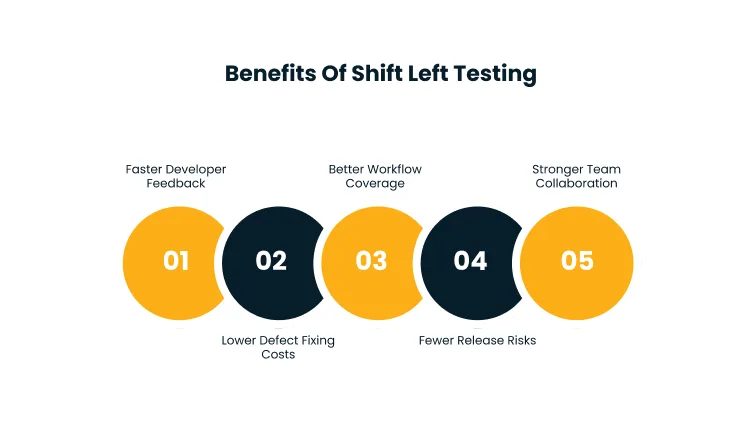
Teams that move testing earlier see improvements across the full delivery cycle. The gains are not limited to defect counts. They show up in how fast developers get feedback, how much rework gets eliminated before it starts, and how predictably a release reaches production.
Recent research also supports the value of embedding quality across the SDLC.
McKinsey’s 2025 research on AI in software development found that the highest-performing organizations achieved software quality improvements of 31 to 45 percent, along with 16 to 30 percent gains in productivity, time to market, and customer experience.
While the research focuses on AI-enabled software delivery, the takeaway applies to shift left testing as well: quality improves when validation, testing, and automated checks are built into the development lifecycle rather than concentrated at the end.
The five outcomes below represent what consistently changes when a shift left strategy is implemented with the right foundations in place.
Faster Feedback For Developers
When unit tests, code reviews, static analysis, and automated checks run close to the point of development, developers catch issues while the code is still fresh. Fixing a problem in the same sprint it was introduced takes a fraction of the time and cognitive effort of revisiting it weeks later during final QA.
According to McKinsey’s 2023 research on measuring software developer productivity, top technology companies target having developers spend up to 70 percent of their time on direct coding activities. Automating outer-loop tasks like manual test runs and pipeline maintenance is what creates that capacity.
Lower Cost Of Fixing Defects
A requirement gap caught during planning is a conversation. The same gap found after development or deployment is a rework cycle involving multiple teams, regression runs, and delayed releases. Shift left testing reduces the points at which defects are allowed to accumulate and downstream dependencies that multiply the fix effort.
Better Coverage Across Critical Workflows
Testing important workflows early, including login, payments, checkout, user permissions, integrations, and data processing, means coverage decisions are made deliberately rather than under release pressure. Teams identify gaps when there is still time to address them, not during a final regression cycle.
Fewer Release Delays And Production Issues
When testing runs throughout development rather than only at the end, final QA has fewer critical defects to surface. The result is fewer last-minute blockers, fewer emergency hotfixes after release, and a delivery timeline that becomes measurably more predictable over successive release cycles.
Stronger Collaboration Between QA, Development, And Product Teams
Shift left testing moves quality ownership upstream.
Product teams write clearer requirements because they know QA will test against them. Developers validate code earlier because quality gates give them immediate feedback.
QA teams contribute to the test strategy from the start rather than inheriting a completed build to assess. The handoff friction that typically causes the most defects decreases across the board.
Achieving these outcomes depends on choosing the right testing types for each stage. Shifting all testing left without distinguishing which practices work early versus late tends to create overhead without improving detection rates.
Types Of Testing Used In A Shift Left Approach
Shift left testing draws on several practices that can run earlier in the SDLC. The right combination depends on the application, architecture, release frequency, and the risk profile of the system being built.
Common testing types and where they fit:
- Unit testing validates individual code components during development. It gives developers immediate confirmation that core logic behaves as expected before code moves anywhere else.
- Static code analysis inspects source code without executing it, surfacing quality, maintainability, and security issues before they become runtime problems.
- API testing validates service behavior before the full UI or end-to-end workflow is ready. Particularly useful in microservices and distributed architectures where integrations are tested independently.
- Integration testing checks whether modules, services, or systems work together correctly, catching interface mismatches before they reach user-facing scenarios.
- Security testing identifies vulnerabilities through code scans, dependency checks, secret scanning, and security reviews, moving security validation earlier rather than treating it as a pre-release gate.
- Automated regression testing confirms that existing functionality holds after new changes. In high-frequency deployment environments, this is what prevents regressions from accumulating silently across sprints.
The tests that add the most value when shifted left are fast enough to run on every commit, stable enough to be trusted, and specific enough to give actionable failure signals. Tests that fail intermittently or take too long to run create noise rather than quality assurance.
Having the right testing types available does not automatically make a team shift left. Without a clear sequence tied to where each team currently operates, most of these practices get added informally and inconsistently, which limits how much they improve.
How To Get Started With A Shift Left QA Strategy?
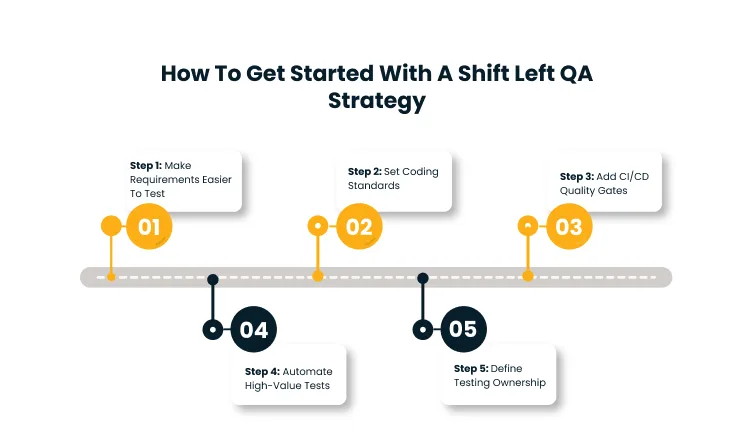
A structured shift-left QA strategy works in five steps. The sequence matters.
Requirements quality determines what gets built, coding standards determine how it gets built, pipeline gates make quality checks consistent, automation focuses effort on the highest-value tests, and ownership clarity ensures no step gets skipped. Each one builds on the previous, so teams can phase the rollout without disrupting an active delivery cycle.
Step 1: Make Requirements Easier To Test
Shift left testing starts before a line of code is written. Requirements need to be specific enough for QA and development teams to derive test cases from them directly, without having to interpret intent or make assumptions about edge cases.
A testable requirement should define:
- Expected user behavior
- Edge cases
- Negative scenarios
- Required test data
- Success criteria
For example, instead of stating “users should log in securely,” the requirement should specify what happens for valid login, invalid credentials, account lockout, MFA, and session timeout, with each scenario defined as a verifiable condition.
Step 2: Set Coding And Review Standards
Coding standards reduce defect injection before code reaches testing. Teams should define expectations for code quality, naming conventions, error handling, security practices, documentation, and unit test coverage thresholds. Code reviews should confirm that requirements are implemented correctly, edge cases are handled, tests are present, and no new security or performance risks have been introduced.
Step 3: Add Quality Gates To The CI/CD Pipeline
Quality gates enforce testing at defined transition points in the pipeline and support a broader continuous testing in DevOps approach.
Common gate configurations include:
- Unit tests passing before merge
- Static analysis showing no critical issues
- API tests passing before deployment
- Security scans showing no high-risk vulnerabilities
- Regression tests passing before release
Without pipeline gates, quality checks become optional. With them, every code change passes the same quality threshold before it moves forward.
Step 4: Automate High-Value Tests First
Automation decisions should be driven by return on investment, not coverage targets. Cygnet.One’s quality engineering service helps teams identify which tests generate the highest return when automated early.
High-value starting points for automation include:
- Unit tests for core business logic
- Static code analysis
- API tests for key workflows
- Smoke tests for critical features
- Regression tests for frequently changed areas
The objective is to reduce defect escape rates and rework cycles, not build the largest possible test suite.
Step 5: Define Who Owns Each Testing Activity
Shift left testing distributes quality ownership across teams. Without explicit ownership, testing activities fall through the gaps between roles or accumulate entirely on QA.
A working ownership model defines:
- Developers own unit testing, local checks, code reviews, and fix issues before merging
- QA teams own test strategy, risk analysis, exploratory testing, and automation guidance
- Product teams own requirements, acceptance criteria, and business rules
- DevOps or engineering teams own CI/CD quality gates, environments, and pipeline reliability
- All teams share accountability for release readiness and defect prevention
Ownership clarity also means that when a defect does escape, teams can trace back to where the breakdown occurred rather than absorbing it as a collective failure with no clear resolution path.
Example: Applying Shift Left Testing To A Login Feature
For a login feature, the shift left process starts during requirement review. The team defines verifiable scenarios for valid login, invalid credentials, account lockout, password reset, MFA, and session timeout before development begins.
During development, developers write unit tests for validation logic. Static analysis flags any security issues in the authentication code. API tests confirm that login endpoints respond correctly. Automated smoke tests run in the CI/CD pipeline before any code is merged into the main branch.
By the time the feature reaches final QA, the structural and functional defects have already been resolved. QA focuses on usability, edge cases, accessibility, and release confidence rather than basic defect triage.
The steps above get a shift left strategy off the ground. Where most teams run into difficulty is not the initial rollout, but the period six months in, when test suites start accumulating flaky tests, automation coverage drifts, and the pipeline slows down enough that developers start bypassing checks.
Best Practices For Shift Left Testing
Shift left testing strategies that start well often degrade over time when maintenance practices are not built in from the beginning. These are the discipline points that separate teams with a sustainable strategy from those that revert to late-stage testing within a few quarters.
Start With The Riskiest User Journeys
Start with workflows where a defect in production has the highest business impact. Authentication, payment flows, order processing, user access controls, third-party integrations, and data-intensive workflows are strong candidates.
Getting early wins on high-risk journeys builds credibility for the broader strategy and gives teams a clear framework for prioritizing what to shift next.
Keep Early Tests Fast And Reliable
A slow or intermittently failing test suite erodes developer trust faster than almost anything else. When tests take too long or produce false positives, developers start ignoring them or bypassing pipeline gates.
Early tests need to be fast enough to run on every commit, reliable enough to be trusted when they fail, and specific enough to identify where the problem is.
Do Not Try To Automate Everything
Automating tests that are inherently unstable or low in value adds a maintenance burden without improving detection. The pipeline slows down, false failures accumulate, and the signal-to-noise ratio drops.
Automate tests that are repeatable, high-value, and stable. Keep human testing where judgment, context, and observation matter more than repeatability.
Use Manual Testing Where Human Judgment Matters
Exploratory testing, usability assessment, accessibility validation, and complex scenario testing all require human judgment that automation cannot substitute.
Shift left testing reduces the volume of avoidable late-stage defects. It does not eliminate the need for testers who can assess software from a user perspective rather than a pass-fail condition.
Review And Improve Tests Continuously
Test suites degrade if they are not maintained. Duplicate tests accumulate, flaky tests go unfixed, coverage gaps widen, and scenarios become outdated as the product changes.
Build in regular test review cycles the same way teams review technical debt. A well-maintained test suite is an asset. An unmaintained one becomes a reason teams stop trusting the results.
A common mistake teams make is measuring shift left progress by counting automated tests written. Test count tells you about activity, not about whether defects are actually being caught sooner or whether releases have become more predictable.
How To Know If Your Shift Left QA Strategy Is Working?
A shift left QA strategy is producing results when defects are being caught earlier in the SDLC, teams are spending less time on rework, and releases are more predictable than they were before.
Indicators worth tracking include:
- Fewer defects reaching production, with more issues caught before release
- Shorter time between a defect being introduced and being detected
- Reduced time to fix because the context is still intact when the issue surfaces
- Fewer release blockers are appearing for the first time in final QA
- More stable CI/CD pipelines with automated checks that teams trust
- Lower rework volume because requirements and code were validated upstream
The clearest sign that a shift-left strategy is working is not the number of tests in a pipeline. It is that final QA stops being where defects are discovered for the first time and starts being where quality is confirmed.
Getting there requires the right sequencing across requirements, pipeline gates, automation, and team ownership.
Cygnet.One’s quality engineering services help teams assess their current QA maturity, identify which testing activities should move earlier, and implement practical quality gates across the SDLC.
The team supports test automation strategy, CI/CD testing, regression optimization, API testing, security validation, and ongoing test maintenance, so shift-left testing becomes part of the delivery process rather than a one-time initiative.
Conclusion
Shift left testing moves quality from the end of a delivery process to throughout it. Teams that implement it well reduce rework, catch defects when they are cheapest to fix, and build releases with evidence rather than assumptions.
A shift left QA strategy requires testable requirements, code quality standards, pipeline gates, targeted automation, and clear team ownership. Getting these in place takes time, but each one compounds the next. Teams that invest in the foundation tend to see the results within a few release cycles.
If your organization is working to improve release reliability, reduce late-stage defects, or modernize how QA fits into your delivery process, Cygnet.One’s quality engineering services can help you assess your current SDLC, prioritize the right testing activities to shift left, and build a practical roadmap for implementation.
Book a demo now to discuss how a structured shift-left QA strategy can fit your delivery process.
FAQs
Shift left testing means running quality checks earlier in the development process so teams find and fix defects before they reach final QA or production. Catching issues during requirements, design, or development reduces the effort and cost of resolving them later.
Software development is typically mapped as a left-to-right timeline, from requirements and design through to deployment and maintenance. Moving testing activities earlier in that sequence means shifting them toward the left side of the timeline, which is where the name comes from.
No. Automation is one component of a shift-left approach, but shift-left testing also includes requirement reviews, coding standards, code reviews, risk analysis, static checks, and distributed quality ownership across the team. Automation accelerates certain types of early testing but does not define the practice.
In a shift left model, QA moves from late-stage defect finder to early-stage quality architect. QA teams define testable requirements, identify risks before development begins, guide test strategy and automation decisions, and focus manual testing effort on the areas where judgment and exploration add the most value.
No. Manual testing remains essential for exploratory scenarios, usability, accessibility, visual validation, and complex workflows that automated tests cannot adequately cover. Shift left testing changes where manual testing effort is focused, not whether it is needed.
Shift left testing integrates quality checks directly into CI/CD pipelines through automated gates, static analysis, and continuous regression coverage. This gives DevOps teams the ability to deploy frequently with confidence because each change has already passed defined quality thresholds before it reaches production.
Author


Yogita Jain
Content Lead
Yogita Jain leads with storytelling and Insightful content that connects with the audiences. She’s the voice behind the brand’s digital presence, translating complex tech like cloud modernization and enterprise AI into narratives that spark interest and drive action. With a diverse of experience across IT and digital transformation, Yogita blends strategic thinking with editorial craft, shaping content that’s sharp, relevant, and grounded in real business outcomes. At Cygnet, she’s not just building content pipelines; she’s building conversations that matter to clients, partners, and decision-makers alike.