




































Introduction
Digital systems across global markets are becoming more complex, connected, and release-driven. Banks manage high-volume transactions, retail enterprises coordinate supply chains across regions, and e-commerce platforms handle traffic spikes across devices, payment systems, and fulfillment channels.
As these systems expand, even small software issues can affect customer experience, operations, compliance, and revenue.
Automation testing has become a key part of enterprise software delivery because it brings speed, consistency, and broader validation to QA. It helps teams test repetitive workflows, validate critical journeys, and check application behavior across web, mobile, API, and backend systems.
A reliable test automation company provides the strategy, frameworks, tools, and QA expertise needed to keep automation scalable and maintainable.
In this blog, we will explain what a test automation company does, how to evaluate the right automation QA partner, and which top test automation companies enterprises can consider for reliable, scalable QA.
What does a test automation company actually do?
A test automation company helps businesses improve software quality by automating repetitive and high-value test cases. It creates the strategy, test architecture, scripts, integrations, and reporting systems needed to validate applications faster across releases.
For enterprises, this often includes regression testing, API validation, cross-browser testing, mobile testing, and checks for core user journeys such as login, payments, onboarding, approvals, and data processing.
A reliable test automation company typically supports the following:
- Strategy and roadmap development based on application complexity, release cycles, and QA goals.
- Automation framework design for web, mobile, API, and enterprise systems.
- Test script creation and maintenance for critical workflows.
- CI/CD integration so automated tests run during builds and release checks.
- Reporting and defect insights to track failures, coverage gaps, and release readiness.
The right company helps enterprises reduce manual effort, improve test coverage, and maintain consistent product quality as applications grow. It also keeps automation aligned with changing features, release cycles, and business-critical workflows, so QA remains reliable as systems become more complex.
How to Evaluate the Right Test Automation Company?
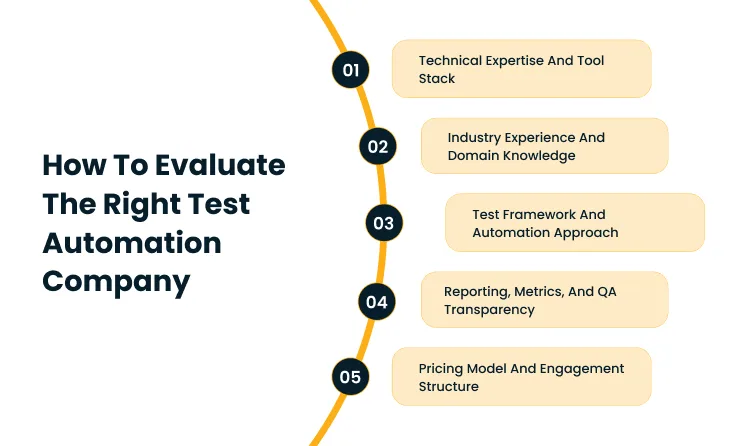
Choosing the right test automation company requires a clear view of technical capability, QA maturity, domain knowledge, reporting quality, and engagement flexibility.
For enterprises working with external QA teams, this evaluation often overlaps with choosing the right QA outsourcing company, especially when scalability, delivery ownership, and long-term testing support are key priorities.
Technical Expertise and Tool Stack
A strong test automation company should have hands-on experience across web, mobile, API, database, and enterprise application testing. Common tools include Selenium, Cypress, Playwright, Appium, Katalon Studio, Postman, Rest Assured, Jenkins, GitHub Actions, GitLab CI, and Azure DevOps.
Tool selection should match the application architecture, testing scope, team skills, and release process. When comparing top automation testing firms, check how clearly they explain tool choices around scalability, reliability, and long-term maintenance.
Industry Experience and Domain Knowledge
Industry experience helps create test scenarios that reflect real business workflows. Enterprise applications often include complex rules, user permissions, integrations, compliance needs, and high-value transactions.
For example, BFSI testing may cover onboarding, KYC, payments, audit trails, and role-based access. Retail and e-commerce testing may include search, checkout, inventory sync, order tracking, and returns.
Test Framework and Automation Approach
A scalable test framework should support reusable components, stable execution, controlled test data, clear reporting, and easier maintenance. This helps QA teams expand coverage as applications and release cycles grow.
The automation approach should define which tests run at each delivery stage. Smoke tests can run after every build, API tests can validate integrations early, and regression suites can support sprint closures or major releases.
Reporting, Metrics, and QA Transparency
Reporting should give QA and engineering leaders a clear view of test execution, product quality, and release readiness. Useful reports show failed test reasons, defect severity, affected modules, flaky tests, and coverage gaps.
Metrics should connect with release decisions. Teams should be able to identify unstable builds, high-risk features, recurring defects, and areas that need deeper validation before deployment.
The 2024 IBM Cost of a Data Breach Report found that the global average cost of a data breach reached $4.88 million, showing why enterprises need stronger visibility into software quality, security risks, and release readiness.
Pricing Model and Engagement Structure
Pricing should reflect automation scope, application complexity, tool needs, delivery timelines, and support requirements. Common models include project-based automation, dedicated QA teams, managed QA services, automation audits, and staff augmentation.
Enterprises should review what the pricing includes, such as framework setup, script development, tool configuration, test data planning, reporting, maintenance, documentation, knowledge transfer, and optimization.
Top 10 Test Automation Companies for Enterprises
Most enterprises face challenges in building a clear test automation roadmap, from tool selection to scalable framework design and continuous integration with fast release cycles.
The 2023 Gartner Peer Community Survey found that 36% of respondents cited implementation struggles, while 34% cited automation skill gaps or high upfront costs as key challenges in automated software testing deployment.
Top test automation companies help address these challenges through structured frameworks, QA engineering expertise, and automation practices that support consistent, scalable quality delivery.
Quick Comparison Between The Top Test Automation Companies
Enterprise test automation plays a critical role in improving software quality, accelerating release cycles, and ensuring consistent validation across complex systems. The following comparison highlights leading test automation companies for enterprises based on their services, industry focus, and key differentiators.
| Company Name | Automation Testing Services | Industry Focus | Key Differentiator |
| Cygnet.One | Test automation strategy, framework development, CI/CD integration, API & multi-layer testing | BFSI, Manufacturing, Retail, Healthcare, FMCG, ISV | Strategy-led QA engineering with scalable automation frameworks and continuous optimization |
| LTIMindtree | Large-scale QA engineering, continuous testing, automation frameworks | Manufacturing, Retail, Healthcare, FMCG, ISV | Large-scale enterprise QA delivery |
| Cigniti Technologies | AI-led test automation, digital assurance, continuous testing | Manufacturing, Retail, Healthcare, FMCG, ISV | AI-driven testing and assurance capabilities |
| TCS | Industrial-scale test automation, enterprise QA transformation | Manufacturing, Retail, Healthcare, FMCG, ISV | Global enterprise QA scale |
| Wipro | Automation-led QA, digital QA services, DevOps-aligned testing | Manufacturing, Retail, Healthcare, FMCG, ISV | Digital transformation-focused QA delivery |
| EPAM Systems | Engineering-led test automation, product QA, agile testing | Retail, Healthcare, ISV, Technology platforms | Product engineering-driven QA approach |
| ImpactQA | QA automation services, regression, API, mobile testing | ISV, Healthcare, Retail | Pure-play QA automation focus |
| QASource | Dedicated QA teams, scalable automation execution | ISV, SaaS, Retail | Dedicated QA outsourcing model |
| QualityLogic | Functional, accessibility, and automation testing services | Healthcare, Media, Digital Products | Accessibility and compliance testing specialization |
| Testlio | Continuous testing platform, managed + crowd testing | ISV, SaaS, Digital Products | Crowd-powered continuous testing model |
Top 10 test automation companies: Detailed overview
These test automation companies serve different enterprise QA needs, including automation strategy, framework development, CI/CD integration, dedicated testing support, accessibility validation, and continuous testing. Selection usually depends on product complexity, release frequency, industry requirements, and internal QA maturity.
Each provider brings a distinct strength, from enterprise-wide QA transformation to product-focused testing, outsourced QA teams, and real-world device coverage.
1. Cygnet.One
Cygnet.One delivers enterprise-focused test automation services for organizations managing complex applications, frequent releases, and multi-layer digital systems. Its approach centers on structured QA automation across web, mobile, API, backend, and enterprise platforms.
Cygnet.One helps enterprises define automation roadmaps, build reusable frameworks, integrate tests into CI/CD pipelines, and improve release visibility. This works well for businesses that need long-term quality engineering across critical workflows.
Key strengths
- Strategy-led QA engineering aligned with business goals, application risk, and release priorities.
- Reusable automation frameworks for web, mobile, API, and enterprise application software testing.
- CI/CD-ready automation that gives teams faster feedback during development and release cycles.
- Continuous optimization for stronger script stability, coverage, and framework maintainability.
Ideal for
- Enterprises are undergoing QA transformation across multiple applications or business units.
- Teams are scaling automation across web, mobile, API, and backend systems.
- Organizations with complex workflows, integrations, and frequent release cycles.
- Businesses focused on long-term test automation maturity and consistent software quality.
2. LTIMindtree
LTIMindtree offers enterprise-grade quality engineering services with strong automation and continuous testing capabilities. It fits large organizations with complex IT systems, distributed engineering teams, and multiple delivery environments.
Its capabilities span enterprise pipelines, legacy systems, cloud platforms, APIs, and third-party integrations. This gives large businesses a structured way to manage QA governance across broad application portfolios.
Key strengths
- Large-scale automation framework development for complex enterprise systems.
- Continuous testing across development, integration, staging, and release environments.
- Strong handling of connected systems, legacy applications, APIs, and modern platforms.
- QA governance support for consistency across teams and business units.
Ideal for
- Large enterprises with broad and complex technology environments.
- Organizations require scalable QA operations across multiple platforms.
- Continuous delivery teams that need structured validation across release stages.
- Businesses are managing large application portfolios with several integrated systems.
3. Cigniti Technologies
Cigniti Technologies focuses on digital assurance, AI-led testing, and enterprise test automation. It serves organizations that want to improve QA maturity, testing speed, and release visibility.
Its automation services cover strategy, framework development, continuous testing, and digital assurance programs. AI-led capabilities support smarter test selection, defect analysis, regression planning, and automation maintenance.
Key strengths
- AI-enabled automation capabilities for smarter test selection and defect analysis.
- Continuous QA engineering practices for faster validation across release cycles.
- Structured automation frameworks designed for enterprise digital assurance needs.
- QA maturity support through automation, analytics, and testing governance.
Ideal for
- Enterprises adopting AI-led QA and digital assurance practices.
- Organizations are running modernization programs across digital applications.
- Teams that need continuous testing across fast-moving delivery pipelines.
- Businesses are looking to improve automation coverage, speed, and decision-making visibility.
4. TCS
TCS provides large-scale test automation and QA transformation services for global enterprises. It suits organizations with high testing volumes, complex system architecture, and multi-region delivery needs.
Its services cover regression testing, integration validation, system testing, and release assurance across large application portfolios. The global delivery model supports broad QA execution and consistent processes across enterprise programs.
Key strengths
- High-volume automation execution for large and complex enterprise environments.
- Enterprise QA transformation across business applications, platforms, and systems.
- Global delivery capabilities for organizations operating across regions and teams.
- Automation support for major transformation programs, migrations, and modernization projects.
Ideal for
- Large-scale enterprise transformation programs with extensive QA needs.
- Global organizations managing complex technology systems across regions.
- Businesses with high-volume regression and release validation requirements.
- Enterprises that need broad QA delivery capacity and standardized testing processes.
5. Wipro
Wipro delivers automation-led QA services aligned with digital transformation, agile delivery, and DevOps adoption. It works well for enterprises modernizing testing practices and improving collaboration between QA and engineering teams.
Its QA services cover enterprise applications, cloud platforms, APIs, and integrated systems. The focus is on scalable testing practices that support continuous delivery and modernization goals.
Key strengths
- Automation support across enterprise applications, APIs, cloud platforms, and digital systems.
- Agile-aligned QA practices for faster sprint cycles and release planning.
- Scalable testing frameworks for large application ecosystems and changing product needs.
- DevOps-focused testing support that connects automation with build and deployment pipelines.
Ideal for
- Enterprises are modernizing QA processes as part of broader digital transformation.
- Agile teams that need automation are aligned with sprint-based delivery.
- Large application ecosystems require consistent validation across systems.
- Organizations are moving toward continuous delivery and DevOps-led release models.
6. EPAM Systems
EPAM Systems combines product engineering and QA expertise for digital products and technology platforms. Its engineering-driven model suits companies where QA works closely with development, architecture, and product teams.
EPAM supports automation design, agile testing, platform validation, and test engineering for fast-moving product environments. This is useful for businesses with complex technical products, API-heavy workflows, and frequent feature releases.
Key strengths
- Engineering-driven automation design aligned with product architecture.
- Product and platform QA delivery for modern digital applications.
- Agile testing capabilities that support frequent releases and fast development cycles.
- Strong coordination between QA, development, architecture, and product teams.
Ideal for
- Product-based companies building complex digital platforms.
- Engineering teams that need QA integrated into development workflows.
- Agile-driven environments with frequent feature updates.
- Organizations with API-heavy systems, modular architecture, and fast product roadmaps.
7. ImpactQA
ImpactQA provides dedicated QA automation services across functional testing, regression testing, API testing, mobile testing, and enterprise QA support. It works well for companies that need focused testing expertise and practical automation execution.
Its services help product and SaaS teams improve regression coverage, automate API-heavy workflows, validate mobile applications, and support recurring release cycles. This makes ImpactQA suitable for teams that need reliable QA support across frequent updates.
Key strengths
- Dedicated automation services for functional, regression, API, and mobile testing.
- Focused QA execution that strengthens release validation.
- Support for API-heavy applications and recurring regression cycles.
- Flexible testing services for companies that need additional QA capacity.
Ideal for
- SaaS and product companies with regular release cycles.
- Teams that need dedicated QA support while controlling internal hiring.
- API-heavy applications that require consistent backend and integration validation.
- Businesses looking to improve regression coverage and release confidence.
8. QASource
QASource offers dedicated QA teams and automation services for startups, mid-sized companies, and enterprises. Its model suits organizations that need long-term testing support and flexible QA capacity.
The team builds, runs, and maintains automated tests while supporting regression cycles, test planning, defect reporting, and release validation. This helps engineering teams maintain steady QA bandwidth as products grow.
Key strengths
- Dedicated QA engineering teams that support long-term product knowledge retention.
- Scalable automation execution for growing test suites and release needs.
- Flexible engagement models for changing QA capacity requirements.
- Ongoing support for regression testing, test maintenance, and release validation.
Ideal for
- Startups and mid-sized enterprises are scaling QA operations.
- Teams need dedicated automation support across product releases.
- Companies looking for long-term QA outsourcing with stable team continuity.
- Engineering teams that need steady testing capacity as products expand.
9. QualityLogic
QualityLogic specializes in functional testing, automation testing, accessibility testing, interoperability testing, and compliance-focused validation. It is a strong fit for organizations that need careful testing across digital products and regulated environments.
Its work spans web platforms, mobile applications, healthcare systems, media products, and specialized digital systems. Accessibility and standards-based testing make QualityLogic relevant for teams that need usability, compatibility, and compliance coverage.
Key strengths
- Accessibility-focused QA testing for digital products and public-facing platforms.
- Functional automation expertise across web, mobile, and specialized systems.
- Compliance-driven validation for industries with regulatory or standards-based needs.
- Structured testing support for usability, compatibility, functionality, and accessibility.
Ideal for
- Accessibility-focused products and digital platforms.
- Compliance-heavy industries such as healthcare, media, and regulated digital services.
- Teams that need functional QA along with accessibility validation.
- Organizations that require careful testing across user groups, devices, and standards.
10. Testlio
Testlio delivers continuous testing through a managed and distributed QA model. It suits companies that need validation across devices, operating systems, regions, languages, and real-world usage conditions.
Its global testing network helps teams identify device-specific defects, usability issues, localization problems, and release risks. This model works well for fast-moving digital products with diverse users.
Key strengths
- Continuous testing support for products with frequent release cycles.
- Managed and crowd testing model for broader real-world validation.
- Fast feedback cycles across devices, operating systems, and user environments.
- Strong coverage for localization, usability, compatibility, and market-specific issues.
Ideal for
- Fast-moving digital products that need frequent validation.
- SaaS, mobile, and consumer-facing applications with diverse users.
- Continuous release environments that require quick QA feedback.
- Companies that need global user testing coverage across multiple devices and regions.
Standard Test Automation Tools Used in Enterprises
Enterprise QA teams use established test automation tools to enable scalable and reliable testing across web, mobile, API, and backend systems. These tools help reduce manual effort, improve test coverage, and support continuous testing in modern delivery pipelines.
| Tool | Key Focus Areas | Key Features |
| TestingWhiz | 360-degree test automation for web, mobile, API, and database testing; Agile and CI/CD-driven environments; codeless + script-based automation for enterprise QA workflows | Selenium import capability, record & playback automation, CI/CD integration, centralized test management, reusable components, distributed execution support |
| Selenium | Web application automation, cross-browser testing, and custom framework development for enterprise QA | Multi-language support, CI/CD compatibility, strong open-source ecosystem, flexible framework building |
| Katalon Studio | Web, mobile, and API testing with unified test execution and a low-code automation approach | Built-in recorder, CI/CD integrations, reporting dashboards, Jira/Git integration |
| Playwright | Cross-browser automation for modern web applications across Chromium, Firefox, and WebKit | Auto-waiting mechanism, fast execution, strong debugging tools, modern CI/CD support |
| Cypress | JavaScript-based UI testing for modern front-end applications | Real-time execution, time-travel debugging, automatic waits, developer-friendly setup |
Why leading enterprises choose Cygnet.One?
Leading enterprises choose Cygnet.One for our structured, strategy-first approach to test automation. Our QA systems align with business goals, improve release stability, and support continuous delivery across complex enterprise environments.
1. Strategy-Led Automation Approach
We evaluate QA maturity, application architecture, release cycles, test coverage, and business priorities before defining the automation roadmap. This helps enterprises prioritize high-value test cases, improve coverage, reduce repetitive effort, and plan automation around delivery goals.
2. Scalable Framework Design
Our reusable and modular automation frameworks support structured test data handling, reusable components, environment configuration, reporting, and easier script maintenance. This helps enterprises expand automation as applications, platforms, and integrations grow.
3. Multi-Layer Test Automation
Cygnet.One supports automation across web, mobile, API, backend, integrations, and enterprise systems through our broader quality engineering services. Our approach helps teams validate connected workflows such as payments, inventory sync, approvals, onboarding, and data processing with stronger consistency.
4. CI-Ready Test Integration
Cygnet.One integrates automated tests into CI/CD pipelines so validation runs during development and release stages. This helps teams execute smoke tests, API checks, and regression suites at the right points in the delivery cycle.
5. Codeless Automation Support
Our codeless and low-code automation support through tools like TestingWhiz helps QA teams create and execute tests faster. It also improves collaboration between manual testers, automation engineers, and business users.
6. Continuous QA Optimization
Ongoing updates to test scripts and frameworks keep automation stable as applications change. This includes flaky test reduction, coverage improvement, execution tracking, and alignment with broader quality checks, such as performance testing services for load, scalability, and release readiness.
Conclusion
Test automation has become essential for modern enterprise software delivery, helping teams improve release speed, expand test coverage, and reduce manual effort across complex systems. It plays a key role in maintaining consistent quality across web, mobile, API, and enterprise applications.
The companies in this list bring different strengths in automation maturity and delivery scale, from enterprise IT providers to specialized QA engineering firms. The real impact of test automation depends on how well it is structured, maintained, and aligned with evolving product needs and release cycles.
For enterprises looking to build a scalable and reliable QA automation process, Cygnet.One helps with strategy, framework design, CI/CD integration, and continuous optimization. Book a Free Demo to explore test automation services built around your software quality goals.
FAQs
The best test automation companies include Cygnet.One, TCS, LTIMindtree, Cigniti Technologies, and EPAM Systems. The right choice depends on your application complexity, industry requirements, release frequency, automation maturity, and need for scalable frameworks, CI/CD integration, reporting visibility, and long-term QA support.
A test automation company creates automation strategies, builds testing frameworks, develops test scripts, and integrates automated tests into CI/CD pipelines. It helps enterprises validate web, mobile, API, and enterprise applications faster while improving test coverage, reducing repetitive manual effort, and strengthening software quality across releases.
Enterprises should outsource automation testing when release cycles become faster, manual regression takes too much time, or internal teams need specialized automation expertise. Outsourcing also helps when applications involve complex workflows, multiple platforms, API integrations, frequent updates, and a need for scalable QA coverage.
Choose a test automation company based on technical expertise, framework design, industry experience, reporting quality, engagement flexibility, and CI/CD capabilities. The company should understand your product architecture, testing goals, release process, and business-critical workflows before recommending tools, automation scope, or delivery models.
A test automation company like Cygnet.One supports enterprise delivery through automation strategy, reusable framework design, multi-layer testing, CI/CD integration, and continuous QA optimization. It helps teams validate critical workflows across web, mobile, API, backend, and enterprise systems while improving release stability and automation maintainability.
Author


Yogita Jain
Content Lead
Yogita Jain leads with storytelling and Insightful content that connects with the audiences. She’s the voice behind the brand’s digital presence, translating complex tech like cloud modernization and enterprise AI into narratives that spark interest and drive action. With a diverse of experience across IT and digital transformation, Yogita blends strategic thinking with editorial craft, shaping content that’s sharp, relevant, and grounded in real business outcomes. At Cygnet, she’s not just building content pipelines; she’s building conversations that matter to clients, partners, and decision-makers alike.