




































Choosing a test automation services partner is one of those decisions where the wrong call only surfaces six months later, in flaky scripts, missed regression coverage, and a CI pipeline that still falls back to manual sign-off at every release.
Most enterprise QA leaders reach this decision with a shortlist of vendors that all promise framework-first automation, multi-platform coverage, and CI/CD integration. The difference between them only surfaces under operational pressure, when application components change every sprint, when flaky tests pass 90% of the time, and when the engagement lead rotates off the account and takes the operational context with them.
The 2025 McKinsey Report on AI in Software Engineering found that more than 90% of software teams reported using AI for refactoring, modernisation, and testing, saving roughly six hours per week. The productivity baseline against which an in-house QA team gets measured has already shifted, which makes the choice of vendor a strategic decision rather than a procurement task.
This guide explains what a strong test automation engagement includes, the eight criteria that separate strong providers from weak ones, the firms’ enterprise teams typically shortlist, and how Cygnet.One approaches the work.
What A Strong Test Automation Services Engagement Includes?
A strong test automation engagement covers strategy, framework design, test development, execution, reporting, and ongoing maintenance. The deliverable is a reliable automation system that supports faster releases and durable test coverage rather than a one-off pile of scripts that go stale by the next release.
A complete engagement is a stack of named deliverables rather than an hourly contract. Outsourced software testing that drifts into headcount billing usually loses sight of the outcome it was hired for, which is why the shape of the engagement matters as much as the talent on the account.
Each deliverable should be named, owned, and measurable, with handover documentation that survives the engagement lead rotating off.
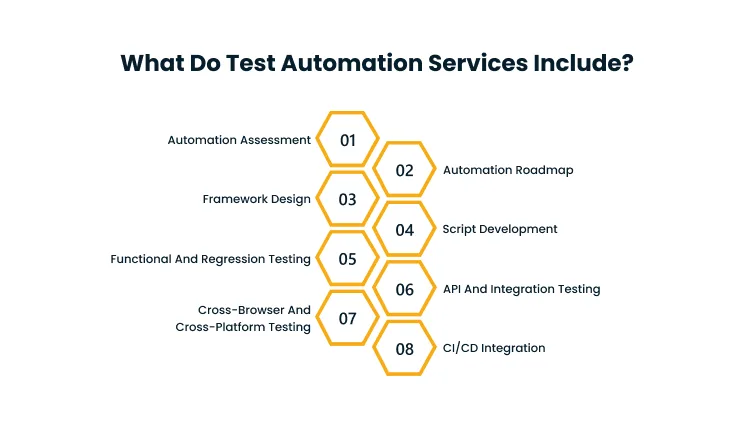
A strong engagement typically includes:
- Automation readiness assessment: A review of current QA processes, manual test cases, release bottlenecks, automation gaps, tools, environments, and testing maturity.
- Test automation roadmap: A plan that identifies what to automate first based on business risk, release frequency, defect history, test stability, and long-term value.
- Test automation framework design: A scalable framework that supports reusable components, structured test data, reporting, parallel execution, CI/CD integration, and easier maintenance.
- Automated test script development: Creation of automated scripts for regression, functional, API, integration, cross-browser, and platform-specific workflows.
- CI/CD integration: Integration of automated tests into tools such as Jenkins, Azure DevOps, GitHub Actions, GitLab, or similar pipelines so testing becomes part of the delivery workflow.
- Test reporting and dashboards: Clear visibility into execution results, pass/fail rates, defect trends, coverage, flaky tests, and release readiness.
- Test maintenance and optimisation: Ongoing updates to scripts, frameworks, test data, and reports as the application evolves across releases.
- Documentation and ownership clarity: Clear documentation on how the framework works, who owns the scripts, how reports are generated, and how internal teams can extend the suite.
The best automation testing companies leave the buyer with a maintainable foundation rather than a fragile script library. The framework, ownership model, and documentation are the long-term assets, and the scripts are the symptoms.
A vendor that prices the scripts and bundles the framework as “included” is signalling that the framework is an afterthought, which usually means it will be the first thing to break under release pressure.
How To Compare Test Automation Service Providers?
Choosing an automation testing company should not be based only on pricing or tool expertise. The right partner understands the product, recommends the right automation approach, designs a scalable framework, and shows measurable outcomes against the metrics that matter to release engineering and QA leadership.
The eight criteria below are how the shortlist gets filtered before the proof-of-concept conversation.
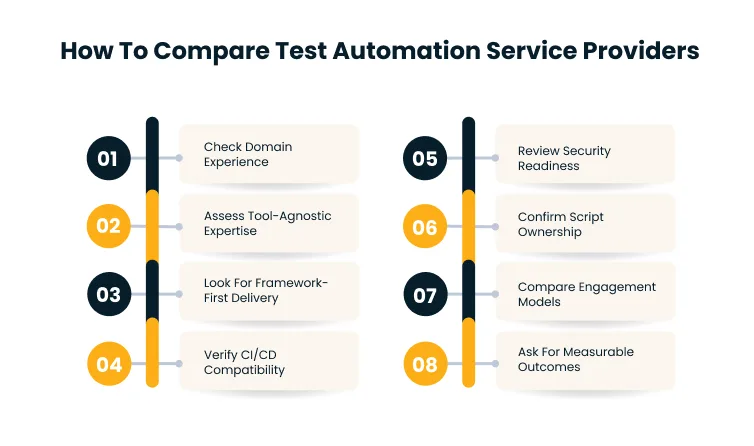
Check Relevant Domain and Application Experience
Look for vendors that have experience with applications similar to yours. A provider that understands SaaS, fintech, healthcare, retail, ERP, CRM, or enterprise software testing will be better equipped to handle the workflows, integrations, risks, and compliance constraints that matter.
Domain experience helps the vendor prioritise the right test cases and avoid a generic automation approach that fits no one cleanly. Engineering depth in your specific stack matters more than generic case study volume.
Ask the vendor to walk through a recent engagement in an industry comparable to yours, naming the application type, the integrations they automated, the regression scenarios they prioritised, and the defect categories they reduced. A vendor that can describe these specifics from memory has done the work, while one that defers to a partner deck has not.
The signal that closes the question is whether the vendor’s senior engineers can sketch a high-level test architecture for your application in the first scoping call, drawing on what they have built before for similar systems. The ability to do this on the whiteboard predicts how the engagement will run six months in.
Assess Tool-Agnostic Automation Expertise
A reliable test automation partner should not force one tool into every project. They should recommend tools based on the technology stack, application type, testing goals, team skills, and CI/CD environment.
Ask whether the vendor has experience with Selenium, Playwright, Cypress, Appium, JMeter, Postman, RestAssured, Jenkins, Azure DevOps, GitHub Actions, TestNG, and low-code or codeless automation platforms. Tool-agnostic does not mean tool-indifferent.
The vendor should hold a clear opinion on which tool fits which problem, backed by recent project experience.
Selenium remains strong for browser-heavy enterprise UI, Playwright fits modern web with cross-browser parity, Cypress suits component testing in JavaScript-heavy stacks, Appium handles native mobile, and codeless platforms like TestingWhiz help with SAP and enterprise applications where the user pool includes non-technical testers.
A vendor that recommends the same tool for every engagement, regardless of the application’s actual shape, is selling a service line rather than solving a testing problem. The shortlist filter is whether the vendor can explain the tradeoff between two tools that could work for your context, and why one fits better given your release cadence and team composition.
Look For A Framework-First Approach
A good vendor does not start by writing scripts immediately. Cygnet.One’s Test Consulting and Maturity Assessment practice, for example, benchmarks QA maturity across people, process, and technology before recommending tools or starting framework design.
A framework-first approach supports reusable components, structured test data, reporting, parallel execution, version control, and long-term maintenance, which prevents automation from becoming difficult to scale later. The framework is the part of the engagement that determines whether automation lasts beyond the original vendor team.
A well-designed framework has clear separation between test data, test logic, and assertion layers, with documented patterns for adding new tests as the application grows. A poorly designed framework has scripts that hardcode locators, embed test data inline, and produce flat pass/fail logs that no one can debug after the original author leaves.
Ask the vendor to share a redacted framework diagram from a previous engagement, with the design rationale for each layer. A vendor that cannot produce this artefact has either reused a template across every account or has been writing scripts without a framework underneath. Either pattern predicts maintenance pain within the first six months.
Verify CI/CD And DevOps Compatibility
Test automation delivers more value when it is integrated into the software delivery pipeline. The vendor should connect automated tests with CI/CD tools so teams can run tests automatically during builds, deployments, and release cycles.
A test suite that runs on a schedule outside the build pipeline catches regressions after they merge rather than before, which defeats most of the value of automating in the first place. The vendor should integrate tests at the right gates, with the right test slices, so the team gets fast feedback on pull requests, deeper validation at staging, and full regression at release.
Ask the vendor how they handle test failures inside the pipeline. The answer should cover retry logic for flaky tests, failure categorisation (real defect, environment issue, test data drift, flake), and the ownership model for fixing each category before the next build runs.
Review Security and Compliance Readiness
If the application handles sensitive data or operates in a regulated industry, security and compliance should be part of the vendor evaluation. Ask how the vendor manages test data, access controls, environment security, data masking, audit requirements, and compliance-sensitive workflows.
The 2024 IBM Cost of a Data Breach Report put the global average cost of a breach at USD 4.88 million, with cloud misconfigurations behind 15% of breaches, which sets the price of weak test-environment security in concrete terms. Test environments are a common source of data exposure because they often contain production-like data with weaker access controls than production itself.
A mature vendor uses synthetic or masked data by default, segregates test environments by client, applies the same identity and access management discipline they expect from your team, and documents the data handling chain so auditors can trace what touched which dataset.
For regulated industries such as financial services, healthcare, and government, the vendor should be able to point to specific compliance frameworks they have worked under (SOC 2, HIPAA, PCI-DSS, GDPR) and describe the evidence trail they produced for prior audits. Generic compliance language on the website is rarely the same as an engagement-level audit experience.
Confirm Ownership Of Scripts, Reports, And Documentation
Before hiring a vendor, clarify who owns the automation scripts, framework, reports, test data, and documentation. The team should not get locked into a vendor because the suite is poorly documented or difficult to transfer.
A good provider makes it easy for the internal team to understand, maintain, and extend the automation setup, and writes the handover document in a way that survives turnover on either side. Cygnet.One’s Business Assurance Testing practice anchors this through version-controlled artefacts and named ownership of every test suite, which is the operational habit that prevents lock-in.
Ownership clarity surfaces in the contract long before the engagement starts. The intellectual property clauses, the source repository structure, the documentation deliverables, and the handover protocol should all be in the SOW. Vendors that leave these clauses vague are protecting future renewal leverage, while vendors that spell them out are confident the work itself will earn the renewal.
A simple test during evaluation is to ask whether your team can fork the framework repository on day one and run a sample test independently. The vendors who say yes have built for portability, while the ones who deflect are selling a managed service in framework clothing.
Compare Flexible Engagement Models
Different teams need different levels of support. Some need a one-time automation assessment, while others need a dedicated QA automation team or ongoing managed testing support.
The evaluation logic that applies to QA outsourcing applies cleanly to test automation as well, because engagement shape drives delivery rhythm and cost predictability. Compare whether vendors offer pilot projects, fixed-scope engagements, dedicated teams, staff augmentation, or long-term managed QA automation services.
The wrong engagement model locks the contract into the wrong cadence. A dedicated team is overkill when the brief is a six-week framework rebuild, and staff augmentation runs too thin when the deliverable is a full automation strategy across web, mobile, and ERP.
The vendor should walk you through which of their engagement models has historically fit teams at your maturity level, and explain the inflexion points that suggest moving from one model to another over the lifetime of the relationship.
Pricing transparency comes next, with mature vendors sharing rate cards or pricing bands by engagement model on request. They explain what changes (and what does not) when the scope moves between models. Vendors that hide all pricing behind a custom quote are protecting margin on assumptions that do not survive the first SOW review.
Ask For Case Studies And Measurable Outcomes
Strong vendors show proof of delivery. Ask for case studies, client examples, or metrics that show how they improved release speed, reduced regression effort, increased coverage, or lowered defect leakage. Useful proof points include:
- Reduction in regression testing time
- Increase in automated test coverage
- Faster release validation
- Lower production defect counts
- Improved test stability
- Successful CI/CD integration across release cycles
The proof points that matter most are the ones tied to release cycles and defect economics, because those are the metrics finance and engineering leadership track jointly.
A vendor that can show a 40% reduction in regression time, mapped to a measurable shortening of release cadence and a reduction in production hotfix volume, has done the work the marketing page promises. Reference calls are the second filter, and they earn their place by surfacing what case study decks usually omit.
Ask the vendor for two references at a comparable scale and industry, and structure the call around three questions: what did the vendor get right, what did they get wrong, and would the reference hire them again at the same price point. Vendors that hesitate to set up reference calls are flagging that the case studies oversold the delivery.
Leading Test Automation Services Companies For Enterprise Teams
Enterprise teams often compare multiple automation testing companies before choosing a partner. The right provider depends on application type, testing maturity, technology stack, delivery model, and the need for long-term automation support.
The five vendors below are common shortlist candidates for enterprise QA automation, compared across the dimensions that matter to release engineering and QA leadership.
| Vendor | Approach | Best for | Engagement models |
Cygnet.One | Framework-first, QEXcelerate, TestingWhiz, ERP and enterprise depth | Enterprises needing scalable QA across web, mobile, API, and ERP | Pilot, dedicated team, managed automation, staff augmentation |
QualityLogic | Accessibility, performance, and functional testing across digital products | Compliance-led digital products | Project-based |
QASource | Offshore and hybrid dedicated QA automation teams | Volume-driven CI/CD environments | Dedicated team, hybrid |
TestFort | Regression automation, QA outsourcing | Mid-market needs a flexible scope | Test-automation-as-a-service |
ScienceSoft | Broad QA consulting, performance, and enterprise software testing | Long-running modernisation programmes | Project, consulting, managed |
When comparing these companies, look beyond the service list. Evaluate how each vendor approaches automation strategy, framework design, reporting, maintenance, ownership, and measurable business outcomes.
The differentiation rarely lives in the marketing page, and almost always lives in the redacted runbook and the reference call. Three patterns separate the strongest providers from the rest. The first is whether automation strategy precedes tool selection in the engagement, or follows it as a constraint set by tooling that was chosen too early.
The second is whether the vendor publishes its framework design philosophy openly enough that a buyer can evaluate it before committing to the scope. The third is whether the engagement model includes a defined maintenance arc, with named ownership and a documented handover, rather than an open-ended retainer that the buyer renews because exiting feels riskier than continuing.
Running a test maturity assessment before signing any vendor surfaces the gaps that should be priced into the engagement, instead of being discovered after kickoff. The maturity baseline also gives the buyer a way to compare vendor proposals on like-for-like terms, since proposals scoped against the same maturity gap are directly comparable in a way that capability decks never are.
Why Cygnet.One Is A Strong Partner For Test Automation Services?
Cygnet.One helps enterprises move from manual-heavy QA to scalable, reliable, continuous test automation through its Quality Engineering practice. The approach combines automation strategy, reusable frameworks, CI/CD integration, codeless automation through TestingWhiz, and ongoing optimisation, so automation becomes part of a broader QA and software delivery strategy rather than a one-time scripting project.
The engagement model is shaped around three operating principles. Strategy precedes tooling, frameworks precede scripts, and ownership precedes go-live. Each principle has an operational anchor in the delivery method, which is what makes the model repeatable across web, mobile, API, ERP, and enterprise application contexts.
Cygnet.One is a strong fit for test automation services because it helps teams:
- Define automation strategy before tool selection: The QEXcelerate framework benchmarks QA maturity across people, process, and technology, with an AI maturity overlay, before recommending tools or starting framework design.
- Design scalable test automation frameworks: The framework-first approach supports reusable components, structured test data, parallel execution, reporting, CI/CD integration, and long-term maintainability, with version-controlled test cases and real-time feedback into build workflows.
- Automate QA across web, mobile, API, and enterprise systems: Coverage extends to UI, UAT, regression, performance, load, stress, and security testing, with end-to-end validation across business workflows and integrations.
- Cover ERP and enterprise application testing: Validation extends to SAP, Oracle, Microsoft Dynamics, Salesforce, ServiceNow, and custom-built applications, including ERP module testing, role-based authorisation, middleware and API integration testing, and end-to-end transaction validation.
- Integrate CI/CD-ready automation for Agile and DevOps teams: Automated tests integrate with Jenkins, GitHub Actions, Azure DevOps, and similar pipelines so teams test earlier, reduce manual release validation, and shorten feedback loops.
- Use codeless and low-code automation through TestingWhiz and AutomationWhiz: The accelerators speed up test creation, particularly for SAP and enterprise applications, and help involve non-technical users in selected automation workflows.
- Maintain, report, and optimise continuously: Cygnet.One supports script updates, flaky-test reduction, coverage reviews, dashboards, and ongoing optimisation as the application evolves across releases.
The engagement footprint typically begins with a four-to-six-week QEXcelerate-led readiness assessment, followed by a phased framework build that runs in parallel with early script development for the highest-priority regression scenarios.
CI/CD integration lands in the third sprint, with reporting and dashboarding stabilised by the time the engagement transitions into a steady-state maintenance arc. The handover documentation is treated as a first-class deliverable from day one, which is what allows the internal team to take ownership without re-engaging the vendor every release cycle.
Conclusion
Choosing the right test automation services partner means more than finding a team that writes automated scripts. The provider should assess QA maturity, design a scalable framework, integrate with the delivery pipeline, and maintain automation over time, with clear ownership of scripts, reports, and documentation when the engagement closes.
The buyers who get this right scope by deliverable and pressure-test the framework approach, the ownership model, and the reporting cadence in the first conversation rather than at renewal. Partners that resist sharing a redacted framework, a sample report, or a handover document are signalling that the deck oversold the depth.
The decision that follows is which partner can describe the first sprint of the engagement in operational specifics and back the description with case studies at a comparable scale. Book a demo with Cygnet.One to walk through QEXcelerate-led maturity assessment, framework-first design, and TestingWhiz codeless automation in the context of your current pipeline.
FAQs
Test automation services usually start with a fixed-fee assessment or pilot, then move into dedicated team, managed automation, or staff augmentation pricing. Cost depends on platforms, framework scope, CI/CD complexity, and maintenance, with enterprise engagements typically priced by deliverable rather than hourly headcount.
Most enterprise test automation engagements deliver early value within four to six weeks through a focused pilot or readiness assessment. Full framework rollout and CI/CD integration usually run three to six months, with maintenance starting once the suite stabilises across two to three release cycles.
Test automation services pricing depends on application complexity, test coverage, platform mix, framework needs, CI/CD scope, and maintenance model. Most enterprise engagements start with a four-to-six-week assessment or pilot before scaling into a dedicated team or managed service, with scope priced over headcount.
Start with repetitive, high-value, stable tests such as regression, smoke, critical business workflows, and API checks. Volatile UI tests or rarely-run scenarios usually create flaky scripts that erode trust. The roadmap should sequence automation by business risk, release frequency, defect history, and test stability.
No, test automation cannot fully replace manual QA. Automation handles repetitive, predictable tests, while manual testing covers exploratory work, usability checks, edge cases, and workflow ergonomics. The right model uses automation to free manual QA capacity for work where human judgment adds the most value.
A test automation framework is a structured setup of tools, reusable components, coding standards, test data, reporting, and execution rules. It supports parallel execution, version control, CI/CD integration, and clear ownership so the automation suite stays maintainable as the application evolves across releases.
Author


Abhishek Nandan
AVP, Marketing
Abhishek Nandan is the AVP of Services Marketing at Cygnet.One, where he drives global marketing strategy and execution. With nearly a decade of experience across growth hacking, digital, and performance marketing, he has built high-impact teams, delivered measurable pipeline growth, and strengthened partner ecosystems. Abhishek is known for his data-driven approach, deep expertise in marketing automation, and passion for mentoring the next generation of marketers.