































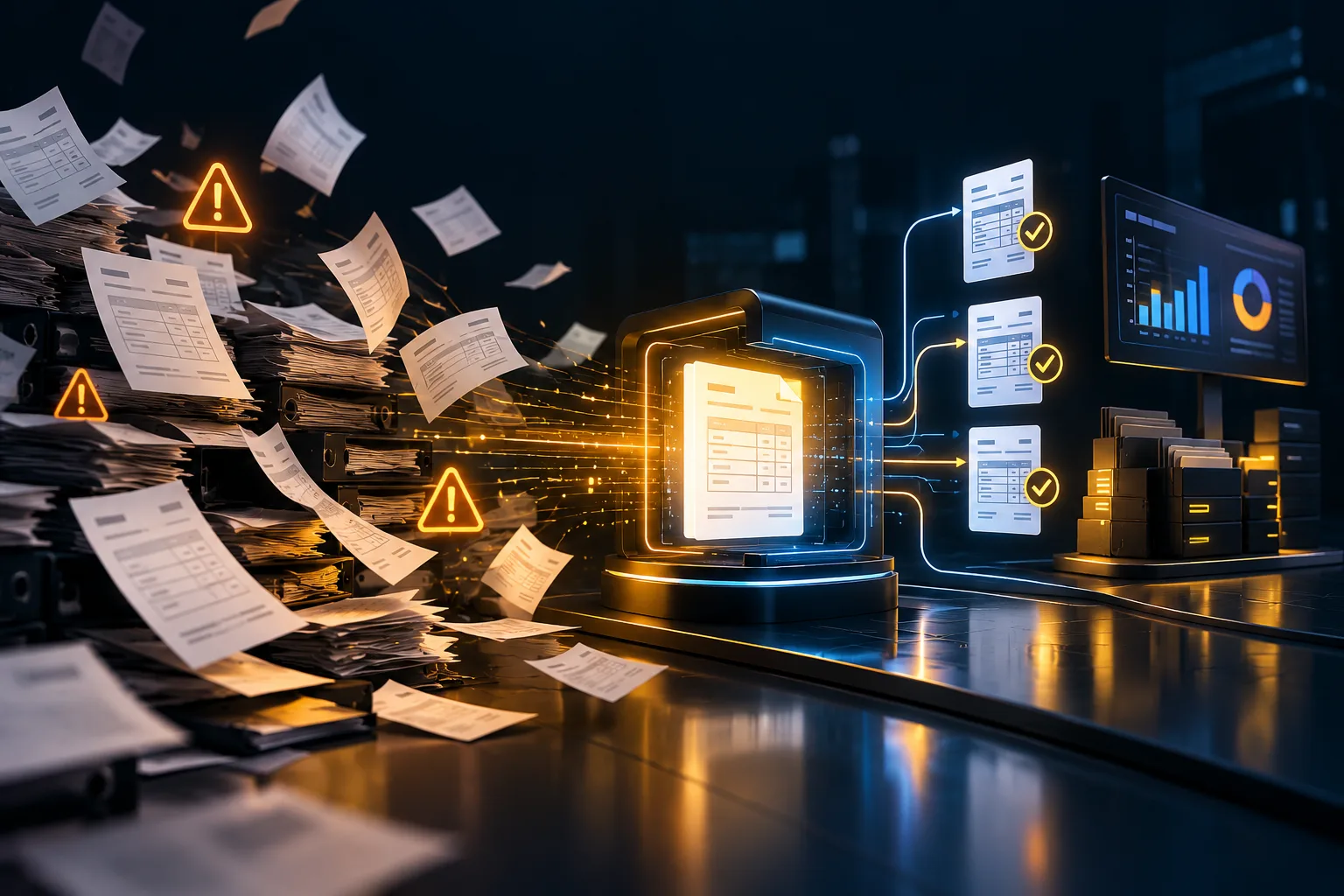
Why Invoice Management Has Become a Strategic Business Challenge
Each month, enterprise finance teams process thousands of invoices from suppliers, business units, and locations. The challenge of large organizations in India as they are looking to balance supplier diversity, multi-state GST requirements, ERP complexity, and regulatory scrutiny all at once. There are investments in ERP systems and finance transformation programs, but companies tend to depend on emails, spreadsheets, manual verification, and a variety of other workflows to process invoices.
This is leading to a growing number of invoice management issues that are translating into operational efficiency, GST compliance, and vendor relationships and financial visibility problems. The common invoice management challenges enterprises face today, the business impact those challenges bring, and how to solve them are outlined in this article.
Challenge 1: Fragmented Invoice Data Across Systems
Mixed Invoice Data Across Systems. Invoices come through multiple channels in a typical enterprise setting. Suppliers send PDFs through email. Some submit directly through ERP integrations. Some still send paper documents that need to be scanned. Each channel has its own data format, validation standard, and process. When invoice data is stored in disconnected systems, there is no single source of truth.
The downstream effects are huge. Without complete data, reporting is inaccurate. Reconciliation takes longer and creates more exceptions. GST compliance is in danger because invoice details in GSTR-1 submitted by suppliers might not be consistent with what your AP team has captured.
Decision making slows down because finance leaders are unable to get a true sense of the outstanding liabilities or payment commitments.
Challenge 2: Manual Validation and Approval Processes
For enterprise finance, manual invoice processing is often one of the costliest processing activities. If an invoice is valid, it will be checked for vendor information, if the purchase order is in place and the tax calculations are correct, if GSTINs are there, then the invoice will be sent to the right approver. It’s slow, error prone and cannot scale up when done manually. In manual environments, the most common invoice processing error is that of incorrect or missing GSTINs on supplier invoices
- False tax rate introduced, especially for multi-rate supplies.
- Duplicate invoice submissions from the same supplier.
- Missing mandatory fields like HSN codes or place of supply.
- Poor vendor bank details that delay payment processing.
Any error needs human intervention, follow-up with the supplier and reprocessing. When invoice volumes are high, even a small error rate means hundreds of exception cases a month. AP teams spend far too much time chasing corrections instead of strategically managing the process.
Challenge 3: GST Compliance and Invoice Accuracy Risks
For enterprises in India, GST invoice issues are more than operational issues. They are compliance risks. The quality of an invoice determines whether Input Tax Credit can be claimed, whether GSTR-2B entry will match, and whether a query can be defended by an audit. Some common GST invoice issues that businesses face are: Supplier fails to file GSTR-1, making ITC unavailable in GSTR-2B
- Supplier fails to file GSTR-1, making ITC unavailable in GSTR-2B.
- Invoice raised with incorrect GSTIN of recipient, which is a mismatch.
- RCM liability is not reflected correctly.
- Tax invoices raised without mandatory fields under GST law.
- Credit notes and debit notes not reflected in the correct tax period.
All these scenarios pose risks at different levels. The ITC that cannot be claimed increases the tax cost. Mismatches between GSTR-2A or GSTR-2B and purchase register need to be manually reconciled and justified for auditors. Repeated discrepancies attract scrutiny from GST authorities.
Challenge 4: Vendor Inconsistencies and Data Quality Problems
Given the size of the enterprise, supplier diversity is a strength in procurement and a challenge in finance. Different suppliers have different invoice formats, numbering conventions, different levels of compliance rigor, and different ERP/accounting tools. This results in very different invoice data for the AP teams to receive, so the AP teams are faced with very complex invoice data.
Typical vendor-driven data quality issues are:
- GSTINs cancelled or suspended but still being used in invoices.
- Duplicate invoice numbers in different periods of time.
- Not accurately specified bank account or PAN in vendor master records.
- Unclear descriptions of goods or services in invoices from the same supplier.
These problems are compounded during vendor onboarding. When the master data is not properly validated at the time of onboarding, there are errors in the supplier relationship. This impacts finance teams with invoice exceptions, payment errors, and compliance issues.
Challenge 5: Lack of Real-Time Visibility and Control
Finance leaders don’t know what they can’t see. The invoice lifecycle for most enterprises does not have end-to-end visibility. AP teams know about which invoices have been paid, but they’re less aware of invoices that are waiting for approval, stuck in exception, or approaching payment terms.
The impact is obvious at month end. Finance controllers need accurate accruals for unpaid invoices, but they may not have a reliable report of what is in-process. Tax teams do not know if all invoices have been captured for the period before the GSTR filing deadline.
Without centralized visibility, the same questions must be answered manually every time:
- How many invoices are pending approval and from which business units?
- Which invoices are on hold for more than 7 days and why?
- What is the total unprocessed liability for a given supplier or category?
- How many invoices this month had GST errors that needed to be corrected?
The Business Impact of Poor Invoice Management
The cumulative effect of these invoice management challenges extends well beyond the accounts payable function. The impact is felt across compliance, working capital, vendor management, and financial planning.
| Area | Key Consequence |
| GST Compliance | Incorrect ITC claims, audit triggers, notices from GST authorities |
| Working Capital | Blocked ITC, missed early-payment discounts, delayed payment runs |
| Operational Cost | Excess manual effort, high exception volumes, slow month-end close |
| Vendor Relations | Payment disputes, delayed settlements, supplier dissatisfaction |
| Financial Visibility | Poor cash-flow forecasting, inaccurate accruals, weak reporting |
Organizations that underestimate these risks often find them in retrospect. A GST audit that reveals years of ITC mismatches. A supplier who restricts credit terms because payments were consistently late. A CFO who cannot get a clear picture of the organization’s short-term liability position because invoice data is incomplete. These are not hypothetical outcomes.
They are common experiences for enterprises that treat invoice management as a back-office administrative function.
How Enterprises Can Solve These Invoice Management Challenges
To solve invoice management problems at enterprise scale is more than one new tool. It needs to be a mix of standardization, automation, GST-aware controls, and centralized management. The good news is that today’s platforms enable this without a multi-year transformation project.
Centralized Invoice Management
The foundation of any effective solution is one platform that is the final system of record for all invoices, regardless of how they arrive or which business unit they belong to. Centralization eliminates data silos, eliminates duplicate records, and provides finance teams with a holistic view of invoice status across the enterprise. Standardized workflows in a centralized platform mean every invoice goes through the same validation, approval, and posting process. Such consistency reduces errors, reduces processing time, and makes audits much easier to manage.
Invoice Automation
Automation takes the manual processes that usually cause bottlenecks and errors in the traditional invoice process. Automated invoice capture takes PDFs, emails, scanned documents, and supplier portals without human touch. Workflow routing sends invoices to the right approver according to the above-described rules. Exception management flags anomalies for review instead of payment. The impact of automation is very measurable.
Automated invoice capture and approval routing processes can see those who use automation reduce processing time from several days to hours. Exception rates drop because validations are done at the point of capture, not downstream.
AI-Powered Invoice Processing
Artificial intelligence adds a layer of intelligence which pure rule-based automation cannot provide. AI-powered invoice extraction can read invoices in unstructured formats, identifying line items, tax values, and vendor information even when layout and format vary across suppliers. AI also enables duplicate detection beyond invoice number matching. Pattern recognition suggests that invoices are likely duplicates even if the supplier has changed a reference number or submission date. Anomaly detection marks any invoices that are different from a supplier’s past patterns. This means that fraud or inaccurate invoices can be overlooked as well.
GST-Aware Invoice Controls
GST compliance of an Indian company should be embedded into its invoice management process and not treated as a separate reconciliation process. GST-aware invoice controls verify GSTIN status at the point of capture, check tax calculations against applicable rates, confirm that required fields are available, and flag invoices that do not meet GST requirements before they enter the approval process.
Once invoice data is GST-validated at the source, GSTR-2B reconciliation becomes a much easier process. ITC eligibility is verified early. Mismatches are identified and corrected before impacting the tax return. The compliance team does not spend more time on retrospective corrections and more time on proactive management.
ERP and GST System Integration
An invoice management system that is isolated from the organization’s ERP creates more problems than it solves. With SAP, Oracle, Microsoft Dynamics, and other enterprise ERP environments, invoice data flows in real time from the invoice management system to the financial system. Integration eliminates the need to manually enter the data into ERP, reduces the reconciliation work, and ensures that the AP ledger shows the invoice status at any point in time. For GST compliance, integration with the GST portal and filing systems means invoice data is directly accessible for return preparation without manual extraction or reformatting.
Conclusion
The biggest invoice management challenges businesses face today are not invoice volume problems. They are a combination of fragmented processes, unreliable vendor data, manual validation dependencies, GST compliance complexity, and lack of real-time visibility. All of which can be resolved. But this is going to happen through a platform-led approach, not incremental adjustments to current manual processes. Organizations that modernize invoice management through automation, AI, and centralized control can deliver tangible benefits: faster processing times, lower error rates, strong ITC positions, less audit exposure, and better working capital visibility. These are not just incremental improvements. They are a profound change in the way finance is handled. At Cygnet, we have worked with large companies across India for over 10 years on invoice automation, GST compliance, and finance process change. Our experiences in this article mirror that of processing billions of invoices and supporting finance teams in audits (compliance and ERP changes).
FAQ's
Common challenges include fragmented invoice data, manual validation, invoice processing errors, GST compliance risks, inconsistent vendor records, duplicate invoices, and limited visibility into approval and payment status.
Invoice automation captures invoice data, validates mandatory fields, checks for duplicates and routes invoices for approval. It reduces manual data entry, helps identify discrepancies earlier, and improves processing consistency.
GST invoice issues can create reconciliation mismatches, delay Input Tax Credit (ITC) claims, and increase audit risks. Incorrect GSTINs, missing mandatory fields, and discrepancies between purchase records and GSTR-2B can require additional investigation and correction.
Enterprises can validate GSTINs and other vendor details during onboarding, maintain a centralized vendor master, identify duplicate records and periodically review supplier information. Automated checks can flag inconsistencies before invoices enter the approval process.
AI can extract invoice data from different document formats, identify potential duplicates, detect unusual transaction patterns, and flag anomalies for review. Combined with automation and GST-aware validation, it helps finance teams reduce manual effort and manage invoice exceptions more efficiently.
Author


Kesha Shah
General Manager - Products Marketing
Kesha Kumar leads the global products marketing team at Cygnet.One, where she turns the complexity of tax and finance transformation into stories that resonate with the people who matter most. She’s the strategic force behind the brand’s presence across India, the GCC, Southeast Asia, and Europe, translating dense subjects like e-Invoicing mandates, digital engineering, and enterprise AI into narratives that inform and drive action. With expertise spanning tax and finance transformation, quality, enterprise applications, and data and AI, Kesha blends sharp strategic thinking with a marketer’s instinct for what truly connects. At Cygnet.One, she does more than build campaigns and content; she shapes the conversations that help enterprises navigate compliance with clarity and confidence, propelling the brand to the forefront of the industry along the way.