




































Artificial intelligence, machine learning, and generative AI dominate every enterprise technology conversation, often as if the three terms are interchangeable, but they are not.
Each describes a different layer of capability inside intelligent systems, and treating them as one category leads buyers to scope projects against the wrong technology, the wrong data requirements, and the wrong cost profile.
The confusion often shows up in budget conversations where a “generative AI” initiative is really a classical machine learning problem, in vendor evaluations where “AI” capabilities are demonstrated with no model behind them, and in roadmaps that bundle three very different deployment patterns into one timeline.
Getting the distinction right is what separates programs that compound value from programs that overspend on the wrong tool.
According to the 2025 Gartner Forecast on Worldwide GenAI Spending, worldwide generative AI spending is projected to reach $644 billion in 2025, an increase of 76.4% from 2024. That growth, concentrated heavily in hardware and infrastructure, is changing how every other AI investment gets evaluated alongside it.
In this guide, we walk through what AI, ML, and generative AI actually are, how they differ on the dimensions that matter for buyers, how they work together inside modern enterprise systems, and how businesses are adopting each one today.
AI vs ML vs GenAI: what’s the difference?
AI (Artificial Intelligence), machine learning (ML), and generative AI (GenAI) are often used interchangeably, but they represent different layers of capability within intelligent systems.
Understanding how they relate, and where they differ, is key to choosing the right approach for a given business problem.
What is artificial intelligence (AI)?
Artificial intelligence (AI) is the broad field of computer science focused on building systems that can perform tasks typically requiring human intelligence.
These tasks include reasoning, problem-solving, language understanding, perception, and decision-making.
AI is not a single technology but an umbrella term that covers multiple approaches, from rule-based systems that follow predefined logic to advanced models that learn from data.
It can be applied across industries for automation, optimization, and insights because of its wide scope. AI also includes subfields like machine learning and generative AI, each addressing different types of problems and use cases.
What is machine learning (ML)?
Machine learning (ML) is a subset of artificial intelligence that enables systems to learn from data and improve their performance over time without being explicitly programmed.
Instead of relying on fixed rules, ML models are trained on historical data to identify patterns and relationships, which they use to make predictions or decisions.
Common approaches include supervised learning, unsupervised learning, and reinforcement learning. ML is widely used in applications such as fraud detection, recommendation systems, demand forecasting, and customer segmentation, where patterns are too complex for manual rule-based systems to handle effectively.
What is generative AI (GenAI)?
Generative AI (GenAI) is a type of artificial intelligence that focuses on creating new content, such as text, images, audio, code, or video, rather than simply analyzing or predicting from existing data.
It uses advanced machine learning models, often based on deep learning and transformer architectures, trained on large datasets to generate outputs that resemble human-created content.
Unlike traditional AI systems that classify or detect patterns, generative AI produces original responses, making it useful for applications like chatbots, content creation, design, and coding assistance.
This capability enables businesses to automate creative and communication-heavy tasks at scale.
AI vs ML vs GenAI: key differences explained
The fastest way to understand the difference is to map each to a problem type. The type of system you choose determines what data pipelines you build, what infrastructure you need, and how the output integrates into workflows.
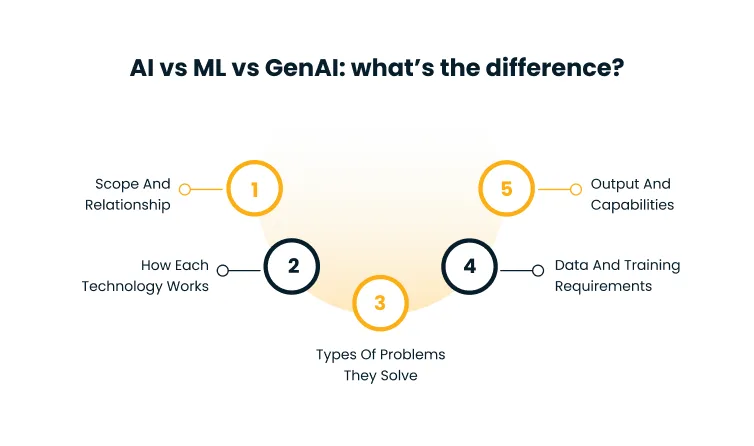
1. Scope and relationship
Machine learning is a subset of AI focused specifically on systems that learn from data. Generative AI is a further subset within AI that builds on machine learning, particularly deep learning, to produce new content.
Every GenAI system is a machine learning system, and every machine learning system is an AI system, but the reverse does not hold.
The reason these terms get confused is partly historical and partly commercial. The rapid rise of generative AI in 2023 and 2024 led many vendors to relabel existing ML or rule-based products as “AI” without changing the underlying technology.
According to the 2025 McKinsey State of AI Report, 72% of organizations have now adopted generative AI in at least one business function, more than double the share a year earlier, which has further compressed the public conversation around the three terms.
For buyers, the practical takeaway is that asking “is this AI, ML, or GenAI?” is the right opening question in any vendor conversation. The answer determines what data you need, what infrastructure you need, what governance applies, and what the true cost of running it at scale will look like over multiple years.
2. How each technology works
AI as a category includes multiple working principles:
- Rule-based AI executes predefined logic.
- Search-based AI explores possible actions and scores them.
- Symbolic AI manipulates structured knowledge representations.
Modern AI is dominated by learning-based approaches, but the older techniques still power significant production systems where predictability and explainability matter more than adaptive performance.
Machine learning works by training a model on a dataset where the model adjusts its internal parameters to minimize prediction error. The trained model is then applied to new data at inference time.
Supervised models learn from labeled examples, unsupervised models find structure without labels, and reinforcement models learn from feedback signals over sequences of actions.
The output of training is a set of weights that captures the patterns the model has learned, which can be deployed independently of the training infrastructure.
Generative AI builds on deep learning, specifically architectures like transformers for language and diffusion models for images.
These systems are pretrained on massive general-purpose corpora to develop broad pattern recognition, then often fine-tuned on domain-specific data for enterprise use cases.
At inference time, the model generates output by predicting the next most likely token, pixel, or frame given the input prompt and prior generated content. The probabilistic nature of generation is why the same prompt can produce different outputs across runs.
3. Types of problems they solve
AI broadly addresses problems that require some form of intelligent behavior, including automation, decision support, planning, and adaptive control. The category is wide enough that the right answer depends entirely on which specific AI technique fits the problem.
Machine learning is the right tool when the problem involves prediction, classification, anomaly detection, or pattern discovery on data that already exists.
Predicting which customers will churn, classifying transactions as fraudulent or legitimate, detecting equipment failures before they happen, and surfacing relevant products in a recommendation feed are all classical ML problems.
The signal that ML is appropriate is when there is enough labeled or structured historical data to train a model, and the operational decision can be expressed as a prediction.
Generative AI is the right tool when the problem involves producing new content rather than classifying or predicting.
Drafting customer emails, summarizing long documents, generating marketing copy variants, writing code, translating between languages, and answering open-ended questions in natural language are GenAI problems.
The signal that GenAI is appropriate is when the output is novel content rather than a label or score, and when the input and output are language, image, or other rich media rather than structured tabular data.
4. Data and training requirements
AI systems vary enormously in their data needs depending on the technique. A rule-based AI system that routes IT tickets requires no training data at all, only a well-designed rule set.
A constraint-solving AI for scheduling requires the constraints and the objective function, but not historical examples.
Machine learning depends entirely on data. The volume, quality, and labeling of training data are usually the largest single determinants of model performance. Most enterprise ML use cases need at least thousands of labeled examples, and many need hundreds of thousands.
Data quality matters more than data volume, two years of clean, consistently-labeled records typically outperform five years of fragmented data. The data engineering work to prepare a dataset for training often consumes more of an ML project’s timeline than the modeling itself.
Generative AI sits at the extreme end of the data spectrum. Training a foundation model from scratch requires trillions of tokens of text or billions of images, plus thousands of GPUs running for weeks or months.
Most enterprises do not train foundation models. They consume them through APIs or fine-tune them on domain-specific data, which requires far less data and compute, typically a few thousand to a few hundred thousand examples for fine-tuning, depending on the technique.
The cost profile of inference at scale, particularly for high-throughput use cases, is also fundamentally different from classical ML.
5. Output and capabilities
AI outputs depend on the technique. Rule-based AI outputs decisions or routes. Optimization AI outputs schedules, allocations, or paths. Search AI outputs sequences of actions. The output is shaped by the problem the system was designed to solve.
Machine learning outputs predictions, classifications, scores, or rankings. A churn model outputs the probability that a customer will leave. A fraud model outputs a risk score per transaction. A recommendation model outputs a ranked list of items.
ML output is typically a number or a label that downstream systems consume to make a decision, which is why ML use cases scale best when the output flows automatically into an operational workflow rather than into a dashboard somebody has to read.
Generative AI outputs novel content. A language model produces text, an image model produces an image, and a code model produces code. The output is open-ended rather than constrained to a fixed set of categories or numerical ranges, which is what makes GenAI useful for creative and generative tasks but also what makes evaluation harder.
Measuring whether a churn prediction was accurate is straightforward. Measuring whether a generated email was good requires criteria like factual correctness, tone, structure, and policy compliance, often evaluated by separate models or human reviewers.
How AI, ML, and GenAI work together
Modern enterprise systems rarely use AI, ML, or GenAI in isolation, instead they layer all three.
- AI provides the overall architecture and decision logic.
- Machine learning provides predictive and classification capabilities.
- Generative AI provides the content production and natural language interface.
The combination is where the most interesting business value is now being captured, and understanding the layering pattern is what separates a coherent AI program from a collection of disconnected initiatives.
A modern customer service system illustrates the pattern clearly. An AI orchestration layer routes inbound queries based on rules, priorities, and SLAs. A machine learning model classifies each query by topic and predicts the likelihood of escalation, which determines whether the case goes to a self-service flow, a chatbot, or a human agent.
A generative AI assistant drafts response content drawing on the customer’s history, prior support transcripts, and the company’s knowledge base. The agent reviews the draft, edits if needed, and sends. Each layer does what it does best, and the system as a whole is more capable than any single layer would be alone.
The same pattern shows up across functions. In marketing, ML segments customers and predicts conversion likelihood, GenAI produces personalized content variants, and AI orchestration decides which variant goes to which segment.
In finance, ML detects anomalies, GenAI summarizes the suspicious activity for human reviewers, and AI workflow tools route the case for resolution.
Cygnet.One’s Data Analytics & AI practice approaches enterprise AI with this layered model in mind, combining data engineering, predictive modeling, business intelligence, and embedded AI so the technologies reinforce rather than compete with one another inside the same workflow.
How businesses are adopting AI, ML, and GenAI
Adoption patterns differ across the three technologies because the maturity, cost, and risk profiles differ.
Machine learning has the longest enterprise track record, generative AI is the fastest-growing investment area, and broader AI sits underneath both as the orchestration and decisioning layer.
Looking at where each technology is being deployed clarifies what buyers are actually buying when they fund an AI initiative.
Machine learning is the most established of the three inside enterprise environments. Banks have run fraud detection models for years, retailers have used recommendation systems across digital channels, manufacturers have deployed predictive maintenance, and marketers have used churn and propensity models to drive retention campaigns.
The infrastructure, talent, and governance patterns are mature, which is why ML use cases tend to scale faster than GenAI use cases when both are launched at the same time.
Generative AI is where the biggest adoption acceleration is happening right now. The use cases concentrate in marketing and sales (content generation, personalization, copy variants), software engineering (code generation, code review), customer service (response drafting, summarization), and knowledge work (document drafting, research synthesis).
According to the 2024 IBM Global AI Adoption Index, 42% of large organizations have actively deployed AI in some form, while another 40% are exploring without yet deploying.
According to the 2025 BCG report on the AI value gap, only 4% of companies are creating substantial value from AI, while the majority remain stuck between proof-of-concept and production. The adoption curve is rising fast, the value curve is rising more slowly, and closing the gap is now the central question for enterprise AI programs.
For enterprises building across all three technologies, the practical pattern is to combine them deliberately.
Cygnet.One’s Business Analytics and Embedded AI practice deploys ML model outputs directly into ERP, CRM, and core enterprise platforms so predictions become native to operational workflows, while Cygnet.One’s AWS Generative AI capability covers production deployment of foundation models through Amazon Bedrock, custom fine-tuning through SageMaker, and agentic workflows that connect generative output back into the enterprise systems where the work actually happens.
Conclusion
AI, ML, and generative AI are different layers of a single capability stack, and the enterprises getting the most from their AI investments are the ones who recognize the distinction and design their programs around it rather than treating “AI” as a single procurement decision.
The next phase of enterprise AI will be defined less by which technology a company adopts and more by how thoughtfully it combines them.
Machine learning will keep delivering the predictive backbone. Generative AI will keep expanding the content and interaction layer. Broader AI orchestration will keep tying them into operational systems that change what actually happens in the business.
The buyers who understand the differences pick the right tool for each problem and the integration pattern that makes the combination compound.
If we are mapping where AI, ML, and generative AI each fit inside your enterprise stack, the conversation we usually start with is your data foundation, your priority use cases, and the integration pattern that lets each layer reinforce the others.
Book a demo with our team to walk through how we sequence AI, ML, and GenAI deployments for measurable enterprise outcomes.
FAQs
AI is the broad field of building systems that perform tasks requiring human-like intelligence. Machine learning is a subset of AI focused on systems that learn from data rather than from explicit rules. Generative AI is a further subset built on deep learning that produces new content such as text, images, or code. Every GenAI system is an ML system, and every ML system is an AI system, but the reverse does not hold.
Yes. Generative AI uses machine learning techniques, particularly deep learning architectures like transformers and diffusion models. The distinction is that GenAI focuses specifically on producing new content, while machine learning more broadly covers prediction, classification, anomaly detection, and pattern discovery. GenAI is the most data-and-compute-intensive corner of the ML field.
None is inherently better. They solve different problems. Machine learning is the right tool for prediction and classification on structured data. Generative AI is the right tool for content creation, summarization, and natural language interaction. Broader AI techniques cover orchestration, optimization, and rule-based decisioning. The question worth asking is which technique fits the specific problem, not which technology is superior overall.
Most modern enterprise AI systems combine all three. A typical layered architecture uses AI orchestration to route work, machine learning models to predict and classify, and generative AI to produce content or natural language responses. Customer service, marketing, fraud and risk, and software development are all functions where the layered pattern is now standard.
Common enterprise GenAI use cases include conversational AI assistants for customer support, AI code copilots for software development, automated content generation for marketing, document summarization for knowledge work, meeting transcription and recap, and image generation for design and merchandising. The pattern across these is that the output is novel content rather than a prediction or classification.
Author


Abhishek Nandan
AVP, Marketing
Abhishek Nandan is the AVP of Services Marketing at Cygnet.One, where he drives global marketing strategy and execution. With nearly a decade of experience across growth hacking, digital, and performance marketing, he has built high-impact teams, delivered measurable pipeline growth, and strengthened partner ecosystems. Abhishek is known for his data-driven approach, deep expertise in marketing automation, and passion for mentoring the next generation of marketers.