































• Cygnet IRP
  • Glib.ai
  • IFSCA
Cygnet.One
  • About
  • Products
  • Solutions
  • Services
  • Partners
  • Resources
Generic selectors
Exact matches only
Search in title
Search in content
Post Type Selectors
Get Started
About
  • Overview

    A promise of limitless possibilities

  • We are Cygnet

    Together, we cultivate an environment of collaboration

  • Careers

    Join Our Dynamic Team: Careers at Cygnet

  • CSR

    Impacting Communities, Enriching Lives

  • In the News

    Catch up on the latest news and updates from Cygnet

  • Contact Us

    Connect with our teams across the globe

What’s new

chatgpt

Our Journey to CMMI Level 5 Appraisal for Development and Service Model

Full Story

chatgpt

ChatGPT: Raising the Standards of Conversational AI in Finance and Healthcare Space

Full Story

Products
  • Cygnet Tax
    • Cygnet Tax
    • e-Invoicing / Real time reportingIRP-integrated e-Invoicing with real-time validation
    • e-Way Bills / Road permitsGST-compliant centralized e-Way Bill platform for scalable operations
    • Direct Tax ComplianceAccurate direct tax compliance, filings, litigation, and assessments
    • Indirect Tax ComplianceEnterprise-grade platform for indirect tax compliance
      • Indirect Tax Compliance
      • GST Compliance India
      • VAT Compliance EU
      • VAT Compliance ME
    • Managed ServicesEnd-to-end indirect tax compliance support by experts
  • Global e-Invoicing
    • Global e-Invoicing
    • APAC
      • India
      • Malaysia
      • Singapore
      • Japan
    • Africa
      • Egypt
      • Kenya
      • Zambia
      • Nigeria
    • Europe
      • Spain
      • France
      • Germany
      • Poland
      • Belgium
    • Oceania
      • Australia
      • New Zealand
    • Middle East
      • UAE
      • Oman
      • Saudi Arabia
      • Bahrain
      • Qatar
      • Jordan
  • Cygnet Vendor Postbox
    • Cygnet Vendor PostboxDigitize purchase invoice validation & posting to ERPs & maximize ITC
  • Finance Transformation
    • Finance Transformation
    • Cygnet FinalyzeUnlock working capital with data-driven invoice-based credit decisions
    • Bank Statement AnalysisEvaluate company health by analyzing performance and financial risk
    • Financial Statement AnalysisAssess company performance and risk with financial statement analysis
    • GST Business Intelligence Report360-degree financial health insights using GST data analytics
    • GST Return Compliance ScoreGST-based compliance score to assess business risk and credibility
    • ITR AnalysisAssess creditworthiness and lending risk using ITR filing analysis
    • Invoice Verification for Trade FinanceVerify invoices to reduce fraud and improve credit decisions
    • Account Aggregator – Technology Service Provider (AA-TSP)Onboard to the Account Aggregator ecosystem with FIP & FIU modules
  • Cygnet BridgeFlow
    • Cygnet BridgeFlowAutomated digital onboarding with real-time validations and compliance
  • Cygnet Bills
    • Cygnet BillsGST-compliant centralized e-Way Bill platform for scalable operations
  • Cygnet IRP
    • Cygnet IRPIRP-integrated e-Invoicing with real-time validation
  • Cygnature
    • CygnatureSecure, compliant digital signing with audit-ready traceability

What’s new

e-Invoicing compliance Timeline

Know More →

UAE e-Invoicing: The Complete Guide to Compliance and Future Readiness

Read More →

Types of Vendor Verification and When to Use Them

Read More →

Safeguard Your Business with Vendor Validation before Onboarding

Read More →

Modernizing Dealer/Distributor & Customer Onboarding with BridgeFlow

Read More →

Accelerate Vendor Onboarding with BridgeFlow

Read More →

GST Filing 360°: GST, E-Invoicing, E-Way Bills & Annual Returns Made Simple

Read More →

Why Manual Tax Determination Fails for High-Volume, Multi-Country Transactions

Read More →

GST Filing 360°: GST, E-Invoicing, E-Way Bills & Annual Returns Made Simple

Read More →

Key Features of an Invoice Management System Every Business Should Know

Read More →

Automating the Shipping Bill & Bill of Entry Invoice Operations for a Leading Construction Company

Read More →

From Manual to Massive: How Enterprises Are Automating Invoice Signing at Scale

Know More →

Solutions
  • HireAI
  • Agent as a Service
  • AI-powered Voice Assistant
  • Generative AI Workshop
  • TestingWhiz
  • VIPRE

What’s new

AI powered Interviewer

AI-Powered Interviewing Helped an Education Group Reduce Hiring Time Significantly

Know More

Generative AI ebook

Navigating the Generative AI Landscape

Download eBook

Services
  • Data Analytics & AI
    • Data Analytics & AI
    • Data Engineering and ManagementData engineering and management for smart, scalable systems
    • Data Migration and ModernizationData migration and modernization for future-ready platforms
    • Insights Driven Business TransformationInsight-driven business transformation for faster decisions
    • Business Analytics and Embedded AIBusiness analytics and embedded AI for data-led growth
  • Digital Engineering
    • Digital Engineering
    • Technical Due DiligenceEnabling smarter decisions through future-ready digital ecosystems
    • Product EngineeringEngineering impactful digital products that elevate business growth
    • HyperautomationSmarter hyperautomation using low-code for agile business processes
    • Enterprise IntegrationIntegrating enterprise systems for seamless operations and growth
    • Application ModernizationModernizing IT ecosystems with scalable, AI-driven innovation
  • Quality Engineering
    • Quality Engineering
    • Test Consulting & Maturity AssessmentTest consulting and maturity assessments for reliable software QA
    • Business Assurance TestingBusiness assurance testing aligned with real business outcomes
    • Enterprise Application & Software TestingEnterprise application testing for continuity and scale
    • Data Transformation TestingData transformation testing for scalable, trusted data quality
  • Cloud Engineering
    • Cloud Engineering
    • Cloud Strategy and DesignCloud strategy and design services for secure, scalable growth
    • Cloud Migration & ModernizationORBIT: a proven framework for measurable cloud transformation
    • Cloud Native DevelopmentCloud-native development for resilient, scalable innovation
    • Cloud Operations and OptimizationCloud optimization and operations for enterprise resilience
    • Cloud for AI FirstAI-first cloud transformation for smarter, scalable enterprises
  • Managed IT Services
    • Managed IT Services
    • IT Strategy and ConsultingStrategic IT consulting to align technology with business goals
    • Application Managed Services24/7 managed application services for performance and security
    • Infrastructure Managed ServicesEnd-to-end infrastructure management for resilient IT operations
    • CybersecurityComprehensive cybersecurity solutions to protect business assets
    • Governance, Risk Management & ComplianceGRC solutions to manage risk, compliance, and governance
  • Cygnet TaxAssurance
    • Cygnet TaxAssurance
    • Tax DatalakeUnified tax data lake for intelligent, compliant decision-making
    • Tax InfraDigital tax infrastructure for efficient, compliant transformation
  • Amazon Web Services
    • Amazon Web Services
    • Migration and ModernizationMake Your Move to the Cloud With AWS Smarter & Faster
    • Generative AIRun your Gen AI workloads on AWS with full control

What’s new

AI-Powered Voice Assistant for Smarter Search Experiences

Explore More →

Cygnet.One’s GenAI Ideation Workshop

Know More →

Our Journey to CMMI Level 5 Appraisal for Development and Service Model

Read More →

Extend your team with vetted talent for cloud, data, and product work

Explore More →

Enterprise Application Testing Services: What to Expect

Read More →

Future-Proof Your Enterprise with AI-First Quality Engineering

Read More →

Cloud Modernization Enabled HDFC to Cut Storage Costs & Recovery Time

Know More →

Cloud-Native Scalability & Release Agility for a Leading AMC

Know More →

AWS workload optimization & cost management for sustainable growth

Know More →

Cloud Cost Optimization Strategies for 2026: Best Practices to Follow

Read More →

Cygnet.One’s GenAI Ideation Workshop

Explore More →

Practical Approaches to Migration with AWS: A Cygnet.One Guide

Know More →

Tax Governance Frameworks for Enterprises

Read More →

Cygnet Launches TaxAssurance: A Step Towards Certainty in Tax Management

Read More →

Partners
  • Cygnet Elevate Global Partner Program
  • Products Partner Program

Partner Program

Cygnet Elevate Global Partner Program

Cygnet Elevate Global Partner Program

Strategic Services Partner Program

A partner program built for services businesses to collaborate, expand offerings, and drive shared growth with Cygnet. Tap into shared expertise, go-to-market support, and long-term value creation.

Know more→

Products Partner Program

Products Partner Program

Co-create value through our global SaaS products.

Partner with Cygnet.One, a global leader in AI-powered compliance, tax, e-Invoicing, and automation solutions. Deliver seamless digital experiences, enable client success, and scale across markets with a future-ready platform.

Know more→

Resources
  • Blogs
  • Case Studies
  • eBooks
  • Events
  • Webinars

Blogs

A Step-by-Step Guide to E-Invoicing Implementation in the UAE

A Step-by-Step Guide to E-Invoicing Implementation in the UAE

View All

Case Studies

Cloud-Based CRM Modernization Helped a UK Based Organization Scale Faster and Reduce Deployment Complexity

Cloud-Based CRM Modernization Helped a UK Based Organization Scale Faster and Reduce Deployment Complexity

View All

eBooks

Build Smart Workflow with Intelligent Automation and Analytics

Build Smart Workflow with Intelligent Automation and Analytics

View All

Events

AWS Summit Mumbai

AWS Summit Mumbai

View All

Webinars

Agents as a Service: Redesigning Operating Models for the AI Era

Agents as a Service: Redesigning Operating Models for the AI Era

View All
Cygnet IRP
Glib.ai
IFSCA

Designing Event-Driven Architectures to Replace Legacy Batch Processing 

  • By Yogita Jain
  • January 19, 2026
  • 7 minutes read
Share
Subscribe

The day your nightly batch misses its window is the day everyone suddenly cares where the data really comes from. 

Legacy batch jobs still run a huge part of enterprise operations. They also hide risk. A batch can look “healthy” right up until the moment it becomes the bottleneck for orders, fraud checks, inventory, pricing, or customer notifications.  

If you are trying to move faster with cloud-native application development, batch can quietly block you. 

This blog breaks down what changes when you move from legacy batch processing to event-driven flows. It keeps the focus practical. You will see how an event-driven architecture AWS approach works, which AWS services fit where, and how to migrate without a big-bang rewrite. 

Problems with batch systems people stop noticing (until it hurts) 

Batch pipelines were built for a world where delays were acceptable and compute was expensive. Many teams still accept batch pain as “normal”: 
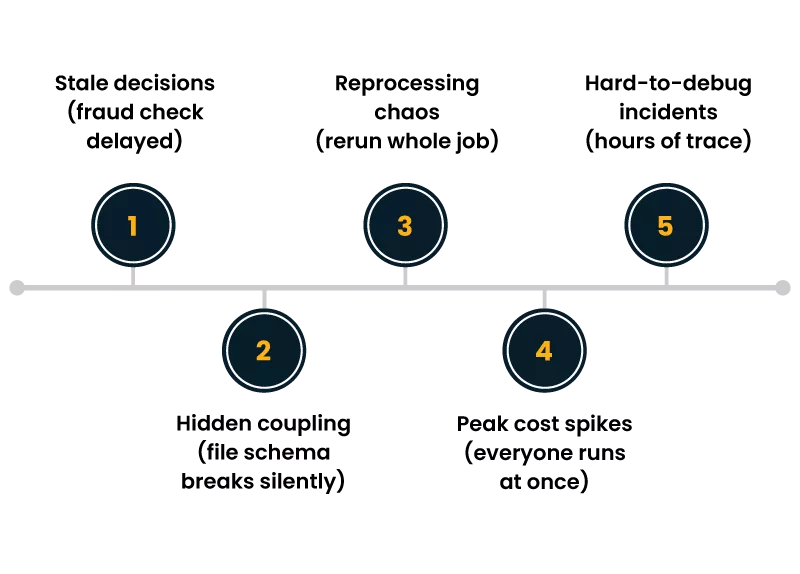
Batch Problems People Ignore
  • Stale decisions- A fraud rule runs at 2 AM. A suspicious transaction happens at 2:05 AM. 
  • Hidden coupling- One job writes a file. Another job assumes a column order. A third job breaks silently. 
  • Reprocessing chaos- A partial failure often means rerunning the whole job, not just the affected records. 
  • Peak-time cost spikes- Everyone schedules work for the same window. You pay for the rush. 
  • Hard-to-debug incidents- When data is wrong, you have to trace through hours of steps and logs. 

In legacy batch processing, a “unit of work” is usually a file, a partition, or a table snapshot. That choice shapes everything: scheduling, retries, monitoring, and even how teams communicate. It also makes true real-time systems hard, because the pipeline is designed around time windows, not business moments. 

Here is the usual picture: 

Users/Apps -> DB updates all day 
                | 
                v 
         Nightly batch (ETL) 
                | 
                v 
     Reports / downstream systems 
 

The core issue is not that batch is “bad.” It is that batch assumes the world can wait. 

Event-driven fundamentals that matter in the real world 

An event is a record that something meaningful happened. “OrderPlaced.” “PaymentAuthorized.” “ItemBackInStock.” It is not “daily_orders.csv.” 

An event-driven architecture AWS setup is built around publishing these events as they occur, then letting multiple consumers react independently. 

What changes conceptually: 

  1. Time is no longer the trigger 
    The trigger is the business action itself. 
  1. You design for partial failure from day one 
    Consumers fail. Retries happen. Duplicate delivery can occur. That is normal. 
  1. You stop thinking in pipelines and start thinking in products of data 
    Events are durable facts that many teams can use. 
  1. You get closer to true operational behavior 
    This is why teams chasing real-time systems adopt events. It is a better fit for businesses to operate. 

The three rules to keep you out of trouble 

  • Make events domain-first- Name them after business outcomes, not technical steps. 
  • Assume duplicates- Consumers must be idempotent. Store a processed event key where needed. 
  • Version carefully- Add fields, do not break fields. Use schema registry patterns when possible. 

A good event-driven architecture AWS design also makes one thing explicit: you are trading “one big batch failure” for “many small, visible processing outcomes.” That is usually a win. 

AWS services that fit event-driven patterns 

There is no single “best” stack. Pick based on latency needs, throughput, ordering requirements, and how many consumers you expect. 

AWS EventBridge as the event router 

AWS EventBridge is a strong default for event distribution across services and accounts. It gives you rules-based routing, filtering, and multiple targets without writing custom fan-out code. It shines when you have many consumers, and each consumer wants only a subset of events. 

Common use cases for AWS EventBridge: 

  • Route “OrderPlaced” to billing, fulfillment, and notifications. 
  • Send events to Step Functions for orchestration. 
  • Forward partner or SaaS events into your environment. 
  • Build cross-account event sharing with clear boundaries. 

In an event-driven architecture AWS approach, AWS EventBridge often becomes the “switchboard” that keeps teams from hardwiring service-to-service calls. 

Other core building blocks (and when to use them) 

  • Amazon SQS- Great for decoupling and buffering work. Use it when you need simple queue semantics. 
  • Amazon SNS- Simple pub/sub, often paired with SQS for fan-out. 
  • Amazon Kinesis- Use when you need stream processing and very high throughput with ordered shards. 
  • AWS Lambda- Fast to connect events to logic. Good for many reaction-style workloads. 
  • AWS Step Functions- Use when you need orchestration with clear state, retries, and branching. 

A practical rule: start with AWS EventBridge for routing and filtering, then choose SQS, Lambda, or Step Functions per consumer based on work type. 

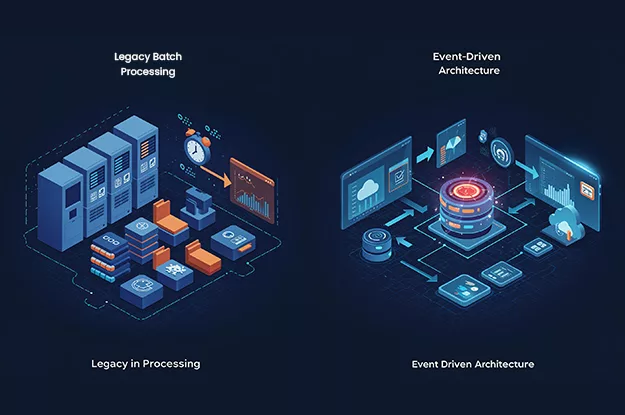
A clear comparison: batch vs events 

Here is a more accurate picture of what teams aim for when they want real-time systems: 

Batch model: 
System A -> write DB -> (wait) -> batch job -> System B 
 
Event model: 
System A -> publish event -> router -> Consumer B 
                           -> router -> Consumer C 
                           -> router -> Consumer D 
 

Notice the second model is not just “faster.” It is also less coupled. Consumers can be added, removed, or changed without modifying the producer, especially when AWS EventBridge rules handle routing. 

This is the main reason an event-driven architecture AWS model becomes a long-term foundation, not just a performance tweak. 

Migration patterns that work when you cannot stop the business 

Most teams cannot replace legacy batch processing overnight. The migration is usually a staged refactor, with coexistence for a period. Here are patterns that hold up in production. 

1) Strangler pattern for batch jobs 

Keep the batch running but start moving individual outcomes to event-driven consumers. 

  • Identify one batch of output that causes pain (late inventory, late fraud flags). 
  • Publish events for that domain as they happen. 
  • Build a consumer that produces the same output as the batch, but sooner. 
  • Compare results for a while. 
  • Turn off that section of the batch when confidence is high. 

This pattern reduces risk and makes progress visible. 

2) Change Data Capture as a bridge 

If the system cannot emit events yet, capture changes from the database and publish derived events. This is a common bridge away from legacy batch processing. The key is to map low-level DB changes into business events, not to expose raw table updates forever. 

3) Dual write, but only with guardrails 

Sometimes the application can publish an event and also write to the database. Dual write can work, but it needs discipline: 

  • Persist the event reliably (outbox pattern is common). 
  • Ensure consumers can handle duplicates. 
  • Monitor drift between the event stream and stored state. 

This is where an event-driven architecture AWS setup benefits from managed routing and retry behavior around AWS EventBridge targets. 

4) Event-carried state transfer for specific use cases 

For some flows, consumers need enough context to act without calling the producer. That reduces runtime dependencies. It can help when building real-time systems where latency and failure of isolation matter. 

Do not overdo it. Keep events “thin” unless the use case truly needs more context. 

A migration playbook you can run in weeks, not quarters 

Use this sequence to avoid false starts: 

  1. Pick one business moment 
    Example: “PaymentAuthorized.” 
  1. Define the event contract 
    Fields, identifiers, timestamps, and a version marker. 
  1. Publish to an event bus 
    Use AWS EventBridge as the backbone for routing. 
  1. Build one consumer with clear value 
    Example: notify fulfillment, update a dashboard, or create a ticket. 
  1. Add observability early 
    Track lag, failures, retries, and end-to-end time. 
  1. Decompose the batch job 
    Remove only the parts you replaced. Keep the rest until the next event is ready. 

Repeat. This is how legacy batch processing gets retired without drama. 

Business benefits that show up beyond “faster” 

Speed matters, but it is not the only win. Teams that adopt an event-driven architecture AWS model usually report benefits in four areas: 

  • Operational clarity- You see what happened, when it happened, and what reacted to it. 
  • Better customer moments- Alerts, status updates, and decisions arrive while they still matter. This is the heart of real-time systems. 
  • Safer change- Add a new consumer without rewriting the producer. AWS EventBridge routing rules help keep changes isolated. 
  • Lower incident blast radius: A failing consumer does not need to take down the whole workflow. 

Even when you keep some batch jobs, events often become the “front edge” that delivers the newest data quickly, while batch continues for deep backfills and reconciliation. 

Common design mistakes and how to avoid them 

  • Using events as remote procedure calls 
    If your consumer requires the producer to be up for every step, you did not really decouple. 
  • Publishing technical events 
    “RowInserted” is not a business event. It leads to brittle consumers. 
  • Ignoring idempotency 
    Duplicate delivery happens. Plan for it. 
  • No clear ownership 
    Each event type needs an owner, a contract, and a change process. 

An event-driven architecture AWS build is not “set and forget.” Treat your event bus like a product. Manage it with standards. 

A simple reference design you can copy 

[Producers] 
  Checkout Service 
  Payments Service 
  Inventory Service 
        | 
        v 
   Event Bus (AWS EventBridge) 
        | 
        +–> SQS -> Lambda (notifications) 
        | 
        +–> Step Functions (order orchestration) 
        | 
        +–> Kinesis (analytics stream) 
        | 
        +–> S3 (audit archive) 
 

This is a practical starting point. AWS EventBridge keeps routing flexible. Consumers can be swapped as needs change, and you can still support real-time systems where they matter most. 

Wrap-up 

Batch is not the enemy. But legacy batch processing becomes expensive when the business needs timely decisions, fast customer updates, and clean system boundaries. Events meet that need because they map directly to business moments. 

If you want a reliable path forward, start with one event, route it through AWS EventBridge, build one consumer with measurable value, and retire only the exact portion of the batch you replaced. Repeat until the batch window stops being a daily risk. 

That is how an event-driven architecture AWS approach earns trust inside the org, not through hype, but through steady outcomes. 

Author

Yogita Jain Linkedin
Yogita Jain
Content Lead

Yogita Jain leads with storytelling and Insightful content that connects with the audiences. She’s the voice behind the brand’s digital presence, translating complex tech like cloud modernization and enterprise AI into narratives that spark interest and drive action. With a diverse of experience across IT and digital transformation, Yogita blends strategic thinking with editorial craft, shaping content that’s sharp, relevant, and grounded in real business outcomes. At Cygnet, she’s not just building content pipelines; she’s building conversations that matter to clients, partners, and decision-makers alike.

Related Blog Posts

Operationalizing AI at Scale: Bridging Bedrock Experiments to Production

CalendarFebruary 05, 2026

Using Agents as a Service on AWS to Simplify Complex Business Operations

CalendarSeptember 02, 2025

Modernizing Legacy Integrations Using EventBridge and Step Functions 

CalendarApril 15, 2026

Sign up to our Newsletter

    Latest Blog Posts

    Data Siloes Problems: Your Complete Guide for 2026
    Data Siloes Problems: Your Complete Guide for 2026

    CalendarApril 24, 2026

    UAE E-Invoicing for Oil & Gas: Key Changes & Timeline
    UAE E-Invoicing for Oil & Gas: Key Changes & Timeline

    CalendarApril 24, 2026

    How to Build a Scalable Data Pipeline Architecture
    How to Build a Scalable Data Pipeline Architecture

    CalendarApril 24, 2026

    Let’s level up your Business Together!

    The more you engage, the better you will realize our role in the digital transformation journey of your business


      I agree to the Terms & Conditions and Privacy Policy and allow Cygnet.One (and its group entities) to contact me via Promotional SMS / Email / WhatsApp / Phone Call.*

      I agree to receive occasional product updates and promotional messages from Cygnet.One (and its group entities) on Promotional SMS / Email / WhatsApp / Phone Call.

      I agree to receive marketing and promotional SMS messages from Cygnet.One, Consent is not a condition of purchase. Message frequency varies. Message and data rates may apply. Reply HELP for help or STOP to opt out.

      Cygnet.One Locations

      India India

      Cygnet Infotech Pvt. Ltd.
      2nd Floor, The Textile Association of India,
      Dinesh Hall, Ashram Rd,
      Navrangpura, Ahmedabad, Gujarat 380009

      Cygnet Infotech Pvt. Ltd.
      6th floor, A-wing Ackruti Trade Center,
      Road number 7, MIDC, Marol,
      Andheri East, Mumbai-400093, Maharashtra

      Cygnet Infotech Pvt. Ltd.
      WESTPORT, Urbanworks,
      5th floor, Pan Card Club rd.,
      Baner, Pune, Maharashtra 411045

      Cygnet Infotech Pvt. Ltd.
      10th floor, 73 East Avenue,
      Sarabhai campus, Vadodara, 391101

      Global

      CYGNET INFOTECH LLC
      125 Village Blvd, 3rd Floor,
      Suite 315, Princeton Forrestal Village,
      Princeton, New Jersey- 08540

      CYGNET DIGITAL IT SOLUTION LLC
      Office 707, Magnum Opus Tower,
      Al Thanyah First, Dubai, U.A.E,
      P.O. Box 125608

      CYGNET INFOTECH PRIVATE LIMITED
      Level 35 Tower One,
      Barangaroo, Sydney, NSW 2000

      CYGNET ONE SDN.BHD.
      Unit F31, Block F, Third Floor Cbd Perdana 3,
      Jalan Perdana, Cyber 12 63000 Cyberjaya Selangor, Malaysia

      CYGNET INFOTECH LIMITED
      C/O Sawhney Consulting, Harrow Business Centre,
      429-433 Pinner Road, Harrow, England, HA1 4HN

      CYGNET INFOTECH PTY LTD
      152, Willowbridge Centre,
      39 Cronje Drive, Tyger Valley,
      Cape Town 7530

      CYGNET INFOTECH BV
      Peutiesesteenweg 74, Machelen (Brab.), Belgium

      Cygnet One Pte. Ltd.
      160 Robinson Road,
      #26-03, SBF Centre,
      Singapore – 068914

      • Explore more about us

      • Download Corporate Deck
      • Terms of Use
      • Privacy Policy
      • Contact Us
      © Copyright – 2026 Cygnet.One
      We use cookies to ensure that we give you the best experience on our website. If you continue to use this site we will assume that you are happy with it.

      Cygnet.One AI Assistant

      ✕
      AI Assistant at your help. Cygnet AI Assistant