



































Choosing an AWS migration partner is a decision that compounds. The right partner gets you AWS-funded discovery, a clean wave plan, and a Day-2 governance posture that survives after they leave. The wrong one delivers a pile of rehosted workloads, a cost spike in month four, and an architecture you cannot audit.
Most enterprise buyers reach this decision with three or four partners that all claim Advanced Tier credentials and Migration competency anchored to MAP and the Well-Architected Framework. The difference only surfaces under operational pressure, when a regulated workload pushes back, a cutover fails, or FinOps tagging breaks down by month six.
The partners that hold up across these moments are scoped around AWS-funded artifacts and an explicit Day-2 handover rather than around hours and headcount. The 2024 McKinsey Report on Projecting the Global Value of Cloud found that companies effectively integrating generative AI in their cloud transformations achieved up to seven times the ROI of peers per migrated business domain.
The cost of a wrong migration in an enterprise environment usually dwarfs the cost of the engagement, and AWS funding programmes make the math more favourable when a competency partner is in the loop.
This guide explains when to bring in an AWS migration partner, what an engagement actually delivers, the six criteria that separate strong partners from weak ones, and how Cygnet.One approaches AWS migration as an Advanced Tier Partner.
When To Bring In An AWS Migration Partner?
An AWS migration partner is justified the moment one of the five conditions appears. The cost of a wrong migration choice in an enterprise environment usually dwarfs the cost of the engagement, and AWS funding programmes make the math more favourable when a competency partner is in the loop.
Buyers who decide that common cloud-migration challenges are running outside in-house capacity should treat that signal as the trigger to bring a partner in.
No Internal AWS Programme Lead Or Competency Owner
Without a single owner accountable for the AWS migration programme, every team makes local decisions that are hard to reverse later. A partner becomes the architect of record while the enterprise decides whether to hire one full-time, with the engagement model designed to transfer to an internal lead at the right phase rather than locking the architecture into the partner’s tooling.
The named-architect arrangement also gives AWS a credible counterpart for MAP-funded artifacts, which the funding cadence needs. AWS solution architects engage with the partner’s named architect on the buyer’s account, which speeds up architecture reviews and unblocks funding gates faster than buyer-led submissions can achieve on their own.
A Previous Migration That Stalled Or Rolled Back
Stalled migrations rarely fail because of AWS. They fail because of unclear gates, missing dependency maps, or workload sequencing that ignores business priority. A competency partner re-runs discovery, fixes the wave plan, and gets the programme moving with explicit gates this time.
The recovery engagement looks different from a fresh migration. The partner starts by auditing what stalled and why, isolates the workloads that can still proceed, and rebuilds the wave plan around the lessons rather than ignoring them.
A partner who has done recovery work before brings the diagnostic playbook from prior engagements, which compresses the re-baseline phase from months to weeks.
Workload Portfolio Too Large For An Internal-Only Effort
Migration portfolios over 200 workloads or with more than three business units typically need partner-led wave planning. Internal teams can run small migrations on their own, while large estate migrations need parallel waves, partner-grade orchestration, cross-team dependency tracking, and named cutover owners per wave.
The scale at which a partner becomes essential is also the scale at which AWS funding eligibility usually pays for most of the partner’s involvement. MAP funding scales with portfolio size, which means the per-workload cost of a competency partner shrinks as the portfolio grows. The math favours partner-led delivery at the same scale that makes internal-only delivery operationally fragile.
MAP Funding Eligibility On The Table
AWS Migration Acceleration Program funding is unlocked through a Migration competency partner. The partner runs the assessment phase that AWS underwrites, and the funding flows to the buyer through the partner across three phases:
- Assess – discovery, business case, and migration readiness, funded by AWS
- Mobilize – landing zone, operating model, and first wave, with cost offsets against migration spend
- Migrate and modernize – production wave execution and post-migration optimization, with continued cost offsets
Without a competency partner, MAP eligibility is harder to establish, and the assessment phase comes out of the buyer’s budget rather than AWS’s. A partner who has shipped MAP-validated migrations before reaches the first milestone weeks faster than one learning the process during your engagement.
Regulated Workloads That Need Auditable Governance From Day One
Regulated workloads in BFSI, healthcare, tax, or public sector cannot be migrated without compliance overlays designed in from the first landing-zone decision. A partner experienced in regulated migrations builds audit trails, identity boundaries, and policy-as-code into the migration sequence rather than retrofitting them after go-live.
The 2024 IBM Cost of a Data Breach Report found that the global average cost of a breach reached USD 4.88 million in 2024, with cloud misconfigurations behind 15% of breaches. The number sets the price of skipping the compliance overlay in concrete terms, and partners who have shipped under PCI, HIPAA, GDPR, SOX, RBI, or country-specific data residency frameworks bring an evidence trail that satisfies auditors rather than capability slides that do not.
What Does An AWS Migration Partner Deliver?
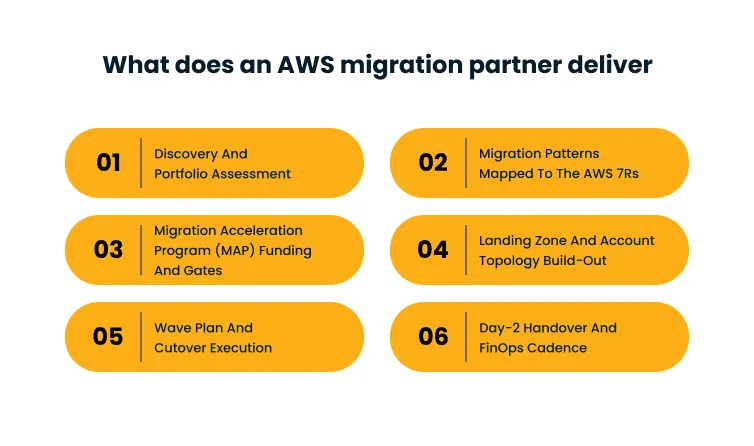
An AWS migration partner delivers six concrete artifacts that AWS funding and architecture reviews both depend on:
- Discovery and portfolio assessment package
- Target-state architecture
- 7Rs-mapped wave plan
- Landing zone build-out
- Cutover execution with rollback plan
- Day-2 handover with FinOps cadence
The MAP framing connects all six. A partner that cannot describe these in the first conversation is signalling unclear scope or templated delivery, and the 7Rs-mapped wave plan in particular sits at the centre of the work. A partner who can defend their pattern selection per workload against the AWS 7Rs migration strategy is showing real depth rather than slideware.
Discovery And Portfolio Assessment
Discovery typically runs four to six weeks. The artifact is a portfolio map where every workload is classified across four dimensions:
- Complexity – code size, dependencies, custom logic, third-party libraries
- Dependency – upstream and downstream systems, shared databases, integrations
- Business priority – revenue impact, customer exposure, regulatory weight
- Migration pattern – which of the AWS 7Rs the workload maps to
AWS Application Discovery Service and Migration Hub are the canonical tools, and the documentation matters more than the tools themselves. A discovery package that the buyer can hand to a second partner without losing context is the test of a clean output, and partners who produce thin or undocumented discovery are protecting future engagement leverage.
Migration Patterns Mapped To The AWS 7Rs
The AWS 7Rs are the canonical migration patterns, the partner names per workload, with gating criteria for moving between them:
- Rehost – lift and shift to AWS with minimal changes
- Replatform – minor optimization during the move
- Refactor – significant code or architecture changes
- Repurchase – replace with a SaaS alternative
- Retain – keep on-premises for now
- Retire – decommission entirely
- Relocate – move VMware workloads through VMware Cloud on AWS
Anything outside the 7Rs framing should be flagged for review, since hybrid or invented patterns usually mean the discovery was incomplete or the partner is justifying a delivery shortcut.
Migration Acceleration Program (MAP) Funding And Gates
MAP funding flows to the buyer through the partner across the three phases above, with named deliverables that AWS validates before each phase unlocks the next tranche of funding. The partner is responsible for the AWS-facing artifacts that release the funding.
A partner that can show prior MAP-validated submissions reaches the first milestone weeks faster than one learning the process on your engagement, and the funding cadence stays predictable rather than slipping through underprepared assessment cycles. Ask any prospective partner to share a redacted MAP submission from a prior engagement before signing the SoW.
Landing Zone And Account Topology Build-Out
The landing zone is the foundation of every workload that follows. A migration partner should land this before any production workload moves, and the build covers four core components:
- Multi-account topology through AWS Organizations
- Identity baselines with SSO, IAM roles, and access boundaries
- Network segmentation with VPCs, transit gateways, and security groups
- Policy-as-code library for guardrails, controls, and compliance overlays
The landing zone is also where Day-2 governance starts, since the policy library decides what gets audited from cutover onwards. A partner that skips landing zone hardening and starts migrating workloads into a default account is creating governance debt that compounds across every wave.
Wave Plan And Cutover Execution
The wave plan sequences workloads into migration waves with explicit cutover criteria per wave. The partner runs cutover rehearsals, owns the rollback plan, and reports against wave-level success metrics that release engineering can audit independently.
Wave planning is where most large migrations succeed or fail. A partner that does not run pre-cutover rehearsals or that treats rollback as a contingency rather than a standard procedure is signalling a brittle process. Mature partners rehearse cutover twice per wave, once with synthetic data and once with production-like data, before the live cutover window opens.
Day-2 Handover And FinOps Cadence
Day-2 handover is the artifact most engagements skip. A clean handover includes four named deliverables tied to a named internal owner for each:
- Policy-as-code library for ongoing governance
- FinOps cadence document with review rhythm and accountability
- Runbook for new account or workload onboarding
- Quarterly drift review baked into engagement closeout
Without this, the architecture starts drifting in month four, and the FinOps signal stops feeding back into design decisions. The handover document should be signed by named owners on both the partner side and the buyer side, rather than a single document tossed over the wall at engagement close.
How Do You Evaluate An AWS Migration Partner?
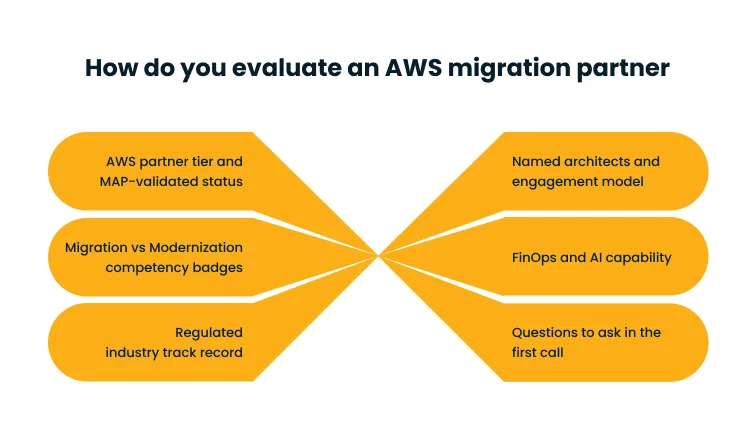
Evaluating an AWS migration partner is a six-criterion decision, plus a short list of questions that surface whether a partner has done the work or has slides about the work. The partner-tier and competency-badge signals do most of the filtering, and the interview questions validate the shortlist.
The criteria below also map to the architecture posture that surfaces in AWS Well-Architected reviews after migration, which is the structured way to verify the partner’s claims six months in.
AWS Partner Tier and MAP-Validated Status
AWS partner tiers grade sustained delivery volume on AWS:
- Select – entry-level, demonstrated AWS practice
- Advanced – committed AWS practice with revenue, certifications, and customer count
- Premier – top-tier scale, audited workforce, and production track record
MAP-validated is a separate audit confirming the partner has delivered AWS-funded migrations under the programme. A partner with the Migration competency badge plus MAP-validated history is shipping at scale on AWS. A partner with neither is selling a delivery promise without the audit trail to back it up.
Migration Vs Modernization Competency Badges
The Migration competency validates partners who move workloads to AWS at scale. The Modernization competency validates partners who refactor and re-architect on AWS after migration.
A partner with both is fluent across the full lift-shift-to-modernize arc. A partner with only one is signalling where their skill stops, which is a useful filter when the portfolio includes legacy applications likely to need refactoring within twenty-four months.
For BOFU buyers planning a multi-year modernization arc, the dual-competency partner is the safer pick because the engagement does not require a vendor change halfway through.
Regulated-Industry Track Record
Regulated-industry track record is assessed by the compliance regimes the partner has shipped under (PCI, HIPAA, GDPR, SOX, RBI, GST, country-specific data residency) and the audit posture of the architectures they have delivered. Generic enterprise references are not a substitute for an in-regime delivery experience.
Ask for references at the same scale, in the same regime, within the last twenty-four months. A partner that can name three regulated-industry references in your specific regime is bringing pattern recognition from real audits rather than translating from adjacent industries. The reference call should cover the audit outcome and the partner’s role in producing the evidence trail.
Named Architects and Engagement Model
The engagement model is tested by asking for the SoW format, the named architect, the cadence of artifacts, and the handover model. A partner that cannot answer these in the first call has not internalized their own delivery method.
Named architects also mean the partner has confidence that the engineer will stay assigned through the engagement rather than rotate off after the SoW signs. Mature partners disclose the named architect upfront and write a continuity clause into the SoW that protects the buyer if the assigned engineer leaves the firm. Anonymous staffing or “team of architects” framing is a signal that delivery quality varies by who picks up the work.
FinOps And AI Capability
FinOps and AI capability are evaluated by what the partner produces rather than what they claim. Ask for evidence in two forms:
- A sample FinOps cadence document from a prior engagement
- A reference AI-workload architecture deployed on AWS
If both exist as artifacts, the practice is real, and the team that built them is likely the team that will run yours. Claims without artifacts collapse on a reference call, particularly when the reference is asked whether the partner’s FinOps practice actually reduced post-migration spend or just reported on it.
Questions To Ask In The First Call
Useful questions in the first call surface operational experience rather than sales playbook answers:
- Who is the named architect on this engagement?
- What does week six of the engagement look like in operational specifics?
- What is your handover model and the named-owner protocol on both sides?
- How would you unlock MAP funding for our portfolio, and what is your first milestone timeline?
- What is the one thing your last enterprise client wishes they had done differently?
Listen for answers grounded in specific prior engagements. Partners who answer in general principles rather than concrete examples are signalling that the team in the room has not done the work at the scale your portfolio requires.
How Cygnet.One Delivers AWS Migrations?
Cygnet.One is an AWS Advanced Tier Partner with a dedicated AWS Services line covering migration, modernization, GenAI workloads, cost optimization, and managed services on AWS. AWS migrations sit inside Cygnet.One’s Cloud Engineering practice and are delivered through the proprietary ORBIT framework, with Managed IT taking over Day-2 operations.
The arc covers discovery to handover in one operating model, which is what keeps the architecture from drifting once the migration team rolls off.
Cygnet.One’s AWS Services Scope
The AWS Services line covers five sub-areas, scoped per engagement rather than sold as a single bundle:
- Migration and modernization
- AWS Generative AI workloads
- Cost optimisation
- Managed services on AWS
- AWS-native data and AI platforms
Each engagement is scoped to the sub-services in play, which means the buyer pays for the operational ownership they actually need. The runbook reflects the agreed split with the in-house team, with explicit boundaries between what Cygnet.One owns and what stays with the buyer’s engineering organization throughout the engagement.
AWS Advanced Tier Partnership
AWS Advanced Tier partnership means Cygnet.One’s architects are trained and audited against AWS Well-Architected pillars, and the engagement has direct access to AWS solution architects for deep design questions.
Design choices land in current AWS service patterns rather than yesterday’s reference designs, which matters when AWS releases that shape architecture cycles ship every quarter. The Advanced Tier credential also unlocks faster MAP-validation cycles, which compresses the funding cadence buyers depend on across the assess, mobilize, and migrate-and-modernize phases.
ORBIT Migration Framework
Cygnet.One’s AWS Modernization and Migration practice runs every engagement through the ORBIT methodology, sequencing five phases with explicit gates between them:
- Observe – discovery, portfolio assessment, dependency mapping
- Roadmap – target architecture, wave plan, MAP funding alignment
- Build – landing zone, account topology, policy-as-code library
- Iterate – wave-by-wave cutover with rehearsals and rollback
- Transform – Day-2 handover, FinOps cadence, optimization reviews
ORBIT overlays the AWS canonical 7Rs and the MAP three-phase structure, so every artifact maps to both methodologies and the buyer never has to translate between Cygnet.One’s process and AWS’s funding cadence.
Cygnet.One’s AI-First Cloud Track
Cygnet.One’s AWS Generative AI track designs GPU capacity, data pipelines, and inference-latency budgets into the AWS architecture from discovery rather than retrofitting them after the migration completes.
The 2025 Gartner Forecast on Worldwide GenAI Spending projected GenAI spending to reach $644 billion in 2025, up 76.4% year-on-year, which is the scale of investment shaping enterprise AWS architecture decisions today. The difference is between migrating workloads to a cloud that can run AI and migrating to a cloud that is built for AI from the first landing-zone decision.
Cygnet.One’s FinOps Practice
Cygnet.One’s Cloud Operations and Optimization practice embeds tagging, account structure, and budget signals into the architecture before workloads land, then runs an ongoing FinOps cadence in the operate phase:
- Weekly tactical cost reviews against the wave plan
- Monthly stakeholder syncs on rightsizing and commitment plans
- Quarterly business reviews against the original cost baseline
This keeps cost behaviour governable rather than reportable after the migration, with rightsizing decisions and reserved-capacity commitments feeding back into architecture reviews rather than month-end surprises.
Managed IT Continuity and Day-2 Operations
Managed IT Services extend the AWS architecture beyond go-live across four operational layers:
- 24/7 monitoring and incident response
- Infrastructure managed services for AWS-native workloads
- Governance, risk, and compliance (GRC) operations
- Cybersecurity operations with policy-as-code enforcement
The migration team and the Day-2 team share the same standards, which is the only way standards survive past month four of an engagement. The handover is documented, signed by named owners on both sides, and reviewed quarterly against drift in architecture, cost, and compliance posture.
Conclusion
Hiring an AWS migration partner determines whether MAP funding lands cleanly, whether the wave plan holds under operational pressure, and whether the architecture stays governable after the migration team rolls off.
The threshold sits at one of five concrete conditions: no internal programme lead, a stalled previous migration, a portfolio too large for an internal-only effort, MAP funding eligibility on the table, or regulated workloads that need auditable governance from day one.
The buyers who get this right scope by artifact and pressure-test the partner’s MAP-validated history, named architects, and FinOps cadence in the first conversation rather than at the renewal.
Partners that resist sharing redacted artifacts or that cannot name the architect on the account are signalling that the deck oversold the depth. Book a demo with Cygnet.One to see how the first six weeks of an Advanced Tier engagement would land in your environment, with ORBIT-driven wave planning, MAP-validated artifacts, and Managed IT taking over the operate phase under one accountability model.
FAQs
AWS Premier and Advanced are partnership tiers grading sustained AWS delivery by revenue, certifications, and customers. Premier is the top tier with audited operations. Advanced indicates a committed AWS practice above entry-level Select. Both deliver enterprise migrations, with Premier carrying more weight in regulated or very large estates.
Big Four firms suit enterprises needing transformation, change management, and audit advisory wrapped around the migration. Boutique AWS partners often run sharper on AWS-specific delivery with faster waves, deeper engineering, and direct solution-architect access at lower rates. The right answer depends on the depth of technology versus broader business transformation needs.
Mid-sized enterprise AWS migrations typically run 9 to 18 months end-to-end: discovery (four to six weeks), landing zone build (four to six weeks), phased waves (three to nine months), and Day-2 handover (30 to 60 days). Large or regulated portfolios extend the wave phase rather than the bookends.
Six metrics matter for AWS migration success: portfolio percentage migrated against plan, wave-level cutover success rate, post-migration cost ratio, security posture against Well-Architected pillars, time to first MAP funding milestone, and Day-2 readiness. Lift-and-shift completion alone is not a success metric without the cost and architecture overlays.
Yes for small portfolios under 50 workloads with mature in-house AWS expertise and a named programme lead. Beyond that scale, wave planning, MAP funding paperwork, regulated-industry controls, and parallel-engineering load usually exceed what an in-house team can absorb without compromising the day job.
MAP funding flows to the buyer through an AWS Migration competency partner across three phases: assess, mobilize, and migrate-and-modernize. The partner runs the AWS-validated assessment that AWS underwrites and prepares the funding artifacts, which AWS reviews before each phase unlocks. The funding offsets migration spend.
Author


Abhishek Nandan
AVP, Marketing
Abhishek Nandan is the AVP of Services Marketing at Cygnet.One, where he drives global marketing strategy and execution. With nearly a decade of experience across growth hacking, digital, and performance marketing, he has built high-impact teams, delivered measurable pipeline growth, and strengthened partner ecosystems. Abhishek is known for his data-driven approach, deep expertise in marketing automation, and passion for mentoring the next generation of marketers.