

































Modern enterprises generate more information than ever before. Organizations that can interpret this information quickly gain a meaningful advantage in competitive markets. That reality is pushing companies toward data analytics consulting services that New York enterprises are increasingly adopting.
Industry leaders often describe this shift as a cultural transformation. Satya Nadella, CEO of Microsoft, once explained the importance of this mindset when he said:
“Drawing insights from data and making decisions based on these insights is a key part of our culture.”
His remark reflects a broader change in how companies operate. Businesses are gradually replacing instinct with evidence using Data Analytics Consulting because digital systems now produce measurable signals about nearly every activity. As a result, business analytics services are enabling data-driven decision making across leadership teams.
New York enterprises are at the center of this transformation. The region hosts financial markets, global media companies, and high-growth technology firms that rely heavily on real-time information. These industries generate large volumes of data, which creates both an opportunity and a challenge. Organizations must learn how to interpret this information effectively.
Understanding how analytics is reshaping enterprise decision processes begins with examining the economic environment that encourages companies to adopt these tools.
What factors are driving analytics adoption across New York enterprises?
New York’s economy combines several industries that operate at exceptional speed. Financial markets react to global events in seconds. Media platforms process millions of user interactions daily. Technology companies analyze product behavior across vast user bases.
These conditions encourage companies to invest in enterprise analytics New York organizations rely on to remain competitive.
Several forces contribute to this growing adoption.
Financial markets generate continuous data streams
Investment firms operate in environments where information changes rapidly. Trading decisions depend on an accurate interpretation of market signals. Analytics platforms allow firms to monitor trends and respond quickly.
Digital media produces large volumes of audience data
Streaming platforms and publishing networks track how users consume content. Analytics reveals patterns in viewing behavior and engagement levels. These insights help companies refine their programming strategies.
Urban competition increases pressure on operational efficiency
New York hosts thousands of companies competing within dense commercial sectors. Data insights help organizations identify opportunities for operational improvement.
Cloud technology makes analytics more accessible
Modern cloud platforms allow companies to process large datasets without building complex infrastructure. This accessibility encourages broader business intelligence adoption NYC organizations now pursue.
As analytics tools become more common, organizations move beyond basic reporting. Leaders begin using data to guide daily operational decisions.
How does data analytics transform everyday business decisions?
Traditional decision processes often rely on historical reports. Leaders reviewed financial statements and operational summaries before determining the next course of action. While those reports provided useful context, they rarely reflect conditions in real time.
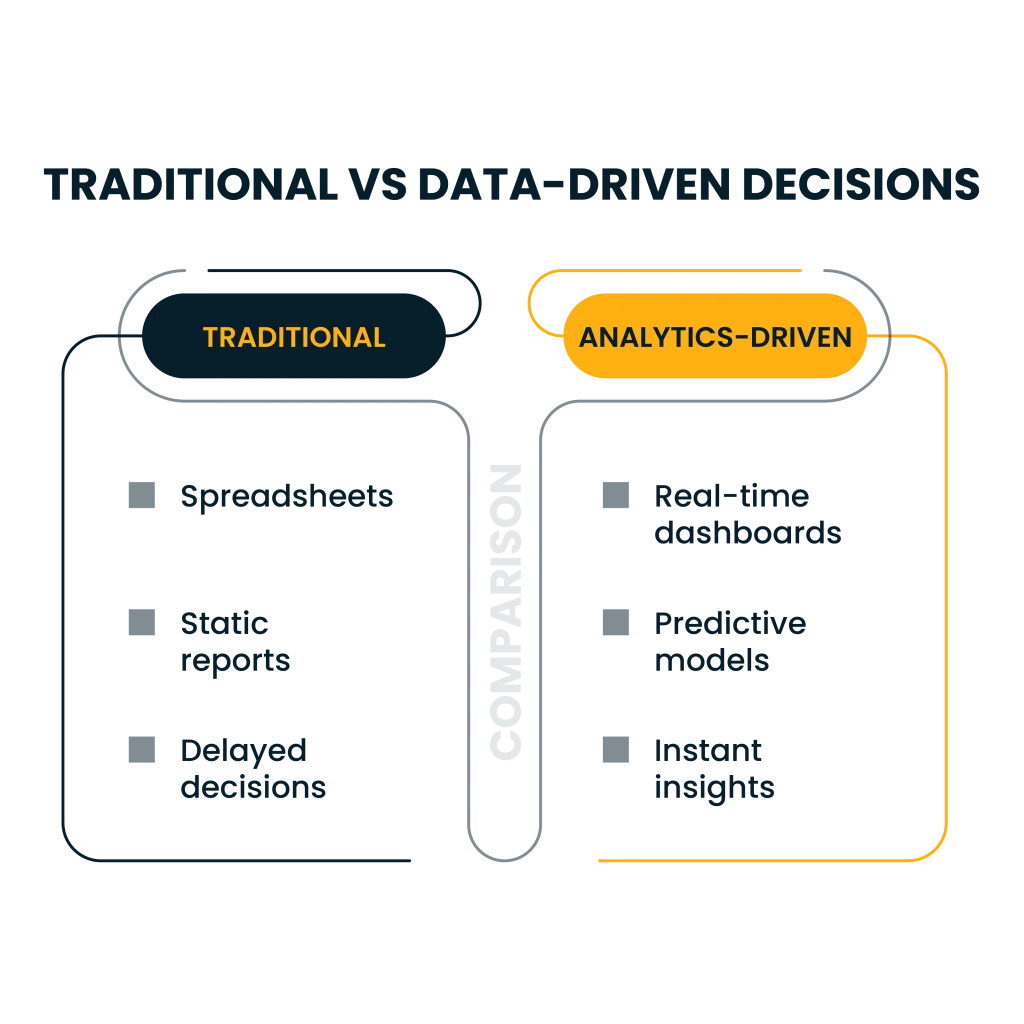
Analytics changes this dynamic because AI data analytics enables information to become available immediately.
| Traditional Decision Process | Analytics-Driven Decisions |
| Historical reports guide strategy | Real-time dashboards reveal trends |
| Decisions rely on experience | Models support data-driven decision making |
| Response occurs after events | Predictive insight enables early action |
When companies adopt data analytics New York enterprises often integrate dashboards into leadership workflows. Executives can observe operational signals while business activity unfolds. This capability shortens decision cycles and improves situational awareness.
The transition does not occur instantly. Organizations must first build frameworks that allow data to guide operational strategy consistently.
What decision intelligence frameworks are enterprises adopting?
Companies that rely on analytics rarely depend on a single tool. Instead, they create structured systems that transform raw data into usable insight. These frameworks connect data sources with analytical models and visualization platforms.
Such frameworks often support business intelligence adoption NYC companies, helping guide leadership decisions.
Several components form the foundation of these systems:
- Data pipelines collect information from operational platforms.
- Analytics engines interpret patterns within that data.
- Visualization dashboards present insights for decision makers.
When these systems operate together, leadership teams gain a clearer understanding of operational performance. Decisions that once required weeks of analysis can now occur during daily planning cycles.
These frameworks also enable organizations to analyze information across departments. Financial metrics, customer behavior, and operational performance can appear within a unified analytical view.
The impact of these frameworks becomes easier to understand when examining specific industries across New York.
How are New York industries using data analytics to improve decision-making?
New York enterprises operate in industries that produce vast quantities of digital information. Organizations across these sectors use analytics to interpret that information and guide operational decisions.
Financial services and investment firms
Financial institutions rely heavily on enterprise analytics New York firms deploy to monitor risk and market activity. Transaction data flows continuously through banking systems and trading platforms. Analytics models evaluate this information to identify patterns that may influence investment strategies.
These insights help firms manage portfolio risk and detect unusual transaction behavior.
Media and digital content companies
Media companies track audience engagement through digital platforms. Streaming services monitor viewing habits while publishers analyze reader interactions.
This process represents an ongoing analytics transformation within the media sector. Content strategies increasingly depend on measurable audience signals rather than editorial assumptions.
Retail and consumer businesses
Retail organizations analyze purchasing behavior across physical stores and digital channels. These insights reveal how customers respond to pricing changes and promotional campaigns.
Retail analytics, therefore, influences inventory planning and product placement strategies.
Technology and SaaS companies
Technology firms rely on usage data to understand how customers interact with digital platforms. Product teams study feature adoption and engagement patterns.
These insights help companies refine product design and improve customer experience.
The growing reliance on analytics across industries demonstrates a clear pattern. Data insights guide operational decisions only when supported by a reliable data infrastructure.
What data platforms enable modern enterprise decision-making?
Analytics initiatives depend on systems capable of storing and processing large datasets. Organizations, therefore, build data environments that integrate multiple information sources.
These platforms support data analytics New York enterprises use to analyze operational activity.
| Data Platform Layer | Role in Decision Systems |
| Data warehouses | Store structured enterprise data |
| Analytics engines | Detect patterns within datasets |
| Visualization tools | Present insights to leadership |
| Governance systems | Maintain accuracy and compliance |
These platforms enable companies to examine operational signals in a single environment. Leaders can observe customer behavior alongside financial metrics and operational performance.
The importance of this capability becomes clearer when examining research on data-driven organizations.
According to McKinsey research, companies that rely on data insights are 23 times more likely to acquire customers and 19 times more likely to be profitable than organizations that do not prioritize analytics.
This statistic highlights why enterprises continue investing in analytics infrastructure. Data insight not only improves operational visibility. It also strengthens competitive positioning in complex markets.
As these systems mature, organizations begin embedding analytics deeper within their culture.
How are New York enterprises building an analytics-driven future?
The shift toward analytics rarely ends with technology adoption. Organizations eventually discover that meaningful insight requires cultural change as well.
Leaders encourage teams to interpret operational data during planning sessions. Analysts collaborate with executives to interpret patterns across departments. This collaboration strengthens the role of data-driven decision-making within leadership processes.
Over time, the data analytics New York enterprises deploy becomes a strategic capability rather than a technical project. Companies gain clearer visibility into operational performance. Decision cycles accelerate because leaders rely on measurable signals instead of assumptions.
Several long-term outcomes begin to appear:
- Leadership teams respond faster to market changes.
- Operational inefficiencies become easier to detect.
- Strategic planning becomes more evidence based.
These outcomes illustrate how analytics transform enterprise strategy. Organizations that learn to interpret their data effectively gain an advantage in industries where speed and accuracy matter.
New York enterprises are demonstrating this transformation clearly. Their adoption of analytics reflects a broader movement across global business environments. Companies that embrace data insight today are shaping the decision frameworks that will define tomorrow’s organizations.
FAQs
What is enterprise data analytics?
Enterprise data analytics is the process of collecting and analyzing business data to guide operational and strategic decisions.
How does data analytics improve decision-making?
Analytics reveals patterns in operational data, which allows leaders to base decisions on measurable insight rather than assumptions.
Why are New York companies investing heavily in analytics?
Many industries in New York generate large volumes of data, which makes analytics valuable for interpreting market activity and customer behavior.
What tools support enterprise analytics adoption?
Organizations typically use data warehouses, analytics engines, and visualization platforms to analyze and present insights.
How long does it take to become a data-driven organization?
The timeline varies across companies, yet most enterprises begin seeing meaningful insights once data infrastructure and analytics processes are established.
Author


Yogita Jain
Content Lead
Yogita Jain leads with storytelling and Insightful content that connects with the audiences. She’s the voice behind the brand’s digital presence, translating complex tech like cloud modernization and enterprise AI into narratives that spark interest and drive action. With a diverse of experience across IT and digital transformation, Yogita blends strategic thinking with editorial craft, shaping content that’s sharp, relevant, and grounded in real business outcomes. At Cygnet, she’s not just building content pipelines; she’s building conversations that matter to clients, partners, and decision-makers alike.